July 28, 2026
The Commodity That Behaves Like a Cartel: Understanding Cobalt's Unique Market Structure
Most commodities traded on global markets share one defining characteristic: supply is distributed across enough sovereign producers that no single nation can unilaterally reshape pricing. Oil has OPEC and its rivals. Copper spans Chile, Peru, the Congo, and beyond. Iron ore flows from Australia, Brazil, and West Africa simultaneously. Cobalt is fundamentally different. It sits in a category of its own, where geographic concentration is so extreme that a single government's regulatory decision can restructure procurement strategies in Seoul, Stuttgart, and Silicon Valley within months.
That structural reality is now being exploited with precision, and the implications for battery supply chains, defence procurement, and semiconductor manufacturing are far-reaching.
DRC cobalt export controls introduced through 2025 and formalised into 2026 represent the most consequential supply management intervention in critical minerals markets in recent memory. To understand why, it is necessary to first understand the geological and commercial architecture that created this leverage in the first place.
When big ASX news breaks, our subscribers know first
How Cobalt's Geology Created an Unavoidable Dependency
Cobalt is not mined as a primary commodity in most parts of the world. It occurs predominantly as a byproduct of copper and nickel extraction, which means its supply is geologically linked to those base metal operations rather than being independently scalable. This byproduct dynamic is one of the least understood features of cobalt markets among non-specialist investors.
In the DRC's Katanga Copperbelt and the broader Central African Copperbelt, the geology produces unusually high cobalt-to-copper ratios relative to deposits found in other jurisdictions. This is partly due to the sediment-hosted stratiform copper deposits characteristic of the region, where cobalt substitutes for copper in the mineral lattice at concentrations that simply do not occur in comparable deposits elsewhere. The result is that DRC operations can extract cobalt at grades and volumes that no other producing nation can match at equivalent cost.
The Democratic Republic of Congo accounts for approximately 70 to 80 percent of global cobalt production, a concentration that places it in a class apart from even the most dominant OPEC producer's share of global oil output. Unlike oil, where spare capacity exists across dozens of sovereign producers, cobalt's alternative supply base — primarily nickel laterite operations in the Philippines, Indonesia, Australia, and Russia — produces cobalt as a dilute byproduct at substantially higher cost and lower volume.
This matters enormously for understanding why DRC cobalt export controls carry such systemic weight. Battery manufacturers, defence contractors producing infrared systems and guidance electronics, semiconductor fabricators using cobalt silicide layers, and fibre optic manufacturers relying on cobalt-based components cannot simply redirect sourcing to alternative jurisdictions at scale. The dependency is structural, not cyclical.
The Price Collapse That Made Policy Intervention Inevitable
Between 2018 and early 2025, cobalt prices traced one of the most dramatic collapse trajectories in commodity market history. From a peak of approximately $95,000 per tonne in 2018, prices ground steadily downward through a combination of Chinese-linked producer oversupply strategies and a deliberate accumulation of processing capacity designed to suppress upstream pricing while capturing downstream manufacturing margins.
By early 2025, cobalt had reached approximately $21,000 per tonne, a nine-year low representing a value erosion of more than 77 percent from peak. This was not simply market-driven oversupply. Analysts tracking the cobalt supply chain identified a sustained pattern where Chinese-affiliated entities expanded DRC production volumes aggressively, flooding the market with concentrate and hydroxide at prices that made long-term investment in the sector economically unviable for independent operators.
The strategic logic of this approach was straightforward: suppress cobalt prices to maintain Chinese downstream battery manufacturers' cost advantages while simultaneously accumulating strategic reserves at depressed prices. China's decade-long cobalt stockpiling strategy, executed through state-directed purchasing entities, created a stockpile buffer that insulated Chinese processors from the very price environment they had helped create.
For Kinshasa, the calculus was becoming untenable. Fiscal revenues from cobalt were collapsing, long-term investment viability was deteriorating, and the DRC was effectively absorbing the costs of a supply management strategy being conducted by external actors for external benefit. Furthermore, the US-China cobalt rivalry was intensifying the geopolitical pressure on Congolese policymakers to act decisively.
From Export Ban to Quota Architecture: How the Policy Evolved
Why Did the DRC First Impose a Blanket Ban?
In February 2025, the Congolese government implemented a temporary cobalt export ban — a blunt initial instrument designed to halt the supply glut immediately and signal that passive acceptance of the existing pricing dynamic was over. The DRC cobalt export ban drew significant international attention but also criticism for its potential to create legal uncertainty for existing export contracts.
The more sophisticated policy response came through ARECOMS, the DRC's national mining regulator, which replaced the blanket ban with a structured quota framework. This transition from prohibition to managed allocation was significant: it preserved the DRC's credibility as a functioning mining jurisdiction while giving the state granular control over supply volumes.
The architecture of the quota system contains several features that reward close examination:
| Policy Parameter | Detail |
|---|---|
| Initial quota window | 18,125 metric tonnes available from October 16, 2025 for remainder of year |
| Annual cap (2026) | 96,600 metric tonnes |
| Annual cap (2027) | 96,600 metric tonnes |
| Benchmark against prior output | Approximately 50% of 2024 export volumes |
| Strategic reserve allocation | 10% of cobalt exports reserved for national strategic projects |
| Royalty prepayment requirement | 10% royalty prepayment within 48 hours of allocation |
| Compliance documentation | Mandatory compliance certificate and enhanced export reporting |
The 48-hour royalty prepayment requirement is a detail that deserves particular attention. By requiring capital outlay before export confirmation, this provision effectively screens out undercapitalised or informally structured exporters while simultaneously accelerating government revenue collection. It is a compliance filter that concentrates quota access among larger, more transparent operators, reinforcing the investment environment signal Kinshasa is trying to send.
The 10 percent strategic reserve buyback mechanism is equally significant. This provision grants the state the right to acquire cobalt stockpiles held by mining operators above their quota thresholds at government-determined terms. In practice, it creates a state-controlled buffer that can be deployed to smooth price volatility or withheld to sustain price elevation, depending on strategic objectives.
According to analysis from Benchmark Minerals, the transition to a quota framework through 2027 represents a more durable and sophisticated supply management tool than the initial ban, with structured parameters designed to provide price support whilst maintaining investor confidence.
It is worth noting that Kinshasa reportedly developed and refined its export control framework with advisory input from Vectus Global, a firm linked to U.S. businessman Erik Prince, which has been engaged with the Congolese government on revenue collection and export control strengthening since late 2024. This external advisory relationship is a rarely discussed dimension of how the quota architecture was designed.
The Fiscal Arithmetic of Supply Management
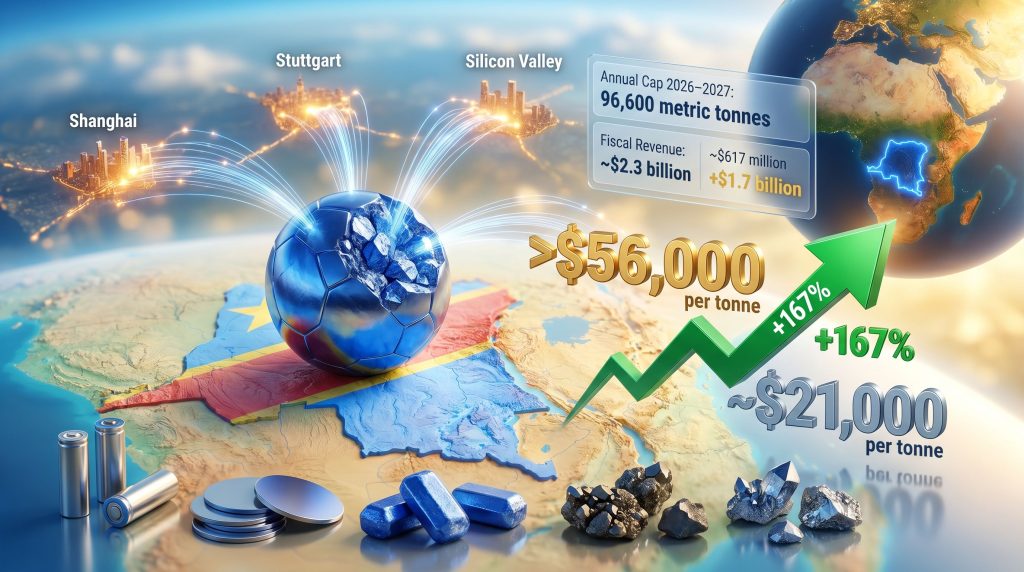
The price response to the cobalt export suspension has been both rapid and substantial. Cobalt prices rose from approximately $21,000 per tonne in early 2025 to over $56,000 per tonne by mid-2026, an appreciation of approximately 167 percent within roughly 12 to 18 months.
The fiscal implications are transformative:
| Metric | Value |
|---|---|
| Cobalt price pre-intervention (early 2025) | ~$21,000 per tonne |
| Cobalt price post-quota implementation (mid-2026) | >$56,000 per tonne |
| Price appreciation | ~167% |
| Projected fiscal revenue under quota system (2026) | ~$2.3 billion |
| Estimated fiscal revenue without intervention | ~$617 million |
| Revenue uplift from policy intervention | ~$1.7 billion |
The contrast between a $617 million baseline revenue trajectory and a $2.3 billion quota-driven outcome is the single most compelling data point in the entire DRC cobalt policy story. It explains why the strategy is being maintained despite international pressure, and why Kinshasa has been largely unmoved by IMF warnings about potential demand headwinds arising from geopolitical disruptions in the Middle East.
The IMF's concerns about a global demand slowdown for critical minerals following geopolitical shocks have been noted by Congolese policymakers. However, the structural inelasticity of cobalt demand — particularly from battery cathode production and defence electronics — provides meaningful insulation against cyclical softness. NMC cathode chemistry remains the dominant chemistry for high energy density applications in premium EV segments, aerospace, and defence, where substitution timelines are measured in years, not quarters.
Strategic Reserves and the Expansion Beyond Cobalt
The quota system represents only one layer of the DRC's evolving critical minerals strategy. In April 2026, Kinshasa announced plans to extend its strategic stockpile framework to include coltan and germanium alongside cobalt, a move that signals the policy framework is not cobalt-specific but reflects a broader industrial sovereignty agenda.
This expansion matters because each of these minerals occupies a distinct and non-substitutable role in modern technology:
- Coltan (columbite-tantalite) is refined into tantalum, which is essential for capacitors in smartphones, laptops, and automotive electronics. The DRC holds an estimated 64 percent of global coltan reserves.
- Germanium is a semiconductor material used in fibre optic cables, infrared night-vision systems, solar cells, and polymerisation catalysts. China currently dominates germanium refining, but the DRC holds significant upstream ore resources.
- Cobalt underpins NMC battery cathodes, cobalt-based superalloys in jet engines and gas turbines, and a range of defence electronics requiring high-temperature performance.
By building state-controlled buffers across all three, Kinshasa is constructing a multi-mineral supply management capability rather than a single-commodity intervention.
The next major ASX story will hit our subscribers first
A Comparative Policy Framework: How the DRC Aligns With Global Stockpiling Strategies
The DRC's approach does not exist in a geopolitical vacuum. It mirrors and responds to resource management strategies already deployed by major powers, as summarised below:
| Country / Bloc | Strategic Mineral Policy | Key Instrument |
|---|---|---|
| China | Decade-long cobalt reserve accumulation to influence pricing and secure downstream advantages | State-directed purchasing through sovereign entities |
| United States | Multi-billion-dollar critical minerals stockpile programme (Project Vault) | Federal procurement and strategic reserve legislation |
| European Union | Coordinated strategic mineral reserve exploration under the Critical Raw Materials Act | Regulatory frameworks and offtake agreements |
| DRC | Quota-controlled exports plus state strategic reserves of cobalt, coltan, and germanium | ARECOMS quota system plus government buyback rights |
What distinguishes Kinshasa's position from these other actors is that the DRC holds the upstream resource base that all of them depend on. China stockpiles processed cobalt. The United States and Europe seek to stockpile refined materials. The DRC controls the ore. This positional advantage is what gives the quota system its leverage.
Investment Landscape Shifts Under the New Policy Environment
Established major producers including Glencore and CMOC remain central to DRC cobalt output, but the new policy environment is attracting a different category of capital. The acquisition of Chemaf by Virtus Minerals is widely cited as emblematic of the investment partnerships Kinshasa is now seeking to cultivate.
Chemaf operates a hydrometallurgical cobalt and copper processing facility in Lubumbashi, Katanga, giving Virtus Minerals exposure to in-country processing capacity rather than simple raw material extraction. This is precisely the type of value-chain participation the DRC's strategic framework is designed to incentivise: investors who bring processing capability, longer capital commitment horizons, and alignment with the country's industrialisation objectives.
The shift from short-cycle extraction capital toward long-duration industrial partnership is a deliberate policy signal. It also reflects a recognition that the revenue gap between exporting raw cobalt concentrate and exporting refined cobalt hydroxide or cobalt sulphate — the precursor forms required by cathode active material producers — is substantial.
Structural Risks and the Cobalt Chemistry Substitution Problem
No analysis of the cobalt price impacts is complete without engaging seriously with the structural risks embedded in the strategy. The most consequential long-term risk is demand substitution through battery chemistry evolution.
Lithium iron phosphate (LFP) batteries, which contain zero cobalt, have captured an increasing share of the global EV market, particularly in China where cost-sensitive mass market segments dominate. Sodium-ion batteries, still in early commercial deployment, represent a further cobalt-free pathway.
The central tension in the DRC's strategy is that the same price elevation designed to maximise near-term fiscal revenues may simultaneously accelerate the battery industry's long-run transition away from cobalt-dependent chemistries, potentially undermining the very asset base the policy is designed to protect.
Furthermore, according to S&P Global Market Intelligence, whilst quota-driven price support is likely to persist through 2026 and 2027, significant challenges loom on the demand side as chemistry diversification accelerates across major battery markets. Additional structural vulnerabilities include:
- Informal export leakage: Artisanal mining regions in Katanga and South Kivu have historically been difficult to bring within formal export control frameworks, creating potential quota circumvention pathways that could dilute the supply restriction's effectiveness.
- Investor confidence tension: Whilst price stability attracts long-duration capital, quota uncertainty and government buyback rights create regulatory risk that some categories of institutional capital will price conservatively or avoid entirely.
- Geopolitical friction: Aggressive supply management by a nation with significant dependence on international development finance and bilateral investment treaties creates potential for diplomatic friction with major trading partners, particularly those most exposed to cobalt supply tightness.
- Demand elasticity in defence: Whilst commercial battery applications offer some substitution flexibility over medium timeframes, defence applications requiring cobalt-based superalloys and specific cathode chemistries are far more inelastic, providing a demand floor that supports the strategy's longer-run viability.
What Supply Chain Strategists and Investors Must Now Accept
For procurement professionals, battery manufacturers, and critical minerals investors, DRC cobalt export controls represent a permanent structural feature of the market rather than a temporary disruption to be weathered. Several implications follow directly:
- Spot market procurement strategies are no longer viable for cobalt-dependent manufacturers. The structural deficit projected by S&P Global through 2026 and 2027 under current quota parameters means that relying on open market availability exposes procurement teams to both price and volume risk simultaneously.
- Long-term offtake agreements at elevated price points have become the primary risk management tool for battery cell manufacturers in China, South Korea, Japan, and Europe. The recalibration of cathode material cost structures will flow through to cell-level and pack-level pricing, with downstream consequences for EV sticker prices in premium segments.
- Cobalt reduction roadmaps at battery gigafactories have moved from strategic aspiration to near-term operational priority. Western automakers and Asian cell manufacturers alike are under renewed pressure to accelerate these programmes, though the physics of energy density means cobalt-free chemistries involve trade-offs that not all applications can absorb.
- Sovereign supply management risk must now be incorporated as a permanent variable in critical minerals investment models. The DRC has demonstrated that a resource-dominant nation can reshape global market dynamics through regulatory action alone, and other mineral-rich developing nations are watching closely.
The broader significance of what Kinshasa has engineered extends well beyond cobalt pricing. It represents a fundamental recalibration of the political economy of critical mineral supply — one in which the nation holding the geological endowment is increasingly unwilling to accept the pricing terms set by downstream processors and end users. Whether through quota systems, strategic reserves, or value-chain ascent strategies, the DRC has established a template that other resource-sovereign nations will study carefully in the years ahead.
Disclaimer: This article is for informational and educational purposes only and does not constitute investment advice. Commodity prices, fiscal projections, and market forecasts referenced in this article involve inherent uncertainty and should not be relied upon as predictions of future outcomes. Readers should conduct independent research and seek professional advice before making any investment decisions.
Want to Identify the Next Major Mineral Discovery Before the Market Does?
Discovery Alert's proprietary Discovery IQ model delivers real-time ASX alerts, transforming complex critical minerals data — across cobalt, copper, and 30+ other commodities — into clear, actionable investment insights for traders and long-term investors alike. Explore historic discoveries and their exceptional returns on Discovery Alert's dedicated discoveries page, then begin your 14-day free trial to position yourself ahead of the market.