
July 24, 2026
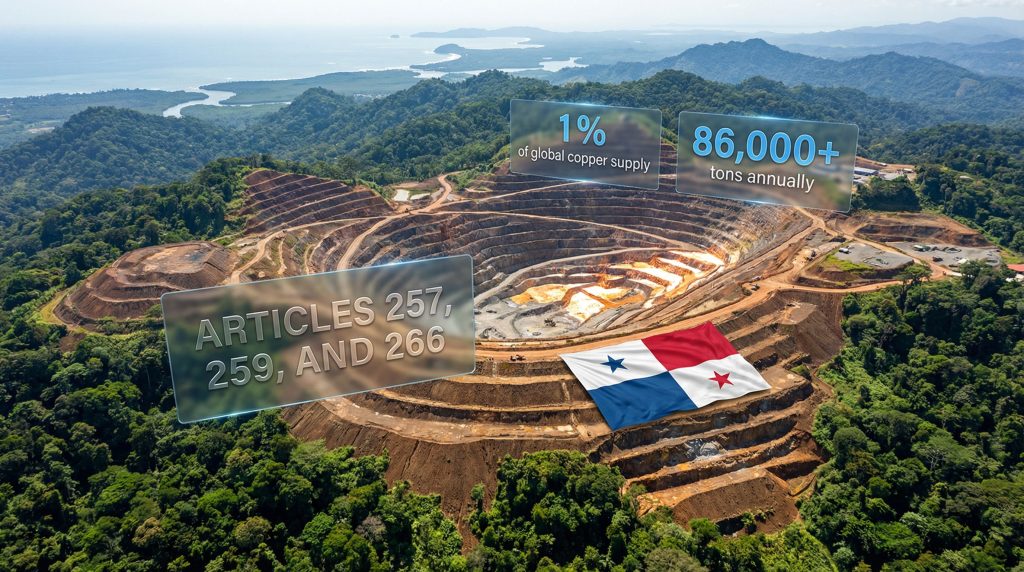
Constitutional mining conflicts rarely emerge from simple regulatory disagreements. Instead, they develop from fundamental tensions between national sovereignty, environmental protection, and foreign investment frameworks that have been building for decades. Panama's current standoff over the Cobre Panama dispute represents one of the most complex intersections of constitutional law, environmental rights, and international arbitration in Latin American mining history, with implications extending far beyond a single copper mine. Furthermore, understanding mining permitting basics becomes essential when analysing how such constitutional conflicts emerge from regulatory frameworks.
What Makes the Cobre Panama Dispute a Constitutional Crisis?
The constitutional dimensions of this conflict extend beyond typical mining permit disputes into fundamental questions about state authority and environmental protection. Panama's Supreme Court has identified multiple constitutional violations in the original concession framework, creating a legal crisis that challenges the very foundation of the country's mining regulatory system.
Supreme Court's Multi-Constitutional Violation Findings
The Supreme Court's analysis reveals systematic failures in how the original mining concession was granted and managed. The court found violations spanning constitutional provisions for environmental protection, public participation in natural resource decisions, and proper oversight of foreign investment agreements. These findings suggest that the problems with Cobre Panama extend far deeper than environmental concerns alone, touching the core of how Panama manages its natural resources under constitutional law.
The constitutional crisis deepened when the court determined that the concession process failed to meet basic constitutional requirements for transparency and public consultation. This finding has created a precedent that could affect numerous other mining and infrastructure projects across Panama, as it establishes that constitutional environmental and participation rights cannot be subordinated to economic development goals without proper legal procedures.
Environmental Rights vs. Economic Development Framework
Panama's constitution establishes environmental protection as a fundamental state obligation, creating an inherent tension with large-scale extractive projects. The Cobre Panama dispute has brought this constitutional framework into sharp focus, as courts must balance the state's duty to protect environmental resources with its authority to grant mining concessions for economic development.
The constitutional analysis reveals that environmental rights in Panama are not merely policy preferences but fundamental legal obligations that carry the same weight as property rights and investment protections. This legal framework means that any resolution of the mining dispute must address constitutional environmental requirements, not simply negotiate economic terms between the government and mining companies.
Public Procurement Law Failures and Sovereignty Concerns
Constitutional experts have identified significant procedural violations in how the original concession was granted, particularly regarding public procurement law and national sovereignty protections. The constitutional framework requires that major natural resource concessions undergo specific approval processes designed to protect national interests and ensure proper public oversight.
The sovereignty concerns centre on whether the original concession agreement improperly constrained Panama's regulatory authority over its own natural resources. Constitutional law requires that any agreement with foreign entities preserve the state's fundamental authority to regulate environmental protection and natural resource management, raising questions about whether the Cobre Panama concession exceeded constitutional limits on government authority to bind future administrations.
When big ASX news breaks, our subscribers know first
How Did Panama's Mining Concession System Create This Legal Deadlock?
The current legal impasse stems from fundamental flaws in Panama's mining concession framework that have been developing since the late 1990s. The regulatory system created contradictory legal obligations that have now culminated in a constitutional crisis requiring judicial resolution.
The 1997 Law 9 Foundation Problems
Law 9 of 1997 established Panama's modern mining framework, but created legal contradictions that have proven impossible to resolve through normal regulatory processes. The law attempted to attract foreign investment by providing extensive guarantees to mining companies while simultaneously maintaining constitutional environmental protection requirements that were incompatible with large-scale open-pit mining operations.
The fundamental problem lies in Law 9's assumption that environmental protection and large-scale copper extraction could be reconciled through technical mitigation measures. However, the constitutional framework requires that environmental protection take precedence over economic development when the two cannot be reconciled, creating an inherent legal contradiction that has now reached the Supreme Court level.
2023 Law 406 Negotiation Attempts and Public Backlash
The government's attempt to resolve the legal deadlock through Law 406 in 2023 demonstrated the impossibility of finding a purely legislative solution to constitutional problems. The law was designed to provide a new legal framework for the mine's operations while addressing environmental concerns, but public opposition revealed that the underlying constitutional issues could not be resolved through negotiation alone.
Law 406's failure highlighted that the Cobre Panama dispute has moved beyond technical regulatory questions into fundamental constitutional territory. The massive public protests that followed the law's passage indicated that significant portions of Panama's population view the mining issue as a matter of constitutional principle rather than negotiable policy, making political compromise extremely difficult.
Constitutional Articles 257, 259, and 266 Compliance Gaps
The specific constitutional violations centre on Articles 257, 259, and 266, which establish the state's environmental protection obligations and requirements for natural resource management. These articles create mandatory legal frameworks that cannot be waived through executive agreements or legislative action, regardless of economic considerations.
Article 257 establishes environmental protection as a fundamental state duty, while Articles 259 and 266 create specific procedural requirements for natural resource concessions and environmental impact assessment. The constitutional analysis reveals that the original Cobre Panama concession failed to meet these mandatory requirements, creating legal violations that cannot be corrected through subsequent regulatory adjustments.
What Are the Economic Stakes Behind the June 2026 Decision Timeline?
President José Raúl Mulino's commitment to reaching a decision by June 2026 reflects the enormous economic pressures surrounding this constitutional crisis. The economic implications extend far beyond Panama's borders, affecting global copper markets and international investment confidence in Latin American mining projects. Moreover, these economic dynamics align with broader copper investment dynamics observed across global mining markets.
Global Copper Supply Chain Disruption Analysis
The closure of Cobre Panama has removed 1% of global copper supply from international markets, creating significant supply chain disruptions at a time when copper demand is rapidly increasing due to energy transition requirements. With annual production capacity of 86,000+ tons, the mine's closure represents one of the largest copper supply disruptions in recent years.
Current copper market dynamics reflect the impact of this supply disruption, with copper prices showing increased volatility and structural upward pressure. The January 15, 2026 copper price of $5.9665 per pound represents market conditions that have been significantly affected by the ongoing uncertainty surrounding Cobre Panama's future operations.
| Global Impact Metrics | Value | Market Implications |
|---|---|---|
| Global Supply Removed | 1% of world production | Structural supply deficit |
| Annual Production Lost | 86,000+ tons | Equivalent to medium-sized mine |
| Market Price Volatility | -2.17% daily change | Reflects ongoing uncertainty |
| Supply Chain Impact | Regional disruption | Affects downstream copper users |
Panama's GDP Impact Assessment
The economic stakes for Panama are enormous, with the mining sector representing a significant portion of the country's economic output and government revenue. The closure has created a substantial gap in both GDP contribution and government fiscal resources that has complicated Panama's overall economic management.
The fiscal impact extends beyond direct mining revenue to include lost employment, reduced regional economic activity, and decreased foreign exchange earnings. These broader economic effects create significant pressure for a resolution that allows mining operations to resume, while constitutional requirements demand that any resolution address fundamental legal violations.
First Quantum's Financial Exposure and Arbitration Strategy
First Quantum Minerals faces massive financial exposure from the mine closure, having invested billions of dollars in developing what was intended to be a decades-long operation. The company's arbitration strategy appears focused on recovering these investments through international legal mechanisms, regardless of Panama's constitutional requirements.
The financial exposure creates a complex dynamic where First Quantum has strong incentives to pursue all available legal remedies, including international arbitration, while Panama must balance potential arbitration awards against constitutional obligations that may prevent the mine from reopening. This creates a situation where both parties face substantial financial risks regardless of the final outcome.
Why Are Environmental Groups Opposing the Government's Audit Process?
Environmental organisations have consistently opposed government-led audit processes, arguing that independent assessment is essential for credible evaluation of the mine's environmental impact. Their position reflects broader concerns about regulatory capture and the government's ability to objectively assess projects with such significant economic implications. Additionally, these concerns align with growing environmental mining controversies observed across the mining sector globally.
Independent Audit Demands vs. Government-Led Reviews
Environmental groups argue that the government's close financial interest in mining revenue makes it impossible to conduct objective environmental assessments. They demand independent audits conducted by international environmental organisations with no financial stake in the mine's operational status.
The independence issue reflects a fundamental problem in environmental regulation of major economic projects. When government revenue depends heavily on project operations, regulatory agencies face inherent conflicts between their environmental protection mandate and fiscal pressures to approve revenue-generating activities.
Rainforest Destruction and Water Contamination Evidence
Documentation of environmental damage has become a central component of opposition arguments, with environmental groups presenting evidence of rainforest destruction and water system contamination that they argue violates constitutional environmental protection requirements.
The environmental evidence suggests that the scale of ecological impact may be incompatible with Panama's constitutional environmental protection obligations, regardless of economic mitigation measures or compensation payments. This creates a situation where environmental damage may constitute constitutional violations that cannot be resolved through regulatory adjustments alone.
Escazú Agreement Obligations and International Law Compliance
Panama's ratification of the Escazú Agreement creates additional international legal obligations for environmental protection and public participation that complicate the government's options for resolving the mining dispute. These international commitments reinforce domestic constitutional requirements for environmental protection.
The Escazú Agreement obligations require meaningful public participation in environmental decision-making, creating procedural requirements that may be difficult to satisfy given the polarised public opinion surrounding mining operations. This adds another layer of legal complexity to any resolution attempt.
How Could International Arbitration Shape the Final Outcome?
International arbitration proceedings represent a parallel legal process that could significantly constrain Panama's options for resolving the constitutional crisis. The arbitration framework creates potential financial obligations that may influence how Panama balances constitutional requirements against economic pressures. These proceedings reflect the complex dynamics analysed in Panama's mining arbitration deliberations currently underway.
Panama-Canada Free Trade Agreement Provisions
The trade agreement between Panama and Canada includes investor protection provisions that may provide First Quantum with legal remedies even if Panama's domestic constitutional requirements prevent mine reopening. These provisions create a potential conflict between international commercial obligations and domestic constitutional law.
The investor protection framework was designed to encourage foreign investment by providing legal recourse against government actions that affect profitability. However, these provisions may not adequately account for situations where government actions are required by constitutional law rather than policy preferences.
International Chamber of Commerce Proceedings
ICC arbitration proceedings operate under international commercial law rather than domestic constitutional frameworks, creating a situation where arbitrators may award damages based on commercial considerations without regard to Panama's constitutional obligations regarding environmental protection.
The ICC process represents a fundamental challenge to national sovereignty over constitutional interpretation, as international arbitrators may effectively determine the financial consequences of constitutional compliance. This creates tension between international commercial law and domestic constitutional authority.
Investor-State Dispute Settlement Mechanisms
ISDS mechanisms provide foreign investors with legal remedies that bypass domestic court systems, potentially creating situations where constitutional compliance carries enormous financial penalties imposed by international arbitrators. This framework may effectively penalise countries for enforcing constitutional environmental protection requirements.
The ISDS system's approach to environmental regulation has evolved significantly, but still prioritises investment protection over environmental compliance in many cases. This creates structural incentives that may conflict with constitutional environmental protection obligations.
What Role Will Chilean Mining Expertise Play in the Decision?
Chilean President-elect José Antonio Kast's offer to provide three mining experts for technical assistance represents an attempt to bring external expertise to the decision-making process. This international collaboration could provide Panama with technical analysis that helps navigate the complex intersection of mining operations and constitutional requirements.
President-Elect Kast's Technical Advisory Offer
The Chilean technical assistance offer reflects recognition that the Cobre Panama dispute requires expertise that extends beyond legal and political considerations to include sophisticated technical analysis of mining operations and environmental protection possibilities.
Chilean mining expertise could provide Panama with independent technical assessment of whether modified mining operations could satisfy constitutional environmental protection requirements. This technical input may be essential for developing solutions that address both constitutional obligations and economic realities.
Regional Mining Governance Best Practices
Chile's experience with mining conflicts and environmental protection provides potentially valuable insights for Panama's situation. Chilean mining governance has evolved to address many of the same constitutional and environmental challenges that Panama currently faces.
The regional cooperation approach recognises that mining constitutional conflicts are becoming common across Latin America, suggesting that shared expertise and best practices may be essential for developing sustainable solutions that balance economic development with constitutional environmental protection.
Cross-Border Regulatory Cooperation Models
International technical cooperation in mining regulation represents an emerging approach to complex constitutional and environmental challenges that individual countries may struggle to resolve alone. This cooperation model could provide frameworks for addressing similar conflicts throughout the region.
The technical assistance model may prove particularly valuable for developing constitutional compliance strategies that maintain economic viability, as Chilean experts bring experience with similar constitutional frameworks and mining industry requirements.
The next major ASX story will hit our subscribers first
Can Panama's Mining Moratorium Survive Political Pressure?
President Mulino's statement that a process will be completed by mid-year and that he will make the announcement that the country requires indicates enormous political pressure to resolve the constitutional crisis. The June 2026 timeline reflects both the urgency of economic pressures and the complexity of constitutional compliance requirements. Furthermore, these pressures are amplified by recent changes in executive mining permits policies that may affect regional investment flows.
Public Opinion vs. Economic Necessity Analysis
Public opinion polling consistently shows strong opposition to mining operations, creating a political environment where constitutional environmental protection requirements align with popular sentiment. However, economic pressures from lost government revenue and employment create countervailing political forces.
The political dynamic suggests that any sustainable resolution must address both constitutional requirements and popular opposition to mining, making simple economic compromise extremely difficult. Political leaders must navigate between constitutional obligations, economic necessities, and democratic accountability.
Constitutional Framework Requirements for Future Mining
Any future mining operations must comply with constitutional environmental protection requirements that may be incompatible with large-scale open-pit copper extraction. The constitutional framework creates mandatory legal standards that cannot be waived for economic or political reasons.
Constitutional compliance requirements may effectively preclude certain types of mining operations regardless of economic benefits or political pressure. This creates a situation where constitutional law, rather than policy preferences, may determine the final outcome of the dispute.
U.S. Critical Minerals Security Considerations
The United States' critical minerals security strategy creates international pressure for resolution that allows copper production to resume. Copper's designation as a critical mineral for energy transition adds geopolitical dimensions to Panama's constitutional crisis.
U.S. strategic interests in secure copper supply chains may influence diplomatic pressure and international support for solutions that prioritise mining operations over environmental protection. However, constitutional requirements cannot be waived to accommodate foreign policy considerations. According to strategic minerals analysis, the geopolitical implications extend well beyond Panama's borders.
What Precedent Will This Set for Latin American Mining Disputes?
The Cobre Panama dispute resolution will establish precedents for constitutional environmental protection enforcement throughout Latin America. As one of the world's largest open-pit copper deposits, the mine's fate will influence how other countries balance constitutional environmental obligations with foreign investment protection. These precedents will likely shape industry evolution trends across the region for decades.
Constitutional Court Mining Jurisdiction Expansion
Supreme Court involvement in mining regulation represents an expansion of constitutional court jurisdiction that may fundamentally change how mining projects are evaluated and approved throughout the region. Constitutional courts are increasingly willing to enforce environmental protection requirements against economic development projects.
This jurisdictional expansion reflects growing recognition that environmental protection constitutes a fundamental constitutional obligation rather than a policy preference that can be balanced against economic considerations. The trend suggests that constitutional environmental law may become a primary constraint on extractive industry operations.
Environmental Rights Enforcement Mechanisms
The enforcement mechanisms developed for constitutional environmental protection in Panama will likely influence similar cases throughout Latin America. Strong enforcement creates precedents that may constrain government authority to approve environmentally damaging projects regardless of economic benefits.
Effective environmental rights enforcement requires legal mechanisms that can override economic and political pressures to approve damaging projects. The Panama case may establish whether constitutional environmental protection can be effectively enforced against powerful economic interests.
Foreign Investment Protection vs. National Sovereignty Balance
The resolution of international arbitration claims against Panama will establish precedents for how international commercial law interacts with domestic constitutional requirements. The outcome may determine whether constitutional environmental protection can be maintained when it conflicts with foreign investment agreements.
The precedent will influence how future international investment agreements are negotiated and whether constitutional environmental protection can be preserved in the face of international commercial arbitration. This balance between investment protection and constitutional sovereignty will shape regional economic development strategies for decades.
Disclaimer: This analysis involves ongoing legal and political processes that may change rapidly. Constitutional interpretations, international arbitration outcomes, and political decisions may differ significantly from current assessments. Readers should consult current legal and financial sources for the most recent developments in the Cobre Panama dispute.
Looking to Navigate Complex Mining Investment Opportunities?
Discovery Alert's proprietary Discovery IQ model provides real-time alerts on significant ASX mineral discoveries, helping investors identify opportunities ahead of market-moving announcements like constitutional disputes and regulatory changes. Stay informed about global mining developments and begin your 30-day free trial today to position yourself ahead of these complex market dynamics.