
July 24, 2026
The Geology of Scarcity: Why Helium Exploration Technologies Are Now Central to Global Industrial Strategy
Most critical resource stories begin with demand. Helium's story begins with physics. Unlike lithium, copper, or rare earth elements, helium is not simply difficult to find in sufficient concentrations; it is actively escaping the planet. As the second lightest element in the universe, helium atoms possess enough thermal energy at surface temperatures to exceed Earth's escape velocity, meaning any helium released into the atmosphere is permanently lost on human timescales. This singular physical reality transforms every commercially viable subsurface helium accumulation into a genuinely non-renewable asset, and it explains why helium exploration technologies have attracted serious capital and scientific attention in ways that would have seemed disproportionate to the gas's modest production volumes just two decades ago.
The stakes are no longer theoretical. Semiconductor fabrication nodes have shrunk below 3 nanometres, MRI installations are expanding across emerging healthcare markets, and dilution refrigerators used in commercial quantum computing require continuous cryogenic helium supply. Each of these technology trajectories increases per-unit helium intensity. Furthermore, none of them has a viable substitution pathway, which means the global helium supply crisis has become a direct concern for the advanced technology economy.
When big ASX news breaks, our subscribers know first
Why Helium Accumulations Are Geologically Rare
Understanding why helium is so difficult to find in commercial concentrations requires a brief detour into deep geological time. Helium-4, the isotope relevant to virtually all industrial applications, is generated through the radioactive decay of uranium and thorium within ancient crustal rocks. This is a slow process measured across hundreds of millions of years, and the helium produced must then migrate upward through the crust and become trapped by an impermeable seal before atmospheric loss occurs.
The trap architecture requirement is particularly demanding. Because helium molecules are so small, even minor imperfections in a geological seal that would comfortably retain natural gas will allow helium to escape over geological time. This means that commercially viable helium fields require exceptionally high-integrity cap rocks, typically fine-grained shales, evaporites, or volcanic sequences that can maintain pressure integrity across timescales measured in tens of millions of years.
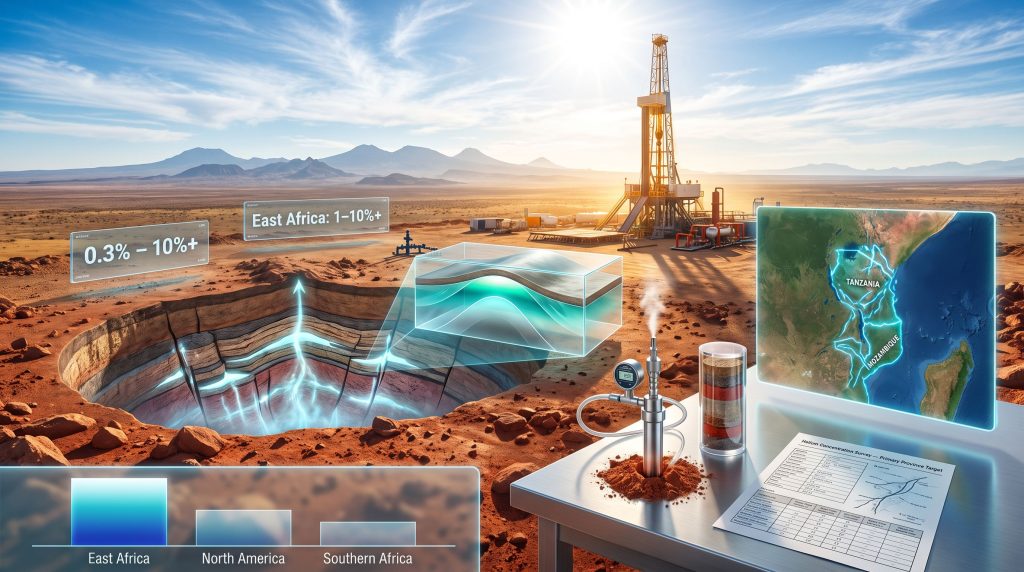
The practical result is that only a handful of geological environments worldwide consistently generate and preserve helium at concentrations worth developing. The threshold for commercial viability is generally considered to be around 0.3% helium by volume, with fields exceeding 1% helium classified as premium-tier targets. East African rift systems have returned documented concentrations exceeding 10% helium by volume in some accumulations, which represents multiples of conventional field grades and explains the intense exploration interest directed toward that region.
Global Helium Prospectivity: A Comparative Overview
| Region | Geological Setting | Helium Purity Range | Exploration Status |
|---|---|---|---|
| East Africa (Tanzania, Mozambique) | Rift basin with volcanic seals | 1% to 10%+ | Active frontier |
| North America (Hugoton, Montana) | Cratonic sedimentary basin | 0.3% to 2% | Mature, declining output |
| Central Asia (Russia, Kazakhstan) | Deep cratonic reservoirs | 0.1% to 0.5% | State-controlled |
| Southern Africa | Precambrian basement | 0.5% to 3% | Early-stage |
| Middle East | Associated natural gas streams | Below 0.1% | Byproduct only |
A critical distinction in helium exploration is the difference between primary helium provinces and associated helium production. Associated helium is recovered as a trace component during natural gas processing, meaning supply is tied to gas field economics rather than helium demand. When gas fields become uneconomic due to low gas prices, helium supply from those fields disappears regardless of helium market conditions.
Primary helium provinces, by contrast, are drilled specifically for helium, giving operators direct control over production decisions and allowing supply management that responds to actual helium market dynamics. This distinction has become commercially significant following the phased wind-down of the US Federal Helium Reserve, which historically buffered global supply against shortfalls.
The Five-Stage Technology Workflow Reshaping Helium Exploration
Modern helium exploration technologies operate as an integrated workflow where each stage reduces uncertainty and improves the capital efficiency of subsequent phases. Understanding the progression from regional screening through to downhole verification reveals why the sector has moved well beyond the relatively blunt instruments of early exploration programs.
Stage 1: Regional Screening and Basin-Scale Target Generation
The first stage of any serious helium exploration program involves generating a ranked inventory of prospective targets across large areas at the lowest possible cost per square kilometre. Several tools now operate effectively at this scale.
Satellite-based hyperspectral remote sensing can map surface geology, structural lineaments, and hydrothermal alteration zones across prospective areas without ground access. Basin-scale geoscience integration combines regional stratigraphic studies, tectonic history models, and crustal thickness data to rank prospective trends before committing field resources.
One underappreciated source of early-stage intelligence is legacy well database mining. Thousands of wells drilled by petroleum companies over the past century passed through helium-bearing intervals that were noted in drilling records but never pursued. Reprocessing these historical datasets, combined with fluid inclusion analysis of archived core samples, effectively converts decades of sunk exploration costs into prospectivity intelligence at minimal additional expense.
Stage 2: Geophysical Imaging of Subsurface Architecture
Once prospective trends are identified, geophysical surveys provide the structural resolution needed to map trap geometry and seal integrity. The primary tools applied in helium exploration technologies at this stage include:
- 3D seismic surveying, which produces volumetric subsurface images that allow geologists to evaluate trap geometry, fault connectivity, and seal continuity with significantly greater precision than older 2D methods. Modern processing workflows including amplitude-versus-offset analysis and full-waveform inversion improve resolution in structurally complex settings.
- 2D seismic reconnaissance, which remains cost-effective for basin-scale structural mapping before committing capital to full 3D programs in frontier areas.
- 3-component seismic sensors, which improve imaging resolution where complex fault networks or basement involvement complicates conventional acquisition, a particularly relevant consideration in rift basin settings.
- Gravity and magnetic surveys, which define basement architecture and regional structural trends with high spatial efficiency, especially valuable in areas with limited well control.
- Magnetotelluric and electromagnetic surveys, which characterise basement conductivity, identify deep fault systems that may function as helium migration pathways, and reduce uncertainty in trap architecture modelling.
In addition, 3D geological modelling has become an increasingly important tool at this stage, allowing geoscientists to visualise complex subsurface architectures and communicate findings more effectively to stakeholders and capital partners.
Stage 3: Geochemical Surveys as Cost-Effective Pre-Drill Screening
Soil sampling techniques such as soil-gas helium surveying have emerged as one of the most cost-effective early-stage screening tools available to helium exploration teams. By measuring helium concentrations in shallow soils directly above prospective structures, geochemical surveys can cover hundreds of square kilometres at a fraction of the cost of seismic acquisition programs.
The economics of soil-gas geochemistry are particularly compelling for junior explorers operating in frontier jurisdictions with limited infrastructure. Coverage costs per square kilometre are orders of magnitude lower than 3D seismic, allowing exploration companies to rapidly high-grade large land positions before committing to expensive geophysical programs.
Complementary pathfinder gas analysis co-detects associated gases including hydrogen, nitrogen, and carbon dioxide to characterise source rock maturity and migration system integrity. Surface seepage mapping, furthermore, identifies micro-seepage anomalies correlating with subsurface structural highs and fault-controlled migration corridors.
An emerging development worth noting is the growing recognition that some geological systems prospective for helium also generate natural hydrogen. This creates dual-commodity exploration opportunities where geochemical survey economics can be shared across two separate potential revenue streams, improving the return on early-stage exploration expenditure.
Stage 4: Downhole Verification and Reservoir Characterisation
Once a drill target is committed, downhole geophysics methods including advanced well logging suites adapted for helium-bearing reservoir evaluation measure gamma ray response, neutron porosity, density, and resistivity to identify productive intervals and quantify reservoir quality. Real-time helium mud logging systems monitor drilling returns continuously, reducing the risk of missing productive intervals during operations.
Drill-stem testing provides pressure transient analysis that confirms helium flow rates, reservoir permeability, and deliverability potential. Directional and precision drilling enables wellbore placement within optimal reservoir intervals identified through pre-drill geophysical modelling, reducing dry-hole risk and minimising capital expenditure per discovery.
Stage 5: AI-Driven Prospectivity Modelling and Data Integration
The final stage of the exploration technology workflow involves synthesising all collected datasets into predictive models that rank targets by probability of commercial helium accumulation. AI in mineral exploration has introduced machine learning algorithms trained on integrated geological, geophysical, geochemical, and historical well datasets, generating probabilistic prospectivity maps that allow exploration teams to allocate drilling capital more efficiently.
Multi-dataset fusion platforms combine seismic interpretation outputs, gravity and magnetics data, soil-gas anomalies, and basin modelling results into unified subsurface models. As helium-specific training datasets grow with each new discovery, the predictive accuracy of these models is expected to improve progressively, particularly for basin entry decisions in frontier geological settings.
How Helium Exploration Differs From Conventional Petroleum Methods
Helium exploration borrows extensively from petroleum industry methodologies, including seismic interpretation, pore-pressure analysis, and structural trap prediction. However, applying these frameworks to helium introduces unique challenges that petroleum analogues do not fully address.
| Exploration Parameter | Conventional Oil and Gas | Standalone Helium |
|---|---|---|
| Primary detection method | Seismic combined with hydrocarbon geochemistry | Seismic combined with soil-gas helium surveys |
| Seal integrity requirement | Moderate to high | Very high due to molecular size sensitivity |
| Source identification | Organic maturity indicators | Radiogenic basement mapping |
| Co-product economics | Oil, gas, and LPG | Nitrogen and CO₂ as processing costs |
| Exploration risk profile | Moderate with established methodology | Higher given limited analogue datasets |
| Infrastructure dependency | Moderate | High, with processing near wellhead critical |
The absence of conventional hydrocarbon indicators in standalone helium provinces is a particularly important challenge. Petroleum exploration teams rely heavily on direct hydrocarbon shows in drilling returns and seismic amplitude anomalies associated with gas saturation. In helium-only systems, however, these indicators are largely absent, meaning exploration teams must rely more heavily on structural evidence, geochemical surveys, and basement geology interpretation to build pre-drill confidence.
Processing Technologies: From Wellhead to High-Purity Product
Discovering a viable helium reservoir is only part of the value creation equation. Delivering helium at the purity specifications required by end markets requires purpose-built processing infrastructure, and the choice of technology has direct implications for which markets a producer can access.
- Membrane separation offers low capital cost and effective bulk separation from nitrogen and carbon dioxide at moderate purity levels, but is limited by gas composition constraints and cannot reach the ultra-high purity required by semiconductor and quantum computing applications.
- Pressure swing adsorption and temperature swing adsorption processes selectively remove impurities through cyclic adsorption cycles and suit mid-purity applications and smaller-scale facilities well.
- Cryogenic fractional distillation remains the dominant technology for producing Grade-A helium at 99.999% purity or higher, the specification required by semiconductor fabrication, MRI manufacturing, and quantum computing. Capital costs are substantial, but access to premium end markets justifies the investment for fields of sufficient scale.
- Hybrid processing trains combining membrane pre-separation with cryogenic finishing are increasingly adopted to balance capital efficiency with product purity, particularly for mid-sized fields where full cryogenic infrastructure would be economically marginal.
As semiconductor nodes continue shrinking and quantum computing scales toward commercial deployment, the tolerance for helium impurities narrows further. Exploration companies targeting these end markets must engineer processing infrastructure capable of meeting ultra-high-purity specifications from the outset rather than retrofitting existing facilities.
Demand Vectors Amplifying the Strategic Case for New Reserves
The demand profile for helium is structurally different from most industrial commodities because it is driven by applications where substitution is technically impossible rather than merely inconvenient. Key growth vectors include:
- Medical imaging: MRI systems require liquid helium for superconducting magnet cooling, and global MRI installation growth in emerging healthcare markets is expanding baseline demand.
- Semiconductor fabrication: Helium is used in wafer cooling, ion implantation, and leak detection across chip manufacturing processes, with advanced node production increasing per-unit helium consumption intensity.
- Quantum computing: Dilution refrigerators operating at millikelvin temperatures require continuous helium supply, and commercial quantum scaling could create step-change demand increases within the current decade.
- Aerospace and defence: Pressurisation systems, rocket propellant purging, and satellite manufacturing depend on reliable helium supply chains that cannot be interrupted without operational consequence.
- Fiber optic manufacturing: Helium atmosphere is required during glass preform production to prevent contamination, linking helium supply directly to global telecommunications infrastructure build-out.
For a broader perspective on these emerging helium exploration trends, the Innovation News Network provides detailed coverage of the technologies and innovations shaping the sector's trajectory.
The next major ASX story will hit our subscribers first
Frequently Asked Questions: Helium Exploration Technologies
What concentration of helium is required for commercial viability?
Fields with helium concentrations above approximately 0.3% by volume are generally considered potentially commercial, though project economics also depend on reservoir size, depth, processing costs, and infrastructure proximity. Deposits exceeding 1% helium are considered premium exploration targets, while some East African discoveries have documented concentrations exceeding 10%, representing exceptional geological settings.
Why is East Africa attracting so much helium exploration investment?
East African rift basins combine the key prerequisites for high-purity helium accumulation: ancient Precambrian basement rocks generating radiogenic helium over geological timescales, active crustal extension creating structural traps, and volcanic sequences providing high-integrity seals. The documented purity levels in some East African finds are multiples of conventional field grades, creating compelling exploration economics. The birth of this new exploration industry in such regions has attracted significant international capital and scientific interest in recent years.
How does soil-gas helium surveying work as an exploration tool?
Soil-gas surveys measure helium concentrations at shallow depths directly above prospective subsurface structures. Because helium migrates upward through fault and fracture systems, anomalous surface concentrations provide a direct geochemical signal of potential subsurface accumulations. The technique is fast, scalable, and low-cost relative to seismic acquisition, making it an attractive first-pass screening tool before committing capital to more expensive geophysical programs.
What role is artificial intelligence playing in helium exploration?
Machine learning algorithms are being trained on integrated datasets combining geological mapping, geophysical survey outputs, geochemical anomalies, and historical well results to generate probabilistic prospectivity rankings. As helium-specific training datasets expand with each new exploration program, these models are expected to progressively improve target prediction accuracy, particularly in frontier basin settings where conventional analogue data is sparse.
The Near-Term Development Trajectory for Helium Exploration
Several technology developments are positioned to further reshape helium exploration economics over the next five to ten years. Direct helium indication methods adapted from petroleum seismic amplitude analysis techniques are being refined to identify helium-saturated intervals before drilling, which could materially reduce dry-hole rates in structurally complex settings. Automated real-time helium mud logging systems are, furthermore, improving interval detection accuracy during drilling operations.
The broader structural shift underway involves the transition of the global helium supply architecture away from its historical dependence on a small number of large producing fields and strategic reserves. Modular liquefaction units are enabling economic production from mid-sized fields that would have been sub-commercial under traditional large-scale processing economics, opening the sector to a broader range of geological settings and operator profiles.
The convergence of advanced helium exploration technologies across every stage of the workflow — from AI-assisted regional screening through to precision downhole verification and high-purity processing — is progressively lowering the capital threshold for commercial development. This is not a marginal efficiency gain. It is a structural transformation of what constitutes a developable resource, and its implications for global helium supply security over the coming decade are considerable.
Readers seeking additional perspectives on helium exploration methodologies and market dynamics may find value in reviewing industry coverage available through Metals & Mining Review, which provides ongoing reporting on critical resource sectors.
Want to Stay Ahead of the Next Major ASX Mineral Discovery?
Discovery Alert's proprietary Discovery IQ model delivers real-time alerts on significant ASX mineral discoveries — including critical minerals and emerging commodities — turning complex geological data into actionable investment insights for both short-term traders and long-term investors. Explore historic discoveries and their exceptional returns, then start your 14-day free trial at Discovery Alert to position yourself ahead of the broader market.