June 6, 2026
When the World's Biggest Copper Producer Stumbles, Everyone Feels It
Few industrial metals carry the systemic weight of copper. Unlike precious metals driven largely by sentiment, copper's price and availability are tightly coupled to real-world physical demand: the wiring inside electric vehicles, the cabling connecting offshore wind farms to national grids, the plumbing inside commercial buildings, and the circuit boards powering consumer electronics. When supply falters at scale, the consequences ripple through every sector touching the modern built environment.
That is precisely why March 2026 data published by Chile's national copper commission, Cochilco, deserves careful attention. The simultaneous production declines recorded at Chile's three largest copper operations in a single month represent more than a routine quarterly variation. They raise fundamental questions about the structural health of the world's most important copper-producing nation and the medium-term outlook for global copper supply.
When big ASX news breaks, our subscribers know first
Chile's Dominance in Global Copper Supply: Why Every Tonne Matters
Chile has held the position of the world's leading copper producer for decades. According to the U.S. Geological Survey's Mineral Commodity Summaries, Chile consistently accounts for roughly one-quarter of global mined copper production, a concentration of supply that has no close parallel among major industrial commodities.
This structural dominance creates an inherent asymmetry: disruptions in Chile carry disproportionate weight on global copper pricing, supply chain reliability, and downstream industries in a way that comparable disruptions in smaller producing nations simply do not. Peru, the second-largest copper producer, contributes approximately 10% of global supply, less than half of Chile's share. The Democratic Republic of Congo, while growing rapidly in copper and cobalt output, remains a more modest contributor to refined copper markets.
The concentration risk embedded in this geography is not a new observation, but the March 2026 production data gives it renewed urgency. Furthermore, when Chile's three largest copper operations decline simultaneously, the statistical averaging effect that normally buffers monthly volatility disappears entirely. Chile's copper supply gap underscores just how exposed global markets are when this single nation underperforms.
According to Cochilco data reported by Reuters on 12 May 2026, Chile's total national copper output fell 9.04% year-on-year in March 2026, dropping from approximately 477,464 metric tons in March 2025 to 434,314 metric tons. That represents a loss of roughly 43,150 metric tons in a single month's year-on-year comparison, a volume significant enough to move global supply balances.
Codelco Copper Output Down 10% in March: Unpacking the Headline Number
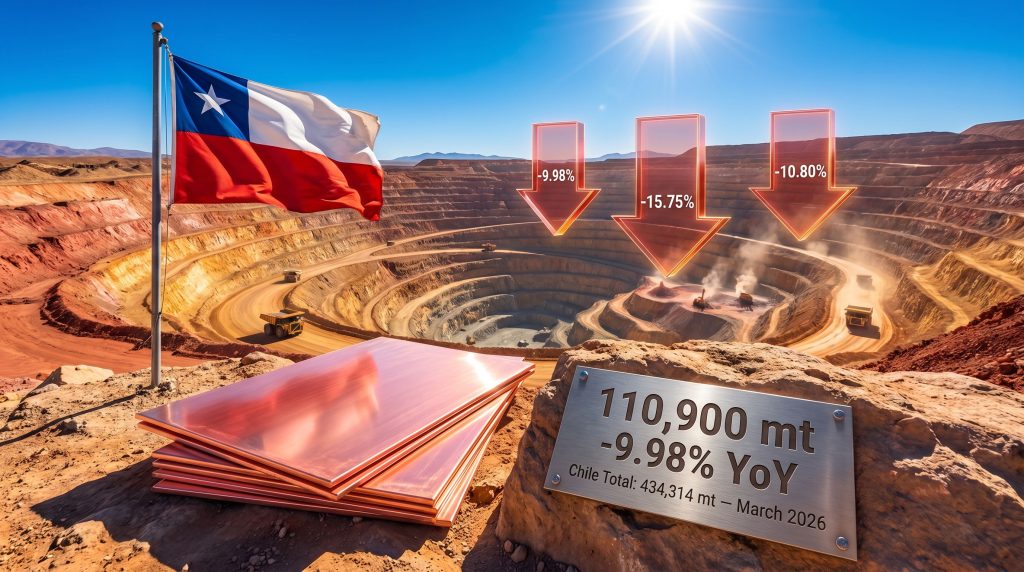
The most closely watched figure within Chile's broader production data is the performance of Codelco, the Chilean state-owned mining company and the world's largest copper producer by national ownership structure. March 2026 confirmed a continuation of a troubling trend: Codelco copper output down 10% in March on a year-on-year basis, with production falling to 110,900 metric tons compared to approximately 123,200 metric tons in March 2025, based on the reported 9.98% decline.
To contextualise this figure, Codelco's full-year 2023 output fell to approximately 1.32 million metric tons, widely reported as the company's weakest annual performance in roughly 25 years. That baseline already reflected a deteriorating operational environment. The March 2026 data suggests that a meaningful recovery has not yet materialised, and that near-term output targets remain elusive.
Codelco's Production Trajectory: A Multi-Year Pattern
The March 2026 decline does not exist in isolation. Codelco's output has traced a broadly declining path across multiple reporting periods, driven by a confluence of structural, operational, and institutional factors that are examined in detail below. Indeed, the Codelco output decline has been a persistent concern for industry analysts tracking supply-side risk.
| Period | Estimated Output | YoY Change | Primary Pressures |
|---|---|---|---|
| Full Year 2023 | ~1.32 million mt | Multi-decade low | Aging assets, ore grade decline |
| March 2024 | ~107,300 mt | ~-10.1% YoY | Safety incidents, operational halts |
| January 2026 | ~100,200 mt | ~-2.4% YoY | El Teniente disruption |
| March 2026 | 110,900 mt | -9.98% YoY | Broad operational pressure |
Note: Historical figures for March 2024 and January 2026 are drawn from industry reporting and Cochilco data. Investors and analysts are encouraged to verify these figures against Codelco's official quarterly disclosures and Cochilco's published monthly statistical bulletins.
El Teniente: The Underground Giant That Keeps Underdelivering
No discussion of Codelco's production challenges is complete without examining El Teniente, located in the Andes mountains of Chile's O'Higgins Region. By total ore volume extracted, El Teniente is widely regarded as the world's largest underground copper mine, a distinction that comes with extraordinary operational complexity.
The mine's ore body is estimated to contain some of the largest known copper reserves in Chile, but accessing and processing these resources becomes progressively harder as mining advances deeper into older, more geologically complex zones. El Teniente experienced a reported year-on-year decline of approximately 29.5% in January 2026, producing an estimated 18,100 metric tons, a figure that contributed meaningfully to Codelco's consolidated January underperformance.
What makes El Teniente's challenges particularly instructive is the geological dimension that rarely receives mainstream coverage. Underground copper mines of this scale and depth encounter a phenomenon known as primary sulphide ore transition, where the ore body shifts from relatively accessible oxide and secondary sulphide zones to harder, lower-grade primary sulphide material deeper underground. This transition requires different, more energy-intensive processing methods and typically yields lower recovery rates per tonne of ore processed.
Combined with the age of the mine's infrastructure, much of which dates back decades and requires phased replacement rather than straightforward maintenance, El Teniente represents a long-cycle problem that capital investment alone cannot resolve quickly. Codelco's New Level Mine project at El Teniente is designed to access deeper ore reserves and extend the mine's productive life, but the development timeline spans years, not quarters.
Escondida and Collahuasi: The Declines That Amplify the Supply Signal
If Codelco's difficulties were offset by strong performance elsewhere in Chile's mining sector, the March 2026 data would carry less systemic weight. However, the two other largest copper operations in the country recorded simultaneous, comparable declines, removing any within-country buffering effect.
BHP's Escondida mine, the single largest copper mine in the world by annual production output, recorded a 15.75% year-on-year decline in March 2026, producing 101,600 metric tons according to Cochilco data reported by Reuters. This is a striking contraction at an operation of Escondida's scale. The mine, located in Chile's Atacama Desert in the Antofagasta Region, typically produces more copper annually than many entire countries and its monthly swings carry significant weight in global supply models.
The Collahuasi copper mine, a joint venture operated by Glencore and Anglo American in Chile's Tarapacá Region, recorded a 10.80% year-on-year decline in March 2026, producing 31,400 metric tons.
| Mine | Operator | March 2026 Output | YoY Change |
|---|---|---|---|
| Codelco (consolidated) | Chilean State | 110,900 mt | -9.98% |
| Escondida | BHP | 101,600 mt | -15.75% |
| Collahuasi | Glencore / Anglo American | 31,400 mt | -10.80% |
| Chile National Total | Multiple | 434,314 mt | -9.04% |
Source: Cochilco data as reported by Reuters, Mining Weekly, 12 May 2026.
The combined weight of these three operations in global copper supply cannot be overstated. Together, they represent a substantial fraction of world copper production concentrated within a single country. Their concurrent decline in March 2026 means the full magnitude of Chilean underperformance flowed through to global supply balances without internal offset.
The Root Causes: Structural Problems That Outlast Any Single Quarter
Understanding why these declines are occurring requires separating short-cycle operational noise from long-cycle structural forces. In Chile's case, the evidence points predominantly toward the latter.
Ore Grade Deterioration: The Invisible Drain on Output
Perhaps the least visible but most consequential driver of Chile's long-term copper output challenge is the progressive decline in ore grades across its major deposits. Ore grade refers to the concentration of copper within rock, typically expressed as a percentage of copper content per tonne of ore processed.
Chile's copper ore grades have been declining for decades. Industry data tracked by USGS and independent mining research suggests that average copper ore grades across Chilean operations have fallen from above 1% copper per tonne in the early 2000s to below 0.7% in more recent years across much of the industry. The practical implication is that producing the same quantity of refined copper requires processing significantly larger volumes of rock, consuming more water, energy, and reagents per unit of output.
This is not a problem that engineering investment can reverse. It reflects the natural depletion of the richest, most accessible portions of ore bodies that have been mined for generations. New, deeper mineralisation can extend mine life, but typically at lower grades and higher unit costs.
Infrastructure Age and Capital Allocation Constraints
Codelco's position as a state-owned enterprise creates a specific tension around capital allocation. The company is required to transfer a substantial proportion of its profits to the Chilean government as a fiscal resource, a structural feature that has at times constrained the reinvestment available for mine modernisation.
Several of Codelco's flagship operations, including the Chuquicamata open-pit mine and El Teniente underground mine, are among the oldest continuously operating large-scale copper mines in the world. The infrastructure supporting these operations requires ongoing capital renewal at a pace that has historically lagged the investment needed to maintain peak production rates.
Safety-Related Operational Halts
Chilean mining regulations mandate operational suspensions following serious workplace incidents. Codelco mines, operating in geologically challenging environments at significant depth and scale, have experienced safety incidents in recent years that triggered regulatory halts. These suspensions, while legally and operationally necessary, create production voids within reporting periods that are difficult to fully recover through subsequent operations.
This dynamic is worth understanding as a recurring rather than exceptional feature of high-intensity mining at aging operations. The risk does not diminish as infrastructure ages; if anything, it compounds.
Institutional and Governance Factors
Chile entered 2026 with administrative transitions within its mining sector governance structure. Periods of institutional adjustment, while normal in any government apparatus, can temporarily slow the pace of regulatory approvals, environmental permitting decisions, and capital deployment authorisations that mining operations depend upon to maintain production schedules.
Copper's Energy Transition Demand and Why Supply Gaps Have Cascading Effects
The timing of Chile's production difficulties coincides with a period of accelerating structural copper demand. The global copper supply crunch is fundamentally tied to the energy transition, which is copper-intensive in a way that no substitution technology has yet meaningfully altered.
According to International Energy Agency analysis, electric vehicles require substantially more copper than equivalent internal combustion engine vehicles, with estimates typically ranging from 2.5 to 4 times more copper per vehicle depending on battery chemistry, motor design, and vehicle class. Grid-scale solar and wind infrastructure is similarly demanding, with offshore wind installations in particular requiring large volumes of copper per megawatt of installed capacity.
The downstream industries most exposed to sustained Chilean supply tightening include:
- Electric vehicle manufacturers relying on copper-intensive battery systems, motors, and wiring harnesses
- Renewable energy developers building grid-scale solar, wind, and battery storage infrastructure
- Electrical grid operators upgrading transmission and distribution networks
- Electronics manufacturers using copper in printed circuit boards, connectors, and thermal management systems
- Construction sectors incorporating copper in plumbing, HVAC, and electrical systems
"When the supply of a commodity with structurally growing demand contracts simultaneously across a nation that provides roughly one-quarter of global output, the price and procurement implications extend well beyond the mining sector itself."
Consequently, supply concerns have continued to escalate copper prices in ways that affect manufacturers, infrastructure developers, and end consumers across multiple continents.
The next major ASX story will hit our subscribers first
Recovery Outlook: Cautious Scenarios Through 2027
The forward-looking question for copper market participants is whether Chile's production trajectory represents a temporary trough from which recovery is imminent, or whether the structural headwinds described above will persist into the late 2020s.
The honest answer is that the evidence leans toward the latter, with some possibility of partial improvement if major expansion projects execute on schedule. The Codelco production recovery narrative remains cautious, with any meaningful rebound in annual output more plausible in the late 2020s, contingent on major capital projects proceeding on schedule and without significant safety-related interruptions.
In addition, the Chile copper outlook for the remainder of the decade remains closely tied to whether expansion timelines hold and whether institutional headwinds ease sufficiently to allow faster capital deployment across the sector.
| Scenario | Core Assumption | Implied Production Direction |
|---|---|---|
| Base Case | Expansion delays continue; ore grade pressure persists | Flat to marginal improvement |
| Upside Case | El Teniente expansion accelerates; safety record improves | Gradual recovery toward 1.4 million mt/year by 2027 |
| Downside Case | Further safety incidents; capital constraints deepen | Continued decline, potentially below 2023 levels |
Disclaimer: These scenario projections are analytical frameworks intended to illustrate outcome ranges, not financial forecasts. Actual production outcomes depend on operational, regulatory, geological, and macroeconomic variables that carry significant uncertainty.
Frequently Asked Questions
Why did Codelco copper output fall approximately 10% in March 2026?
Cochilco data reported by Reuters on 12 May 2026 confirmed that Codelco copper output down 10% in March to 110,900 metric tons year-on-year. The decline reflects a combination of long-cycle structural factors including ore grade deterioration at aging mines, infrastructure underinvestment relative to modernisation requirements, safety-related operational halts, and ongoing delays in major expansion programmes. This March result is consistent with a multi-year pattern of underperformance that has seen Codelco's annual output reach its weakest levels in approximately 25 years.
What is Cochilco and why does its data carry authority?
Cochilco, or the Comisión Chilena del Cobre, is Chile's official government copper commission. It compiles and publishes production statistics across all Chilean copper mining operations and is widely regarded as the authoritative institutional source for Chilean copper data. Its monthly bulletins and annual statistical reports are referenced by commodity analysts, investment banks, policymakers, and industrial users globally.
Which other Chilean mines declined alongside Codelco in March 2026?
BHP's Escondida mine fell 15.75% to 101,600 metric tons, and the Collahuasi joint venture operated by Glencore and Anglo American declined 10.80% to 31,400 metric tons. Chile's aggregate national output fell 9.04% to 434,314 metric tons. The breadth of simultaneous declines across all three of Chile's largest operations is what distinguishes March 2026 from typical monthly volatility.
Can Codelco realistically recover its production in the near term?
Near-term output recovery is constrained by the long development timelines of expansion projects, ongoing ore grade challenges, and the operational complexity of aging underground and open-pit mines. Analyst consensus as of mid-2026 suggests a cautious outlook, with any meaningful recovery in annual output more plausible in the late 2020s, contingent on major capital projects proceeding on schedule and without significant safety-related interruptions.
Key Takeaways: What March 2026 Tells Copper Markets
- Codelco copper output down 10% in March 2026 to 110,900 metric tons is not an isolated result but part of a sustained, multi-year production contraction at the world's largest state-owned copper producer
- Simultaneous declines at Escondida (-15.75%) and Collahuasi (-10.80%) compound the supply-side signal and eliminate any within-country statistical offset
- Chile's aggregate March 2026 output of 434,314 metric tons represents a 9.04% year-on-year contraction, confirming the breadth of the production challenge
- Structural drivers including ore grade deterioration, aging infrastructure, safety-related halts, and expansion project delays are medium-to-long-cycle headwinds, not short-term fluctuations
- Industries dependent on copper across electric vehicles, renewable energy infrastructure, grid development, and electronics manufacturing face genuine supply chain risk from sustained Chilean underperformance
- Investors and procurement professionals should monitor Cochilco's monthly statistical bulletins and Codelco's quarterly operational disclosures as the primary authoritative data sources for tracking production trends
This article is intended for informational purposes only and does not constitute financial, investment, or commodity trading advice. Production figures sourced from Cochilco data as reported by Reuters via Mining Weekly, 12 May 2026. Historical figures and forward scenario projections carry inherent uncertainty and should be verified against primary source documents before being relied upon for commercial or investment decisions.
Want to Spot the Next Major Copper Discovery Before the Market Does?
Discovery Alert's proprietary Discovery IQ model delivers real-time alerts on significant ASX mineral discoveries — instantly translating complex geological data into actionable investment insights for both short-term traders and long-term investors. With copper supply under sustained structural pressure, explore historic discoveries and their returns and begin your 14-day free trial today to position yourself ahead of the next major find.