July 28, 2026
The Hidden Ceiling Above Global Copper Supply
The global mining industry has spent decades extracting copper from progressively deeper, lower-grade deposits. What once required minimal capital and relatively straightforward logistics now demands billions in upfront investment, years of permitting, and increasingly sophisticated engineering just to maintain existing output levels. This structural reality sits at the centre of a problem that markets are only beginning to fully price: the world's largest copper mines cannot get back to where they once were, even as demand accelerates faster than at any point in modern mining history.
Understanding why Codelco copper production goals have been systematically revised downward requires more than reading a single year's results. It demands a forensic look at ore body economics, state enterprise dynamics, and the compounding effect of years of deferred decisions.
When big ASX news breaks, our subscribers know first
What the 1.7 Million Tonne Ambition Actually Represented
Origins of the Target and Why It Mattered
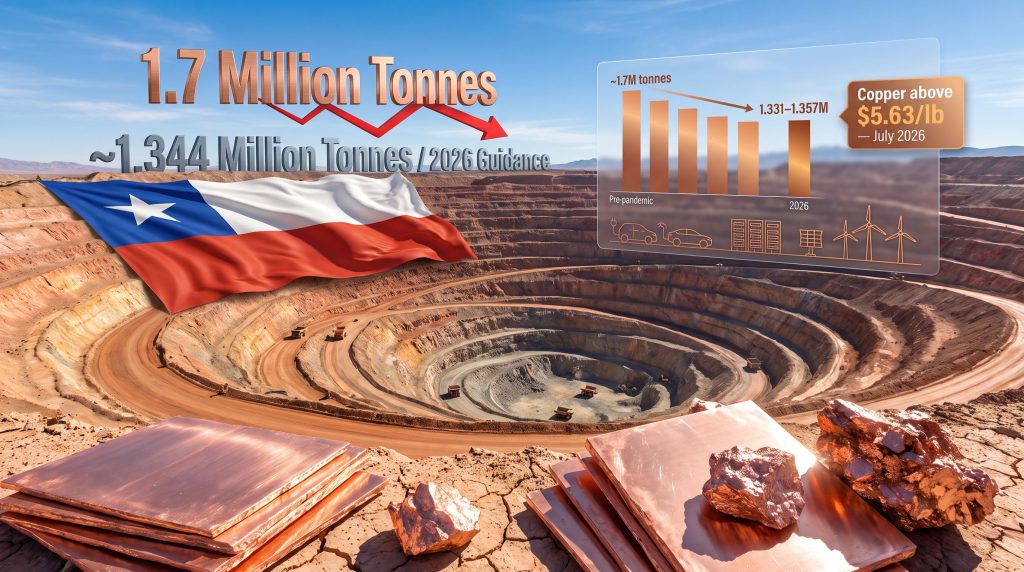
The 1.7 million tonne annual production target was never simply a corporate aspiration. It represented a return to operational relevance for a company that had, in prior years, achieved that level of output before a combination of aging infrastructure, declining ore grades, and pandemic-related disruptions pulled performance sharply lower.
Critically, the target was defined broadly: it incorporated not just Codelco's directly controlled mine output but also attributed production from joint-venture stakes in operations including El Abra (49% Codelco), Anglo American Sur, and Quebrada Blanca. This distinction matters enormously for analysts and investors who may conflate headline figures with operational reality.
| Year | Production Target | Status |
|---|---|---|
| 2025 | ~1.391 million tonnes | Near-term guidance |
| 2026 | ~1.331 to 1.357 million tonnes | Active confirmed guidance range |
| 2030 | 1.7 million tonnes per year | No viable pathway confirmed |
Own Mine Output vs. Attributed Production: A Critical Distinction
Investors tracking Codelco copper production goals often overlook the structural difference between two distinct categories of output:
-
Own-mine production reflects assets under Codelco's direct operational control, where capital decisions, workforce management, and extraction strategies are internally governed.
-
Attributed production captures the company's proportional share of output from partially owned operations, where decision-making authority is shared with private partners.
As legacy assets have underperformed and new project timelines have repeatedly slipped, the gap between these two figures has widened. The 1.7 million tonne target, measured in total attributed terms, becomes even more difficult to achieve if joint-venture partners are themselves navigating operational headwinds.
Seven Years of Structural Underperformance: More Than Bad Luck
The Pattern Behind Persistent Target Misses
When a company misses production targets once, it can reasonably attribute the shortfall to external events. When it misses for seven consecutive years, the explanation shifts from circumstance to structure. Furthermore, the Codelco production decline was confirmed directly by the organisation's chairman, Bernardo Fontaine, who assumed his role in May 2026, acknowledging that the company has not met its own projections for seven years running, and that 2026 is expected to continue that trend.
This is not a fringe observation. It reflects a deeply embedded set of operational challenges that previous leadership failed to resolve:
-
Ore grade deterioration: As surface and near-surface copper deposits become exhausted, miners must access deeper material with lower copper concentrations. Extracting one tonne of copper from a 0.3% grade deposit requires processing roughly three times more rock than from a 1.0% grade deposit, dramatically increasing energy, water, and capital consumption per unit of output.
-
Infrastructure overhaul delays: Many of Codelco's core operations were developed decades ago. Modernising underground transport systems, ventilation, hoisting, and ore processing circuits is an enormously complex engineering undertaking that consistently runs over time and over budget.
-
Capital allocation friction: As a state-owned enterprise, Codelco's investment decisions are subject to layers of governmental and institutional oversight that can slow the responsive capital deployment private miners often take for granted.
-
Rising unit costs: Codelco's all-in sustaining costs have climbed steadily, meaning each tonne of copper produced costs more to extract and process than in prior periods.
Are High Copper Prices a Cure-All?
Record-high commodity prices do not automatically translate into improved financial performance when operational costs are rising faster than revenue.
This counterintuitive dynamic is playing out in real time. Despite copper trading above $5.60 per pound in mid-2026, near multi-year highs, Codelco's contributions to the Chilean state have declined sharply. The company carries a debt load exceeding $20 billion, and while its 2025 EBITDA of approximately US$6.67 billion represents meaningful earnings power, cost escalation and underperforming capital projects have absorbed much of the benefit that elevated copper price drivers would otherwise deliver.
The lesson here extends beyond Codelco. Investors who assume high commodity prices automatically resolve mining company challenges often underestimate the degree to which operational and structural costs can neutralise price-driven revenue gains.
The New Strategic Direction: Profitability Before Volume
What Fontaine's Recovery Plan Signals About the Business
The strategic pivot announced by Codelco's new chairman is philosophically significant. Rather than reaffirming volume-growth targets or committing to new capital projects, Fontaine has indicated the company will present a comprehensive recovery plan in October or November 2026. The central organising principle of that plan: EBITDA improvement rather than tonne maximisation.
This shift carries several important implications:
- New project approvals have been suspended pending a return-on-investment review across the capital programme.
- Existing projects will be evaluated against minimum acceptable return thresholds before receiving further funding commitments.
- The company is explicitly signalling that it will not pursue production growth at the expense of financial discipline.
For a state-owned enterprise whose historical mandate has partly been defined by maximising national copper output, this represents a notable departure from institutional precedent.
Private Sector Partnerships: Breaking a Long-Standing Taboo
Perhaps the most strategically consequential development is Codelco's open acknowledgment that it lacks the capital and internal capacity to develop its full asset portfolio independently. The company is actively exploring structured partnerships with private mining companies as a mechanism to unlock value from assets that cannot be advanced under current resource constraints.
The El Abra copper mine, in which Codelco holds a 49% stake alongside Freeport-McMoRan, has been explicitly identified as a candidate for ownership restructuring. All options are under active review, including the dilution of Codelco's existing holding. According to Codelco's own corporate reporting, these structural decisions will form a central part of the forthcoming recovery plan.
For a state enterprise historically resistant to private co-ownership arrangements, placing asset dilution on the table marks a structural shift in how Chile's copper legacy is being managed.
El Abra itself is a significant asset. Located in Chile's Atacama Desert at high altitude, it processes oxide and sulphide ores and has long been considered a candidate for a large-scale expansion that could meaningfully increase output. However, advancing that expansion requires capital commitments that Codelco has been unable to fund internally given its debt position and competing priorities.
Copper Market Consequences: Why the World Is Watching
A Supply Gap That Demand Growth Cannot Ignore
Codelco's inability to return to historical output levels is not an isolated corporate story. It sits within a broader supply-side narrative that has directly contributed to the ongoing copper supply crunch and copper's elevated price environment. The metal's demand drivers in 2026 are simultaneously powerful and structurally durable:
-
Electric vehicles: A single battery electric vehicle contains roughly 80 to 110 kilograms of copper, compared to approximately 20 kilograms in a conventional internal combustion engine vehicle. Global EV adoption continues to accelerate.
-
Data centre infrastructure: Artificial intelligence compute buildout is driving unprecedented demand for copper in server wiring, cooling systems, and power distribution. Each large-scale AI data centre can require hundreds of tonnes of copper across its electrical and mechanical systems.
-
Grid modernisation: Renewable energy generation at scale requires extensive transmission infrastructure. Wind turbines, solar installations, and high-voltage direct current transmission lines are all heavily copper-dependent.
Against this demand backdrop, the supply side's structural ceiling is becoming a market-defining constraint.
Climate Volatility: The Risk Layer Rarely Priced In
The Chile copper outlook is further complicated by climate risk, a dimension that financial models frequently underweight. Extreme winter weather events in Chile during 2026 have caused additional supply chain disruption across the copper sector, compounding operational pressures already facing producers including Codelco. As climate volatility intensifies, the frequency and severity of weather-related production interruptions in Chile's Atacama and central regions is an emerging risk that copper market participants should incorporate into supply forecasts.
The Ore Grade Problem: A Sector-Wide Challenge
It is worth underscoring a geological reality that contextualises Codelco's struggle: the average grade of copper ore mined globally has declined by roughly 25 to 30 percent over the past two decades. What was once considered a sub-economic deposit is now routinely mined because higher-grade alternatives have been exhausted. This grade decline means that even with more sophisticated technology and higher capital investment, producing the same quantity of copper requires processing substantially more ore.
For Codelco, whose assets include some of the world's oldest continuously operating porphyry copper mines, this grade challenge is particularly acute. Porphyry copper deposits, which dominate Chile's mining landscape, are typically large, low-grade disseminated mineralisation systems where grade declines as mining moves deeper into the ore body. Indeed, industry analysts note that these grade pressures have been measurable in Codelco's monthly production figures for several consecutive reporting periods.
Debt, Dividends, and Political Pressure
The Fiscal Feedback Loop
Codelco's financial architecture creates a self-reinforcing pressure cycle that is rarely discussed in mainstream coverage:
- Declining production and rising costs reduce EBITDA.
- Lower EBITDA reduces dividend transfers to the Chilean state.
- Reduced state revenue creates political pressure to restore output levels.
- Political pressure to restore output conflicts with the new leadership's capital discipline mandate.
The company's chairman has characterised the primary challenge as operational rather than financial, arguing that the debt burden, while substantial, is serviceable against the company's asset base and cash-generating capacity. The more pressing issue is that capital servicing obligations consume firepower that could otherwise fund mine rejuvenation and grade management programmes.
The next major ASX story will hit our subscribers first
Key Takeaways: Five Points Every Copper Investor Should Know
-
The 1.7 million tonne production goal has been effectively abandoned by current leadership, with Codelco's chairman stating there is no realistic pathway to achieving it within four to five years.
-
2026 production guidance of 1.331 to 1.357 million tonnes represents flat-to-modest output relative to prior-year levels, not a recovery trajectory.
-
A strategic overhaul is expected in late 2026, centred on profitability improvement and rigorous capital return screening rather than volume expansion.
-
Private partnerships are now actively on the table, including possible dilution of Codelco's El Abra stake, in a significant departure from the state miner's historical operating philosophy.
-
Copper's elevated price environment, with the metal trading above $5.60 per pound in mid-2026, partly reflects markets pricing in the structural inability of major producers like Codelco to deliver meaningful supply growth.
Frequently Asked Questions: Codelco Copper Production Goals
What is Codelco's copper production target for 2030?
Codelco's previous administration had set a goal of reaching 1.7 million tonnes per year by 2030, encompassing both own-mine output and attributed stakes in joint-venture operations. As of mid-2026, current leadership has confirmed there is no viable path to achieving this target within the stated timeframe.
How much copper is Codelco expected to produce in 2026?
The confirmed guidance range sits between 1.331 million and 1.357 million tonnes, which represents a slight adjustment from prior-year levels and a substantial shortfall relative to the 1.7 million tonne long-term ambition.
Why has Codelco missed production targets for seven consecutive years?
The persistent shortfall reflects a combination of declining ore grades at aging mines, structural delays in infrastructure overhaul projects, rising unit costs, and capital allocation processes that are slower and less responsive than those of private mining companies.
Is Codelco considering bringing private partners into its assets?
Yes. The company has openly acknowledged that it lacks the capital and operational capacity to independently develop its full asset portfolio. Structured private partnerships are under active exploration, with El Abra identified as a potential candidate for ownership restructuring.
What does Codelco's underperformance mean for global copper prices?
As the world's single largest copper producer, Codelco copper production goals that continue to fall short directly tighten global supply balances. Combined with accelerating demand from electric vehicles, AI infrastructure, and grid expansion, this supply constraint is a key driver sustaining copper's elevated price environment in 2026 and beyond.
Want to Track the Next Major Copper Discovery Before the Market Does?
Discovery Alert's proprietary Discovery IQ model scans ASX announcements in real time, instantly identifying significant mineral discoveries — including copper — and delivering actionable alerts to subscribers before the broader market reacts; explore historic discovery returns to understand what's at stake, then begin your 14-day free trial at Discovery Alert to position yourself ahead of the next major find.