July 28, 2026
The Accountability Architecture Problem at the World's Largest Copper Producer
State ownership of strategic mineral assets has always carried an inherent tension at its core. Governments that nationalise resource industries do so to capture economic sovereignty, redirect commodity rents toward public welfare, and maintain influence over assets deemed too important to leave entirely to private markets. Yet the very act of ownership creates a conflict of interest that commercial governance frameworks are poorly equipped to resolve.
The state is simultaneously the regulator, the shareholder, the auditor, and the political beneficiary of the enterprise it nominally oversees. Few institutions in global mining illustrate this tension more sharply than Codelco, the world's top copper producer.
The current debate around stronger oversight of Codelco is not simply a reaction to a specific operational failure. It is the product of decades of accumulated governance compromises, structural underinvestment in accountability mechanisms, and a gradual divergence between the scale and complexity of Codelco's operations and the institutional architecture designed to supervise them.
When big ASX news breaks, our subscribers know first
Why Codelco's Governance Matters Far Beyond Chile's Borders
Codelco accounts for roughly 8 to 10 percent of global copper mine production, making it the single largest copper-producing entity in the world. Copper's role in the energy transition has elevated its strategic importance considerably. The metal is essential for electric vehicle motors, grid-scale battery storage systems, wind turbines, and power transmission infrastructure.
International energy analysts have estimated that achieving net-zero emissions targets globally could require copper demand to roughly double by 2035 relative to 2022 levels. Consequently, how Codelco is governed carries enormous implications not just for Chile, but for global decarbonisation timelines.
Within Chile, Codelco's institutional weight is even more concentrated. Copper exports have historically represented around 50 percent of Chile's total export revenue, and Codelco's contributions to the Chilean Treasury, which flow through a statutory transfer mechanism, have at various points represented a meaningful share of public spending capacity. When Codelco underperforms, the fiscal consequences are not abstract.
This dual role, as a commercial mining company and as a fiscal instrument of the Chilean state, creates a governance structure that is inherently more complex than that of a purely commercial enterprise. Decisions about capital allocation, production targets, and partnership agreements are never purely technical. They carry political and fiscal dimensions that can distort incentives at every level of the organisation.
What Codelco's Current Oversight Structure Actually Looks Like
Understanding why calls for stronger oversight of Codelco have intensified requires first mapping what the existing framework actually involves.
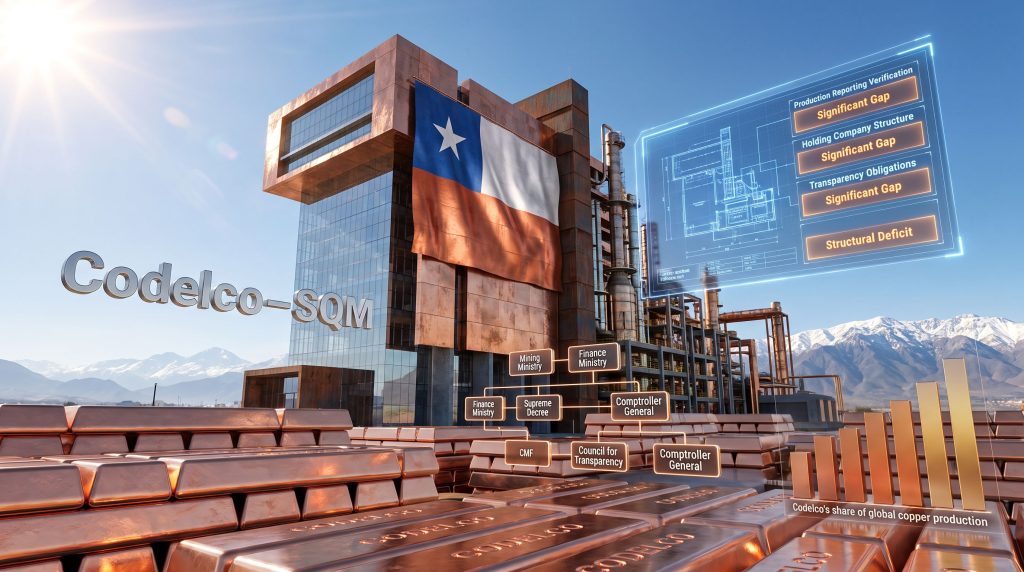
Codelco's annual budget requires approval through a Supreme Decree, jointly authorised by both the Ministry of Mining and the Ministry of Finance. The company is subject to supervision by Chile's Financial Market Authority (CMF) and the Council for Transparency, and maintains mandatory external auditing arrangements alongside an internal audit committee that reports to the board. On paper, this represents a multi-layered accountability structure.
In practice, however, significant gaps exist:
| Oversight Mechanism | Codelco (Chile) | Comparable SOE Standard | Gap Assessment |
|---|---|---|---|
| Annual budget approval | Supreme Decree (dual ministry) | Independent fiscal authority review | Politically exposed |
| External audit | Required, board-level committee | Mandatory, regulator-reported | Partially adequate |
| Production reporting verification | Internal with selective external review | Real-time independent verification | Significant gap |
| Transparency obligations | Council for Transparency | Full public disclosure regime | Partial compliance |
| Holding company structure | Absent | Common in global SOE reform models | Structural deficit |
The board composition question sits at the heart of this problem. Ministerially appointed directors, regardless of their individual competence, carry inherent conflicts of interest when the appointing government also sets policy objectives that Codelco is expected to deliver. This conflation of ownership and direction, without an arm's-length buffer, means that board-level accountability is structurally compromised before a single audit report is written.
How Production Reporting Failures Exposed the Depth of Internal Control Weaknesses
The discovery of inaccurate production reporting figures for the 2024 to 2025 period, which triggered executive dismissals and disciplinary action against additional personnel, did more than reveal an isolated operational error. It demonstrated a systemic failure in how self-reported data is validated within the organisation. The Codelco production decline narrative has, furthermore, been deepened by these revelations.
Production reporting in large-scale mining operations involves multiple stages of measurement, reconciliation, and verification. At each stage, there are opportunities for discrepancies to arise, whether through measurement instrument calibration issues, ore grade variability between geological blocks, processing plant throughput miscalculations, or deliberate misrepresentation.
The specific mechanisms behind Codelco's reporting inaccuracies have not been fully disclosed publicly. However, the institutional response, including the commissioning of an external audit with a special mandate covering both production figures and expenditure items, signals that the board itself assessed the situation as requiring independent scrutiny beyond normal internal review processes.
Key Policy Insight: An external audit commissioned after a known irregularity has already been identified serves primarily a reputational and legal function. It documents what went wrong and assigns responsibility. What it does not do is reform the control architecture that permitted the irregularity to go undetected for as long as it did. Genuine reform requires redesigning the system, not just investigating its failures.
This distinction matters enormously. Reactive audits are necessary but insufficient. The governance literature on state-owned enterprise failures consistently identifies the absence of proactive, independent verification mechanisms as a root cause of recurring control breakdowns, particularly in organisations where internal audit functions report upward through management chains that have their own performance incentives.
The Three Governance Reform Pathways Under Active Consideration
Chile's current government has explicitly committed to tighter accountability standards at Codelco, with a stated emphasis on shifting the company's strategic orientation from production volume maximisation toward financial discipline and long-term profitability. Three distinct reform models have emerged in policy discussions:
-
Enhanced ministerial scrutiny model: Strengthening existing dual-ministry budget approval mechanisms with more granular, milestone-linked reporting requirements. This path preserves the current structure but adds procedural rigour.
-
Independent regulatory oversight model: Transferring supervisory functions to an arm's-length regulatory body insulated from political appointment cycles. This approach draws on models used in utility regulation and financial services supervision.
-
Holding company restructure model: Restructuring Codelco under an autonomous holding company framework that formally separates the state's role as strategic owner from the enterprise's operational management. This is the most structurally ambitious pathway and the one most frequently cited by governance specialists as delivering durable reform.
Reform Design Consideration: Analysts focused on long-term SOE institutional performance have noted that management instability at Codelco is structurally linked to governance design rather than individual personnel quality. When board composition and strategic direction rotate with electoral cycles, no audit programme and no management team can fully compensate for the resulting strategic discontinuity.
The Codelco-SQM Lithium Agreement: A Separate Governance Test
The governance challenges at Codelco extend beyond copper production into its expanding lithium ambitions. Chile's Comptroller General, the country's independent constitutional auditing authority, has scrutinised the commercial structure of Codelco's partnership agreement with SQM for lithium operations in the Atacama region. In addition, the broader Chile lithium strategy raises its own accountability questions that intersect with Codelco's commercial objectives.
The Comptroller imposed conditions on the agreement and launched a formal audit of the deal's structure, raising questions about how major sovereign commercial agreements are negotiated, approved, and disclosed. This intervention is significant for several reasons.
The Codelco-SQM agreement is not a peripheral transaction. It sits at the centre of Chile's ambition to move up the lithium value chain, capturing a larger share of the economic value created as lithium transitions from a raw extracted commodity into refined battery-grade product. The agreement's commercial terms, particularly around revenue sharing, operational control thresholds, and technology transfer obligations, carry multi-decade fiscal implications for Chile.
The Comptroller's willingness to scrutinise the deal proactively reflects an important institutional dynamic. When an SOE enters long-term commercial agreements with private sector counterparties, the accountability gap between executive discretion and public interest obligations becomes most acute. Commercial confidentiality claims can be used to shield agreement terms from meaningful public scrutiny, and board-level approval processes offer limited protection when the board itself lacks full independence from the executive that negotiated the deal.
The next major ASX story will hit our subscribers first
Codelco's Debt Profile: A Governance Failure in Plain Sight
Codelco's debt accumulation has attracted sustained attention from credit analysts and governance researchers. Fitch Ratings has assessed Codelco's senior unsecured notes at BBB, reflecting the company's structurally elevated leverage profile. The company's net debt has grown substantially over the course of its structural transformation programme, a multi-year capital expenditure initiative designed to extend the productive life of its ageing underground mine operations.
The challenge is structural rather than cyclical. Codelco's ore grades have been declining for decades, a geological reality common to mature porphyry copper deposits. Average copper ore grades across Codelco's portfolio have fallen from around 1.5 percent copper in the early 2000s to below 0.8 percent in recent years, requiring significantly more rock to be processed per tonne of refined copper produced. This translates directly into higher energy consumption, higher reagent costs, and greater capital intensity per unit of output, regardless of copper price movements.
Structural Risk Flag: When an SOE's capital expenditure programme is approved through a politically mediated budget process rather than a commercially rigorous project finance framework with independent technical review gates, cost discipline becomes structurally difficult to enforce. This is not a criticism of any individual administration but a design problem inherent to the approval architecture itself.
Independent project finance frameworks typically include mandatory independent engineers' reports, milestone-linked funding disbursement, and external cost estimate validation before large capital commitments are approved. Codelco's capital approval process lacks equivalents to most of these mechanisms.
What a Meaningful Reform Framework Would Actually Require
A genuine accountability upgrade for Codelco requires more than additional reporting layers. Based on international SOE governance standards, particularly the OECD Guidelines on Corporate Governance of State-Owned Enterprises, meaningful reform involves five interconnected changes:
-
Independent production data verification: Mandating real-time, third-party verification of production reporting as a non-negotiable operational baseline, not a response to discovered failures.
-
Depoliticised board appointment mechanisms: Introducing skills-based, tenure-protected selection processes for board members that reduce exposure to electoral cycle pressures.
-
Arm's-length capital project oversight: Establishing an independent technical review body with formal authority over major project approvals, cost estimate validation, and milestone performance assessment.
-
Transparent debt and contingent liability reporting: Requiring Codelco to publish consolidated debt positions, contingent liabilities, and sovereign exposure data in standardised formats accessible to Chilean citizens and international investors.
-
Proactive Comptroller mandate expansion: Formalising the Comptroller General's authority to conduct forward-looking audits of major commercial agreements and capital decisions before, not only after, implementation.
However, what reform will not achieve without political will is the more fundamental question of ownership clarity. The OECD's ownership guidelines draw a sharp distinction between the state as a strategic owner, setting long-term performance expectations and holding management accountable for them, and the state as a political operator, using the enterprise to deliver short-term policy objectives. The Codelco copper strategy debate must ultimately grapple with this distinction directly. Chile has not yet fully made this transition, and until it does, governance improvements at the technical level will face constant pressure from political incentive structures that point in the opposite direction.
Benchmarking Against International State-Owned Mining Enterprise Standards
Comparative analysis of state-owned mining enterprises globally suggests that the holding company model consistently produces better governance outcomes across a range of performance dimensions. Furthermore, the Chile copper market outlook will remain closely tied to whether structural governance reform materialises or stalls.
Examples from Scandinavia, Southeast Asia, and parts of Africa indicate that ownership entities with clear mandates, published ownership policies, and independent boards achieve lower capital cost overruns, higher transparency scores, and more stable management tenures than politically administered equivalents. Mining industry analysts have similarly flagged these governance gaps as central to Codelco's long-term competitiveness.
Chile has the institutional capacity and legal framework to implement this transition. What has been absent is the political consensus to accept the genuine reduction in executive discretion that structural reform necessarily involves. The current debate around stronger oversight of Codelco, elevated by production reporting failures, Comptroller scrutiny of the lithium agreement, and sustained pressure from financial markets on Codelco's debt trajectory, may represent the clearest window for structural reform that has opened in a generation.
The broader signal for Latin American resource governance is equally important. Chile has historically been a regional benchmark for institutional quality in resource management. How it resolves the question of stronger oversight of Codelco will shape expectations for state-owned resource enterprises across a region that is increasingly grappling with the same ownership-accountability tensions at scale.
Disclaimer: This article contains forward-looking analysis, governance assessments, and structural comparisons based on publicly available information and established international frameworks. It does not constitute financial or investment advice. Readers should conduct their own independent research before making decisions based on any information presented here.
Want to Track ASX Mineral Discoveries Before the Broader Market Does?
Discovery Alert's proprietary Discovery IQ model delivers real-time alerts on significant ASX mineral discoveries, transforming complex mineral data into clear, actionable insights for investors at every experience level — explore Discovery Alert's dedicated discoveries page to see how historic finds have generated substantial market returns, and begin your 14-day free trial today to position yourself ahead of the market.