July 28, 2026
The Permitting Gauntlet: Why Securing Environmental Approval Is Only Half the Battle in Mexican Copper Mining
Few milestones in the lifecycle of a large-scale mining project carry as much symbolic and practical weight as environmental authorisation. In Mexico, where the regulatory pathway from discovery to production can span decades, clearing the environmental review process under SEMARNAT represents a genuine inflection point. Yet for investors and industry observers tracking the Southern Copper El Pilar environmental permits story, understanding what that approval actually unlocks, and what it does not, is essential to forming an accurate picture of where this project stands.
Mexico's mining permitting basics architecture is layered by design. The Environmental Impact Assessment (MIA) process governs whether a project can legally disturb land and commence construction activity, but it sits alongside, rather than above, a suite of parallel authorisations. Water concessions, land-use change permits, indigenous community consultation obligations under the Consulta Previa framework, and CFE electrical grid interconnection agreements each constitute independent approval tracks. Clearing one does not accelerate the others.
For open-pit operations of El Pilar's scale, all of these tracks must converge before commercial production becomes possible.
This regulatory complexity is not unique to El Pilar, but it is particularly pronounced in Sonora, where water scarcity adds a politically sensitive dimension to any mining proposal. The state's arid geography means that water concession approvals are among the most contested regulatory decisions in the region. This factor will continue to shape El Pilar's development timeline regardless of its environmental authorisation status.
SEMARNAT has also recently moved to halt mining environmental authorisations within Natural Protected Areas, a regulatory tightening that, while not directly affecting El Pilar, signals the broader direction of Mexico's environmental governance framework.
When big ASX news breaks, our subscribers know first
What the Southern Copper El Pilar Environmental Permits Actually Cover
The environmental authorisation secured by Southern Copper grants legal clearance for preliminary site preparation activities, with a scheduled commencement date of September 2026. Specifically, the permits authorise construction of the enabling infrastructure necessary to prepare the site for full-scale development, encompassing:
- Power transmission lines to connect the site to electrical supply
- Water pipelines to establish operational water delivery systems
- Access roads for construction and operational logistics
- Worker accommodation facilities to support the workforce
Full project construction is targeted to begin in the first quarter of 2027, with first copper cathode production anticipated during the second half of 2029. This three-year runway from permit to production reflects both the scale of the operation and the sequential nature of the remaining approval processes.
El Pilar: Project Fundamentals at a Glance
Understanding the project's physical and economic characteristics is essential context for evaluating what the permit milestone means in practice.
| Metric | Detail |
|---|---|
| Location | Sonora, Mexico (~45km from Cananea and Buenavista mines) |
| Reserve Classification | Proven and probable copper oxide |
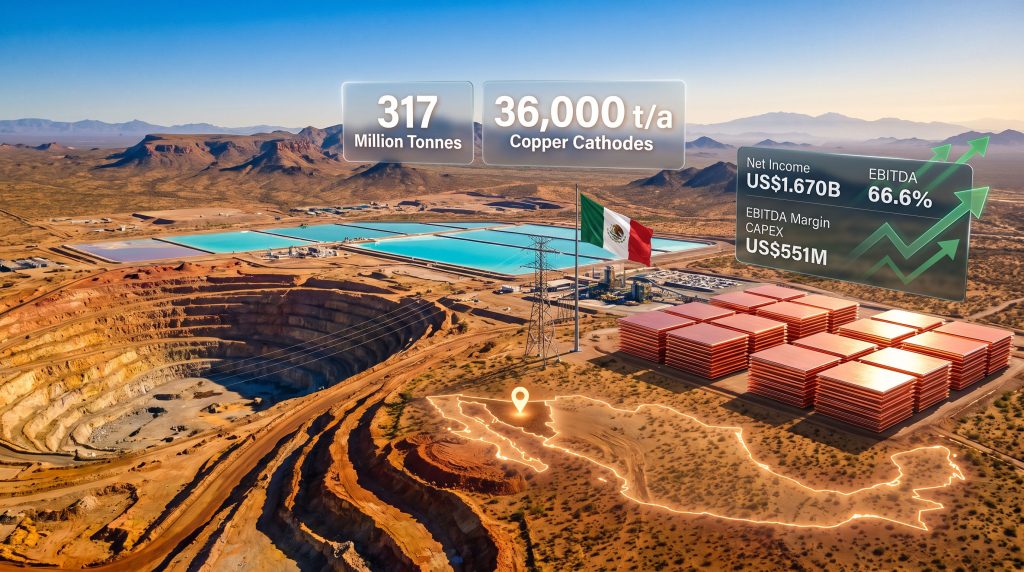
| Total Reserves | 317 million tonnes |
| Average Ore Grade | 0.249% copper |
| Mine Life | 18 years |
| Processing Technology | Solvent Extraction and Electrowinning (SX-EW) |
| Annual Production Capacity | 36,000 tonnes of copper cathodes |
| Total Capital Investment | US$551 million |
| Construction Jobs | 450 direct positions |
| Operational Jobs | 300 permanent positions |
The project's location within Sonora's established copper belt, approximately 45 kilometres from both the Cananea and Buenavista operations, provides meaningful infrastructure adjacency advantages. Existing regional knowledge of labour markets, supply chains, and community relationships in the corridor may help reduce some of the execution risk associated with greenfield development.
SX-EW Technology: A Geology-Driven Processing Choice
The decision to deploy Solvent Extraction and Electrowinning at El Pilar is not arbitrary. SX-EW is a hydrometallurgical process specifically suited to copper oxide ore bodies, which are chemically distinct from sulphide deposits and cannot be economically processed through conventional flotation and smelting methods. Furthermore, the copper leaching process used here offers distinct advantages for oxide-dominant deposits like El Pilar.
In practice, SX-EW works by leaching crushed oxide ore with a dilute sulphuric acid solution, which selectively dissolves copper into a pregnant leach solution. That solution then passes through a solvent extraction circuit where copper is selectively transferred into an organic solvent, purified, and then stripped back into an aqueous electrolyte. Electrowinning then deposits pure copper metal onto cathode blanks through an electrolytic process, producing 99.99% pure copper cathodes that are market-ready without any smelter requirement.
This bypass of the smelting step is commercially significant. Smelting infrastructure represents one of the largest capital cost components in conventional copper production. For an oxide-dominant deposit like El Pilar's 317 million tonne reserve base, SX-EW delivers cathode-grade copper at materially lower capital intensity per unit of annual production capacity compared to sulphide processing routes.
The tradeoff is that SX-EW is incompatible with sulphide ore. This is why El Pilar and El Arco, despite both being Southern Copper assets in Mexico, require fundamentally different processing infrastructure. El Arco's sulphide-dominant reserve base necessitates a conventional concentrator operation, which is one reason why its capital requirements, project complexity, and grid dependency are substantially larger.
The CAPEX Revision: From US$310 Million to US$551 Million
One of the more consequential details embedded in the El Pilar announcement is the magnitude of the capital cost revision. The project's 4Q24 report estimated construction capital at US$310 million. The current authorised budget stands at US$551 million, a US$241 million increase representing a 77.7% escalation from the earlier figure.
This kind of cost revision between preliminary estimate and construction-ready budget is not unusual in the mining industry, but the scale warrants scrutiny. Several factors likely contributed to the increase:
- Expanded infrastructure scope as detailed engineering revealed greater enabling works requirements, particularly for power and water delivery systems in a remote Sonoran location
- Construction material cost inflation accumulated since the original estimate was prepared
- Labour market tightening in Sonora's active mining corridor, where competition for skilled trades has intensified
- Engineering and design specification revisions incorporating updated geotechnical, environmental, and operational requirements
- Contingency loading applied as the project transitions from conceptual-stage budgeting to execution-ready cost planning
Cost Escalation Context: The gap between preliminary capital estimates and construction-ready budgets is a structural feature of long-cycle mining projects. Industry data consistently shows that CAPEX revisions of 20–50% between prefeasibility and execution are common, making El Pilar's 77.7% revision toward the upper end of typical variance. Investors should treat current estimates as subject to further revision as detailed engineering progresses.
Despite the escalation, the revised budget does not appear to strain Southern Copper's financial capacity, as the company's 2026 financial performance demonstrates in striking terms.
Southern Copper's Financial Position: Record Results Underpin El Pilar Funding
The financial backdrop against which El Pilar's development is proceeding is, by any measure, exceptional. Southern Copper's second quarter 2026 results represent record performance across virtually every key metric.
| Financial Metric | 2Q26 Result | Year-over-Year Change |
|---|---|---|
| Net Sales | US$4.289 billion | +40.6% vs. 2Q25 |
| Net Income | US$1.670 billion | +71.6% vs. 2Q25 |
| Adjusted EBITDA | US$2.85 billion | +59.5% vs. 2Q25 |
| Adjusted EBITDA Margin | 66.6% | N/A |
| Net Operating Cash Flow (H1 2026) | US$3.68 billion | +116.9% vs. H1 2025 |
| Capital Expenditures (Q2 2026) | US$422.8 million | +79.4% vs. 2Q25 |
The metal price environment driving these results reflects broad-based commodity strength. LME copper rose 39.8% year-on-year, while COMEX copper gained 30.5%. Molybdenum appreciated 43.1%, zinc climbed 30.8%, and silver surged 118.6%. The convergence of price strength across the portfolio simultaneously inflated revenues and compressed unit costs through byproduct credit expansion.
The most operationally notable metric is the net cash cost per pound of copper, which fell from US$0.63/lb in 2Q25 to just US$0.05/lb in 2Q26, a 93% reduction. This near-zero net cash cost reflects a 51.4% increase in byproduct credits from silver, molybdenum, and zinc, effectively subsidising copper production costs to negligible levels. At these cost levels, virtually every copper price scenario above the marginal cost floor generates substantial free cash flow.
Production Metrics: Geographic Divergence
| Metal | 2Q26 Output | Quarter-over-Quarter Change |
|---|---|---|
| Total Mined Copper | 230,662 tonnes | -3.5% |
| Mexican Copper Operations | N/A | +3.2% |
| Peruvian Copper Operations | N/A | -12.0% |
| Mined Silver | 5.76 million oz | -3.8% |
| Mined Zinc | 39,257 tonnes | -14.5% |
| Mined Molybdenum | 7,046 tonnes | -11.0% |
The divergence between Mexico and Peru is worth noting. Mexican operations posted a 3.2% increase in copper output during the quarter, while Peruvian production fell 12% due to lower ore grades. This operational trajectory reinforces the strategic logic of investing in Mexican capacity expansion at a time when the existing Mexican asset base is performing well.
El Pilar's Capital Requirement in Context
With first-half 2026 operating cash flow reaching US$3.68 billion, El Pilar's total construction budget of US$551 million represents approximately 15% of a single half-year's cash generation. The company is already deploying US$422.8 million in capital expenditure per quarter. By this measure, El Pilar's funding requirement sits comfortably within existing capital deployment capacity and does not appear to require external financing.
At full production of 36,000 tonnes per annum and assuming copper prices in the approximate US$4.50 to US$5.00 per pound range consistent with recent LME trading, El Pilar's gross annual revenue potential falls in the US$357 to US$396 million range. On that basis, the project's simple payback on its US$551 million capital cost could fall within approximately 1.4 to 1.5 years at full production under current price assumptions. The 18-year mine life then provides a substantial long-duration cash flow runway.
Note: This is a simplified illustrative scenario based on current price levels. Actual financial returns will depend on realised copper prices, operating costs, royalties, taxes, SX-EW processing efficiencies, and ramp-up timelines. This does not constitute financial advice.
El Pilar vs. El Arco: Two Projects, Two Very Different Risk Profiles
To properly contextualise El Pilar's permit achievement, it is necessary to understand how it compares to the other flagship project in Southern Copper's Mexican pipeline: El Arco.
| Factor | El Pilar | El Arco |
|---|---|---|
| Location | Sonora | Baja California |
| Reserve Base | 317Mt copper oxide | 1,230Mt+ sulphide (+ 141Mt leachable) |
| Average Grade (Sulphide) | 0.249% | 0.40% |
| Processing | SX-EW | Concentrator (120,000 t/d) + SX-EW (28,000 t/a) |
| Environmental Permits | Secured | Not confirmed |
| CFE Grid Dependency | Lower | Critical blocker |
| Construction Timeline | Q1 2027 target | No established date |
| First Production Target | 2H 2029 | Undetermined |
El Arco is by any reserve metric the larger opportunity, with more than 1,230 million tonnes of sulphide reserves at a meaningfully higher average grade of 0.40% compared to El Pilar's 0.249%. The planned operation includes both a large-scale concentrator and a standalone SX-EW facility. However, El Arco faces a structural constraint that no amount of engineering or capital can resolve internally: the Baja California peninsula is not connected to Mexico's national electrical grid.
Under constitutional law, electrical transmission is an exclusive function of the state administered through CFE. Southern Copper has been explicit that El Arco's advancement is contingent on a federal decision to interconnect Baja California with the national grid. This dependency places El Arco's timeline outside the company's direct control. El Pilar, by contrast, operates in Sonora within the established grid network, making power supply a manageable rather than a structurally dependent variable.
Southern Copper's US$10.2 Billion Mexican Pipeline
El Pilar does not exist in isolation. It forms part of a broader US$10.2 billion investment portfolio that Southern Copper is advancing through ongoing discussions with Mexico's federal government. The full pipeline spans multiple states and development stages:
| Project | Location | Status | Key Feature |
|---|---|---|---|
| El Pilar | Sonora | Environmental permits secured | 317Mt copper oxide; SX-EW |
| El Arco | Baja California | Awaiting CFE grid interconnection | 1,230Mt+ sulphide; 0.40% grade |
| Angangueo | Michoacán | Under evaluation | Base metals |
| Chalchihuites | Zacatecas | Under evaluation | Base metals |
| Empalme Smelter | Sonora | Under evaluation | Processing infrastructure |
The breadth of this pipeline illustrates why the El Arco CFE dependency matters so much at a portfolio level. El Arco's reserve base dwarfs El Pilar's, and its resolution would transform the scale of Southern Copper's Mexican production capacity. Until federal infrastructure decisions are made, El Pilar carries the weight of being the pipeline's near-term deliverable.
The next major ASX story will hit our subscribers first
Mexico's Copper Landscape and the CAMIMEX Strategic Assessment
The Mexican Mining Chamber (CAMIMEX) identified El Pilar as one of the country's most strategically significant copper developments in its 2025 assessment, grouping it among a cohort of projects considered important for Mexico's critical mineral supply positioning and energy transition objectives. In addition, the prevailing copper market trends point firmly toward sustained structural demand for projects precisely like El Pilar.
The broader project landscape in Mexico reflects a diverse mix of development stages and mineral focuses:
| Company | Project | State | Mineral Focus |
|---|---|---|---|
| Southern Copper | El Pilar | Sonora | Copper |
| Agnico Eagle / Teck JV | San Nicolas | Zacatecas | Copper-Zinc |
| Oroco Resource | Santo Tomas | Sinaloa | Copper |
| Barksdale Resources | San Javier | Sonora | Copper |
| Torex Gold Resources | Media Luna | Guerrero | Gold |
| Americas Gold and Silver | EC120 | Sinaloa | Silver-Gold |
| GoGold Resources | Los Ricos Sur/Norte | Jalisco | Silver-Gold |
| Minera Alamos | La Fortuna | Durango | Gold |
Copper's role in this landscape is particularly prominent. The metal serves dual demand functions: as an industrial workhorse in construction and manufacturing, and as a critical enabler of energy transition infrastructure including electric vehicles, power grid modernisation, and renewable energy generation systems. Each of these demand channels is growing independently, which creates a structural demand floor beneath copper pricing that was absent in prior commodity cycles.
Mexico's geographic position under the USMCA trade framework adds a further dimension to El Pilar's strategic value. North American manufacturing is increasingly motivated to shorten and domesticate its critical mineral supply chains, and a Mexican copper cathode producer supplying directly into the North American industrial base occupies a commercially advantaged position relative to supplies originating from more distant geographies.
Risk Matrix: El Pilar's Path from Permit to Production
Environmental authorisation is a significant milestone, but the risk register between today and first cathode production in 2H 2029 remains substantive.
| Risk Category | Risk Factor | Severity | Current Status |
|---|---|---|---|
| Regulatory | Water concession approval | High | Pending |
| Regulatory | Land-use change authorisation | Medium | Pending |
| Social | Indigenous community consultation | High | Ongoing |
| Infrastructure | CFE power connection | Medium | Enabling works planned |
| Financial | CAPEX overrun beyond US$551M | Medium | Under monitoring |
| Operational | Construction contractor availability | Low-Medium | September 2026 prep start |
| Market | Copper price volatility | Low (currently favourable) | LME copper +39.8% YoY |
Water concession risk deserves particular emphasis. Sonora's water basins are already classified as stressed or over-allocated in several sub-regions, and the environmental and community sensitivity around water allocation for industrial mining use has grown considerably in recent years. Any delay or condition attached to water concession approval could materially affect the construction timeline.
Indigenous community consultation under Mexico's Consulta Previa framework is similarly consequential. The process is not merely procedural. Courts have consistently held that meaningful, good-faith consultation is required before projects affecting indigenous communities can proceed, and inadequate consultation can result in injunctions that halt construction regardless of other permit statuses.
Those considering copper investment strategies should weigh these social licence risks carefully alongside the project's compelling financial metrics.
Frequently Asked Questions: Southern Copper El Pilar Environmental Permits
What do the El Pilar environmental permits authorise?
The permits authorise Southern Copper to begin preliminary site preparation in September 2026, covering power line construction, water pipeline installation, access road development, and worker accommodation. Full construction is targeted for Q1 2027.
Does El Pilar have all approvals needed for construction to begin?
No. While the Southern Copper El Pilar environmental permits represent the primary regulatory milestone, additional authorisations remain outstanding, including water concessions, land-use change approvals, and community consultation processes.
When is first copper production expected?
First copper cathode production is targeted for the second half of 2029.
Why did El Pilar's capital cost increase from US$310 million to US$551 million?
The 77.7% increase reflects expanded infrastructure scope, construction cost inflation, revised engineering specifications, and the transition from conceptual-stage budgeting to execution-ready cost planning. Further revisions remain possible as detailed engineering advances.
How does El Pilar differ from El Arco?
El Pilar is an oxide copper deposit processed via SX-EW technology in Sonora, with environmental permits now secured and construction approaching. El Arco is a substantially larger sulphide deposit in Baja California with over 1,230 million tonnes of reserves at a higher grade. However, its advancement depends on a federal decision to connect the Baja California peninsula to Mexico's national electrical grid, a requirement that remains unresolved. The copper price growth drivers that currently favour El Pilar would equally benefit El Arco once this structural barrier is resolved.
Can Southern Copper fund El Pilar from internal cash flow?
Based on the company's H1 2026 operating cash flow of US$3.68 billion, El Pilar's US$551 million total capital requirement represents approximately 15% of a single half-year's cash generation, well within existing capital deployment capacity. As reported by BN Americas, the permit win positions Southern Copper to advance this project with considerable financial confidence, further evidenced by the company's annual reporting which consistently demonstrates strong balance sheet management across multi-year capital programmes.
Want to Track the Next Major Copper Discovery Before the Market Does?
Discovery Alert's proprietary Discovery IQ model delivers real-time alerts on significant ASX mineral discoveries — instantly translating complex geological and commodity data into actionable investment insights for both short-term traders and long-term investors. Explore historic discoveries and their returns to understand the scale of opportunity, then begin your 14-day free trial to position yourself ahead of the broader market.