July 28, 2026
When Infrastructure Fails at Altitude: The Hidden Fragility of High-Desert Copper Mining
Copper mining at extreme elevation is an exercise in managing compounding risk. The same remote, arid conditions that preserve ore bodies for millions of years also expose surface infrastructure to climate events that can halt production within hours. High-voltage transmission lines crossing hundreds of kilometres of unpopulated terrain represent single points of failure that no amount of operational excellence can fully eliminate. When those lines go down, the consequences cascade rapidly through every system on site.
This dynamic sits at the heart of the ongoing Lundin Caserones mine power restoration and restart process, which entered its second week in late July 2026 following a severe Atacama winter storm. Understanding what happened, why recovery takes the time it does, and what it means for investors requires looking beyond the headline event toward the engineering, logistics, and market psychology underneath it.
When big ASX news breaks, our subscribers know first
The Atacama's Winter Season: Not as Stable as It Appears
Why High-Altitude Chilean Mines Face Asymmetric Climate Risk
The Atacama Desert carries a global reputation as the driest place on Earth, but this framing obscures important seasonal realities. During the Southern Hemisphere winter months of June through August, the high Andean plateau that borders the Atacama receives moisture-laden air from the Amazon basin in a phenomenon known as the Bolivian Winter or Altiplano Winter. At elevations above 3,500 metres, this translates into heavy snowfall events that can strand personnel, block access roads, and critically, structurally load transmission infrastructure in ways engineers designing decades ago may not have fully anticipated.
The Caserones mine sits at approximately 4,600 metres above sea level in Chile's Atacama Region III, making it one of the highest-altitude open-pit copper operations in the world. At this elevation, winter storms carry disproportionate destructive potential compared to lower-altitude operations. Snow accumulation on powerline towers, combined with high winds and ice loading, can compromise structural integrity rapidly.
The mid-July 2026 storm event delivered unusually heavy snowfall at higher elevations while simultaneously bringing heavy rainfall at lower altitudes, affecting multiple operations across the Atacama simultaneously. This dual-elevation impact is characteristic of the most severe Bolivian Winter events and illustrates why a single weather system can generate operationally distinct disruption profiles across mines located within the same regional geography. Understanding the Chile copper outlook requires factoring in these seasonal infrastructure risks as a recurring variable.
What Happened at Caserones: A Precise Infrastructure Failure
The Sequence of Events From July 18 Onward
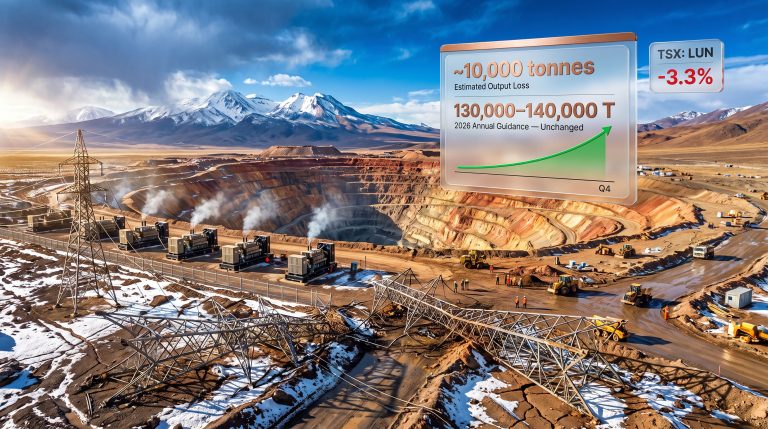
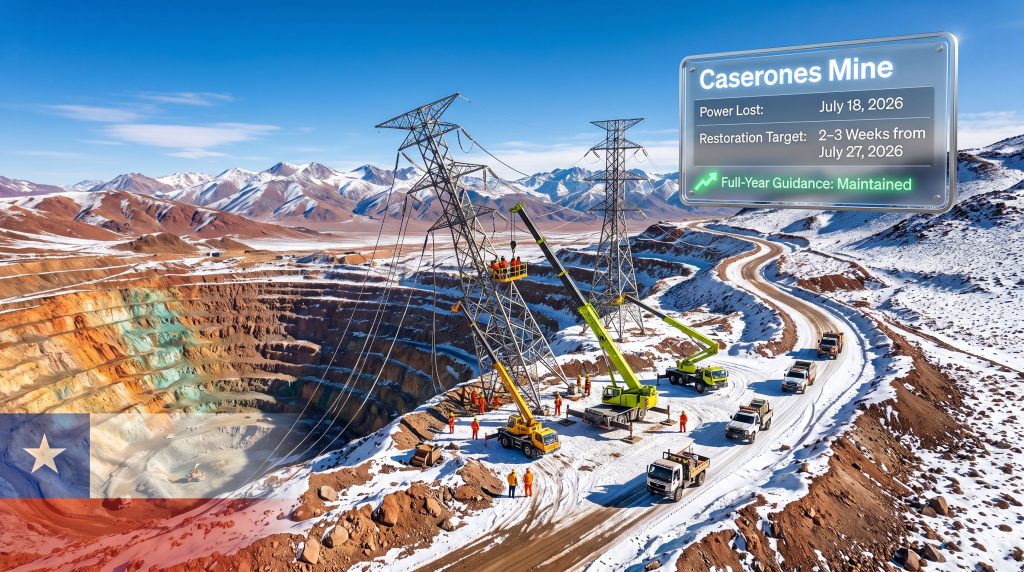
On July 18, 2026, the Caserones copper mine lost its connection to the primary electricity grid. The cause was structural damage to two high-voltage powerline transmission towers that supply the site. This was not a gradual degradation; it was an abrupt severance that immediately disabled primary power to the entire operation.
According to Lundin Mining's official update, the timeline as of the July 27 announcement is as follows:
| Event | Date / Status |
|---|---|
| Bolivian Winter storm impacts Atacama region | Mid-July 2026 |
| Caserones loses grid power (tower damage confirmed) | July 18, 2026 |
| Candelaria mill continues operation via ore stockpiles | Throughout storm period |
| Candelaria returns to full mining capacity | Prior to July 27, 2026 |
| Repair crews mobilised to damaged tower sites | Underway as of July 27, 2026 |
| Estimated power restoration window | 2 to 3 weeks from July 27, 2026 |
| Projected full production restart | Gradual, following power restoration (mid-to-late August 2026 target) |
Why Two Towers Can Shut Down an Entire Mine
A common misconception outside engineering circles is that transmission tower damage affects only a portion of a power supply. In reality, high-voltage transmission systems are configured in series along a single corridor route. Damage to even one tower creates an open circuit that renders the entire line inoperable from that point forward. Two damaged towers within the same line segment create redundant failure points that eliminate any possibility of partial rerouting.
At Caserones, the relevant transmission infrastructure traverses remote, high-altitude terrain with no alternative routing options. There is no secondary grid connection available as an immediate fallback. The mine is therefore dependent on:
- Backup diesel generators to sustain critical safety systems, ventilation, and monitoring equipment
- Controlled suspension of major processing equipment including crushers, SAG mills, and flotation circuits
- Carefully managed rotation of non-essential personnel off-site during the extended outage
Repairing high-voltage towers at 4,600 metres is not comparable to standard industrial electrical maintenance. Crews require specialised high-altitude training, dedicated equipment transport up mountain access roads, and coordination with Chile's national grid operator for safe re-energisation testing once structural repairs are complete.
Candelaria vs. Caserones: Two Mines, Two Very Different Recovery Stories
The Stockpile Buffer Strategy That Protected Candelaria
Lundin Mining's Candelaria mine, also positioned in the Atacama but at considerably lower elevation, experienced disruption of a fundamentally different character. Heavy rainfall affected surface mining operations temporarily, but crucially, the processing mill continued running throughout by drawing down existing ore stockpiles. This operational buffer strategy prevented the rainfall event from translating into any meaningful throughput loss.
Candelaria's ability to maintain mill continuity during a weather disruption underscores the operational value of strategic ore stockpile management as a resilience mechanism, particularly for mines operating in seasonally volatile environments.
The contrast between the two operations reveals important structural differences in their vulnerability profiles. Furthermore, Chile's copper supply role in global markets means these operational distinctions carry weight well beyond individual company balance sheets.
| Factor | Caserones | Candelaria |
|---|---|---|
| Primary disruption mechanism | Grid power infrastructure failure | Surface rainfall affecting mining access |
| Operational continuity tool | Backup generators (critical systems only) | Ore stockpile-fed mill continuity |
| Processing capability during event | Suspended | Maintained |
| Recovery timeline | 2 to 3 weeks (power + staged restart) | Already at full capacity |
| Elevation exposure | Approximately 4,600 metres (severe storm impact) | Lower elevation (lesser snow loading) |
| Production guidance impact | Guidance maintained | No material impact recorded |
The Two-to-Three Week Restart: Engineering Logic Behind the Timeline
Phase One: Restoring Grid Power
The dominant variable controlling the entire recovery schedule is the physical repair of the two damaged transmission towers. This process involves several sequential steps that cannot be meaningfully compressed without introducing safety risk:
- Site access confirmation – Access roads to the tower locations must be cleared of snow and debris before heavy equipment can reach the damage sites
- Structural assessment – Engineers must physically inspect the extent of damage before fabrication or replacement components can be ordered or deployed
- Component transport – Replacement tower sections, cross-arms, and insulator strings must be transported up mountain access roads using heavy haulage vehicles
- Structural reconstruction – Tower erection at high altitude requires specialised rigging crews working under compressed-time constraints due to weather window availability
- Conductor re-stringing and tensioning – Damaged or compromised line conductors must be replaced and properly tensioned across each tower span
- Grid operator coordination – Chile's national electricity grid operator must coordinate safe re-energisation and switching procedures before power can flow to site
Phase Two: The Gradual Mine Restart
Once grid power is restored, Caserones will not immediately return to full throughput. Large open-pit copper operations follow structured recommissioning sequences following cold shutdowns:
- Primary and secondary crushing circuits require inspection and sequential restart
- Semi-autogenous grinding (SAG) and ball mills need bearing temperature normalisation before full load operation
- Flotation circuits require reagent dosing re-establishment and froth stability verification
- Pumping infrastructure must be checked for blockages or freeze damage accumulated during the outage
- All electrical switchgear and motor control centres require systematic testing before energisation
The use of the term gradual restart in Lundin's communication is therefore technically precise rather than vague. It reflects the industry-standard multi-day ramp from zero throughput to steady-state production, not an indication of deeper damage or uncertainty about the asset's condition. This broader pattern is consistent with copper market trends that highlight supply-side disruption risk as a persistent feature of the global copper landscape.
What Investors Should Understand About the Guidance Decision
Holding Annual Guidance: Reading Between the Lines
Lundin Mining's decision to maintain its full-year copper production guidance following the Caserones outage carries meaningful informational content for market participants. In copper mining, guidance revisions are among the most significant negative signals a company can issue, frequently triggering outsized share price responses relative to the actual production volume change involved.
By holding guidance, Lundin is communicating several things simultaneously:
- The expected production shortfall from the outage period falls within pre-existing guidance tolerance ranges
- Management does not anticipate the restart timeline extending materially beyond the two-to-three week estimate
- The underlying ore body, processing plant, and tailings infrastructure have not sustained damage requiring extended repair
- Candelaria's continued full-capacity operation provides partial portfolio offset during the Caserones recovery period
It is worth noting that guidance maintenance is not a guarantee of outcome. Investors should treat it as a management confidence signal rather than a production certainty, particularly given the potential for further Bolivian Winter activity in August.
Key Metrics Investors Should Monitor Through Q3
For those tracking Lundin Mining through the Caserones recovery period, the following datapoints represent the most material leading indicators:
- Power restoration confirmation – Any announcement confirming grid reconnection will serve as the primary positive catalyst
- Restart ramp-up rate – The speed at which throughput recovers toward nameplate capacity following power restoration
- Q3 production report copper volumes – Will confirm whether the outage period remained within guidance tolerance
- Weather recurrence signals – Any further Bolivian Winter activity in August that could re-interrupt access road operations or further stress transmission infrastructure
The next major ASX story will hit our subscribers first
Chile's Copper Infrastructure: A Systemic Vulnerability Hiding in Plain Sight
The Broader Pattern of Weather-Related Operational Disruption
The Caserones event does not exist in isolation. Chilean copper production, which accounts for approximately 26% of global mined copper supply according to Chilean Copper Commission (Cochilco) data, is disproportionately concentrated in high-altitude Andean environments where transmission infrastructure crosses vast, sparsely populated terrain. This creates systemic exposure that the industry has historically managed reactively rather than proactively.
Key structural vulnerabilities across Chilean copper transmission infrastructure include:
- Long single-corridor transmission routes with no geographic redundancy
- Tower designs in some older corridors that predate updated Andean extreme weather loading standards
- Limited availability of specialised high-altitude electrical construction crews in northern Chile
- Extended repair timelines driven by access road fragility in post-storm conditions
The question the Caserones event raises for the industry is not whether severe Bolivian Winter events will recur, but whether the current approach of generator-backup-during-repair remains a sufficient resilience strategy as weather intensity patterns shift. Grid redundancy investment and alternative transmission routing studies represent longer-term infrastructure discussions that the sector has been slow to prioritise relative to direct production capacity expansion. In addition, major copper project development in other regions highlights how geographic diversification can reduce the systemic concentration risk that events like this expose.
However, the copper price drivers that analysts monitor most closely remain broadly supportive, meaning that temporary supply disruptions from weather events tend to reinforce rather than undermine the long-term investment thesis for the metal.
Frequently Asked Questions: Lundin Caserones Mine Power Restoration and Restart
How Long Has the Caserones Mine Been Without Power?
The Caserones mine lost grid power on July 18, 2026, following storm-related structural damage to two powerline transmission towers. As of the July 27, 2026 announcement, the site had been without primary grid power for approximately nine days, with backup generators sustaining critical safety and monitoring infrastructure throughout.
What Caused the Power Outage at Caserones?
A severe Bolivian Winter storm struck Chile's Atacama region in mid-July 2026, causing structural damage to two high-voltage powerline towers that form part of the transmission corridor supplying the Caserones mine. The damage severed the mine's connection to Chile's national electricity grid. Reporting from The Deep Dive has noted that the site could remain offline for several weeks as a consequence.
When Will Caserones Mine Restart Production?
Lundin Mining has indicated that the Lundin Caserones mine power restoration and restart is expected to require two to three weeks from July 27, 2026, placing the target restart window in mid-to-late August 2026. The restart will be staged rather than immediate following power reconnection.
Has Lundin Mining Revised Its Production Guidance Due to the Outage?
No. Lundin Mining has maintained its full-year copper production guidance without revision, classifying the Caserones disruption as a temporary, recoverable weather event rather than a structural production impairment.
Is the Candelaria Mine Also Affected?
Candelaria, also in Chile's Atacama region, experienced brief surface mining disruption from heavy rainfall. Its processing mill continued operating throughout the storm period using existing ore stockpiles, and the operation has already returned to full mining capacity.
What Is Keeping Critical Systems Operational at Caserones During the Outage?
Backup diesel generators are sustaining essential site infrastructure including safety monitoring systems, ventilation, emergency lighting, and communications. Access roads are progressively reopening as post-storm conditions improve, enabling personnel rotation and equipment access.
Caserones Restart: Situation Summary at a Glance
- Grid power lost: July 18, 2026, due to storm damage to two transmission towers
- Duration of outage as of July 27: Approximately nine days
- Estimated power restoration window: Two to three weeks from July 27, 2026
- Restart approach: Gradual, staged recommissioning sequence following power reconnection
- Backup systems active: Diesel generators maintaining critical site infrastructure
- Candelaria status: Already operating at full capacity
- Full-year production guidance: Maintained unchanged
- Active repair status: Crews mobilised and working on damaged tower structures
- Access road status: Progressively reopening as storm conditions ease
This article contains forward-looking statements regarding production timelines, restart schedules, and operational guidance. These are based on information available as of July 27, 2026, and are subject to change depending on weather conditions, engineering progress, and regulatory coordination. This content is for informational purposes only and does not constitute financial advice. Investors should conduct their own due diligence before making investment decisions.
Want to Stay Ahead of ASX Copper Discoveries Before the Market Reacts?
While infrastructure disruptions like the Caserones outage highlight the complexities of copper supply, Discovery Alert's proprietary Discovery IQ model scans ASX announcements in real time, instantly alerting subscribers to significant copper and mineral discoveries the moment they are announced — explore historic discovery returns on Discovery Alert's discoveries page to understand the opportunity, and begin your 14-day free trial to position yourself ahead of the broader market.