August 5, 2026
The Hidden Cost of Going Deeper: Seismic Risk and the Future of Ultra-Deep Copper Mining
Underground mining has always carried a fundamental paradox: the richest ore bodies often sit in the most geologically complex, mechanically hostile environments on earth. As decades of relatively accessible deposits become exhausted at shallower depths, major copper producers are being pushed progressively deeper into the crust. Codelco halts El Teniente mine expansion over seismic risk, and this decision is one of the clearest signals yet that ultra-deep mining is entering genuinely uncharted geomechanical territory.
When big ASX news breaks, our subscribers know first
Understanding Seismic Hazard at Extreme Mining Depths
How Rock Mechanics Change Below 1,000 Metres
At relatively shallow mining depths, rock behaves in broadly predictable ways. Stress accumulates gradually, deformation is measurable, and risk management frameworks built on decades of empirical data can be applied with reasonable confidence. Once operations push past 1,000 metres below surface, and especially beyond 2,000 metres, the physics shift considerably.
Rock under extreme confinement stores elastic energy in ways that shallower geology does not. When underground excavations disturb this equilibrium by removing supporting rock, stored strain energy releases suddenly and violently. This phenomenon, known as a rock burst, is fundamentally different from a conventional roof collapse or wall failure. Rather than a gradual mechanical breakdown, a rock burst is an explosive, instantaneous failure that can generate ground motion equivalent to a small-magnitude earthquake.
The critical distinction that makes ultra-deep mining so technically demanding is not merely that rock bursts happen, but that the characteristics of seismic events change with depth in ways that existing monitoring models may not fully capture. Frequency-magnitude relationships shift. Furthermore, precursor signals that reliably predicted events at shallower depths may no longer serve as adequate warnings, and new failure modes can emerge outside historically calibrated risk systems.
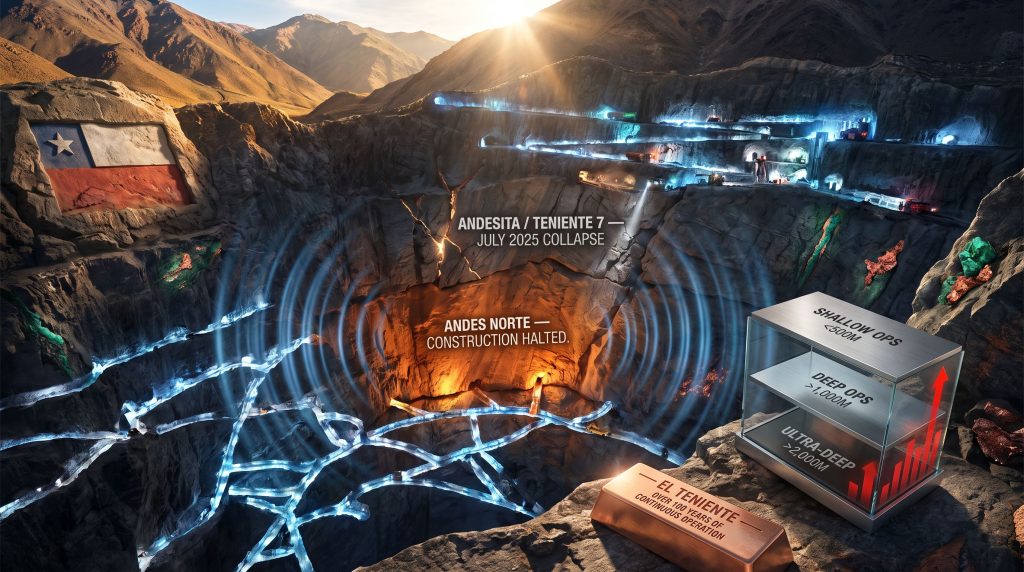
| Factor | Shallow Operations (<500m) | Deep Operations (>1,000m) | Ultra-Deep (>2,000m) |
|---|---|---|---|
| Rock stress levels | Moderate | High | Extreme |
| Seismic event frequency | Low | Elevated | High and unpredictable |
| Monitoring complexity | Standard | Advanced | Cutting-edge instrumentation required |
| Expansion risk profile | Well-understood | Partially modelled | Emerging phenomena possible |
This table illustrates why Codelco's internal findings at Andes Norte carry particular weight. The mine's technical teams did not identify a known risk being mismanaged. They identified a seismic profile that behaves differently from anything El Teniente's operational history has recorded — a qualitative distinction that fundamentally changes the response required.
What Happened at El Teniente: The Andes Norte Suspension Explained
A Preventive Halt Driven by Emerging Data
Codelco confirmed it has placed construction and development works within the Andes Norte section of El Teniente on hold, citing findings from six months of technical analysis that point to seismic risks associated with the depth of the deposit. Critically, the company characterised these risks as different from those previously identified and managed across the mine's long operational history.
This is not a reactive shutdown triggered by a new disaster. It is a preventive suspension driven by analytical findings, which arguably reflects more sophisticated risk governance than simply continuing operations until a threshold event occurs. According to reporting from Bloomberg, the company confirmed it will continue studying the phenomenon before determining how Andes Norte construction should proceed, if and when conditions allow.
Mapping the Affected and Unaffected Zones
| Mine Section | Status | Proximity to Andes Norte |
|---|---|---|
| Andes Norte | Construction/Development Halted | Core affected zone |
| Andesita | Previously impacted by July 2025 collapse | Adjacent |
| Teniente 7 | Previously impacted by July 2025 collapse | Adjacent |
| Other production areas | Continuing operations | Separate from halt zone |
Production across El Teniente's other sections is continuing, and Codelco has implemented strengthened seismic monitoring protocols across the operation. The Andes Norte halt is therefore contained in scope, though its implications extend well beyond the physical boundaries of a single development zone.
The July 2025 Rock Burst: Context and Consequences
A Fatal Event That Reshaped El Teniente's Safety Calculus
On July 31, 2025, a collapse at El Teniente killed six workers and halted production across several mine sections. The event generated ground motion equivalent to a 4.2-magnitude earthquake, placing it firmly within the range of significant underground seismic events. Andesita and Teniente 7, the zones most severely affected by this collapse, sit in close proximity to the Andes Norte development corridor.
The disaster triggered simultaneous criminal, regulatory, and technical investigations. Codelco remains in the process of determining the precise geomechanical cause of the event, underscoring how incompletely understood the failure mechanisms at these depths remain, even to an operator with over a century of experience at the site.
Rock bursts represent one of the most lethal and least predictable hazards in hard rock underground mining. As the industry pushes deeper in pursuit of ore, the energy stored in surrounding rock masses grows substantially, and the consequences of sudden stress release scale accordingly.
The six-month technical review that followed directly informed the Andes Norte suspension. The proximity of that project to the worst-affected zones, combined with findings about depth-related seismic behaviour, created a risk profile that Codelco assessed as warranting a construction pause.
El Teniente: Scale, Age, and Strategic Weight
A Centenary Operation at the Frontier of Its Own Geology
El Teniente is not simply a large mine. It is, by tunnel extent, the largest underground copper mine in the world, with a network of more than 4,500 kilometres of underground galleries and tunnels bored through the Andes mountains approximately 75 kilometres southeast of Santiago. It has been in continuous operation for over 100 years, a lifespan that has carried its working zones progressively deeper as shallower ore bodies have been exhausted.
This aging-but-expanding dynamic creates a particular tension in mine management. The infrastructure, institutional knowledge, and operational systems developed over a century are optimised for geological conditions at the depths already mined. Consequently, extending those systems into qualitatively different geomechanical environments — as the copper expansion plans at Andes Norte require — demands a form of technical reinvention even within an established operation.
Why El Teniente's Output Matters to Global Copper Supply
Codelco has been navigating a prolonged period of declining production, with output levels reaching multi-decade lows in recent years. El Teniente is central to the company's strategy for reversing that trajectory. Any delay to Andes Norte, even one framed as temporary and preventive, introduces meaningful uncertainty into medium-term production forecasts.
This matters beyond Chile's borders. Codelco is the world's largest copper producer by national output, and disruptions at its flagship asset feed directly into global supply calculations. This is particularly significant given the ongoing copper supply crunch at a time when copper demand projections are being driven upward by electrification, grid infrastructure, and energy transition investment.
Deep Mining Seismicity as a Global Industry Challenge
Why Operators Worldwide Are Facing the Same Problem
The forces pushing Codelco deeper at El Teniente are not unique to that operation. Across the global copper mining industry, declining ore grades at accessible depths are compelling producers to develop increasingly deep underground assets. Average copper ore grades mined globally have fallen significantly over several decades, a trend that makes finding high-quality ore at manageable depths progressively more difficult.
The consequence is a structural shift toward ultra-deep mining that the industry's risk frameworks have not fully kept pace with. Seismic monitoring technology has advanced considerably, however, as the Andes Norte situation illustrates, even sophisticated monitoring systems can encounter genuinely novel phenomena at depth. For instance, among the largest copper mines globally, this depth-driven challenge is becoming an increasingly common operational reality.
What Emerging Seismic Phenomena Actually Means
For non-specialists, the term emerging seismic phenomenon warrants unpacking. In conventional underground seismic risk management, operators build hazard models based on the historical behaviour of rock masses at their specific mine site. These models incorporate:
- The frequency and magnitude distribution of past seismic events
- The spatial clustering patterns of rock failures
- The relationship between excavation activity and seismic response
- The precursor signals that have historically preceded significant events
When Codelco's technical teams describe a phenomenon with characteristics different from risks historically known and managed at the operation, they are indicating that the seismic data being recorded at Andes Norte depth does not fit within these established parameters. Whether this reflects different failure mechanisms, unexpected geological structures, or depth-induced changes in rock mass behaviour is precisely what the ongoing investigation aims to determine.
The significance of this finding should not be understated. In an industry where risk management depends heavily on pattern recognition and historical analogy, encountering a genuinely new pattern is among the most challenging conditions an operator can face.
The next major ASX story will hit our subscribers first
Market Implications: What the Andes Norte Pause Means for Copper Supply
Short, Medium, and Long-Term Impact Assessment
| Timeframe | Likely Impact | Key Variable |
|---|---|---|
| Immediate (0-6 months) | Minimal, production continues in other zones | Scope of ongoing monitoring findings |
| Medium-term (6-24 months) | Moderate, expansion timeline delayed | Duration of technical investigation |
| Long-term (2+ years) | Potentially significant, depends on redesign requirements | Whether new seismic data requires project re-engineering |
In the near term, the suspension of development work at Andes Norte does not reduce El Teniente's current production output. Other sections of the mine continue operating. The supply impact at this stage is prospective rather than immediate, relating to future production that Andes Norte was expected to enable rather than output already being delivered.
The medium to long-term picture is more complex. If the technical investigation concludes that Andes Norte's design requires fundamental re-engineering to accommodate the newly identified seismic profile, the timeline for bringing that additional capacity online could extend considerably. In a market where the supply pipeline for new copper production is already constrained by permitting timelines, capital costs, and geological complexity, further delays at a project of this scale add incremental pressure to longer-dated supply forecasts.
Supply-Side Pressure in a Demand-Growth Environment
Copper's demand outlook is being shaped by forces that are largely independent of near-term price cycles. Electrification of transport, expansion of renewable energy generation, grid modernisation programmes, and data centre infrastructure growth all represent structurally elevated sources of copper consumption. Against this backdrop, copper investment strategies must account for supply disruptions at major producing operations, which carry heightened significance in such an environment.
Disclaimer: The above analysis of copper market impacts involves forward-looking assessments that are inherently uncertain. Actual supply and demand outcomes will depend on a wide range of variables including the results of Codelco's technical investigation, copper price movements, global economic conditions, and the pace of energy transition investment. This content is informational only and does not constitute financial or investment advice.
Seismic Risk Governance: What Best Practice Looks Like
From Reactive Safety to Predictive Risk Management
The Andes Norte decision reflects an industry-wide evolution in how underground mines approach safety governance. The older model treated seismic risk as a hazard to be responded to after events occurred. Modern deep mining operations increasingly adopt predictive frameworks built on continuous data collection, statistical modelling, and pre-emptive intervention.
Key components of advanced underground seismic management include:
- Dense microseismic sensor arrays that detect sub-millimetre rock deformation in real time
- Automated magnitude-frequency analysis to identify statistical anomalies in seismic catalogues
- Integration of geological mapping data with live seismic records to identify stress concentration zones
- Time-of-blast seismic response monitoring to assess how blasting activities influence rock mass stability
- Machine learning tools trained on historical event databases to flag precursor patterns
Even with these tools, the fundamental challenge at ultra-deep operations remains the possibility of encountering geological or geomechanical conditions outside the training data of any existing model. This is precisely the challenge that Codelco's Andes Norte investigation is now confronting.
What the Suspension Signals About Industry Standards
Codelco's decision to halt Andes Norte construction on the basis of analytical findings — before any additional incident occurred — sets a meaningful precedent for deep underground mine risk governance. It demonstrates a willingness to absorb the commercial cost of a development delay rather than continue operations under an insufficiently understood risk profile.
Whether this reflects pressure from ongoing criminal and regulatory investigations following the July 2025 fatalities, internal safety culture, or genuine precautionary risk management, the practical outcome is the same. As detailed analysis from mining.com highlights, Codelco halts El Teniente mine expansion over seismic risk that exceeds its current modelling capacity — and has acted accordingly. This also raises broader questions about the viability of similar major copper project developments at comparable depths elsewhere in the world.
Frequently Asked Questions
What exactly has Codelco halted at El Teniente?
Codelco has suspended construction and development works within the Andes Norte section of El Teniente. This is a development-phase halt, not a production shutdown across the entire mine.
Is El Teniente still producing copper?
Yes. Production continues across other sections of El Teniente that are not affected by the Andes Norte suspension. Enhanced seismic monitoring has been implemented across the operation.
What caused the July 2025 collapse at El Teniente?
A rock burst-type collapse on July 31, 2025, generated ground motion equivalent to a 4.2-magnitude earthquake, killing six workers. The precise geomechanical cause remains under investigation across criminal, regulatory, and technical inquiries.
What is the Andes Norte project and why is it significant?
Andes Norte is an expansion development within El Teniente intended to extend the mine's productive life by accessing ore bodies at greater depth. It is a key component of Codelco's strategy to reverse multi-decade production declines. Notably, among the largest copper mines worldwide, El Teniente's ultra-deep trajectory is being watched closely as a bellwether for the industry.
How does seismic risk increase with mining depth?
As depth increases, the weight of overlying rock creates greater confining stress on underground excavations. Rock under extreme stress stores substantial elastic energy, and when excavation disturbs this equilibrium, the energy releases can be sudden, violent, and increasingly difficult to predict using models calibrated at shallower depths.
What is a rock burst and how does it differ from an earthquake?
A rock burst is a sudden, violent failure of rock under extreme stress in an underground mining environment. Unlike tectonic earthquakes caused by movement along geological fault lines, rock bursts are driven by the stress redistribution created by mining excavations. Both can generate similar levels of ground motion but arise from entirely different mechanisms.
Will the Andes Norte halt affect global copper prices?
The immediate production impact is limited since other El Teniente sections continue operating. However, prolonged development delays could reduce the volume of future copper supply from a major producing operation, adding incremental pressure to medium and long-term supply projections. Any price impact would depend on broader market conditions and the eventual duration and outcome of the technical investigation.
How long could the expansion pause last?
Codelco has not specified a timeline for resuming Andes Norte construction. The duration will depend on the findings of the ongoing technical investigation, and potentially on whether the project's engineering design requires modification to accommodate the seismic profile identified at depth.
Key Takeaways: What the Andes Norte Suspension Reveals About Deep Mining Risk
- The halt is preventive in nature, driven by six months of analytical findings rather than a subsequent incident, representing proactive rather than reactive risk governance.
- Codelco's investigation identified a seismic phenomenon at Andes Norte depth that differs qualitatively from the hazard profiles El Teniente has historically managed, making this a genuinely novel technical challenge rather than a known risk being underweighted.
- Andes Norte sits in close proximity to the Andesita and Teniente 7 sections, the zones most severely affected by the fatal July 2025 rock burst, which adds geographical and geological weight to the precautionary decision.
- Production across other El Teniente sections continues, limiting the immediate supply impact, though medium to long-term output growth projections face meaningful uncertainty.
- The decision highlights a growing industry-wide challenge: as copper mining operations extend to ultra-deep levels in pursuit of diminishing shallow-depth reserves, existing geomechanical risk models may encounter conditions for which they were never calibrated.
- For copper markets, the pause introduces incremental supply-side uncertainty at a moment when Codelco is already managing a multi-year production recovery effort, and when global copper demand is being structurally elevated by energy transition and electrification investment.
Want to Identify ASX Copper Discoveries Before the Broader Market Does?
As seismic risk and ultra-deep mining complexity reshape global copper supply, the window to act on significant new discoveries is narrowing — Discovery Alert's proprietary Discovery IQ model delivers real-time alerts on major ASX mineral discoveries, turning complex geological data into actionable investment insights, so explore Discovery Alert's discoveries page to understand the historic returns major mineral discoveries have generated, and begin your 14-day free trial to position yourself ahead of the market.