August 5, 2026
Automation as a First Principle: How the Viscaria Restart Redefines Underground Mine Development
The mining industry has spent decades treating automation as something applied to a mine rather than built into one. Legacy operations retrofitted sensors onto ageing drills, bolted remote-control modules onto manually-designed loaders, and struggled with the operational friction of integrating digital systems into workflows shaped by human-only processes. That paradigm is now shifting, and the Sandvik automated fleet for Viscaria mine revival offers one of the clearest demonstrations of what the alternative looks like in practice.
Rather than reactivating dormant infrastructure and layering technology on top later, Gruvaktiebolaget Viscaria has inverted the conventional model entirely. Automation is being installed before a single tonne of ore is extracted commercially, embedding digital capability into the mine's operational DNA from the earliest development phase. Understanding why this matters requires looking at the mechanics of underground automation, the economics of Nordic copper production, and the strategic logic of lifecycle OEM partnerships.
When big ASX news breaks, our subscribers know first
The Viscaria Deposit: From Cold Care to Copper Revival
The Viscaria copper mine sits within the iron ore-rich Kiruna district of northern Sweden, a region that has hosted some of Scandinavia's most significant hard-rock mining operations for more than a century. Viscaria itself operated as a producing copper mine between 1982 and 1997, extracting ore from VMS ore deposits before a prolonged slump in global copper prices pushed the economics below viability. The mine entered care and maintenance and remained dormant for more than two decades.
Gruvaktiebolaget Viscaria reacquired the asset in 2019, recognising that the structural conditions that had made the original operation uneconomic had fundamentally changed. Copper demand was entering a new secular growth cycle, driven by the electrification of transport, the buildout of renewable energy infrastructure, and the grid investment requirements of an increasingly digital economy. With updated resource estimates and modern mining technology available, the case for a restart became compelling.
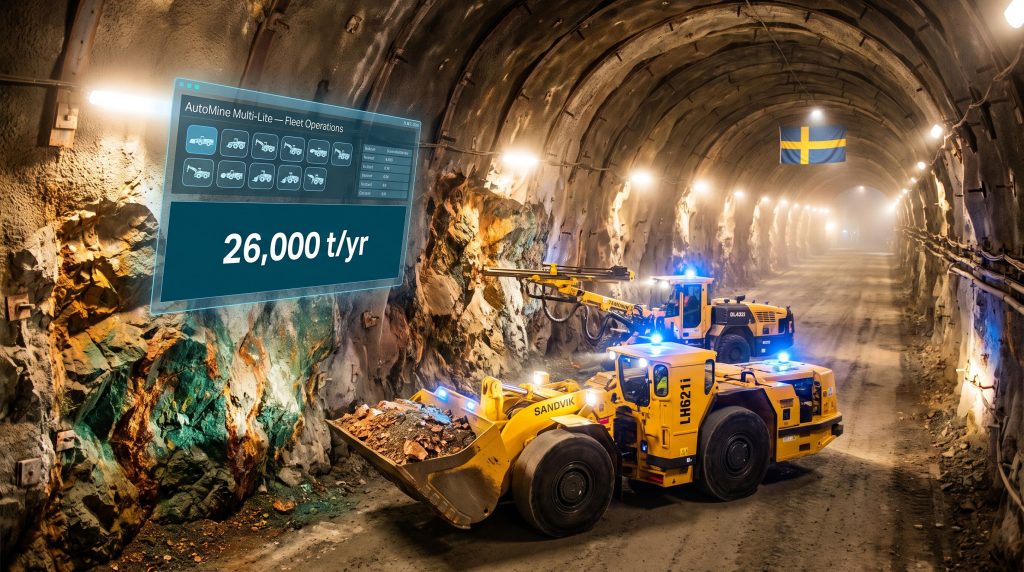
At full operational capacity, Viscaria is projected to produce approximately 26,000 tonnes of copper per year, a figure that would place it as Sweden's second-largest copper producer behind Boliden's Aitik open-pit operation in the same northern region.
Geological Note: VMS deposits like Viscaria are typically characterised by high-grade copper mineralisation in relatively compact ore bodies, making them well-suited to selective underground mining methods such as sublevel stoping. This geology directly influenced the choice of longhole drilling as the primary extraction technique.
Why Automation-First Is Not Just a Technology Choice
The Economics of Nordic Labour and the Automation Imperative
Sweden sits among the highest-cost labour markets in global mining. Underground mining in Nordic jurisdictions carries a structural cost disadvantage relative to operations in lower-wage producing regions, and this reality weighs heavily on per-tonne production economics. Furthermore, the growing copper supply crunch makes operational efficiency more critical than ever. Automation directly addresses this constraint by decoupling production throughput from headcount, particularly across extended shift windows where manual operations would otherwise require additional personnel rotations.
Automated drilling and loading systems do not experience fatigue-related performance degradation across a shift, meaning machine utilisation rates can remain consistent from the first hour of a cycle to the last. In a sublevel stoping operation where drilling efficiency directly determines stope development speed, this consistency translates into meaningful schedule compression.
Beyond productivity, automation carries significant occupational health and safety implications in the Nordic regulatory context. Swedish mining safety standards are among the most stringent globally, and reducing the physical presence of personnel within active production zones lowers exposure to blast fumes, seismic risk, and heavy equipment interactions. In a high-regulatory environment, this risk reduction carries both ethical weight and financial consequence through reduced incident-related costs and insurance considerations.
Greenfield Mindset in a Brownfield Restart
One of the more technically significant aspects of the Viscaria restart strategy is the decision to treat the project as a greenfield automation deployment rather than a brownfield retrofit. The distinction matters because the two approaches generate fundamentally different outcomes:
- Retrofit deployments require automation systems to adapt to existing infrastructure, communication networks, and workforce habits, creating compatibility friction and extended commissioning periods
- First-principles deployments allow communication networks, machine routes, and operator workflows to be designed around automation requirements from inception, eliminating integration-related inefficiencies before they can develop
- Procurement alignment at the development stage locks in system compatibility across the entire fleet, preventing the interoperability gaps that arise when equipment is sourced incrementally from multiple vendors over time
- Workforce training during the development phase creates experienced automation operators before production pressure exists, allowing competency to develop in a lower-stakes environment
The practical outcome of deploying the Sandvik automated fleet for Viscaria mine revival before production commences is that the mine will effectively enter its ramp-up phase with an already-calibrated automation system, trained personnel, and mapped underground routes. This is a qualitatively different starting position than most mine restarts historically achieve.
The Eight-Unit Fleet: Technical Architecture and Operational Logic
The Q3 2026 procurement order encompasses two machine classes and one fleet-level automation platform, configured as a matched production circuit:
| Equipment Type | Model | Units | Payload / Function |
|---|---|---|---|
| Longhole Drill | Sandvik DL432i | 4 | Production drilling, sublevel stoping |
| Underground Loader (LHD) | Toro LH621i | 4 | Ore loading and tramming, 21-tonne payload |
| Automation Platform | AutoMine Multi-Lite | All 8 units | Fleet-wide remote and autonomous operation |
The DL432i: Built for Massive Sulphide Drilling
The Sandvik DL432i longhole drill is engineered specifically for mid-to-large scale sublevel stoping, the mining method most appropriate for the compact, high-grade ore bodies characteristic of VMS copper deposits. Its i-series designation indicates full integration with Sandvik's digital intelligence architecture, enabling automated drill plan execution where the machine follows a pre-programmed drilling pattern with minimal continuous operator input.
Key capabilities relevant to the Viscaria application include:
- Automated collaring and rod changing, reducing the manual intervention required during repetitive drilling cycles
- Real-time drill performance telemetry, enabling surface operators to monitor penetration rates, bit wear, and deviation without underground presence
- Compatibility with Sandvik's rock tools ecosystem, which is included in the Viscaria supply agreement, ensuring tooling and machine performance parameters are factory-matched rather than approximated
The Toro LH621i: Closing the Production Circuit
The Toro LH621i is a 21-tonne payload capacity load-haul-dump (LHD) machine designed for high-throughput ore extraction in constrained underground geometries. Paired with four DL432i drills, the four-loader configuration creates a balanced production circuit where loading capacity is matched to the drilling programme's output, preventing ore accumulation bottlenecks at draw points.
Under AutoMine Multi-Lite control, the LH621i can execute autonomous tramming cycles between draw points and ore passes along pre-mapped routes. This capability is particularly valuable during night shifts or blast re-entry periods, when ventilation requirements limit personnel access but loaders can continue moving broken ore under remote supervision.
AutoMine Multi-Lite: Fleet Intelligence in a Scalable Architecture
AutoMine Multi-Lite is Sandvik's fleet-level coordination platform, and it represents a meaningful advance beyond single-machine automation. The system enables one operator to supervise multiple machines simultaneously from a surface or refuge-based control station, fundamentally changing the supervision-to-machine ratio that determines workforce requirements.
The platform's scalable architecture is a commercially significant feature. Because the system is designed to accommodate additional machines without full reconfiguration, the initial eight-unit fleet can be expanded as Viscaria's production profile develops, without requiring a parallel investment in new automation infrastructure. Each additional integrated machine also increases the volume of operational data available for predictive maintenance modelling, creating compounding analytical value as the fleet grows.
Industry Insight: Fleet-level automation platforms generate a form of operational intelligence that single-machine systems cannot replicate. When four loaders and four drills are sharing a common data environment, pattern recognition algorithms can identify production bottlenecks, maintenance precursors, and shift efficiency variations across the entire circuit simultaneously. This is categorically different from monitoring each machine in isolation.
The Lifecycle Services Model: Beyond Hardware Delivery
The Sandvik supply agreement for Viscaria extends well beyond the eight machines themselves. Three distinct service layers are included:
- Rock Tools Supply – consumable drilling tools including bits, rods, and shanks, factory-matched to the DL432i fleet to ensure consistent penetration performance and bit life metrics
- Parts and Services Package – a structured maintenance and spare parts framework designed to sustain target fleet availability figures throughout the development and ramp-up phases
- Dedicated On-Site Service Station – a permanent Sandvik technical presence at Viscaria, providing preventive maintenance execution, rapid fault response, and ongoing operator training support
The on-site service station element is particularly noteworthy from a commercial standpoint. Automated equipment generates substantially more diagnostic data than conventional manually-operated machines. Interpreting this data effectively, especially during the early operational period when baseline performance parameters are still being established, requires OEM-level technical expertise. Third-party service providers typically lack the software-layer access and proprietary diagnostic tooling needed to resolve complex electronic or automation-related faults efficiently.
From a switching-cost perspective, the lifecycle services agreement also creates a multi-year commercial relationship that extends the value of the initial hardware transaction significantly. Once Viscaria's underground communication network, route mapping database, and operator training programmes are built around the AutoMine Multi-Lite platform, transitioning to a competitor's automation system mid-operation would carry prohibitive disruption costs. This dynamic is well understood by major mining OEMs and represents a structural feature of how automation contracts generate long-term revenue beyond the initial equipment sale.
Delivery Timeline and Commissioning Sequence
Equipment deliveries are scheduled to begin in January 2027 and continue through August 2028, spanning approximately 20 months. This phased delivery approach is operationally deliberate rather than logistically constrained:
Jan 2027        — First equipment deliveries commence; underground network installation begins
Q2–Q3 2027      — Core fleet units on site; AutoMine platform commissioning initiated
Q4 2027         — Fleet integration testing; operator training programme underway
Q1 2028         — Supervised autonomous trials in development headings
Q2–Q3 2028      — Final deliveries complete; full fleet validated and operational
Late 2028+      — Production ramp-up toward 26,000 t/yr copper output target
The extended delivery window allows earlier-arriving machines to begin generating operational data and training value before the complete fleet is on site. Underground automation systems require substantial site-specific configuration work before productive autonomous operation becomes possible, including:
- Fibre optic or wireless mesh communication network deployment throughout development headings
- Tunnel geometry mapping and virtual route boundary establishment
- Machine-to-platform integration and parameter assignment for each unit
- Control station setup and operator qualification against defined competency standards
- Progressive supervised trial cycles with performance review before handover to routine operation
By the time the final machines arrive in mid-2028, the Viscaria automation system will have accumulated more than a year of operational data from the earlier deliveries, creating a significantly more mature technical environment than a simultaneous full-fleet commissioning would produce.
The next major ASX story will hit our subscribers first
Viscaria in the Context of European Copper Supply
Europe's strategic metals production base has contracted materially over the past three decades relative to the continent's consumption growth. Structural demand drivers including EV manufacturing expansion, offshore wind infrastructure deployment, and power grid modernisation programmes are pushing European copper requirements higher, while domestic production capacity has not kept pace.
The regional production landscape illustrates the gap clearly:
| Operation | Country | Approx. Annual Copper Output | Status |
|---|---|---|---|
| Boliden Aitik | Sweden | ~80,000 t/yr | Operating |
| KGHM Lubin District | Poland | ~400,000 t/yr | Operating |
| Cobre Las Cruces | Spain | ~72,000 t/yr | Operating (transitioning) |
| Viscaria (projected) | Sweden | ~26,000 t/yr | Pre-production |
Viscaria's projected 26,000 tonne annual output is modest against the scale of European demand, but raw tonnage understates the asset's strategic value. As a high-grade underground operation in a politically stable Nordic jurisdiction, Viscaria offers supply chain characteristics that large-scale open-pit operations in more geographically distant regions cannot replicate: consistent ore grade from a VMS deposit, a transparent and predictable Swedish permitting environment, and proximity to Scandinavian industrial consumers who place growing emphasis on supply chain traceability and provenance.
Supply Chain Note: The sourcing geography of copper is becoming increasingly material to European manufacturers, particularly in the automotive and clean energy sectors, where supply chain due diligence requirements are tightening. A domestically produced Swedish copper concentrate carries inherent provenance advantages that import-dependent alternatives cannot offer.
What the Viscaria Model Signals for the Mining Automation Sector
The Sandvik automated fleet for Viscaria mine revival is not an isolated procurement event. It reflects a broader shift in how mine operators and equipment OEMs are structuring their commercial relationships, and what that means for the mining automation trends sector is worth examining carefully. In addition, 3D geological modelling is increasingly being integrated alongside automated fleet deployments to enhance orebody definition and mine planning precision from the outset.
For OEMs, securing automation contracts at the project development stage rather than at production commencement represents a fundamentally superior commercial position. The revenue stream begins earlier, the switching cost barriers are higher, and the lifecycle services component generates recurring income across the mine's operational life rather than a one-time hardware margin. For instance, Sandvik's automation order at Codelco's El Teniente mine in Chile illustrates how the OEM applies this same strategic approach across multiple global operations.
For mine operators, the automation-first approach eliminates the productivity cost of mid-cycle technology transitions. Retrofitting automation into a producing mine requires taking equipment offline during commissioning, retraining an established workforce, and managing the operational disruption of changing workflows under production pressure. None of these costs exist when automation is embedded from day one.
For investors, the emergence of automation-first restarts as a distinct project development strategy carries valuation implications. Mines designed around automated production from inception carry structurally lower long-term operating cost profiles than conventionally designed operations, a characteristic that should be reflected in long-term cash flow modelling. Equally, the lifecycle services component of OEM agreements creates a revenue quality argument for major equipment manufacturers that is distinct from the cyclicality of new equipment sales.
Disclaimer: This article contains forward-looking statements and projections regarding mine output, production timelines, and market conditions. These represent management estimates and analytical perspectives and should not be construed as investment advice. Actual outcomes may differ materially from projections due to operational, market, geological, or regulatory factors.
Frequently Asked Questions
What is the Sandvik automated fleet being supplied to Viscaria?
The fleet comprises four Sandvik DL432i longhole drills and four Toro LH621i underground loaders, all integrated with the AutoMine Multi-Lite fleet automation platform. The supply agreement also includes rock tools, a parts and services package, and a dedicated on-site Sandvik service station.
Why did the Viscaria mine close in 1997?
The mine ceased operations due to a sustained decline in global copper prices that rendered the operation financially unviable. The asset remained dormant until Gruvaktiebolaget Viscaria reacquired it in 2019.
When will equipment deliveries begin?
Initial deliveries are scheduled to commence in January 2027, with the full fleet delivery programme completing in August 2028.
What is AutoMine Multi-Lite?
It is Sandvik's fleet-level underground automation platform enabling multiple drills and loaders to operate autonomously or under remote supervision simultaneously, coordinated through a centralised control interface with real-time telemetry and production monitoring.
How much copper will Viscaria produce annually?
At full operational capacity, Viscaria is projected to produce approximately 26,000 tonnes of copper per year, which would rank it as Sweden's second-largest copper producer.
What type of ore deposit does Viscaria contain?
Viscaria hosts a volcanogenic massive sulphide (VMS) copper deposit, a geology characterised by high-grade copper mineralisation in compact ore bodies well-suited to sublevel stoping extraction methods.
Want to Invest in the Next Major Mineral Discovery Before the Market Does?
Discovery Alert's proprietary Discovery IQ model delivers real-time alerts on significant ASX mineral discoveries — transforming complex mineral data into actionable investment insights for both short-term traders and long-term investors. Explore how historic discoveries have generated exceptional returns on Discovery Alert's dedicated discoveries page, and begin your 14-day free trial to secure your market-leading edge.