August 5, 2026
The Mechanics Behind America's Most Disruptive Industrial Metal Policy
Few commodity markets reveal the true complexity of trade policy quite like copper. Unlike oil or gold, copper sits at the intersection of construction, manufacturing, electrification, and defence production, making any tariff intervention a multi-dimensional shock that ripples across industries, geographies, and investment portfolios simultaneously. Understanding the architecture of copper tariffs in the US requires more than reading a policy summary. It demands a grasp of supply chain mechanics, trader psychology, warehouse dynamics, and the very real possibility that the entire policy framework could reverse course before it fully matures.
When big ASX news breaks, our subscribers know first
The Policy Architecture Behind US Copper Tariffs: A Section 232 Framework
How Section 232 Authority Became the Legal Basis for Copper Trade Restrictions
Section 232 of the Trade Expansion Act of 1962 grants the US President authority to impose import restrictions when a product is deemed a national security concern. Originally deployed against steel and aluminium, this legal mechanism was extended to copper, reflecting growing recognition of the metal's critical role in defence systems, power grid infrastructure, and advanced manufacturing. The invocation of Section 232 for copper was not a sudden move but a logical extension of an established trade strategy framework.
From Copper Content to Full Product Value: The Critical 2026 Policy Shift
When the initial copper tariff action took effect in August 2025, duties were calculated only on the copper content value within imported products. This was significant in its own right, but the structural overhaul that followed in April 2026 dramatically expanded the effective burden on importers. Furthermore, the broader copper tariff impacts on global trade have been substantial, extending well beyond what headline rates alone suggest.
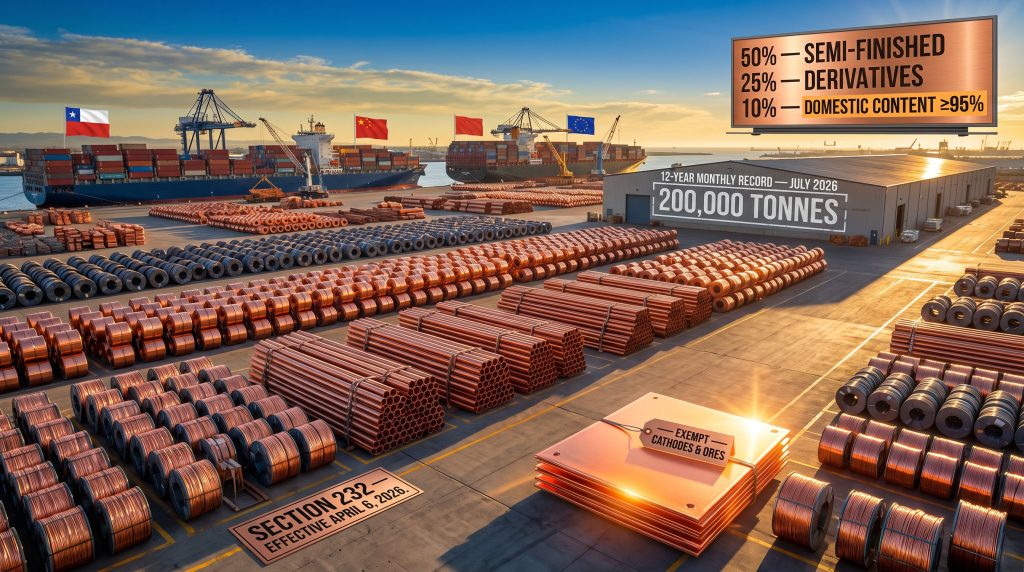
The shift from taxing copper content to taxing full product value is more consequential than the rate change itself. A copper pipe that previously attracted duties only on its metal content now faces a 50% levy on its entire declared value, including fabrication costs, logistics, and embedded margin.
This change fundamentally altered the import cost equation for semi-finished goods and copper-intensive derivatives, consequently creating an immediate incentive for front-loading behaviour across global supply chains.
Timeline of US Copper Tariff Escalation
| Policy Stage | Effective Date | Tariff Rate | Basis of Assessment |
|---|---|---|---|
| Initial Section 232 Action | August 1, 2025 | 50% | Copper content value only |
| Structural Policy Revision | April 6, 2026 | 50% (semi-finished) / 25% (derivatives) | Full product value |
| Domestic Content Preference | April 6, 2026 | 10% | 95%+ US-sourced metals |
| Proposed Refined Copper Phase | 2027+ (under review) | 15% starting rate | Under consideration only |
The domestic content preference rate of 10% is noteworthy. It is designed to incentivise manufacturers to source copper, steel, and aluminium domestically, effectively building a structural preference for American supply chains into the tariff framework itself.
Which Copper Products Are Covered and Which Are Exempt?
Tariffed Product Categories Under the Current Framework
The existing Section 232 copper tariffs apply to a broad range of processed and semi-finished products. According to the official White House presidential action, these include:
- Copper pipes, tubes, rods, and sheets
- Copper wires and drawn wire products
- Cables, connectors, and pipe fittings
- Electrical components with high copper intensity
Products Explicitly Excluded from US Copper Tariffs
Critically, the following categories remain outside the current tariff regime:
- Copper ores and concentrates
- Copper mattes
- Refined copper cathodes and anodes
- Copper scrap
Key exemption insight: Copper cathodes, the purest commercially traded form of refined copper and the benchmark product for global pricing, are currently excluded from Section 232 obligations. This exemption has created a significant arbitrage opportunity that is actively reshaping global inventory flows.
This distinction between raw, refined, and processed copper is not simply administrative. It reflects a deliberate policy logic: the US aims to protect domestic fabricators and manufacturers by making imported finished and semi-finished copper goods more expensive, while keeping raw material inputs accessible. Whether this logic achieves its intended outcome without generating unintended cost burdens across the industrial base remains contested among trade economists.
Why Copper Is Flooding Into the United States Right Now
Front-Loading Behaviour: The Trade Strategy Driving Record Import Volumes
Front-loading is among the most rational responses available to commodity traders facing an impending tariff. The strategy involves accelerating procurement and shipment of goods before a tariff takes effect, absorbing short-term freight and storage costs in exchange for locking in pre-tariff pricing advantages. In copper markets, the scale of this response in 2026 has been extraordinary.
July 2026 Import Data: A 12-Year High in Monthly Copper Inflows
IHS Markit shipping data confirmed that more than 200,000 tonnes of copper arrived at US ports in July 2026 alone. This represents the highest single-month import volume recorded in over twelve years. The immediate consequence was a combined inventory position across Comex and LME US-based warehouses that exceeded 740,000 tonnes, according to reporting by the South China Morning Post citing market data.
Beyond exchange-registered storage, an additional 110,860 tonnes were being held in port storage facilities as of early August 2026, according to LME data. The scale of this inventory accumulation is without recent precedent in the US copper market.
Port Storage Overhang: What the Bonded Warehouse Data Reveals
The geographic redistribution of copper inventory tells a compelling story about how global supply chains are responding to US tariff policy in real time. In addition, copper supply chain disruption driven by policy uncertainty has accelerated the pace of this geographic reallocation:
- LME warehouse stocks outside the United States declined sharply across 2026 as metal was redirected toward American ports
- Shanghai's Lingang bonded warehouse hub, one of China's most significant copper storage centres, recorded outflows from the beginning of the year
- Bloomberg reported a material and sustained drop in LME non-US inventory levels, consistent with large-scale diversion toward the US market
The Supply Chain Mechanics of Tariff Front-Loading
Understanding how traders execute a front-loading strategy helps explain why inventory surges of this magnitude occur so rapidly:
- Identify the anticipated tariff implementation window and assess credibility of the policy timeline
- Accelerate procurement contracts, purchasing available spot and near-term forward copper at pre-tariff prices
- Negotiate and confirm shipping contracts to maximise cargo volumes before the effective date
- Absorb elevated freight premiums and short-term warehouse storage costs as a calculable expense against expected price uplift
- Place copper into bonded or exchange-registered warehouses, maintaining optionality on timing of domestic market entry
- Sell into the domestic market at a premium once tariff-driven price increases materialise, capturing the arbitrage spread
What makes copper particularly suited to this strategy is its physical fungibility. Copper cathodes, rods, and semi-finished products can be stored efficiently and moved between warehouse locations as pricing incentives shift.
What Is the TACO Scenario and Why Does It Matter for Copper Prices?
Defining the TACO Risk Factor in Commodity Markets
Wall Street analysts coined the term TACO as shorthand for Trump Always Chickens Out, capturing the market's recurring observation that trade policy announcements under the Trump administration have at times been softened, delayed, or reversed before their full implementation. The TACO scenario does not imply that tariffs will never materialise, but rather that traders must price in a non-trivial probability of policy reversal when executing front-loading strategies.
How Policy Reversal Risk Creates a Two-Sided Copper Price Equation
| Scenario | Short-Term Price Impact | Inventory Consequence |
|---|---|---|
| Tariffs proceed as announced | US copper premiums rise; import arbitrage premium closes | Accumulated inventory becomes strategically valuable |
| TACO scenario unfolds (policy reversal) | US copper prices fall as front-loaded supply floods the market | Inventory overhang creates a meaningful price correction risk |
The asymmetry here is instructive. If tariffs proceed, traders holding pre-positioned copper inventories benefit. However, if tariffs are reversed or significantly softened, the same traders are exposed to a supply glut precisely when the pricing incentive that justified their strategy disappears. This dynamic creates a self-reinforcing anxiety in copper markets: the larger the front-loading surge, the more severe the potential correction if policy pivots.
Analysts have noted that the TACO risk is not hypothetical. Past instances of tariff announcements that were subsequently modified contributed to sharp short-term commodity price corrections, reinforcing the two-sided nature of current copper positioning.
How Do US Copper Tariffs Affect Domestic Prices and Industrial Costs?
Industries Most Exposed to Copper Tariff Pass-Through
The cost transmission from import duty to end-user pricing is rarely immediate but is structurally unavoidable over time. The copper supply and US tariffs dynamic has placed particular pressure on industries carrying the greatest exposure to tariff pass-through, including:
- Construction and infrastructure: Copper pipe and tube applications in plumbing, HVAC, and building services face direct cost increases on the most heavily tariffed product categories
- Electrical manufacturing: Wire, cable, and connector producers relying on imported semi-finished copper inputs face significant margin compression or customer price increases
- Automotive and electric vehicle supply chains: Modern EVs use substantially more copper per unit than internal combustion vehicles, amplifying tariff sensitivity across this growth sector
- Renewable energy installations: Both wind turbines and utility-scale solar facilities require extensive copper wiring, making the cost of electrification infrastructure materially sensitive to copper tariff policy
The domestic content preference rate of 10% for manufacturers using at least 95% US-sourced metals creates a powerful incentive to onshore upstream supply relationships, but building that domestic supply capacity takes years, not months.
The next major ASX story will hit our subscribers first
How Are Global Copper Supply Chains Restructuring in Response?
The Geographic Redistribution of Copper Inventory
The structural response to copper tariffs in the US extends well beyond individual trading decisions. Entire supply chain corridors are being reconfigured:
| Supply Region | Pre-Tariff Role | Post-Tariff Strategic Position |
|---|---|---|
| Chile / South America | Primary cathode exporter to global markets | Cathode exports remain tariff-exempt, preserving competitive positioning |
| China | Major semi-finished product supplier | Facing tariff exposure on processed copper exports to the US |
| Europe | LME warehouse hub for global copper storage | Non-US inventory declining as metal redirects toward US ports |
| Australia | Concentrate and ore supplier | Exempt product categories; stable upstream supplier positioning |
China's Role in the Copper Reallocation Dynamic
China's position in the copper tariff story is particularly layered. As both the world's largest copper consumer and a major processor of imported concentrate into semi-finished products, China sits at the intersection of multiple conflicting pressures. The broader US-China copper trade war dynamic has consequently intensified these pressures considerably.
Outflows from Shanghai's Lingang bonded warehouse hub signal that copper previously sitting in Chinese storage is being diverted toward US-bound shipments, effectively reducing China's buffer inventory while simultaneously building up US port stockpiles. This dynamic is creating bifurcated pricing structures across Pacific and Atlantic copper markets, with US premiums elevated relative to Asian benchmark prices in ways that reflect the tariff-driven distortion rather than underlying demand fundamentals.
What Could a Phased Tariff on Refined Copper Mean for Markets?
The 2027 Refined Copper Tariff Proposal: Recommendation vs. Reality
The most significant unresolved variable in the US copper tariff landscape is the potential extension of duties to refined copper cathodes. A phased tariff reportedly starting at 15% in 2027 has been discussed at the policy level, but as of mid-2026 this remains a recommendation under consideration rather than legislated policy. The distinction matters enormously for market positioning. According to ING's analysis of what's next for US copper import tariffs, the trajectory of this policy decision will significantly shape global copper trade flows well into the next decade.
Scenario A: Phased Tariff on Cathodes Proceeds
- US cathode import costs rise by at least 15% from 2027 onward
- Domestic copper smelting and refining capacity gains a meaningful competitive cost advantage over imported material
- Global cathode pricing faces upward pressure as US demand competes more aggressively with other consuming regions for available refined supply
- Countries with tariff-exempt concentrate exports, including Australia and several South American nations, gain relative strategic value as upstream suppliers to refiners seeking to produce domestically qualifying metal
Scenario B: Cathode Exemption Is Maintained
- The existing cathode arbitrage window remains open, sustaining front-loading activity concentrated in semi-finished product categories
- US manufacturers of copper-intensive goods continue facing downstream tariff exposure on fabricated inputs without upstream cost relief
- Global inventory flows stabilise once tariff implementation certainty is established, removing the acute front-loading incentive
Frequently Asked Questions: US Copper Tariffs Explained
What is the current US tariff rate on copper imports?
As of April 2026, semi-finished copper products face a 50% tariff assessed on full product value. Copper-intensive derivative products are subject to a 25% rate on full value, while products manufactured using at least 95% domestically sourced copper, steel, and aluminium qualify for a preferential 10% rate.
Are copper cathodes subject to US tariffs?
No. Copper cathodes, along with ores, concentrates, mattes, anodes, and scrap, are currently excluded from Section 232 copper tariff obligations. This exemption is the subject of ongoing policy review for potential revision from 2027 onward.
Why did copper imports into the US surge in July 2026?
Traders accelerated shipments ahead of anticipated tariff implementation in a classic front-loading response. More than 200,000 tonnes of copper arrived at US ports in July 2026, a twelve-year monthly record, as market participants sought to secure pre-tariff pricing advantages before new duty structures took effect.
What happens to copper prices if tariffs are reversed?
A policy reversal consistent with the TACO scenario would likely trigger a short-term price decline in the US market. The large volume of pre-positioned copper inventory held in Comex, LME US-registered warehouses, and port storage facilities would flood domestic supply channels without the tariff-driven price premium that made the front-loading strategy commercially viable.
Could tariffs be extended to refined copper in the future?
A phased tariff starting at 15% in 2027 has been discussed as a policy recommendation, but refined copper cathodes remain exempt from existing Section 232 measures as of mid-2026. Any extension to cathodes would represent the most consequential single policy change in the current tariff framework.
Key Takeaways: The Strategic Implications of US Copper Tariffs
The current landscape of copper tariffs in the US is neither static nor simple. The copper tariff fears driving market behaviour have produced several structural conclusions that emerge clearly from the evidence:
- The Section 232 framework has created a two-tier tariff structure that sharply distinguishes between raw and refined copper (exempt) and processed or derivative copper products (heavily tariffed)
- The April 2026 shift to full-value assessment dramatically expanded the effective duty burden on semi-finished imports beyond what the headline rate alone implies
- Record import volumes in mid-2026 represent rational front-loading behaviour, but the resulting inventory overhang carries genuine price correction risk if policy is softened or reversed
- Global copper supply chains are actively rerouting inventory flows, with LME non-US warehouse stocks declining sharply and US port storage reaching multi-year highs
- The potential extension of tariffs to refined copper cathodes from 2027 represents the most consequential unresolved policy risk for industrial end-users, commodity traders, and upstream producers across multiple jurisdictions
- Nations supplying exempt product categories, particularly concentrate and ore exporters, hold a structurally advantaged position under the current framework that could be further enhanced if cathode tariffs materialise
Disclaimer: This article is intended for informational purposes only and does not constitute financial or investment advice. Commodity markets are subject to rapid change, and forward-looking statements regarding tariff policy, price movements, and inventory dynamics involve material uncertainty. Readers should conduct their own due diligence before making any trading or investment decisions.
Want to Stay Ahead of ASX Mineral Discoveries Linked to the Copper Boom?
As US copper tariff policy reshapes global supply chains and directs renewed attention toward exempt upstream suppliers like Australia, the exploration investment landscape is shifting rapidly. Discovery Alert's proprietary Discovery IQ model delivers real-time alerts on significant ASX mineral discoveries — including copper — ensuring subscribers can identify actionable opportunities the moment they're announced; explore historic discoveries and their market returns or start your 14-day free trial today to position yourself ahead of the broader market.