August 5, 2026
The Electrification Economy and the Scramble for Domestic Copper
Across Europe, the mathematics of mineral supply are becoming increasingly uncomfortable. The continent's ambitious electrification agenda, spanning EV manufacturing, offshore wind buildout, and grid modernisation, requires copper at a scale that European domestic production has never been positioned to deliver. The region imports the vast majority of its refined copper, leaving industrial supply chains exposed to geopolitical disruption, logistics volatility, and price shocks rooted in decisions made thousands of kilometres away.
Furthermore, the ongoing copper supply crunch is intensifying pressure on policymakers and project developers alike to accelerate domestic production wherever viable deposits exist.
Against this backdrop, the reactivation of dormant mineral assets within Europe's own borders has shifted from an aspirational policy discussion to an operational priority. Few projects illustrate this shift more concretely than the Viscaria copper mine in Kiruna, northern Sweden, now being brought back to life with one of the most technologically advanced underground fleet configurations ever deployed in the region. The Sandvik automated fleet for Viscaria mine reopening stands as a defining moment in European copper's industrial revival.
When big ASX news breaks, our subscribers know first
What Is the Viscaria Mine and Why Did It Take Three Decades to Return?
Viscaria sits within one of the most mineralogically rich corridors in Scandinavia. Kiruna is already synonymous with large-scale iron ore extraction, and the surrounding geology hosts substantial base metal deposits that were identified and developed during the latter half of the twentieth century. The Viscaria copper deposit entered production in 1982 and operated for fifteen years before market forces intervened.
The mine's closure in 1997 was not a reflection of geological exhaustion. It was a direct consequence of a prolonged copper price collapse that rendered extraction at Viscaria's cost structure economically indefensible. The orebody remained intact, the infrastructure degraded over time, but the resource never disappeared.
What Changed the Economic Equation?
What changed over the following three decades was the demand equation. The copper intensity of a modern battery electric vehicle is roughly two to four times greater than a conventional internal combustion engine vehicle. A single offshore wind turbine can require several tonnes of copper in its cabling, generators, and transformer systems.
Grid infrastructure upgrades across Europe are projected to require tens of millions of tonnes of additional copper globally through 2040. These are not marginal shifts in consumption patterns. They represent a structural realignment of demand that has fundamentally restored the economic logic of deposits like Viscaria.
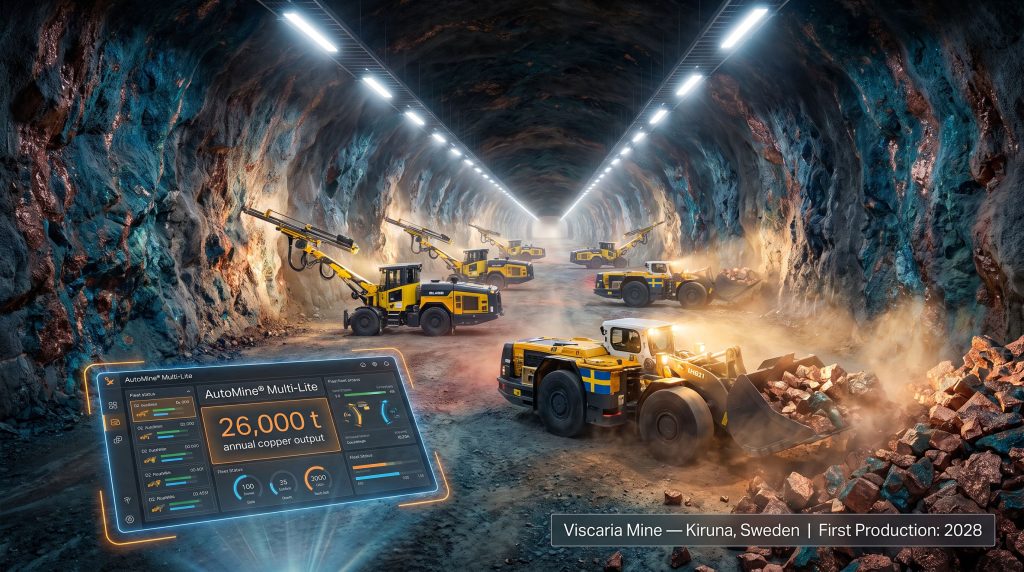
Gruvaktiebolaget Viscaria acquired the project in 2019 and has since advanced through environmental permitting, feasibility work, and partnership development. At full annual output capacity of 26,000 tonnes of copper, Viscaria is projected to become Sweden's second-largest copper producer, a figure that contextualises the project's genuine industrial significance. In addition, European critical raw materials supply policy has created a supportive regulatory environment for exactly this kind of domestic reactivation.
The Sandvik Automated Fleet for Viscaria Mine Reopening: Equipment, Technology, and Scope
The selection of Sandvik to supply the underground production fleet and lifecycle services represents one of the more consequential procurement decisions in European mining this decade. The agreement covers both hardware and the operational infrastructure required to run it effectively.
The Full Equipment Package
| Equipment Type | Model | Quantity | Primary Function |
|---|---|---|---|
| Longhole Drill Rigs | Sandvik DL432i | 4 units | Underground production drilling |
| Underground Loaders | Toro® LH621i | 4 units | Ore loading and haulage |
| Automation Platform | AutoMine® Multi-Lite | Unified system | Fleet-wide autonomous coordination |
| Rock Tools | Various | Included | Consumable drilling support |
| Service Contract | Full lifecycle | Site-specific | Dedicated on-site service organisation |
The i-series designation across both machine types is significant. These are not retrofitted conventional machines with automation added as an afterthought. They are purpose-engineered for sensor integration, data telemetry, and remote operation from the point of manufacture.
This distinction matters operationally because retrofit automation systems often introduce reliability gaps at the mechanical-digital interface. Factory-integrated automation removes that vulnerability. Consequently, the underground copper mining technology deployed at Viscaria reflects some of the most advanced thinking currently available in the sector.
The order was formally booked in Q3 2026, with deliveries scheduled to commence in January 2027 and continue through to August 2027. First copper concentrate production is targeted by the end of 2027 or early 2028, with full-scale production ramp-up anticipated by 2029.
How AutoMine® Multi-Lite Actually Works
AutoMine® Multi-Lite is Sandvik's underground fleet automation platform that enables operators to manage multiple drill rigs and loaders simultaneously from a single, centrally connected interface, reducing manual exposure in hazardous zones and optimising production cycle efficiency across the entire working fleet.
The platform's defining capability is cross-machine-type unification. Many automation systems in underground mining operate within a single equipment class, meaning loaders are automated separately from drills, creating coordination friction and requiring operators to switch between interfaces. AutoMine® Multi-Lite resolves this by integrating both machine types under one control architecture.
Practically, this means:
- Automated tramming moves loaders along defined underground routes without continuous operator input
- Obstacle detection systems halt machines when unexpected obstructions enter the operating envelope
- Remote operation capability allows control from any connected node within the mine network, not just a surface control room
- Cycle time consistency improves because automated machines maintain optimal operating parameters without fatigue-related variation
- Shift change continuity is preserved because machines can remain operational during personnel transitions, blasting re-entry windows, and other human-driven interruptions
In conventional underground operations, these interruptions can consume 15 to 25 percent of available production time. Eliminating or reducing them has a compounding effect on throughput that straightforward equipment capacity figures alone do not capture. Epiroc's experience managing automated underground fleets from surface reinforces this point, demonstrating measurable gains in operational continuity across comparable deployments.
The Long-Cycle Partnership Model and Why It Matters
One of the less-discussed dimensions of the Viscaria-Sandvik arrangement is its timeline. Sandvik's collaboration with the Viscaria development team began in 2020, approximately six years before the formal equipment order was confirmed. This is not incidental. It reflects a deliberate procurement philosophy that is becoming a distinguishing feature of well-executed mining project development.
In transactional procurement models, equipment suppliers are engaged late in the development cycle, often after mine design has been substantially finalised. This creates a mismatch between infrastructure decisions and equipment capabilities, forcing compromises on tunnel dimensions, ventilation layouts, charging infrastructure, and maintenance bay specifications.
By contrast, early OEM engagement allows mine design to be optimised around the specific equipment that will operate within it. Ramp gradients, tunnel cross-sections, turning radii, and power supply architecture can all be calibrated to the chosen fleet, reducing ramp-up friction when production begins. For an asset like Viscaria, where the underground workings are being redeveloped after decades of disuse, this alignment between design intent and operational reality is particularly valuable.
Sandvik's commitment to establishing a dedicated on-site service organisation at Viscaria further extends this partnership logic into the operational phase. Rather than relying on regional service teams dispatched reactively, a resident maintenance organisation can perform predictive interventions based on real-time machine health data, reducing unplanned downtime and extending component service life.
Automation Economics: Rewriting the Cost Structure of Underground Copper Mining
The economic case for deploying the Sandvik automated fleet for Viscaria mine reopening extends well beyond productivity metrics. In high-cost labour markets like northern Sweden, automation reshapes the fundamental cost architecture of underground operations. The broader shift in mining automation trends confirms this pattern across multiple jurisdictions globally.
Consider the operational levers at play:
- Labour intensity reduction: Fewer operators are required per tonne of ore moved when machines operate autonomously during shift changes and re-entry delays
- Safety incident cost reduction: Fewer personnel in active production zones reduces both the frequency and severity of underground incidents, which carry direct financial costs beyond human consequences
- Maintenance cost predictability: Lifecycle service contracts convert variable, reactive maintenance expenditure into structured, forecastable operational costs
- Financing profile improvement: Automated mines with demonstrated operational continuity and lower cost variability are increasingly viewed as lower-risk credit propositions by institutional lenders
The total cost of ownership calculation for automation-ready equipment involves a higher upfront capital commitment than conventional alternatives. However, when assessed across a mine life of ten to twenty years, the operational savings and productivity gains consistently favour automated configurations, particularly in geographies where workforce logistics, housing, and regulatory compliance add structural cost layers that automation circumvents.
Sweden as a Critical Minerals Jurisdiction: Infrastructure, Stability, and Scale
The Viscaria reopening does not occur in a vacuum. It emerges from a jurisdiction that consistently ranks among the top tier globally for mining regulatory stability, environmental governance, and infrastructure maturity. Northern Sweden benefits from established heavy freight rail corridors, port access through the Gulf of Bothnia, and a power grid with substantial renewable generation capacity, all prerequisites for cost-competitive copper production.
The Kiruna region specifically has become a proving ground for autonomous mining technology at industrial scale. Sandvik's work automating the fleet at Codelco's El Teniente mine demonstrates how this technology performs under demanding real-world conditions, providing a meaningful reference point for what Viscaria can achieve. The concentration of large-scale operations in the Kiruna area has created a local ecosystem of technical expertise, logistics networks, and regulatory familiarity that reduces development risk for new or reactivated projects.
Comparing AutoMine® Multi-Lite Against Industry Benchmarks
| Capability | AutoMine® Multi-Lite | Typical Industry Baseline |
|---|---|---|
| Multi-machine type integration | Drills and loaders unified | Often single machine class |
| Remote operation flexibility | Full remote from connected location | System-dependent |
| Obstacle detection | Factory-integrated | Varies by OEM |
| Lifecycle service bundling | Included in contract | Typically procured separately |
| Scalability | Modular fleet expansion | Often fixed configurations |
This comparison illustrates why unified platform control across different machine types represents a genuine technical differentiator rather than a marketing distinction. The operational complexity of managing separate automation systems for drilling and loading, with different interfaces, different data streams, and different service requirements, creates coordination overhead that integrated platforms eliminate.
The next major ASX story will hit our subscribers first
Frequently Asked Questions: Sandvik Automated Fleet and the Viscaria Mine Reopening
When is Viscaria expected to begin producing copper?
Copper concentrate production is targeted to commence by late 2027 or early 2028, with full-scale output of 26,000 tonnes annually anticipated by 2029.
What specific equipment is Sandvik delivering to Viscaria?
The package includes four DL432i longhole drill rigs, four Toro® LH621i underground loaders, fleet-wide integration under the AutoMine® Multi-Lite platform, rock tools, and a comprehensive lifecycle service agreement supported by a dedicated on-site team.
How long has Sandvik been working with the Viscaria project?
Sandvik's involvement with the Viscaria development team dates back to 2020, predating the formal equipment order by approximately six years.
Why was the mine closed for so long?
Viscaria ceased operations in 1997 following a sustained decline in global copper prices that made extraction commercially unviable at the time. The resource itself was never depleted. The structural rise in copper demand driven by electrification has since restored the project's commercial foundation.
What makes AutoMine® Multi-Lite different from other underground automation systems?
Its primary differentiator is the ability to coordinate multiple machine types simultaneously from a single interface, covering both drill rigs and loaders within one unified control architecture, rather than requiring separate platforms for different equipment classes.
Key Signals for the Broader Mining Industry
The Viscaria project, and specifically the deployment of the Sandvik automated fleet for Viscaria mine reopening, carries implications that extend beyond a single copper deposit in northern Sweden. For those evaluating exposure to this sector, understanding copper investment opportunities in the context of projects like this provides a more grounded basis for decision-making.
- Long-cycle OEM partnerships that begin during pre-feasibility stages are becoming a structural advantage in capital-intensive underground projects, not a premium option
- Automation is transitioning from differentiator to prerequisite in high-cost labour markets, where the economics of conventional underground mining are increasingly difficult to defend
- Lifecycle service integration is redefining procurement strategy, with bundled maintenance contracts replacing transactional parts-and-labour models as the preferred risk management tool
- Dormant European mineral assets represent an underappreciated inventory of potential production capacity that modern technology and elevated commodity demand are systematically making viable again
- Northern Sweden's Kiruna corridor is consolidating its position as one of the world's most technologically advanced underground mining districts
The reopening of Viscaria is ultimately a case study in how favourable long-term demand signals, combined with purpose-built automation technology and disciplined early-stage partnership development, can unlock mineral value that market conditions once made inaccessible. For project developers, equipment suppliers, and investors monitoring European copper supply, the trajectory of this project will serve as a closely watched benchmark.
This article contains forward-looking statements and projections regarding production timelines, output capacity, and market conditions. These are subject to change based on operational, regulatory, financial, and commodity market factors. Readers should conduct independent research before making investment or commercial decisions based on information contained herein.
Want to Track the Next Major Copper Discovery Before the Market Moves?
Discovery Alert's proprietary Discovery IQ model delivers real-time alerts on significant ASX mineral discoveries, instantly transforming complex mineral data into actionable insights for investors at every level — explore historic discoveries and the substantial returns they've generated, then begin your 14-day free trial at Discovery Alert to position yourself ahead of the next major find.