August 5, 2026
Porphyry Copper and the Scale Problem: Why Size Alone Doesn't Tell the Full Story
In the world of large-scale copper development, tonnage figures travel fast and context travels slowly. Investors scanning headlines for the next major undeveloped copper district can easily conflate resource classification categories, mistake historic estimates for bankable reserves, and misread a geological opportunity as a de-risked project. The Lion Copper Yerington Bear deposit resource estimate, now formally published and NI 43-101 compliant, changes the conversation around the Yerington Copper District in Nevada in ways that deserve careful unpacking.
This is not simply a story about big numbers. It is a story about how a deposit transitions from legacy data to independently verified inventory, and what that transition means for a project's standing in a field increasingly defined by sovereign risk, processing innovation, and the structural growth in copper demand. Furthermore, understanding the broader copper market trends helps contextualise why this transition matters now more than ever.
When big ASX news breaks, our subscribers know first
What the Bear Deposit Resource Estimate Actually Confirms
The Bear deposit, situated within Lion Copper & Gold's (CSE: LEO; US-OTC: LCGMF) Yerington project approximately 34 km west of Carson City, Nevada, has now received its first compliant Mineral Resource Estimate. The result is substantial by any measure.
The estimate defines:
- Approximately 1 billion indicated tonnes grading 0.29% copper, containing roughly 6.7 billion lb of copper
- Approximately 1.7 billion inferred tonnes grading 0.22% copper, containing roughly 8.7 billion lb of copper
Critical context for investors: The distinction between Indicated and Inferred resources is not merely technical. Indicated resources, supported by sufficient drill data density to establish geological continuity with reasonable confidence, carry materially more weight in economic studies than Inferred resources, which reflect geological interpolation across wider-spaced data. The 1 billion indicated tonne figure at Bear represents a meaningful upgrade in confidence compared to what the historical Anaconda-era data could support.
For years, Bear's copper inventory was referenced through a non-compliant historic estimate originating from Anaconda-era exploration work, which suggested approximately 735 million tonnes at 0.44% total copper for around 6.5 billion lb of contained metal. That figure, generated under pre-modern reporting frameworks, could not be used in bankable feasibility studies or treated as equivalent to a compliant resource. The newly published NI 43-101 estimate supersedes those figures entirely, while also expanding the known scope of the system.
Why the Grade Difference Between Historic and Compliant Estimates Matters
One detail that tends to get lost in headline comparisons is the grade differential between the historic Anaconda estimate and the new compliant resource. The historic estimate cited 0.44% total copper, while the compliant estimate reports 0.29% copper for indicated tonnes and 0.22% for inferred. This is not necessarily a sign that the deposit is weaker than previously thought. Several factors drive this kind of grade difference:
- Methodological differences: Historic estimates often applied simpler interpolation methods that could over-smooth grade distributions
- Domain boundary changes: A compliant estimate defines geological domains more rigorously, which can alter how high-grade and low-grade zones are weighted
- Data validation: Legacy assay data may require downgrading or exclusion after quality control review
- Cut-off grade application: Modern estimates apply economic cut-off grades calibrated to current processing costs; understanding cut-off grade economics is therefore essential when evaluating how marginal material is included or excluded
Despite the lower reported grade in the compliant estimate, the sheer increase in tonnage from 735 million to nearly 2.7 billion tonnes combined means the total contained copper inventory has grown significantly compared to the Anaconda-era figure.
Nevada's Copper Landscape: Where Yerington Now Stands
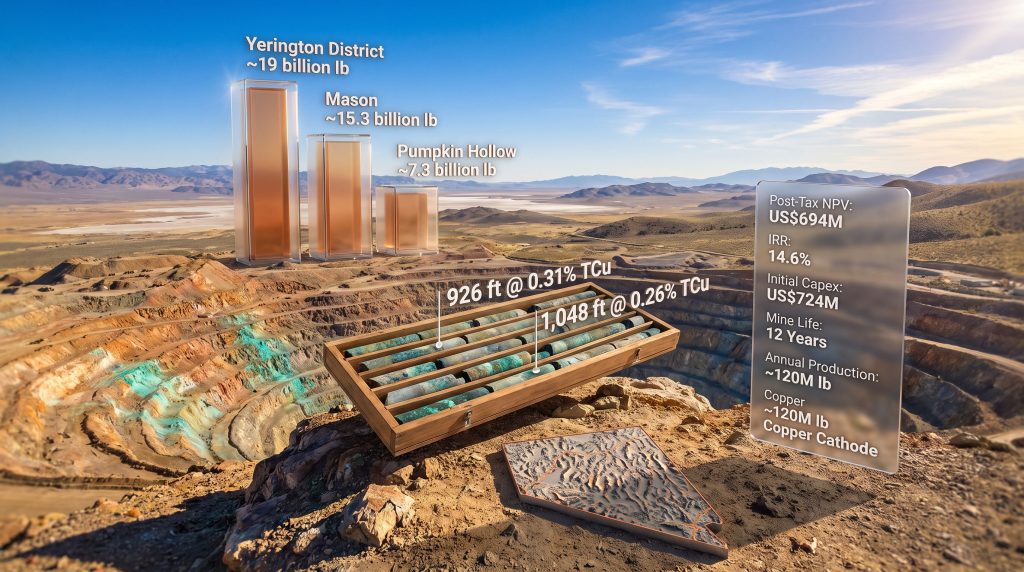
With the Bear resource now formally established, Lion Copper's combined Nevada copper inventory has expanded considerably. When aggregated with the Yerington deposit's proven and probable reserves outlined in the August 2025 pre-feasibility study, the total global contained copper across the Yerington district reaches approximately 19 billion lb.
| Project | Operator | Approx. Global Contained Copper | Resource Standard |
|---|---|---|---|
| Yerington (incl. Bear + MacArthur) | Lion Copper & Gold | ~19 billion lb | Mixed (NI 43-101 PFS reserves + new Bear MRE) |
| Mason | Hudbay Minerals (TSX, NYSE: HBM) | ~15.3 billion lb | NI 43-101 |
| Pumpkin Hollow | Southwest Critical Materials | ~7.3 billion lb | NI 43-101 |
Analytical note: These figures blend resource classification categories across projects and should not be treated as directly equivalent for comparative purposes. Hudbay's Mason project inventory is derived from a different mix of Measured, Indicated, and Inferred resources than Yerington's combined dataset, which now incorporates a fresh Bear MRE alongside PFS-level reserves for the Yerington and MacArthur deposits.
The Yerington Deposit's Pre-Feasibility Baseline
Separate from Bear, the Yerington deposit itself has a completed pre-feasibility study. That study's key metrics provide the economic foundation against which Bear's future contribution will eventually be assessed. The feasibility study pathway from preliminary assessment through to a bankable document is a rigorous process that significantly de-risks a project in the eyes of investors and financiers.
| PFS Metric | Value |
|---|---|
| Proven and Probable Reserves | 506.6 million tons at 0.21% copper |
| Contained Copper (Reserves) | 2.1 billion lb |
| Annual Copper Cathode Production | ~120 million lb |
| Mine Life | 12 years |
| Post-Tax NPV (7% discount rate) | US$694 million |
| Internal Rate of Return | 14.6% |
| Initial Capital Cost | US$724 million |
The 14.6% IRR sits at a level where project economics are functional but not insulated from copper price volatility. A sustained copper price decline below US$3.50 per lb would compress the return profile meaningfully. Importantly, these PFS metrics reflect only the Yerington and MacArthur deposits. Bear's contribution to mine life extension, production rate, and NPV has not yet been incorporated into any formal economic study.
Rio Tinto's Nuton and the Processing Technology Dimension
The involvement of Rio Tinto (NYSE, LSE, ASX: RIO) through its Nuton subsidiary introduces a dimension that goes beyond financial participation. Nuton holds an option to earn a 65% interest in a new company holding both the Yerington and Bear deposits through a staged earn-in agreement.
What distinguishes Nuton's role is its proprietary heap-leach copper recovery technology, which has been under active testing at Yerington since 2022. The technology is specifically engineered to extract copper from oxide and transitional mineralisation more efficiently than conventional solvent extraction and electrowinning (SX-EW) circuits.
The commercial deployment of Nuton's technology at Gunnison Copper's (TSX: GCU; US-OTC: GCUMF) Johnson Camp mine in Arizona provides a real-world reference point for what the technology can deliver in a geologically analogous setting. Arizona and Nevada share broadly similar porphyry copper geology, and heap-leach technology performance in arid, basin-and-range environments is relatively well understood.
Why Heap-Leach Technology Matters for a Deposit Like Bear
Porphyry copper systems at the scale of Bear typically carry grades that place them at or near the margin of conventional flotation-based milling economics. The grade profile at Bear, averaging 0.29% copper for indicated resources, sits in a zone where processing cost per tonne becomes a defining variable for project viability.
Heap-leach processing generally carries lower capital and operating costs per tonne processed compared to concentrator-based flowsheets, making it particularly well-suited to bulk-tonnage, lower-grade oxide systems. If Nuton's proprietary technology can improve recovery rates beyond what standard acid heap-leach achieves, the economic threshold for processing marginal ore zones at Bear could shift in the project's favour.
This technology angle is frequently underappreciated in standard financial analyses of the Yerington district, which tend to anchor on the PFS numbers without modelling the potential upside from recovery improvements.
Understanding the Resource Classification Journey: From Drilling to Compliant Estimate
For investors less familiar with how copper deposits move through the resource definition pipeline, the Bear deposit's journey from legacy data to NI 43-101 compliant resource illustrates a standard but technically demanding process. In addition, interpreting drill results correctly is a critical skill for any investor following this type of project:
- Legacy data compilation and validation – Historical drill logs, assay certificates, and survey records from Anaconda-era exploration must be digitised, quality-controlled, and assessed for usability
- Verification drilling – Modern twin holes drilled adjacent to legacy holes confirm whether historic assay values are reproducible under current laboratory standards
- Geological domain modelling – A three-dimensional model defining mineralisation envelopes, lithological contacts, and structural controls is built using modern software
- Variography and geostatistical analysis – Spatial continuity of copper grades is measured in multiple directions to inform interpolation parameters
- Grade estimation – Kriging or other interpolation methods populate a block model with estimated copper grades within defined domains
- Cut-off grade determination – An economic cut-off grade is applied based on assumed processing costs, metal prices, and recoveries to define the resource boundary
- Resource classification – Blocks are assigned Inferred, Indicated, or Measured status based on drill hole spacing and geological confidence thresholds
- Independent Qualified Person certification – A QP as defined under NI 43-101 reviews and signs off the estimate before it can be publicly disclosed
The transition of Bear from a non-compliant historic reference to a NI 43-101 compliant resource represents the completion of this entire sequence — a technically demanding and time-consuming process that fundamentally changes how the deposit can be used in economic studies and project financing discussions.
Key Risks That Investors Should Weigh
Technical and Geological Risks
- The Bear deposit remains open at depth and along strike, which carries a dual implication: resource growth potential is real, but so is the possibility that grade continuity assumptions built into the current estimate may require revision as drilling advances
- At 0.22% copper for the inferred component, grade-tonnage relationships will be sensitive to processing cost assumptions that can shift with energy prices, reagent costs, and water availability in Nevada's arid environment
- The current MRE does not yet form the basis of an economic study, meaning the path from compliant resource to preliminary economic assessment to pre-feasibility to feasibility remains a multi-year, capital-intensive process
Financial and Market Risks
- Lion Copper's market capitalisation fell to approximately C$94.9 million at C$0.22 per share following the Bear resource release, a 24% single-day decline. The share price traded in a 12-month range of C$0.12 to C$0.47, reflecting the inherent volatility of junior copper developers
- The gap between the project's stated NPV of US$694 million and Lion Copper's market capitalisation illustrates both the market's execution risk discount and the reality that the PFS economics have not yet been validated at the feasibility level
- The Nuton earn-in structure means Lion Copper would retain only 35% of the project if the earn-in is completed, limiting its proportional share of any future cash flows despite holding the underlying land package
Water and Permitting Considerations
Nevada's basin-and-range geology creates specific water management challenges for heap-leach operations. Acid consumption and water recycling in arid environments require careful engineering, and water rights acquisition in Nevada's prior appropriation system can represent a material permitting risk for large-scale hydrometallurgical projects. These factors are not unique to Yerington but apply across the state's copper development pipeline.
The next major ASX story will hit our subscribers first
What Comes Next for Bear and the Yerington District
The publication of a compliant NI 43-101 resource for the Lion Copper Yerington Bear deposit resource estimate is a genuine technical milestone, but it is also the beginning of a longer development arc rather than its conclusion. The near-term catalysts most likely to drive meaningful re-rating of Lion Copper's position include:
- Integration of Bear into an updated economic study – A preliminary economic assessment or eventually an updated PFS incorporating Bear's indicated resources could materially extend the project's modelled mine life beyond the current 12 years
- Upgrade drilling within the inferred resource – Converting a portion of the 1.7 billion inferred tonnes to indicated status through infill drilling would increase the bankable proportion of Bear's copper inventory
- Nuton technology trial results – Quantified recovery data from Nuton's heap-leach trials at Yerington, particularly for ore types present in Bear's mineralised zones, will inform the processing economics that underpin any future economic assessment
- Earn-in progression milestones – Any formal announcements from Rio Tinto's Nuton regarding its earn-in progress toward the 65% threshold would carry significant signalling value for market participants
Consequently, investors considering exposure to the Yerington district should also review broader copper investment strategies to ensure their portfolio approach accounts for the long development timelines and capital requirements that characterise projects of this scale.
Investor note: This article contains forward-looking analysis based on publicly available information. Resource estimates, economic projections, and development timelines are subject to change. Nothing in this article constitutes financial advice. Investors should conduct independent due diligence and consult a qualified financial adviser before making investment decisions related to any securities mentioned.
The Lion Copper Yerington Bear deposit resource estimate represents a substantive step in the maturation of one of Nevada's most geologically prospective copper districts. However, whether that geological potential translates into economic value at scale depends on a process of technical validation, capital formation, and processing technology performance that is still very much in progress. The latest PFS update from Lion Copper & Gold provides further detail for investors seeking to track how these milestones are progressing in real time.
Ready to Catch the Next Major Mineral Discovery Before the Market Does?
Discovery Alert's proprietary Discovery IQ model scans ASX announcements in real time, instantly converting complex mineral data — like the resource classification transitions explored in this article — into actionable investment insights for both short-term traders and long-term investors. Explore how historic discoveries have generated significant returns on Discovery Alert's dedicated discoveries page, then begin your 14-day free trial to position yourself ahead of the broader market.