August 4, 2026
The Governance Gap Between Geological Wealth and Production Reality
Few commodities illustrate the complex relationship between natural endowment and institutional capacity quite like copper. A nation can sit atop some of the world's most significant copper deposits, attract billions in foreign capital, and still fall short of production ambitions if the underlying governance architecture fails to keep pace with industrial ambition. This tension is not theoretical for Zambia. Zambia copper expansion election support is playing out in real time, with the country's 2026 electoral cycle serving as a pressure test for whether the reforms of the past four years can be consolidated into a durable, investor-grade policy environment.
Understanding what is actually at stake requires moving beyond the headline production targets and examining the structural mechanics that will determine whether Zambia's copper decade becomes a defining success or a cautionary tale about the distance between political intent and economic delivery.
When big ASX news breaks, our subscribers know first
How Copper Became Zambia's Economic Backbone and Why That Matters Now
Zambia's relationship with copper is not simply transactional. The metal is woven into the fiscal architecture of the state itself. Consider the scale of this dependency across the country's core economic indicators:
| Economic Indicator | Copper Sector Contribution |
|---|---|
| GDP Contribution | ~9% |
| Export Earnings Share | ~72% |
| Government Revenue Share | ~50% |
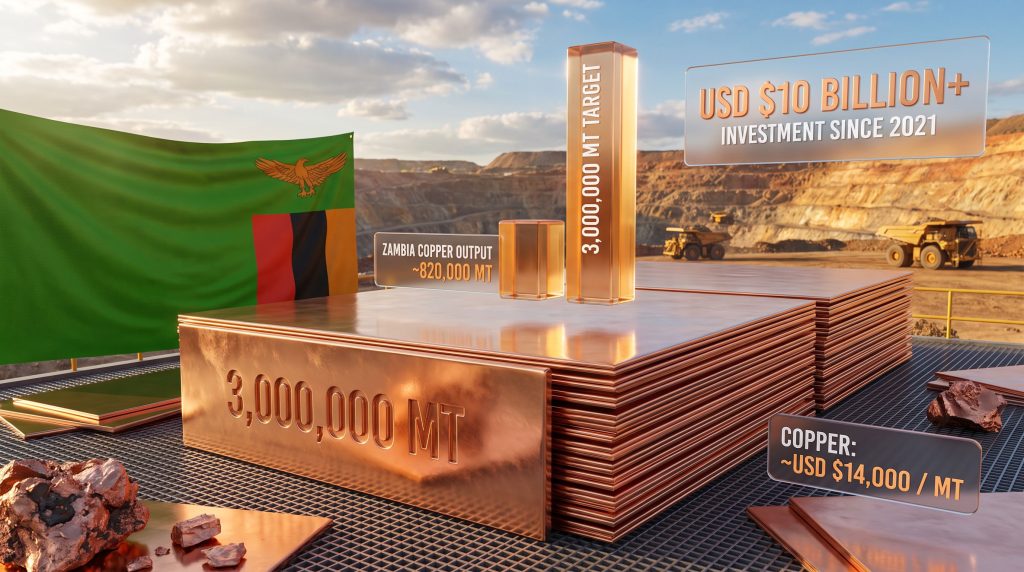
| Current Annual Output | ~820,000 to 1,000,000 metric tonnes |
| National Production Target | 3,000,000 metric tonnes |
| Investment Attracted Since 2021 | USD $10 billion+ |
These figures are not incidental. They define the fiscal ceiling on everything from infrastructure spending to social programmes. When copper revenues contract, government capacity contracts with them. When production expands, the fiscal multiplier effects ripple across the entire economy. This is why the tripling target is treated as a national development objective rather than simply a sectoral aspiration.
Zambia currently ranks as Africa's second-largest copper producer by output volume, trailing only the Democratic Republic of Congo. Closing the gap between current output of roughly 820,000 to 1 million metric tonnes annually and the 3 million tonne target would require not just incremental growth, but a structural transformation of the country's mining and infrastructure base. The Zambia copper growth forecast reinforces how significant this ambition truly is.
The Major Projects Anchoring Zambia's Expansion Pipeline
Several large-scale operations form the core of Zambia's production growth narrative, each carrying its own capital requirements, timelines, and dependencies:
- Kansanshi Mine operated by First Quantum Minerals, representing the country's flagship copper asset and currently undergoing significant capacity enhancement works
- Lumwana Mine developed by Barrick Gold as a large open-pit operation with substantial long-life reserves providing multi-decade production visibility
- Konkola Copper Mines (KCM) where Vedanta Resources has returned to one of Zambia's most historically significant underground copper assets following years of disputed ownership and operational uncertainty
- Mingomba Project being advanced by KoBold Metals, a technology-forward exploration and development company deploying artificial intelligence and geophysical analysis to accelerate resource delineation in the Copperbelt region
What these projects share is a common dependency on factors that extend well beyond their individual mine gates: reliable electricity supply, functioning transport corridors, stable regulatory frameworks, and consistent access to exploration licensing. The absence of any single element can cascade into project delays, cost overruns, or capital reallocation to competing jurisdictions.
Why Greenfield Exploration Is Falling Behind
A critical structural observation that receives insufficient attention in mainstream coverage is the decade-long underinvestment in greenfield exploration across the Zambian Copperbelt. Unlike brownfield expansions at established operations, greenfield exploration importance requires long-lead exploration expenditure with uncertain returns. When fiscal instability or regulatory unpredictability elevated the perceived risk premium of Zambian exploration in prior years, the exploration pipeline effectively stalled. The consequence is a structural catch-up challenge that cannot be resolved quickly, regardless of how much capital is available today.
What Mining Operators Are Actually Demanding From the Post-Election Government
Industry engagement ahead of the August 2026 vote has crystallised around a four-part policy agenda that operators and industry bodies view as foundational to sustaining investment momentum:
- Exploration Incentives and Licensing Reform – Greenfield exploration remains severely underfunded relative to the scale of Zambia's production ambitions. The Chamber of Mines has emphasised that licensing frameworks must be restructured to ensure exploration permits are allocated to operators with genuine technical and financial capacity to develop projects, rather than being held speculatively by entities without development intent
- Downstream Value Addition – Industry executives have consistently called for stronger fiscal incentives to develop copper refining and semi-fabrication capacity within Zambia, capturing more of the value chain domestically rather than exporting raw concentrate or blister copper
- Export Duty Rationalisation – Current levies applied to concentrate exports create a structural disadvantage for producers that lack access to domestic refining infrastructure, effectively penalising the early stages of mine development before integrated processing capacity is established
- Enforceable Dispute Resolution Mechanisms – Long-term capital deployment in frontier mining jurisdictions is fundamentally dependent on confidence that contractual obligations will be honoured and that disputes can be resolved through transparent, rule-of-law processes rather than through political negotiation
The Konkola Copper Mines situation serves as a live case study in why the fourth point carries particular weight. The prolonged ownership and operational disputes surrounding that asset consumed significant time, capital, and investor confidence, functioning as a visible deterrent to other prospective entrants. Restoring and maintaining credibility in this area is not simply a legal nicety. It is a commercial prerequisite.
"The growth of Zambia's copper sector ultimately depends on sustaining a robust greenfield exploration pipeline. Without increased spending on genuine exploration by operators with the capacity to develop what they discover, the production tripling target becomes structurally unreachable regardless of prevailing copper prices or policy ambitions."
The Four Structural Risks That Could Derail the Expansion Narrative
Even within an optimistic policy scenario, Zambia's copper expansion faces material headwinds across four distinct risk dimensions. Investors and analysts should understand each independently rather than treating them as a composite risk factor.
Power Generation: The Most Binding Constraint
Zambia's electricity system is overwhelmingly dependent on hydropower, with the Kafue Gorge and Kariba North Bank facilities generating the majority of the country's installed capacity. This creates a structural vulnerability that has proven consequential in practice. Drought conditions, which climate modelling suggests will become more frequent and severe across southern Africa, directly reduce reservoir levels and curtail generation output at precisely the moments when economic activity demands maximum power availability.
Industry estimates indicate that at least 2,000 megawatts of additional generation capacity is required to support the copper production tripling ambition. Recent investment announcements are expected to provide partial relief, but the aggregate gap remains material. Mining operations at the scale envisaged consume electricity at industrial volumes that cannot be managed through load-shedding arrangements without directly impacting ore processing throughput and unit economics.
Labour Market Dynamics
Rising mining activity creates upward pressure on wages through multiple channels simultaneously. Union representation in Zambia's copper sector is organised and politically engaged. As production volumes grow and profitability improves at elevated copper prices, labour organisations will have both the leverage and the incentive to pursue wage renegotiation.
While this is a natural feature of any expanding resource economy, cost inflation from labour agreements can compress margins at higher-cost operations, potentially affecting the economics of marginal projects within the development pipeline.
Infrastructure and Logistics Gaps
Ore and concentrate transport from mine to port is a significant cost component that is frequently underweighted in production growth narratives. Zambia is landlocked, meaning all export flows must traverse neighbouring countries, typically through Tanzania or South Africa, via a combination of road and rail networks that are themselves capacity-constrained and subject to maintenance variability. Production gains at the mine level can be partially absorbed by logistical inefficiency before the metal reaches international markets.
Fiscal Constraints From Sovereign Debt History
Zambia completed a significant sovereign debt restructuring process in recent years, emerging from a prolonged period of default that constrained access to international capital markets. While the restructuring has restored a degree of fiscal credibility, the government's capacity to co-invest in enabling infrastructure, offer competitive exploration incentives, or absorb the fiscal cost of tax concessions remains bounded by ongoing debt service obligations and multilateral conditionality requirements.
| Risk Category | Severity | Near-Term Outlook |
|---|---|---|
| Power Generation Deficit | High | Partially improving with new investment commitments |
| Labour Cost Pressures | Medium | Likely to intensify as sector activity grows |
| Infrastructure and Logistics | High | Requires sustained multi-year capital deployment |
| Fiscal and Debt Constraints | Medium-High | Dependent on continued debt restructuring progress |
Why Copper Price Dynamics Are Amplifying the Urgency of Political Stability
The commodity price environment surrounding Zambia's 2026 election is unusually constructive. Benchmark copper futures have risen by more than 40% over the preceding year, reaching approximately USD $14,000 per metric tonne, driven by a convergence of structural demand accelerators. Furthermore, the critical minerals demand driven by the global energy transition shows no signs of abating.
The energy transition is the dominant demand vector, operating through several distinct channels:
- Electric vehicles require approximately 2.5 to 4 times more copper than equivalent internal combustion engine vehicles, across motors, wiring, charging infrastructure, and battery thermal management systems
- Grid modernisation and renewable energy buildout, including solar farms, wind installations, and long-distance transmission networks, consume copper at volumes that dwarf historical benchmarks
- Energy storage systems and distributed power infrastructure add a third demand layer that was largely absent from copper demand models a decade ago
For Zambia, this demand backdrop creates a narrow but genuine window of opportunity. The combination of structurally elevated prices, deep institutional investor interest, and a political reform narrative that has regained credibility since 2021 means that capital is genuinely available for credible projects. The risk is not a shortage of interested capital. The risk is that structural constraints convert investor interest into frustration before production milestones are achieved. Understanding the copper supply crunch that underpins these dynamics is essential context for any investor watching the Zambian story.
The next major ASX story will hit our subscribers first
Political Continuity as an Investment Thesis: What Analysts Are Watching
Analysts monitoring Zambia's electoral outcome are less focused on the binary result and more attentive to the downstream policy signals that will emerge in the months following the vote. According to reporting from MarketScreener, miners are eyeing the election with specific hopes for sustained support for copper expansion, reinforcing how central the political environment is to commercial decision-making.
The reforms introduced since 2021, including revised currency regulations, updated local-content frameworks, and adjustments to fuel cost structures within the mining sector, have collectively shifted Zambia's risk-adjusted investment profile in a measurable direction. When investors can reasonably project that the tax and regulatory framework will be recognisable across a political cycle, the discount rate applied to long-dated mining projects compresses. This discount rate compression is the mechanism through which political stability translates into actual capital deployment.
"In resource-dependent economies, the mining sector does not simply respond to electoral outcomes. It prices them in advance. The degree to which capital commitments accelerate or stall in the months before and after the vote is itself a market-observable measure of institutional confidence."
Power shortages and organised labour dynamics have been identified by risk analysts as the two most immediate operational threats to Zambia's expansion trajectory, independent of which political configuration governs after August 2026. These are structural rather than political risks, meaning they persist across electoral cycles and demand solutions that operate at a longer timescale than any single government's term.
Scenario Analysis: Three Pathways for Zambia's Copper Decade
Scenario A: Accelerated Growth
Policy continuity combines with meaningful progress on power generation investment and licensing reform to create a compounding growth environment. Greenfield exploration activity increases as reformed permit allocation directs licences toward technically and financially capable operators. Zambia approaches or exceeds 2 million metric tonnes of annual output by the late 2020s, establishing a credible trajectory toward the 3 million tonne target in the early-to-mid 2030s.
Scenario B: Constrained Growth
Policy signals post-election prove ambiguous, power investment falls below the minimum threshold required for production ramp-up, and infrastructure bottlenecks absorb a disproportionate share of efficiency gains. Output growth continues but at a pace that leaves the tripling target structurally out of reach within the originally envisaged timeframe. A ceiling of approximately 2 million metric tonnes becomes the realistic medium-term plateau.
Scenario C: Structural Disruption
Labour disputes interrupt production continuity at key operations, fiscal constraints prevent the government from sustaining competitive incentive structures, and unresolved dispute-resolution mechanisms erode confidence among prospective new entrants. Capital flows redirect toward the DRC, Chile, or other copper jurisdictions offering cleaner regulatory environments, and Zambia's window of opportunity narrows materially. Analysing copper investment strategies becomes especially critical under this scenario for those seeking alternative exposure.
Frequently Asked Questions: Zambia Copper Expansion and the 2026 Election
What is Zambia's copper production target and when does it aim to achieve it?
Zambia has established a national ambition to reach 3 million metric tonnes of annual copper output, representing roughly triple current production levels. The timeline is oriented toward the early-to-mid 2030s, contingent on sustained progress across exploration, power generation, and infrastructure investment.
Why does the 2026 election matter for copper investors?
Electoral outcomes shape the policy environment governing taxation, licensing, export duties, and legal dispute resolution. Investors are watching whether the post-election framework preserves and extends the conditions that have attracted more than USD $10 billion in mining investment since 2021. As analysts have observed, policy continuity amid economic reform is the central concern driving investor sentiment ahead of the vote.
What is the most critical infrastructure challenge facing Zambia's mining expansion?
Power generation capacity is widely identified as the binding constraint. Industry estimates indicate that at least 2,000 megawatts of additional capacity is needed, with current hydropower infrastructure insufficient to meet the electricity demands of a significantly expanded mining sector.
Which major mining companies are active in Zambia's copper sector?
Key operators and developers include First Quantum Minerals at Kansanshi, Barrick Gold at Lumwana, Vedanta Resources at Konkola Copper Mines, and KoBold Metals advancing the Mingomba project, among other active participants across the Copperbelt.
How dependent is Zambia's national budget on copper revenues?
Copper-related activity contributes approximately 72% of Zambia's export earnings and accounts for close to 50% of government revenue, making the sector the dominant driver of both fiscal capacity and foreign exchange generation. This concentration creates significant macroeconomic sensitivity to both copper price movements and production volume changes.
What is the significance of greenfield exploration reform?
Greenfield exploration is the mechanism through which new mineral resources are discovered and converted into future mine development projects. Without a functioning pipeline of new discoveries, production growth becomes dependent solely on expansions at existing operations, which have physical and economic limits. Licensing reform that ensures permits are held by developers with genuine project development intent is therefore a precondition for long-term production growth, not simply a regulatory housekeeping matter.
The Copper Decade Requires More Than Political Will
Zambia's copper expansion story is ultimately a test of institutional depth. The geological endowment is real, the demand tailwinds from the global energy transition are structural, and the investment interest from major global mining operators is demonstrably present. Zambia copper expansion election support, however, is only one part of what separates the optimistic scenario from the constrained one.
What matters equally is the capacity of Zambia's governance architecture, regulatory systems, and infrastructure to convert geological wealth and available capital into consistent, bankable, and scalable production growth across a multi-decade horizon.
The 2026 election is a catalyst in that story, not a conclusion. The years that follow the vote will determine whether the reforms of the past four years were a durable institutional shift or a temporary alignment of political incentives. For investors, industry participants, and the Zambian economy alike, that distinction is the one that matters most.
Want to Track the Next Major Copper Discovery Before the Market Moves?
Discovery Alert's proprietary Discovery IQ model delivers real-time alerts on significant ASX mineral discoveries — transforming complex geological data into actionable investment insights the moment they hit the exchange. Start your 14-day free trial today and see why historic mineral discoveries have generated extraordinary returns for investors who positioned early.