August 5, 2026
The Copper Imperative Reshaping Mining's Biggest Non-Deal
Commodity markets operate on cycles measured in decades, and within those cycles, the decisions mining giants make about consolidation reveal far more about structural pressures than any single earnings report. The expiry of the Rio Tinto Glencore deal standstill this August sits precisely at one of those inflection points: legally significant, strategically ambiguous, and rich with implications for how the world's largest miners intend to navigate an increasingly copper-constrained future.
Understanding why this moment matters requires looking well beyond the headline. The standstill mechanism itself, the relative share price trajectories, the copper production gap looming beyond 2030, and the hardening stance of Australian institutional capital all converge here in ways that define the broader mining consolidation trends across the sector.
When big ASX news breaks, our subscribers know first
What the UK Takeover Standstill Mechanism Actually Does
Under UK Takeover Panel regulations, when a potential acquirer formally withdraws from merger discussions with a target company, a mandatory six-month restriction period is automatically triggered. During this window, the withdrawing party is legally barred from re-initiating contact or making a fresh approach, regardless of how market conditions evolve.
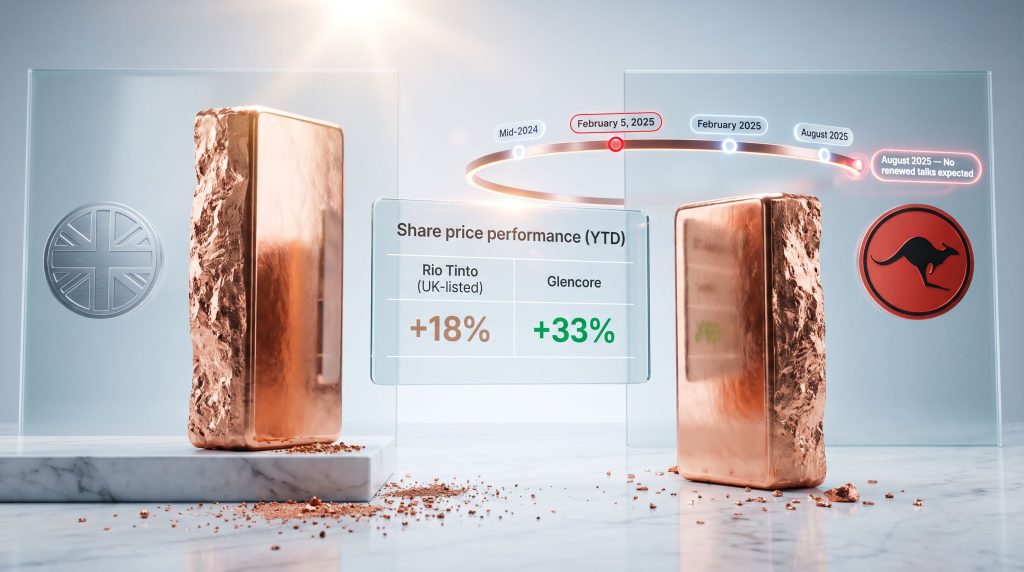
Rio Tinto formally withdrew from merger discussions with Glencore on February 5, 2025, activating that restriction immediately. The six-month clock expired in August 2025, restoring Rio Tinto's legal right to re-engage. What it did not restore, however, is any commercial rationale for doing so.
The distinction matters enormously for investors interpreting this moment. Legal freedom and strategic intent are entirely separate variables, and conflating the two misreads the current situation. According to the AFR, this marks the third time Rio Tinto and Glencore have walked away from deal discussions.
A Timeline of the Collapsed Mega-Merger Attempt
| Milestone | Date | Key Detail |
|---|---|---|
| Internal merger modelling begins | Mid-2024 | Evaluated a combined entity worth ~$200 billion |
| Rio Tinto formally withdraws | February 5, 2025 | No value case identified |
| UK standstill period commences | February 2025 | Six-month regulatory freeze begins |
| Standstill expires | August 2025 | Legal prohibition on re-approach lifted |
| Current posture | August 2025 | No renewed talks anticipated |
Why the Deal Collapsed: Three Structural Fault Lines
The proposed combination was not defeated by a single obstacle. It was undermined by three reinforcing structural problems that, taken together, made the value case impossible to construct convincingly.
Fault Line 1: Asset Valuation Disagreements
At the centre of the breakdown was a fundamental disagreement over how to value Glencore's commodity trading and marketing division. Traditional mining valuation frameworks, built around reserve volumes, production capacity, and operating cost structures, are poorly equipped to price an integrated trading operation that derives value from information asymmetry, counterparty relationships, and commodity flow management. No consensus methodology exists across the industry, which meant both parties were working from incompatible financial architectures.
Fault Line 2: Coal Exposure and the Australian Investor Veto
Glencore ranks among the world's top five coal exporters. Rio Tinto, by contrast, exited thermal coal years ago as part of a deliberate portfolio transformation designed to align with long-duration capital that prioritises decarbonisation pathways.
Australian superannuation funds and institutional investors, who represent a critical constituency for Rio's dual-listed structure, were unambiguous in their opposition. The position of Solaris Investment Management, a Brisbane-based firm holding Rio Tinto shares, captures the sentiment of the broader Australian institutional bloc: a resumption of merger talks would be interpreted as a governance failure by management, with direct consequences for the share price. This is not a soft preference. It is a hard constraint that any deal architecture would need to solve before Australian capital would re-engage. Furthermore, Australian investors have applauded the end of these discussions, reinforcing the depth of opposition.
Fault Line 3: Governance Integration Risk
Merging a Swiss commodity trading house with an Anglo-Australian mining major involves far more than combining balance sheets. The corporate cultures, incentive structures, regulatory reporting obligations, and board composition models of the two entities represent genuinely different operating philosophies. Execution risk in integrations of this complexity is systematically underpriced by markets at the announcement stage and systematically overpriced once problems emerge post-merger.
Rio Tinto's Current Strategic Architecture Under Simon Trott
CEO Simon Trott, who took the role a year ago, has constructed a three-pillar internal value creation framework that is explicitly positioned as an alternative to transformative M&A. The Rio Tinto copper expansion strategy sits at the heart of this approach.
- Portfolio rationalisation – Consolidating Rio Tinto's operations into three core business divisions, reducing complexity and overhead across the group.
- Capital discipline through divestment – Targeting more than $10 billion in asset sales, with approximately $5 billion earmarked for delivery by year-end 2025.
- Selective copper growth – Pursuing copper expansion through partnerships and bolt-on acquisitions rather than large-scale consolidation.
Trott has publicly described the preferred growth approach as partnering and pursuing bolt-on opportunities, signalling a strategic preference for surgical deal-making. He has also directly reassured Australian investors that no reason exists to revisit merger discussions with Glencore, according to multiple people familiar with those conversations.
"The strategic challenge exposed by Rio's approach to Glencore, specifically a lack of copper growth options beyond 2030, is one that cannot easily be solved through means other than M&A." – Barclays analysts, via Reuters
This observation from Barclays cuts to the core tension in Rio Tinto's current position. The simplification strategy addresses near-term operational efficiency. However, it does not address the post-2030 copper production cliff. That gap remains open.
How Share Price Divergence Has Reshaped the Deal Calculus
Even setting aside strategic and governance considerations, the mechanics of any hypothetical Rio-led approach have become materially more difficult since February 2025.
| Metric | Rio Tinto (UK-listed) | Glencore |
|---|---|---|
| Year-to-date share price performance | +18% | +33% |
| Negotiating position | Relatively weaker | Strengthened leverage |
| Implication for deal structure | More dilutive for Rio shareholders | Higher implicit premium required |
Glencore's 33% year-to-date share price appreciation means that any Rio-led approach today would require issuing significantly more shares per unit of Glencore value acquired. This dilutes existing Rio shareholders and simultaneously contradicts Trott's public rationale for walking away initially. Morningstar analyst Jon Mills has noted the Glencore share price rally directly reduces the probability of Rio returning, precisely because it would both dilute shareholders and undermine the credibility of the original decision to withdraw.
Glyn Lawcock, an analyst at Barrenjoey, has framed the current dynamic clearly: any offer that could generate genuine interest from Glencore would need to look fundamentally different from what was discussed and rejected during the original talks. That is a high bar.
Glencore's Four-Track Parallel Strategy
Rather than waiting passively for Rio Tinto to re-engage, Glencore has been running a multi-track strategic programme designed to strengthen its negotiating position and expand its optionality.
Track 1: Copper Asset Development
Glencore has been actively proving up its copper reserves and expanding production capacity. Copper is the strategic currency of any mega-merger thesis in the current environment, and a stronger copper portfolio increases Glencore's leverage in any future negotiation. The broader copper supply crunch is, in turn, elevating the strategic value of every incremental tonne of production capacity.
Track 2: Australian Investor Relations
One of the acknowledged failures of the original merger process was that Glencore significantly underestimated the depth of Australian institutional opposition. Following its half-year results, Glencore scheduled dedicated engagement sessions with Australian institutional investors, including funds that do not currently hold Glencore shares. This kind of pre-relationship building is a long-cycle activity. It signals that Glencore views Australian capital as a necessary constituency for any future transaction, not an afterthought.
Track 3: ASX Listing Consideration
A potential Sydney listing has been discussed as a structural mechanism to reduce the friction that derailed the Rio Tinto Glencore deal standstill negotiations. By creating a locally accessible equity vehicle, Glencore could deepen its Australian investor base and reduce the perception gap around coal exposure and governance history. Bankers have noted that chatter around an ASX listing has quietened recently, though this does not mean the option has been abandoned. Multiple funds have indicated they would participate in an ASX listing if Glencore proceeds.
Track 4: BHP as an Alternative Partner
People familiar with Glencore's strategic thinking have indicated that a friendly approach to BHP, under its new CEO Brandon Craig, cannot be entirely ruled out. This is a speculative scenario rather than an active discussion. Craig has been unambiguous that BHP's focus remains on organic asset growth, and major Australian institutional investors have indicated opposition to a Glencore-BHP combination on the same grounds as a Glencore-Rio combination: coal exposure and governance concerns.
BHP declined to comment on merger speculation. Rio Tinto and Glencore also declined to comment.
The next major ASX story will hit our subscribers first
What Would Actually Need to Change for Talks to Resume
Scenario planning around deal revival requires identifying which specific conditions would need to shift, and assessing their realistic probability.
| Scenario | Probability Assessment | Impact on Deal Revival |
|---|---|---|
| Significant Rio outperformance vs. Glencore | Low-Medium | Restores exchange ratio logic |
| Glencore materially divests coal assets | Low (near-term) | Removes primary Australian investor objection |
| Rio fails to deliver $10B divestment target | Medium | Increases pressure toward transformative M&A |
| Copper price surge creates urgency for scale | Medium | Elevates strategic premium on copper consolidation |
| Activist pressure on either board | Low | Could force strategic reconsideration |
| BHP-Glencore approach gains traction | Low-Medium | Changes competitive dynamics for Rio |
The most actionable of these scenarios is Rio Tinto's divestment execution. If the $10 billion programme falls short of its year-end target, Trott's internal value creation thesis loses credibility, and pressure from investors to address the post-2030 copper gap through external means will intensify.
Three Structural Truths This Episode Has Exposed
The Rio Tinto Glencore deal standstill period and its expiry are instructive not just for what they reveal about these two companies, but for what they signal about the broader mining M&A environment.
First, ESG constraints are now primary deal-design variables, not compliance footnotes. Australian superannuation capital has become a structural force in determining which transactions are executable. Coal exposure alone was sufficient to mobilise institutional opposition powerful enough to influence a $200 billion deal. Future mega-mergers in the sector will need to solve for ESG alignment at the architecture stage, not after the fact.
Second, integrated trading businesses remain systematically mispriced by conventional mining valuation frameworks. The inability to agree on Glencore's marketing division value reflects a genuine analytical gap in the market. As commodity trading becomes increasingly integrated into mining operations, this gap will become a recurring obstacle in consolidation discussions.
Third, the post-2030 copper supply cliff is accelerating consolidation logic across the sector. The electrification of transport, expansion of grid infrastructure, and growth of AI data centre power demand are all converging on copper as a critical constraint. The copper growth drivers underpinning this dynamic mean miners that cannot demonstrate credible copper growth pipelines beyond 2030 will face increasing pressure, from analysts, investors, and boards, to source that growth externally. The Rio-Glencore episode is likely the first significant preview of a broader consolidation cycle driven by copper partnerships and targeted deal-making.
Frequently Asked Questions: Rio Tinto Glencore Deal Standstill
What is the Rio Tinto Glencore standstill period?
The standstill period is a six-month regulatory restriction under UK Takeover Panel rules, triggered when Rio Tinto formally withdrew from merger discussions with Glencore on February 5, 2025. It prohibited Rio Tinto from making any new approach to Glencore during that window. The restriction expired in August 2025.
Why did Rio Tinto walk away from the Glencore deal?
Rio Tinto concluded that no compelling value case existed for the proposed merger. The key obstacles included fundamental disagreements over asset valuation methodology, concerns about Glencore's coal portfolio, difficulties in pricing Glencore's marketing and trading operations, and strong opposition from Australian institutional investors who hold significant positions in Rio Tinto's dual-listed equity.
Will Rio Tinto approach Glencore again now the standstill has ended?
Based on current investor briefings and public statements, no immediate renewal of talks is expected. CEO Simon Trott has directly reassured Australian investors that Rio Tinto has no intention of revisiting the merger, and Glencore's significantly stronger share price performance year-to-date has made a Rio-led approach more financially challenging and more dilutive to existing Rio shareholders.
What is Rio Tinto's current strategic focus?
Under Simon Trott, Rio Tinto is executing a simplification strategy centred on consolidating into three core business divisions, completing more than $10 billion in asset divestments with approximately $5 billion targeted by year-end, and pursuing copper growth through partnerships and selective bolt-on acquisitions rather than large-scale M&A.
What does Rio Tinto's copper gap beyond 2030 mean for investors?
Barclays analysts have identified a structural shortfall in Rio Tinto's copper production pipeline beyond 2030 that the Glencore merger was partly intended to address. That gap remains unresolved. Investors monitoring Rio Tinto's long-term copper strategy should watch whether the bolt-on and partnership approach generates sufficient production growth to close this gap, or whether pressure builds for a larger transaction in the medium term.
This article is for informational purposes only and does not constitute financial advice or a solicitation to trade in any securities or commodities. Forecasts, scenario assessments, and strategic interpretations reflect publicly available information and analyst commentary as of August 2025. Readers should conduct their own due diligence before making any investment decisions.
Want to Track the Next Major Copper Discovery Before the Market Moves?
Discovery Alert's proprietary Discovery IQ model scans ASX announcements in real time, instantly identifying significant mineral discoveries — including copper — and converting complex geological data into clear, actionable investment insights for traders and long-term investors alike. Explore historic examples of major discovery returns to understand the scale of opportunity, and begin your 14-day free trial today to position yourself ahead of the broader market.