
June 16, 2026
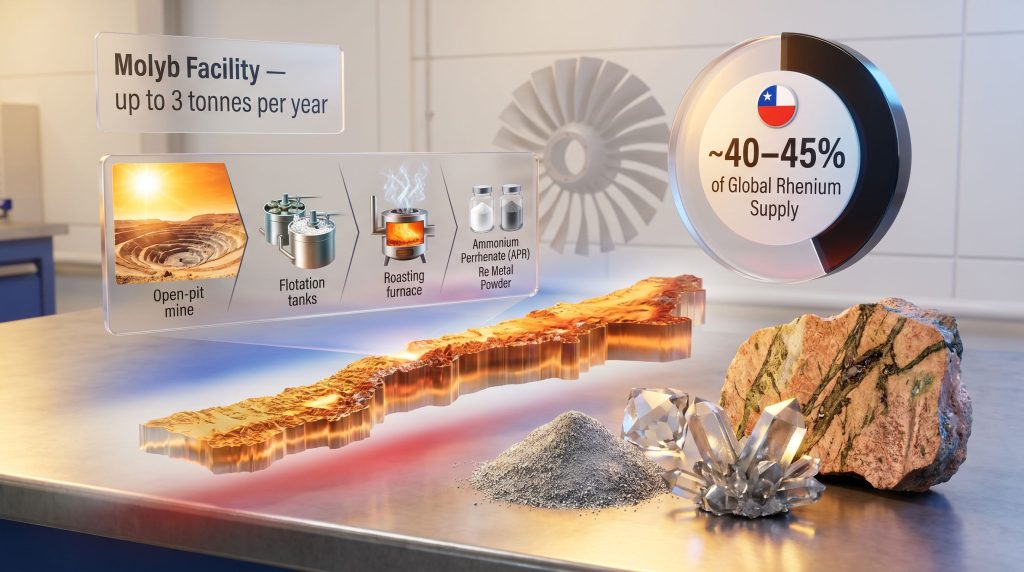
The Invisible Metal Holding the Aerospace Industry Together
Somewhere between the fiery combustion chambers of a modern jet engine and the gleaming output of a Chilean copper smelter lies one of the most consequential metals most people have never considered. It has no dedicated mines. It cannot be drilled for directly. Its price cannot stimulate new supply in any conventional sense. Yet without it, the turbine blades powering commercial aviation would fail under their own operating temperatures, and the catalysts refining petroleum into usable fuel products would degrade far faster than refineries can tolerate.
Rhenium occupies a uniquely precarious position in the global critical minerals landscape, and understanding the Codelco rhenium potential in Chile requires starting not with the metal itself, but with the industrial architecture that makes its production possible at all.
When big ASX news breaks, our subscribers know first
Why Rhenium Falls Through the Cracks of Critical Mineral Policy
Most critical mineral frameworks are built around metals that can, in theory, be mined more aggressively in response to demand. Lithium, cobalt, nickel, and rare earth elements all share the characteristic that new mine development is at least a theoretically viable supply response. Rhenium does not fit this model.
It is among the rarest stable elements in the Earth's crust, with an average crustal abundance measured in parts per billion. No economically mineable primary rhenium deposit has ever been identified or brought into production anywhere in the world. Every gram of rhenium ever sold commercially has arrived as a byproduct, captured at the tail end of copper and molybdenum processing operations.
This structural invisibility creates a paradox for policymakers. Rhenium is simultaneously:
- Functionally irreplaceable in aerospace superalloy manufacturing
- Incapable of responding to price signals with new primary supply
- Absent from most national critical mineral registers despite its strategic role
- Controlled almost entirely by a handful of copper-producing nations
The metal's melting point of approximately 3,180 degrees Celsius is the second highest of any element, surpassed only by tungsten. This thermal performance characteristic is not an academic curiosity. It is the precise reason rhenium-bearing nickel superalloys can survive the extreme thermal gradients inside single-crystal turbine blades, where temperatures regularly exceed the melting point of most structural metals.
Rhenium's combination of high-temperature strength, creep resistance, and compatibility with nickel-based superalloy matrices has made it the material of choice for turbine blade manufacturers for decades, with no cost-competitive substitute currently in commercial use.
How Rhenium Actually Gets Made: The Three-Stage Byproduct Cascade
The production pathway for rhenium is unlike that of any other commercially significant metal. Understanding it is essential for correctly interpreting both supply constraints and growth scenarios. Furthermore, the copper processing methods employed at major facilities have a direct bearing on how efficiently rhenium can be captured at each stage.
The sequence unfolds as follows:
- Porphyry copper ore is mined, crushed, and processed through froth flotation, which separates copper-bearing concentrate from a molybdenum-bearing fraction.
- Molybdenum concentrate is collected and transported to a dedicated roasting facility, where it is heated at high temperatures to oxidise molybdenum sulfide into marketable molybdenum oxide.
- During roasting, rhenium present in the molybdenum sulfide matrix volatilises as rhenium heptoxide (Re₂O₇) and enters the facility's flue gas stream.
- Scrubber systems capture rhenium-bearing gases and process them into ammonium perrhenate (APR), the primary commercial form of refined rhenium, or further reduce them to rhenium metal powder.
The concentration challenge at every stage is formidable. Rhenium content in molybdenite typically ranges from a few hundred to a few thousand parts per million within the molybdenite crystal structure itself, but the molybdenite represents only a small fraction of the total ore volume. The cumulative dilution means that rhenium recovery requires processing enormous quantities of ore before meaningful output volumes are achieved.
This multi-stage dependency creates a critical market asymmetry that investors and procurement professionals often underestimate.
| Production Driver | Impact on Rhenium Output |
|---|---|
| Rising copper mine throughput | Indirect positive, more molybdenum concentrate flows |
| Higher molybdenum flotation recovery | Direct positive, more rhenium available per tonne |
| Copper price downturns | Indirect negative, curtailments reduce the entire chain |
| Roasting facility capacity constraints | Hard ceiling on rhenium output regardless of ore grade |
| Scrubber efficiency improvements | Direct positive, higher capture rates from existing flue gas |
Chile's Geological Foundation for Rhenium Dominance
Chile's position as the world's largest copper producer, consistently generating between 5.5 and 5.7 million tonnes of copper annually, is well understood by commodity markets. What is less appreciated is how directly that copper leadership translates into rhenium supply dominance. The Chile copper price outlook consequently has significant knock-on implications for rhenium supply volumes.
Chile's northern and central mining regions contain some of the world's largest and highest-grade porphyry copper-molybdenum systems. These deposits, formed by ancient magmatic intrusions, are characterised by the simultaneous occurrence of copper sulfides and molybdenite mineralisation, a geological pairing that is particularly common in the Andean volcanic arc.
The result is that Chile generates a disproportionately large share of global molybdenum co-production relative to other copper-producing nations, and that molybdenum concentrate, when roasted, yields rhenium at a scale no other country can currently match. In addition, Chile's critical minerals ambition has brought renewed policy focus to securing value from these byproduct streams.
| Country | Estimated Annual Rhenium Output | Primary Production Source |
|---|---|---|
| Chile | ~40-45% of global supply | Copper-molybdenum porphyry belt |
| United States | ~15-20% | Primary molybdenum operations |
| Poland | ~10-12% | Copper smelting byproduct streams |
| Kazakhstan | ~8-10% | Copper smelting operations |
| Other producers | Remainder | Various copper and molybdenum sources |
Chile's rhenium leadership is therefore not a policy outcome. It is a geological reality, reinforced by the extraordinary scale of its copper industry.
Codelco's Rhenium Infrastructure: The Molyb Facility Examined
Codelco, the Chilean state copper company and the world's top copper producer by reserve base, sits at the centre of Chile's rhenium production story. Its rhenium output is not the product of a dedicated rhenium strategy but rather the logical commercial extension of its molybdenum processing infrastructure.
The Molyb processing facility represents Codelco's most direct mechanism for rhenium recovery. Designed primarily to consolidate and refine molybdenum concentrates generated across multiple Codelco mining divisions, the facility also captures rhenium from flue gases produced during the molybdenum roasting process. Sulfuric acid is a third product stream from the same operation.
The divisions feeding concentrate into this centralised system include some of the most significant copper operations on Earth:
- Chuquicamata, one of the world's largest open-pit copper mines, which generates substantial molybdenum co-product volumes given the deposit's porphyry geological character.
- El Teniente, the world's largest underground copper mine by ore reserves, historically a meaningful molybdenum contributor.
- Andina, a high-altitude porphyry operation whose ore characteristics include molybdenum-bearing mineralisation suited to byproduct recovery.
The Molyb facility has a reported rhenium production capacity of up to 3 tonnes per year, with commercial rhenium output from this operation established from approximately 2016. Against a global rhenium market that produces roughly 50 to 60 tonnes annually across all sources, Codelco's contribution represents a meaningful but not dominant share of total supply.
A critical structural reality governs Codelco's rhenium trajectory: output is determined by copper mine plans and molybdenum processing throughput, not by any standalone rhenium investment decision. This means rhenium production at Codelco is incremental by nature, not transformational.
Demand Fundamentals: Who Actually Needs Chilean Rhenium?
The demand side of the rhenium equation is heavily concentrated in a single industry sector, which creates unusual supply chain risk dynamics for downstream buyers. However, the broader landscape of hydrogen-based metal processing and advanced industrial metallurgy is expanding the range of refractory metals attracting strategic attention.
Aerospace superalloys account for an estimated 70 to 80 percent of global rhenium demand. Second and third generation single-crystal turbine blades used in jet engines and industrial gas turbines contain between 3 and 6 percent rhenium by weight in their nickel superalloy matrices. The physics driving this requirement are non-negotiable: turbine inlet temperatures in modern high-bypass turbofan engines now regularly exceed 1,700 degrees Celsius, well beyond the capability of rhenium-free alloy systems to sustain over the required service life.
Petrochemical catalysts represent the second major demand category. Platinum-rhenium bimetallic catalysts are used in catalytic reforming units at petroleum refineries to upgrade naphtha fractions into higher-octane gasoline blending components. Rhenium improves catalyst selectivity and dramatically extends operational life between regeneration cycles, making it economically indispensable even as refinery operators seek to optimise catalyst costs.
Emerging demand sectors include:
- High-temperature refractory coatings for hypersonic vehicle and re-entry vehicle applications in defence programmes
- Specialised electrical contact materials and thermocouple components requiring extreme-temperature performance
- Speculative interest from advanced fission reactor designs that require refractory structural materials in high-neutron-flux environments
- Potential semiconductor manufacturing applications as device geometries continue shrinking toward atomically thin layers
Furthermore, global rhenium supply stability remains closely watched by aerospace procurement teams, particularly as engine revert volumes from recycled superalloys increase as a supplementary source.
The next major ASX story will hit our subscribers first
Scenario Analysis: Three Pathways for Codelco Rhenium Output
Accurately framing the Codelco rhenium potential in Chile requires thinking in scenarios rather than projections, given the structural dependency on copper and molybdenum throughput. Codelco's copper strategy in the context of evolving global trade conditions will consequently shape the rhenium output trajectory in ways that are difficult to forecast with precision.
| Scenario | Rhenium Output Direction | Key Dependency | Likely Market Price Impact |
|---|---|---|---|
| Base Case: steady-state recovery | Stable at approximately 3t/yr | Existing mine plans and Molyb capacity | Neutral |
| Upside Case: throughput growth | Moderate increase, potentially toward 5-6t/yr | Higher molybdenum concentrate volumes and improved scrubber efficiency | Modest downward pressure on APR pricing |
| Constraint Scenario: copper downturn | Meaningful decline | Copper price weakness triggering mine curtailments | Significant upward price pressure from supply tightening |
The constraint scenario deserves particular attention because it reveals an uncomfortable paradox for downstream industries. When copper prices weaken significantly, Codelco and peer producers reduce throughput at higher-cost operations. Molybdenum concentrate volumes fall in parallel. Rhenium output contracts. But aerospace demand for turbine blade alloys is largely inelastic to rhenium price, because rhenium content in a finished jet engine represents a small fraction of total manufacturing cost. The result historically has been sharp rhenium price spikes during periods of copper market stress, precisely when producers are least able to respond with additional supply.
Chile's Strategic Opportunity: Moving Beyond Raw Material Export
Is There a Viable Case for Downstream Rhenium Refining?
The economic case for Chile to develop greater downstream rhenium processing capability is compelling when the value differential between product forms is considered. Molybdenum oxide, the primary output of concentrate roasting, commands a relatively modest price per tonne. Ammonium perrhenate (APR), the refined rhenium product sold directly to superalloy manufacturers, commands prices measured in thousands of dollars per kilogram.
Rhenium metal powder, used in the most demanding aerospace applications, commands a further premium. Chile's ability to capture more of this value chain depends on investment in additional refining infrastructure and, critically, on securing long-term commercial relationships with aerospace and defence supply chain partners who have strong incentives to diversify their rhenium procurement away from geopolitically concentrated sources.
Chile's relative geopolitical stability, compared with other rhenium-producing nations including Kazakhstan and certain Eastern European copper processors, represents a tangible supply chain security argument that major aerospace original equipment manufacturers are increasingly willing to pay a premium to access.
Frequently Asked Questions
Does Codelco extract rhenium as a primary product?
No. Rhenium is not targeted or mined directly at any Codelco operation. It is recovered entirely as a multi-stage byproduct, captured from flue gases generated during the roasting of molybdenum concentrates that are themselves a byproduct of copper ore processing.
What is Codelco's current rhenium production capacity?
The Molyb processing facility has a reported rhenium production capacity of up to 3 tonnes per year. Commercial rhenium production at this facility has been operational since approximately 2016.
Why does Chile dominate global rhenium supply?
Chile's dominance is a direct consequence of its position as the world's largest copper producer. Its porphyry copper-molybdenum geological belt generates large volumes of molybdenum concentrate as a copper mining byproduct, and rhenium is in turn recovered when that concentrate is roasted. The scale of Chile's copper industry makes its rhenium output structurally larger than that of any other nation.
Can rhenium output be increased without expanding copper or molybdenum production?
Incremental improvements are possible through better scrubber efficiency and higher capture rates from existing flue gas volumes. However, meaningful step-change increases in rhenium output require either higher molybdenum concentrate throughput or expanded roasting capacity, both of which are driven by copper mine performance rather than rhenium-specific investment.
Which industries are most exposed to rhenium supply disruption?
Commercial aerospace manufacturers producing jet engine turbine blades carry the highest concentration of demand and the least ability to substitute alternative materials at current technology readiness levels. Petroleum refiners using platinum-rhenium catalysts represent the second most exposed sector.
Disclaimer: This article contains forward-looking analysis and scenario-based assessments that involve inherent uncertainty. Production figures, market share estimates, and demand projections are drawn from publicly available industry sources and should not be construed as investment advice. Readers are encouraged to conduct independent research before making any investment or procurement decisions related to rhenium or associated commodity markets.
Want to Discover the Next Major ASX Mineral Find Before the Market Does?
Discovery Alert's proprietary Discovery IQ model scans ASX announcements in real time, instantly identifying significant mineral discoveries across more than 30 commodities — from critical metals like rhenium to copper and beyond — and converts complex data into clear, actionable insights for investors at every level. Explore how historic discoveries have generated extraordinary returns on Discovery Alert's dedicated discoveries page, then begin your 14-day free trial to position yourself ahead of the market.