June 16, 2026
The Infrastructure Bottleneck Nobody Talks About: How a Single Railway Line Shapes Global Copper Markets
Most conversations about copper supply risk focus on mine grades, permitting delays, or geopolitical tensions in producing nations. Far less attention goes to what happens between the mine and the port. Yet in the Democratic Republic of Congo, one of the most mineral-rich jurisdictions on earth, the answer to that question runs along approximately 1,350 kilometres of railway track cutting across Angola to the Atlantic Ocean. When that track fails, the consequences ripple far beyond the African continent.
The Lobito railway Congo copper shipment after flood repairs milestone, confirmed in a June 13, 2026 statement from Lobito Atlantic Railway, offers more than a routine infrastructure update. It reveals something fundamental about how critical mineral supply chains actually function under stress, and where their structural vulnerabilities lie.
When big ASX news breaks, our subscribers know first
What the Lobito Atlantic Railway Actually Does, and Why It Is Irreplaceable
The Lobito Atlantic Railway corridor is not merely a domestic Angolan transport asset. It functions as the primary Atlantic export artery for copper and cobalt extracted from landlocked mining districts in the southern DRC, a region that sits at the geographic heart of the global critical minerals economy. The DRC mineral wealth underpinning this corridor is, furthermore, among the most strategically significant on the planet.
The physical logic of the corridor is straightforward: DRC mining operations are separated from the nearest coastline by hundreds of kilometres of difficult terrain. Getting extracted copper concentrate to international shipping markets requires traversing that distance efficiently. The Lobito route, running from the DRC border crossing at Luau eastward through Angola to the deep-water Port of Lobito, offers the shortest and most direct path to the Atlantic for Congolese miners.
When compared against the realistic alternatives, the corridor's competitive advantage becomes immediately clear:
| Export Route | Approximate Distance to Port | Primary Commodity | Key Constraint |
|---|---|---|---|
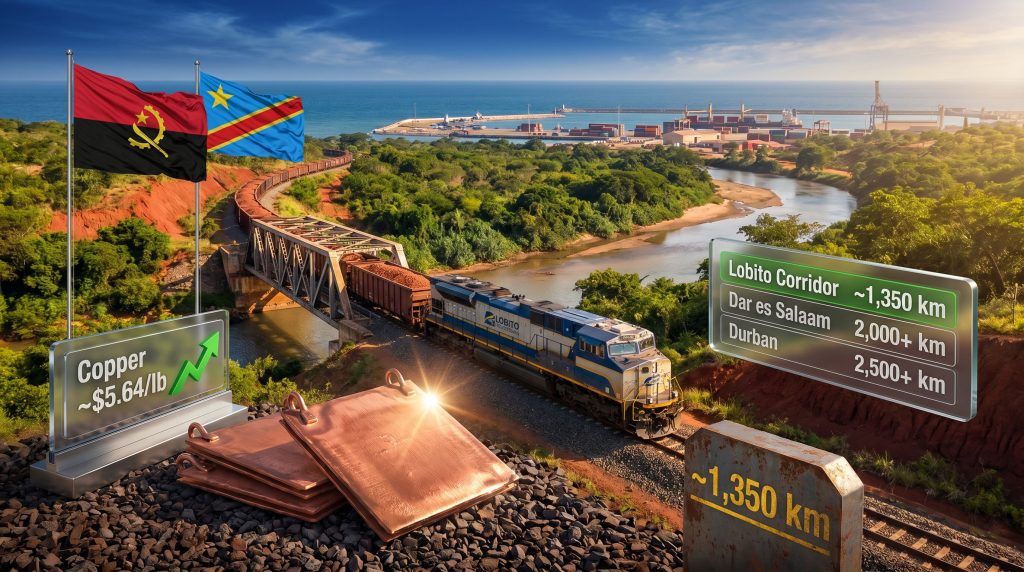
| Lobito Corridor (Angola) | ~1,350 km | Copper, Cobalt | Flood and infrastructure exposure |
| Dar es Salaam Route (Tanzania) | 2,000+ km | Mixed minerals | Transit time, port congestion |
| Durban Route (South Africa) | 2,500+ km | Copper, Coal | Distance, cross-border complexity |
| Beira Route (Mozambique) | ~1,800 km | Mixed minerals | Cyclone exposure, capacity limits |
The distance differential is not a trivial consideration. In bulk commodity logistics, every additional kilometre of transit translates into higher freight costs, longer delivery windows, and reduced price competitiveness at the point of sale. For high-volume copper concentrate shipments where margins are already compressed by processing and handling costs, route efficiency is a commercial determinant, not merely a logistical preference.
The DRC's Commodity Weight Amplifies Every Disruption
Understanding why this corridor commands strategic attention requires appreciating the DRC's position in global mineral supply. The country is consistently ranked among the world's top five copper producers and, critically, accounts for approximately 70% of global cobalt output. That cobalt dependency is not a peripheral concern. Cobalt is a core input in lithium-ion battery cathode chemistry, meaning DRC mine output flows directly into electric vehicle and energy storage supply chains serving manufacturers in Europe, East Asia, and North America.
The growing critical minerals demand driven by the global energy transition has, consequently, elevated the corridor's strategic importance considerably. When the Lobito corridor goes offline, it is not one supply route among many that absorbs the disruption quietly. It is the primary channel through which a disproportionate share of two strategically critical commodities reach global markets.
How Severe Flooding Exposed the Corridor's Core Vulnerability
In early 2026, extreme flooding in Angola damaged a critical section of the rail link between the Port of Lobito and the inland junction at Huambo. This segment functions as the western gateway of the entire corridor system. Its closure effectively disconnected DRC mining operations from Atlantic export access for approximately two months. The Northern Miner reported in detail on how the closure reverberated across African copper export markets.
The mechanics of flood damage to rail infrastructure in tropical environments are worth understanding in detail, because they recur predictably across the continent:
- Track bed erosion occurs when sustained water flow undermines the compacted earth and gravel supporting rail sleepers, causing track geometry to distort
- Bridge stress and scour happens when floodwaters accelerate around bridge foundations, removing supporting material and creating structural instability
- Ballast displacement refers to the washing away of the crushed rock layer that distributes train weight and maintains track drainage, requiring complete replacement across affected sections
- Embankment failure occurs when saturated slopes adjacent to elevated track sections collapse, dropping the track itself
These are not exotic failure modes. They are the predictable consequences of laying rail infrastructure through tropical river catchments where seasonal rainfall intensity has been increasing over recent decades. The Lobito-Huambo segment sits in precisely this category of exposure.
Operational Continuity Under Pressure: The Multimodal Workaround
Rather than allowing the closure to sever commercial relationships with DRC mining clients entirely, Lobito Atlantic Railway deployed a contingency logistics model during the two-month repair period. Freight arriving by rail from the DRC side of the corridor was unloaded and transferred to road trucks at the edge of the damaged section. Those trucks carried cargo across the affected zone, where it was reloaded onto trains for the remaining journey to the Port of Lobito.
This kind of truck-rail intermodal bridging operation is operationally demanding in ways that are not immediately obvious:
- It requires matching train arrival schedules with truck fleet availability in real time
- Cargo transfer points must be established in locations with sufficient hard-standing area for heavy vehicle movements
- Concentrate and other bulk mineral cargoes require careful handling to prevent moisture ingress and spillage
- Road infrastructure in the affected region must be capable of handling the axle loads generated by fully laden bulk transport vehicles
- Documentation and chain of custody for international shipments must be maintained across the mode transfer
The cost premium for this kind of workaround versus normal rail throughput is substantial. Industry benchmarks suggest truck haulage in sub-Saharan Africa typically costs between three and five times the equivalent rail freight rate per tonne-kilometre, depending on road conditions and fuel costs. For a two-month closure on a high-volume corridor, that premium accumulates quickly across the shipper base.
The contingency logistics model preserved export continuity during the closure, but it did so at significantly elevated cost and operational complexity. This gap between planned rail efficiency and emergency road bridging represents a hidden financial risk that DRC mining operators absorb whenever corridor outages occur.
The June 2026 Resumption: What the First Train Actually Signals
The confirmation on June 13, 2026 that the first international copper train from the DRC had been received following the corridor's reopening carries significance at multiple levels. On the operational side, it marked the conclusion of emergency repair works and the restoration of normal freight movement. On the commercial side, it signalled to DRC mining operators that scheduled shipment programs could resume without the cost burden of the intermodal workaround.
On the market side, it removed an active supply disruption from one of the world's most monitored critical mineral corridors. The Lobito railway Congo copper shipment after flood repairs was, in this sense, a signal to global markets that normal throughput conditions had been restored.
The timing of the resumption places it against a demanding commodity price environment. Copper was trading at approximately $5.64 per pound at the time of the corridor's reopening, a level reflecting both strong underlying demand driven by electrification investment and acute sensitivity to supply-side disruptions. At that price point, even short-duration logistics bottlenecks generate measurable price premium effects in physical copper markets.
The market context at the time of reopening further illustrates the stakes involved:
| Commodity | Price at Corridor Reopening | Market Sensitivity to DRC Disruption |
|---|---|---|
| Copper | ~$5.64/lb | High: DRC is a top-5 global producer |
| Cobalt | Elevated | Very High: DRC produces ~70% of global supply |
| Silver | ~$75.50/ozt | Moderate: indirect supply chain exposure |
| Gold | ~$4,713/ozt | Low: minimal DRC production dependency |
The Geopolitical Layer: Why Western Nations Care Deeply About This Railway
The Lobito corridor's significance extends well beyond commercial freight economics. Since the early 2020s, the railway has emerged as a central element in Western efforts to construct critical mineral supply chains that operate independently of Chinese-controlled logistics infrastructure. The broader Congolese cobalt rivalry between the United States and China, furthermore, has elevated the corridor to a position of genuine strategic importance.
The World Bank has provided financing frameworks supporting the corridor's rehabilitation and capacity development. Western governments, particularly within the G7 grouping, have identified African mineral transport corridors as strategic assets in the broader contest over critical mineral access that characterises the current phase of U.S.-China competition.
This geopolitical framing creates an important distinction that investors and analysts should understand:
- The Lobito corridor competes directly with Chinese Belt and Road Initiative rail projects in East and Central Africa that offer alternative routes for DRC mineral exports
- Chinese-backed routes tend to connect toward Indian Ocean ports such as Dar es Salaam, creating a geographic and political division in DRC export logistics
- Western interest in the Lobito corridor is partly motivated by reducing DRC mining operators' structural dependency on Chinese-controlled transport infrastructure
- The corridor's operational reliability therefore carries strategic weight beyond its commercial freight volumes
The Lobito corridor sits at the intersection of African infrastructure development and the global competition for critical mineral supply chain control. Its operational status is monitored not just by copper traders but by policymakers in Washington, Brussels, and Beijing.
What a Six-Month Closure Would Have Meant
It is worth modelling the counterfactual more explicitly. Had emergency repairs taken six months rather than two, DRC copper and cobalt producers would have faced a stark set of choices: absorb the full cost premium of the truck intermodal workaround, reroute shipments through longer and more expensive alternative corridors, or reduce production throughput to match available export capacity.
A prolonged reroute through Dar es Salaam or Durban would have added several weeks to average transit times and potentially hundreds of dollars per tonne in additional freight costs. For cobalt, where the DRC's approximately 70% global market share means there is no easy substitution from alternative producers, sustained export pressure would have translated into physical tightness at battery manufacturer level. The downstream impact on electric vehicle production schedules at European and Asian manufacturers would have been tangible.
The copper supply crunch already evident across global markets would, moreover, have been meaningfully exacerbated by a prolonged corridor closure of this nature.
Engineering the Next Phase: What the Corridor Needs to Become Resilient
The flood event has exposed a structural engineering gap that emergency repair alone does not resolve. Building genuine climate resilience into a tropical rail corridor requires a fundamentally different approach to infrastructure specification:
- Elevated track beds reduce vulnerability to surface flooding by lifting rail infrastructure above the historic flood extent of river systems
- Reinforced bridge structures with deeper foundation piles resist the scour erosion that undermines standard bridge designs during high-flow events
- Improved drainage systems alongside the track formation direct water away from the ballast layer before saturation occurs
- Predictive monitoring technology, including track geometry sensors and water level gauges at flood-prone crossings, provides advance warning of deteriorating conditions
The capacity dimension is equally pressing. Current corridor throughput is not calibrated to handle the volumes implied by DRC copper and cobalt production growth projections through 2030. Several major mining operations in the Copperbelt are in active expansion phases. Without parallel investment in corridor capacity, including potential track electrification to increase train frequency and reduce operating costs, the infrastructure could become a bottleneck even in the absence of flood events.
The Case Against Single-Corridor Dependency
Perhaps the most important structural lesson from the 2026 flood closure is the systemic fragility embedded in routing a significant proportion of global cobalt supply through a single railway line. Redundancy is a well-established principle in supply chain risk management. It is, however, conspicuously absent in the current architecture of DRC mineral export logistics.
These energy security risks extend well beyond the immediate freight economics, ultimately touching the reliability of clean energy supply chains in consuming nations. Developing complementary export capacity, whether through upgrading alternative routes or building new connective infrastructure, would distribute weather and political risk across multiple pathways. The flooding provided a rare, costly reminder of what normal obscures.
The next major ASX story will hit our subscribers first
Frequently Asked Questions: Lobito Railway Congo Copper Shipment After Flood Repairs
What caused the Lobito railway closure before the first DRC copper shipment resumed?
Severe flooding damaged the rail link between the Port of Lobito and the inland hub of Huambo in Angola, forcing a full closure of approximately two months while emergency repairs were completed across the affected track sections.
How did Lobito Atlantic Railway maintain cargo flows during the flood closure?
LAR implemented a contingency logistics plan involving the physical transfer of freight between trains and road trucks on either side of the damaged section, creating a temporary multimodal bridge to maintain export continuity at higher operational cost.
Why does the Lobito Corridor matter so much for global critical mineral supply?
The corridor provides the shortest and most direct Atlantic export route for copper and cobalt produced in the DRC, which is simultaneously a top-five global copper producer and the source of approximately 70% of global cobalt supply.
Who provides financial support for the Lobito Atlantic Railway corridor?
The corridor operates within a financing framework that includes World Bank involvement, with broader Western government interest reflecting its role in developing critical mineral transport infrastructure outside Chinese-controlled logistics networks.
How does the Lobito route compare to alternative DRC export corridors?
At approximately 1,350 kilometres to the Port of Lobito, the corridor is materially shorter than alternatives through Tanzania to Dar es Salaam (over 2,000 km), Mozambique to Beira (around 1,800 km), or South Africa to Durban (approximately 2,500 km), making it the most cost-efficient Atlantic export option for DRC miners.
What does the copper price environment mean for corridor disruptions?
With copper trading near $5.64 per pound at the time of the Lobito railway Congo copper shipment after flood repairs resumption, even temporary logistics disruptions carry outsized price consequences. At elevated price levels, physical supply tightness generated by corridor outages translates more rapidly into spot market premium effects.
This article contains forward-looking analysis and scenario modelling based on publicly available information. Infrastructure timelines, commodity price projections, and corridor capacity assessments involve inherent uncertainty. Readers should conduct independent research before making any investment or commercial decisions based on the information presented here.
Want to Catch the Next Major Mineral Discovery Before the Market Does?
Discovery Alert's proprietary Discovery IQ model scans ASX announcements in real time, instantly alerting subscribers to significant mineral discoveries — including those tied to critical commodities like copper and cobalt that underpin the very supply chains explored in this article. Start your 14-day free trial at Discovery Alert today, or explore how historic mineral discoveries have generated exceptional market returns to understand the full scale of the opportunity.