June 16, 2026
When Capital Follows Conviction: Trader-Backed Financing and the New Architecture of Critical Metals Development
The global copper supply chain is undergoing a structural transformation. Electrification demand, grid modernisation programmes, and accelerating electric vehicle adoption are collectively placing pressure on a market already grappling with declining ore grades, extended project development timelines, and persistent underinvestment in new processing capacity. Against this backdrop, an increasingly important financing mechanism has emerged: commodity-linked prepayment structures arranged not by traditional lenders, but by metals trading houses with long-term supply chain interests.
The Transamine NVRO copper deal, announced in June 2026, represents a textbook example of this shift. It illuminates how a Geneva-headquartered trading firm and a British Columbia-based mining technology developer are attempting to unlock a dormant Northern Territory processing facility through a layered, multi-tranche financing framework tied directly to copper cathode offtake. Understanding the mechanics, the asset economics, and the conditions attached to this arrangement reveals a great deal about how critical metals project finance actually works in 2026.
When big ASX news breaks, our subscribers know first
Copper Cathode and the Offtake Agreement as a Financing Tool
Before examining the specifics of the Transamine NVRO copper deal, it is worth understanding why copper cathode commands particular commercial attention and how offtake agreements function as instruments of project finance. Furthermore, the copper supply crunch currently reshaping global markets makes this understanding all the more urgent for investors tracking the sector.
Copper cathode is a refined copper product carrying extremely high purity, typically 99.99%, generated through a two-stage hydrometallurgical process. Oxide copper ore is first leached using dilute sulphuric acid in heap leach pads, then the resulting copper-rich solution passes through solvent extraction circuits before being deposited as solid copper cathode sheets via electrowinning. The LME Grade A classification is the industry benchmark, and cathode meeting this specification commands measurable premiums over lower-grade copper forms in international markets.
Offtake agreements serve a dual commercial function that is often underappreciated:
- They provide the producing company with revenue certainty by locking in a buyer before first production
- They simultaneously function as collateral in commodity-linked financing negotiations, since a committed offtaker reduces cash flow risk for any lender assessing the project
- They signal commercial credibility to third-party investors and potential co-financiers reviewing the project
- When structured with prepayment components, they effectively convert future copper production into present-day capital
This dual nature explains why established trading houses are willing to provide financing alongside offtake commitments. The capital deployment is not philanthropic; it is strategically rational. By funding refurbishment and commissioning, the trader accelerates the point at which purchased copper cathode begins flowing, securing supply chain positioning at a relatively low cost compared to acquiring equity in the project itself.
The Asset at the Centre: What NVRO Is Actually Acquiring
The foundation of the Transamine NVRO copper deal rests on a specific physical asset: a fully constructed hydrometallurgical processing complex located approximately 55 miles south of Darwin in Australia's Northern Territory. The facility was developed by Northern Territories Resources Pty Ltd, which built the processing plant at an estimated cost of US$148 million before entering insolvency proceedings without reaching commercial production.
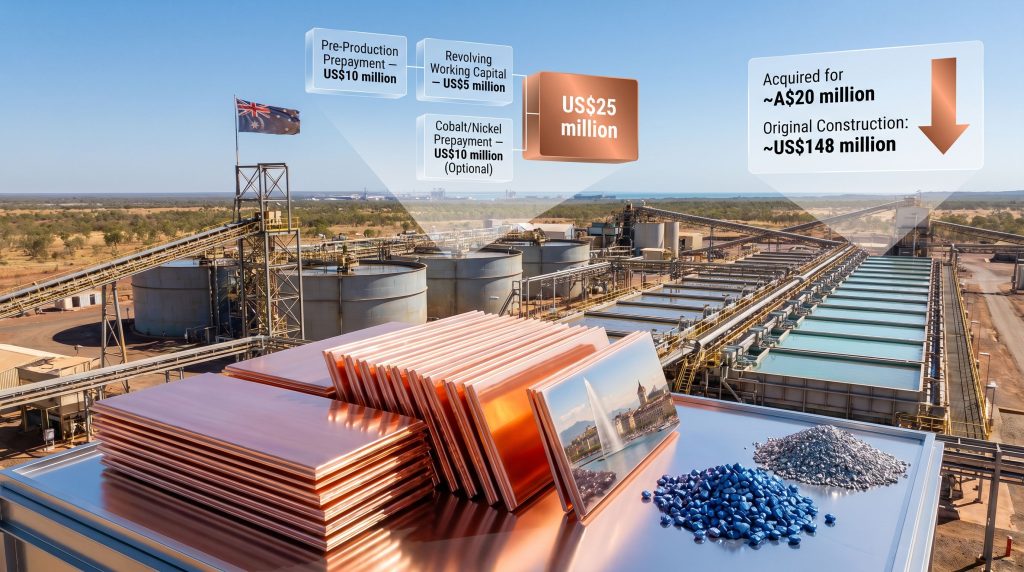
NVRO Metals Ltd. is acquiring this facility, along with associated infrastructure and a mineral property hosting copper-cobalt-silver-lead-zinc-nickel mineralisation, for approximately A$20 million. The arithmetic here is striking.
| Asset Component | Prior Owner's Investment | NVRO Acquisition Cost | Implied Discount |
|---|---|---|---|
| Processing plant construction | ~US$148 million | Included in ~A$20M total | ~86-87% below replacement |
| Infrastructure + mineral property | Additional capital | Included in ~A$20M total | Material discount |
| Total package | Substantially above A$20M | ~A$20 million | Deep value entry |
This kind of acquisition, sometimes described in project finance circles as buying distressed infrastructure at replacement-cost discounts, substantially alters the capital intensity equation. Greenfield hydrometallurgical facilities require years of permitting, construction, and commissioning before a single tonne of cathode can be produced. NVRO is bypassing that entire phase by acquiring circuits that have already been built, installed, and partially tested.
The existing solvent extraction and electrowinning (SX-EW) circuits at the Northern Territory site are specifically suited to processing oxide copper mineralisation through heap leaching operations. This creates a near-term production pathway that does not require NVRO's proprietary processing technology to be deployed first. The company's broader ambition involves installing its own copper leaching process, which is designed to recover precious, base, and critical metals from tailings, waste rock, and sulphide materials, but the SX-EW infrastructure provides an earlier, lower-risk production entry point.
Dissecting the US$25 Million Financing Architecture
The proposed Transamine financing package is structured in three tranches, each serving a distinct operational phase and risk profile.
| Facility | Maximum Value | Purpose | Conditionality |
|---|---|---|---|
| Pre-Production Prepayment | US$10 million | Refurbishment and commissioning | Non-binding; subject to conditions |
| Revolving Working Capital | US$5 million | Early-stage operations and liquidity | Non-binding; subject to conditions |
| Cobalt/Nickel Prepayment (optional) | US$10 million | Byproduct offtake-linked | Optional; non-binding |
| Total Package | US$25 million | Full hub launch support | Subject to multiple conditions |
The first tranche targets the refurbishment phase, covering the capital requirements to bring dormant SX-EW circuits back to operational readiness. The second, a revolving working capital facility, is structured to support the operational rhythm of early production, where cash flows can be irregular and working capital timing mismatches are common. The third and largest tranche is contingent on separate cobalt and nickel byproduct offtake terms being agreed, making it the most speculative component of the package.
The multi-tranche architecture is not accidental. Staged financing structures are deliberately designed to align capital deployment with verifiable project milestones, reducing the trader's exposure at each phase while providing the project company with a credible total financing narrative for other stakeholders.
The byproduct optionality is strategically significant beyond the dollar value alone. Cobalt and nickel are both classified as critical minerals demand materials within the battery supply chain, and their pricing dynamics are entirely independent from copper. Cobalt has historically experienced severe price cyclicality tied to Democratic Republic of Congo supply conditions, while nickel markets have faced structural oversupply pressure following Indonesian production surges. Structuring the third tranche as optional preserves NVRO's ability to pursue alternative cobalt and nickel offtake arrangements if more favourable terms emerge from other counterparties or strategic investors.
What Makes This a Non-Binding Agreement and Why That Matters
The current arrangement is constituted as a heads of agreement (HOA), a preliminary commercial instrument that establishes intent and framework but carries no binding legal obligation on either party. Investors interpreting HOA announcements require particular discipline in separating commercial signalling from contractual commitment.
The conditions that must be satisfied before the arrangement progresses to a binding definitive agreement include:
- Successful completion of NVRO's acquisition of Northern Territories Resources Pty Ltd
- Satisfactory completion of due diligence by Transamine on both the asset and the proposed financing structure
- Negotiation and full execution of a definitive offtake and financing agreement
- Acceptance of the transaction terms by the TSX Venture Exchange
Each of these conditions represents a genuine risk point. The underlying acquisition must close, the processing plant must pass Transamine's technical and commercial scrutiny, legal documentation must be negotiated to both parties' satisfaction, and the exchange regulatory framework must be navigated. Any one of these conditions failing to be met would leave the arrangement without legal effect.
Investors should treat non-binding heads of agreement as indicators of commercial intent and relationship quality, not as confirmed financing outcomes. The progression from HOA to definitive agreement requires additional milestones that carry independent execution risk. This article does not constitute financial advice.
Transamine as a Counterparty: Why Trading House Engagement Carries Signalling Value
Transamine SA is a Geneva-headquartered metals trading and commodity finance house with an established track record as both an offtake counterparty and a financing partner across global copper supply chains. The firm's willingness to engage at the heads of agreement stage is not commercially trivial. Proactive Investors notes that Transamine has previously facilitated mine expansion financing through comparable offtake-linked structures, reinforcing its credibility as a counterparty in this space.
Established trading houses conduct extensive internal due diligence before committing even non-binding intent to a project. Their risk-adjusted return frameworks, refined across decades of commodity exposure, typically screen out projects with fundamental commercial, technical, or jurisdictional flaws before a preliminary agreement is even tabled. NVRO's disclosure that Transamine was selected through a competitive process, evaluated against alternative counterparties, further reinforces the commercial credibility argument.
This dynamic reflects a broader trend in junior critical metals finance. As traditional project finance lenders remain cautious toward early-stage production hubs, commodity trading houses have increasingly filled the capital gap, accepting commodity price exposure in exchange for supply chain positioning and financing returns. The Transamine NVRO copper deal is one of the cleaner recent examples of this pattern applied to an Australian critical minerals asset.
The next major ASX story will hit our subscribers first
Northern Territory Jurisdiction: Why Location Shapes the Commercial Case
The Northern Territory site carries geographic and logistical attributes that directly inform the commercial viability of the project's copper cathode export thesis.
- Darwin port proximity provides efficient, cost-effective access to Asian copper import markets, particularly Japan, South Korea, Taiwan, and Chinese smelters purchasing refined cathode
- Tier 1 sovereign jurisdiction reduces the country risk premium that commodity traders and financiers typically apply to competing projects in parts of Africa, South America, or Southeast Asia
- Existing infrastructure around the Darwin corridor, including roads, power, and port facilities, reduces the auxiliary capital requirements that can derail remote mining projects
- Australian regulatory standards, while rigorous, are well understood by international counterparties and lenders, reducing legal due diligence complexity
Australia's position as one of the world's most established mining jurisdictions, combined with growing international interest in diversifying copper cathode supply away from geopolitically concentrated sources, creates a structural backdrop that supports trader engagement with projects like the NVRO Metals Hub.
Key Risks Investors Should Understand Before Drawing Conclusions
Beyond the non-binding status of the current arrangement, several operational and market risks warrant careful consideration.
Refurbishment timeline risk is perhaps the most immediate. Restarting dormant hydrometallurgical infrastructure is technically demanding. SX-EW circuits require membrane integrity checks, reagent system recommissioning, and process chemistry validation before reliable cathode quality can be assured. NVRO's stated target of initial production by the end of 2027 requires that the acquisition, financing, refurbishment, and commissioning sequence all execute on schedule, a timeline that leaves limited margin for delays.
Cobalt market risk is particularly relevant to the optional US$10 million tranche. Cobalt prices have undergone dramatic cycles, falling from above US$90,000 per tonne in 2018 to below US$30,000 per tonne in subsequent years, driven by supply surges from artisanal and industrial mining in the DRC and demand-side shifts in battery chemistry toward lower-cobalt formulations. Any offtake and prepayment terms negotiated for cobalt will consequently be sensitive to prevailing price conditions at the time of negotiation.
Identity transition risk is a less commonly discussed but structurally important factor. NVRO is moving from a mining technology development identity to an active critical metals production role. These are fundamentally different operational disciplines, with different management requirements, regulatory obligations, and capital market expectations. Successfully navigating this transition while simultaneously executing an asset acquisition and financing negotiation introduces meaningful execution complexity. In addition, copper investment strategies that account for this identity shift will be essential for investors evaluating NVRO's longer-term trajectory.
Frequently Asked Questions: Transamine NVRO Copper Deal
What is the Transamine NVRO copper deal?
It is a non-binding heads of agreement through which Geneva-based metals trader Transamine SA has proposed to purchase copper cathode production from NVRO Metals' planned Northern Territory processing hub while providing a staged financing package of up to US$25 million to support the hub's operational launch. Full details of the agreement have been published via NVRO Metals' official announcement channels.
What is copper cathode and why does the Northern Territory facility produce it?
Copper cathode is a high-purity refined copper product, typically 99.99% pure, produced through solvent extraction followed by electrowinning. The existing SX-EW circuits at the Northern Territory site are well suited to processing oxide copper mineralisation via heap leaching, making copper cathode the most viable near-term product from the available mineralisation type.
How much is NVRO paying for the Northern Territory asset?
Approximately A$20 million for the processing facility, associated infrastructure, and mineral property package. The prior owner invested an estimated US$148 million in constructing the processing plant alone before entering insolvency.
Is the financing confirmed?
No. The arrangement is a non-binding heads of agreement, subject to completion of the underlying asset acquisition, satisfactory due diligence, definitive agreement negotiation, and TSX Venture Exchange approval.
What byproducts could be produced?
The Northern Territory mineral project hosts copper-cobalt-silver-lead-zinc-nickel mineralisation. Cobalt and nickel byproducts from oxide processing are referenced in the proposed financing framework, with an optional US$10 million prepayment facility tied to agreed byproduct offtake terms.
When does NVRO expect first copper cathode production?
NVRO has indicated a target of initial copper cathode production from the Northern Territory hub by the end of 2027, contingent on the acquisition, financing, refurbishment, and commissioning milestones being completed on schedule.
What the Transamine NVRO Copper Deal Reveals About Critical Metals Finance
The emerging pattern this deal exemplifies deserves broader analytical attention. Trader-backed commodity financing is systematically filling a structural capital gap in early-stage critical metals development, particularly for projects combining near-term production potential with distressed asset acquisition economics. When a processing facility built for over US$148 million can be acquired for roughly A$20 million following insolvency, and when an established trading house is prepared to provide staged financing against that asset's future copper cathode output, the capital efficiency argument for this development model becomes difficult to dismiss.
The Transamine NVRO copper deal, if it progresses to a definitive agreement and ultimately to production, would also represent a meaningful data point for the broader thesis that Northern Australia can develop into a credible critical metals processing hub serving Asian demand. Darwin's port infrastructure, the jurisdiction's sovereign stability, and the availability of underutilised or distressed processing assets collectively create conditions that international commodity finance houses are beginning to price into their deal sourcing strategies.
This article is provided for informational purposes only and does not constitute financial or investment advice. Readers should conduct their own due diligence and consult qualified financial advisers before making investment decisions related to any company or project discussed herein.
Want to Track the Next Major Critical Metals Discovery Before the Market Does?
Discovery Alert's proprietary Discovery IQ model delivers real-time alerts on significant ASX mineral discoveries — cutting through complex data to surface actionable opportunities in copper, cobalt, nickel, and beyond the moment they're announced. Start your 14-day free trial today, or explore historic discovery returns to understand just how transformative early positioning in major mineral finds can be.