June 15, 2026
The Copper Supply Gap That Makes Large-Scale Undeveloped Projects Increasingly Rare
The global copper industry is navigating a structural tension that has been building for more than a decade. On one side, demand projections linked to electric vehicle adoption, grid modernisation, and renewable energy infrastructure continue to climb. On the other, the pipeline of new, large-scale copper projects capable of moving into production within a meaningful timeframe has shrunk considerably. The copper supply crunch is making greenfield discoveries of genuine scale less frequent, exploration budgets remain constrained relative to historical cycles, and permitting timelines in many jurisdictions have lengthened substantially.
Against this backdrop, the Surge Copper Berg pre-feasibility study, released on May 29, 2026, carries significance that extends well beyond a single junior mining company's development milestone. It represents a detailed technical and economic validation of what may be one of the last genuinely large-scale undeveloped copper deposits in a stable, mining-friendly jurisdiction.
When big ASX news breaks, our subscribers know first
Berg's Economic Architecture: What the Numbers Actually Mean
Base-Case and Spot-Price Scenarios Compared
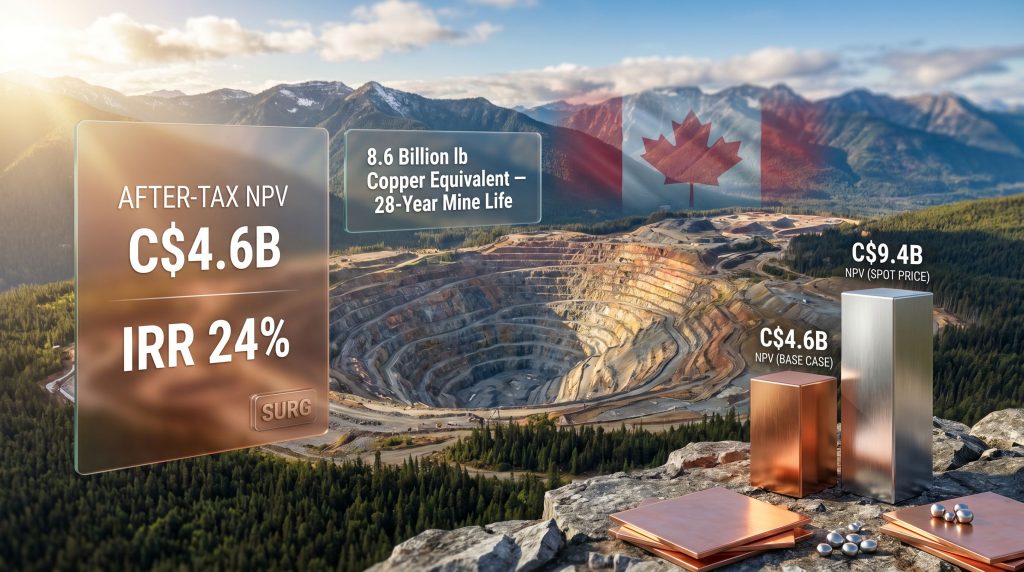
The headline figures from the Surge Copper Berg pre-feasibility study are substantial by any measure of the development-stage copper sector. Under base-case metal price assumptions, Berg returned an after-tax NPV of C$4.6 billion at an 8% discount rate, an internal rate of return of 24%, and a payback period of 2.9 years. The initial capital cost is estimated at C$4.7 billion.
What is particularly notable is how dramatically the economics improve under spot-price conditions:
| Economic Metric | Base-Case Scenario | Spot-Price Scenario |
|---|---|---|
| After-Tax NPV (8% Discount) | C$4.6 billion | C$9.4 billion |
| Internal Rate of Return | 24% | 36% |
| Payback Period | 2.9 years | 1.8 years |
| Initial Capital Cost | C$4.7 billion | C$4.7 billion |
The near-doubling of NPV under spot pricing illustrates a key dynamic in copper project economics: price leverage. Because operating costs are largely fixed once a mine is constructed, incremental copper price gains translate disproportionately into cash flow improvements. For a 28-year operation of this scale, even modest upward moves in long-term copper price assumptions compound significantly across the mine life.
What a C$4.7 Billion Capital Cost Signals
A capital requirement of this magnitude places Berg firmly in the category of projects that cannot be financed through conventional junior mining equity markets alone. Projects at this scale typically require a combination of project finance debt, strategic partnerships, offtake-linked prepayments, or participation from major mining companies or sovereign wealth funds. The C$4.7 billion figure is not a deterrent so much as a defining characteristic: it establishes Berg as an asset that, if developed, would represent a generational infrastructure commitment rather than a speculative exploration play.
Context for Investors: At C$4.7 billion in initial capital against a base-case NPV of C$4.6 billion, Berg's capital intensity is high relative to its base-case economics but becomes considerably more attractive under spot pricing, where the NPV-to-CapEx ratio rises to approximately 2x. This sensitivity underscores why long-term copper price assumptions are the single most consequential variable in any valuation framework applied to Berg.
NI 43-101 Compliance and Independent Study Authorship
The PFS was prepared by Ausenco Engineering Canada and Moose Mountain Technical Services, both independent of Surge Copper. This distinction matters for institutional capital markets. NI 43-101 is the Canadian regulatory standard governing the disclosure of scientific and technical information for mineral projects. Studies prepared to this standard by independent qualified persons carry a level of institutional credibility that earlier-stage assessments, including the 2023 preliminary economic assessment (PEA), do not provide.
Compliance with NI 43-101 also enables the formal declaration of mineral reserves, which is a foundational requirement before most institutional lenders will consider project financing discussions.
Production Profile: 28 Years of Multi-Metal Output
Life-of-Mine Metal Delivery
The Berg mine, as designed in the PFS, would process ore through a conventional open-pit operation feeding a 12,000-tonne-per-day concentrator. Over a projected 28-year mine life, total production is expected to reach:
| Metal | Total Life-of-Mine Production |
|---|---|
| Copper | 4.9 billion lb |
| Molybdenum | 602 million lb |
| Silver | 89 million lb |
| Total Copper Equivalent | 8.6 billion lb |
Front-Loaded Production and the Payback Acceleration Effect
One of the more strategically significant features of Berg's production profile is its front-loaded output schedule. During the first five years of steady-state production, Berg is projected to deliver approximately 416 million lb of copper equivalent annually, which is approximately 35% above the life-of-mine average of 308 million lb per year.
This is not unusual in open-pit mining. Early mining phases typically target higher-grade ore zones that are geometrically accessible near surface or in the upper portions of the pit. The practical effect is that a disproportionate share of revenue is generated early in the mine life, which compresses the payback period and reduces the effective financial risk exposure for debt lenders and equity participants alike.
Technical Note: In open-pit mine sequencing, the concept of mining the highest-grade material earliest is known as grade optimisation or high-grading the schedule. At Berg, this approach materially reduces the time to capital recovery, which in project finance terms reduces the duration over which lenders carry exposure.
Molybdenum as a Strategic Co-Product
Molybdenum is frequently underappreciated in copper project discussions, but at Berg, it represents a genuinely significant co-product. With 602 million lb of molybdenum projected over the mine life, Berg would rank among the more consequential molybdenum-producing operations globally if developed. Molybdenum is a critical alloying element used primarily in high-strength steels for energy infrastructure, including pipelines, wind towers, and pressure vessels. Its demand profile is linked to both decarbonisation infrastructure and industrial modernisation, making it a strategically coherent co-product alongside copper.
Silver, at 89 million lb over the mine life, provides additional precious metals revenue diversification, while the 800,000 oz of contained gold within the reserve base adds further optionality.
Mineral Reserve and Resource Base: Geological Substance Behind the Economics
Proven and Probable Reserve Summary
The Berg PFS is anchored by a formally declared reserve base, a milestone that distinguishes it from the 2023 PEA:
| Category | Tonnes | Cu Grade | Mo Grade | Ag Grade | Au Grade |
|---|---|---|---|---|---|
| Proven + Probable | 1.2 billion t | 0.22% Cu | 0.026% Mo | 4.1 g/t Ag | 0.02 g/t Au |
| Contained Cu | 5.8 billion lb | ||||
| Contained Mo | 687 million lb | ||||
| Contained Ag | 160 million oz | ||||
| Contained Au | 800,000 oz |
Measured, Indicated, and Inferred Resource Breakdown
| Resource Category | Tonnes | Cu | Mo | Ag | Au |
|---|---|---|---|---|---|
| Measured + Indicated | 1.4 billion t | 0.21% | 0.025% | 4.0 g/t | 0.02 g/t |
| Inferred | 1.0 billion t | 0.16% | 0.027% | 4.3 g/t | 0.01 g/t |
The 1.0 billion tonne inferred resource at 0.16% copper represents a meaningful exploration upside case. While inferred resources cannot be included in reserve declarations or mine plans, they suggest that the geological system at Berg extends beyond what has been delineated to the level required for economic mine planning. Conversion of even a portion of this inferred material to indicated status through additional drilling could extend the mine life or improve the overall economic profile at a future definitive feasibility study stage.
How the Resource Improved Between 2023 and 2026
The updated resource estimate incorporated in the PFS benefited from several technical advancements compared to the 2023 PEA:
- Expanded gold and silver assay coverage derived from reanalysis of historical drill core, which added precious metals credit without requiring new drilling in those areas
- Updated geological and geostatistical modelling frameworks that improved grade continuity interpretation
- Revised metallurgical recovery assumptions based on more recent testwork
- Additional geotechnical and environmental data collected during the 2025 drilling and data validation program to support mine design
This iterative improvement process is characteristic of how large porphyry copper-molybdenum systems are advanced through the study cycle. Berg is classified geologically as a porphyry deposit, a deposit type associated with large tonnages, moderate grades, and predictable bulk-mining characteristics, making it well-suited to the open-pit, high-volume processing approach outlined in the PFS.
PFS vs. 2023 PEA: Measuring the Advancement in Berg's Development Thesis
| Parameter | 2023 PEA | 2026 PFS |
|---|---|---|
| Study Standard | Preliminary Economic Assessment | NI 43-101 Pre-Feasibility Study |
| Reserve Declaration | Not applicable | 1.2 billion tonnes P+P |
| After-Tax NPV | Not disclosed at PFS-equivalent standard | C$4.6B (base) / C$9.4B (spot) |
| IRR | Not disclosed at PFS-equivalent standard | 24% (base) / 36% (spot) |
| Mine Life | Large-scale open-pit concept | 28 years confirmed |
The progression from PEA to PFS is more than a technical upgrade. It represents a fundamental shift in how counterparties, whether financiers, offtake partners, or joint venture candidates, engage with a project. A PFS-level study with a formal reserve declaration enables conversations that are simply not possible at the conceptual stage.
Key milestones along the path from PEA to PFS release included:
- November 2025: Trade-off studies completed; full design and cost estimation work formally initiated
- January 2026: 2025 field program confirmed as PFS-support focused, with geotechnical, environmental, and metallurgical work completed
- May 29, 2026: Berg PFS results formally released to the market
- June 2026: Surge Copper shares rose more than 10% on the day of PFS release, with the stock trading at approximately C$0.82 and a market capitalisation of C$320.6 million
Infrastructure and Energy: Why Berg's Positioning Is Structurally Advantageous
Access to low-carbon hydroelectric power is increasingly a decisive factor in how copper projects are evaluated, both economically and from an environmental, social, and governance perspective. Smelters operating under tightening Scope 2 emissions commitments are beginning to apply carbon intensity criteria to their concentrate purchasing decisions. Projects powered by diesel or coal-heavy grids face a growing commercial disadvantage relative to those with access to renewable electricity.
Berg's access to hydroelectric power in central British Columbia represents a tangible competitive differentiator. It reduces operating energy costs relative to diesel-dependent operations and positions the project's concentrate as inherently lower-carbon, a characteristic that is expected to attract a premium in offtake negotiations as the global copper supply chain responds to decarbonisation pressures. Furthermore, the project's geographic positioning in central British Columbia also provides logistical advantages in terms of proximity to established infrastructure corridors, which contributes to the capital and operating cost assumptions embedded in the PFS.
The next major ASX story will hit our subscribers first
Environmental Assessment Pathway and Indigenous Governance
Dual-Track Regulatory Process
The completion of the Surge Copper Berg pre-feasibility study formally enables the company to file an initial project description, which is the procedural trigger for commencing both provincial and federal environmental assessments in Canada. These processes run on separate but parallel tracks under British Columbia's Environmental Assessment Act and the federal Impact Assessment Act respectively. Timeline outcomes depend on regulatory scheduling, the scope of technical review, and community consultation processes.
The Wet'suwet'en Indigenous-Led Assessment: An Emerging Governance Model
Among the most significant governance dimensions of the Berg project is the planned Indigenous-led assessment to be conducted by the Office of the Wet'suwet'en, the coordination body mandated by Wet'suwet'en Houses and Hereditary Chiefs. The Gilseyhu Clan's Thin House has publicly acknowledged a collaborative framework with Surge Copper for implementing a robust assessment process. The evolving British Columbia mining framework reflects the growing role that Indigenous nations play in shaping how large resource projects advance through regulatory processes.
Governance Context: The Wet'suwet'en assessment operates in parallel with, and not subordinate to, provincial and federal regulatory frameworks. This reflects the evolving interpretation of Free, Prior and Informed Consent (FPIC) principles in Canadian resource development, where Indigenous nations are increasingly asserting parallel or complementary assessment authority rather than simply participating as stakeholders within government-led processes.
This is an important distinction for investors to understand. A project that achieves substantive alignment with the Wet'suwet'en assessment process is not simply satisfying a regulatory checkbox. It is building the social licence foundation that has historically been the single most consequential variable in determining whether large mining projects in British Columbia proceed to construction.
BC Premier David Eby's public statement expressing encouragement for responsible critical mineral development reflected provincial-level interest in projects of this nature, though this should be understood as a policy-level commentary rather than any form of project-specific approval or designation.
Investor Framework: Valuation, Risk, and Re-Rating Potential
Price-to-NAV Analysis at PFS Stage
At the time of the PFS release, Surge Copper's market capitalisation of approximately C$320.6 million compared against a base-case after-tax NPV of C$4.6 billion implies a price-to-NAV ratio of approximately 0.07x. Historically, development-stage copper projects trade within a range of roughly 0.1x to 0.3x NAV in the period between PFS completion and construction decision, depending on permitting progress, market conditions, and project-specific risk factors.
At 0.07x NAV, Berg's implied discount is deep even by development-stage standards. This may reflect the scale of the capital requirement, the length of the permitting runway ahead, and the inherent uncertainty associated with Indigenous consultation outcomes. However, it also implies meaningful re-rating potential as de-risking milestones are achieved, which is why many analysts tracking the future of copper mining are watching Berg closely.
Key De-Risking Milestones to Monitor
- Filing of the initial project description and formal commencement of environmental assessment processes
- Progress and outcome of the Wet'suwet'en Indigenous-led assessment
- Advancement toward a Definitive Feasibility Study (DFS), which would represent the next formal technical de-risking step
- Securing offtake agreements or strategic partnership arrangements with major copper consumers or mining companies
- Construction decision and financing package confirmation, which would represent the most significant re-rating event
Principal Risk Factors
- Environmental assessment duration remains uncertain and can extend considerably depending on the scope of technical and community review
- Capital markets capacity to finance a C$4.7 billion project in a junior mining vehicle is inherently limited without strategic partners or major offtake backing
- Copper price volatility relative to the base-case price assumptions embedded in the PFS
- Permitting complexity in British Columbia, which has a mixed track record on large-scale mining project timelines
- Indigenous consultation outcomes, which cannot be predicted or assumed based on current engagement status
In addition, broader copper investment strategies should account for the possibility that permitting timelines extend meaningfully beyond current expectations, which would alter the project's effective risk-adjusted return profile.
Disclaimer: The financial analysis and valuation commentary contained in this article is provided for informational and educational purposes only and does not constitute financial or investment advice. Development-stage mining projects carry substantial risks, and forward-looking statements, projections, and NPV figures are subject to significant uncertainty. Past performance of comparable projects does not guarantee similar outcomes for the Berg project.
Canada's Undeveloped Copper Pipeline: Where Berg Fits
| Attribute | Berg (Surge Copper) | Typical Large-Scale Canadian Cu PFS |
|---|---|---|
| Mine Life | 28 years | 15 to 25 years (typical range) |
| After-Tax NPV (base) | C$4.6 billion | Variable |
| Initial CapEx | C$4.7 billion | C$1B to C$5B+ |
| Primary Metal | Copper | Copper or Gold |
| Co-Products | Mo, Ag, Au | Variable |
| Power Source | Hydroelectric (low-carbon) | Grid or diesel dependent |
The combination of a 28-year mine life, 8.6 billion lb of copper equivalent production, and access to hydroelectric power distinguishes Berg from most comparable assets in Canada's undeveloped project pipeline. Molybdenum output of 602 million lb over the mine life would position Berg as a meaningful global contributor to that market, adding a dimension of strategic value that is frequently overlooked in copper-focused project analyses.
The Surge Copper Berg pre-feasibility study ultimately confirms what the geological data has suggested for years: this is a generational-scale asset in a tier-one jurisdiction, now supported by institutional-grade technical and economic analysis. The distance between that confirmation and a construction decision remains substantial, but the PFS represents the most credible foundation from which that journey can begin.
Want to Track the Next Major Copper Discovery Before the Market Catches On?
Discovery Alert's proprietary Discovery IQ model delivers real-time alerts on significant ASX mineral discoveries — instantly transforming complex geological data into actionable investment insights for traders and long-term investors alike. Explore historic examples of exceptional discovery returns and begin your 14-day free trial today to position yourself ahead of the market.