
June 15, 2026
The Infrastructure Bottleneck That Shapes Global Battery Supply Chains
Every tonne of copper and cobalt that powers an electric vehicle, a wind turbine, or a grid-scale battery storage system must travel from mine to port before it reaches a refinery or manufacturer. For much of Central Africa's mineral output, that journey depends on a relatively small number of railway corridors threading through difficult terrain. When those corridors fail, even temporarily, the downstream consequences ripple through supply chains that span continents. Understanding how these logistics systems work, where they break, and how they recover is increasingly essential knowledge for anyone tracking the global energy transition.
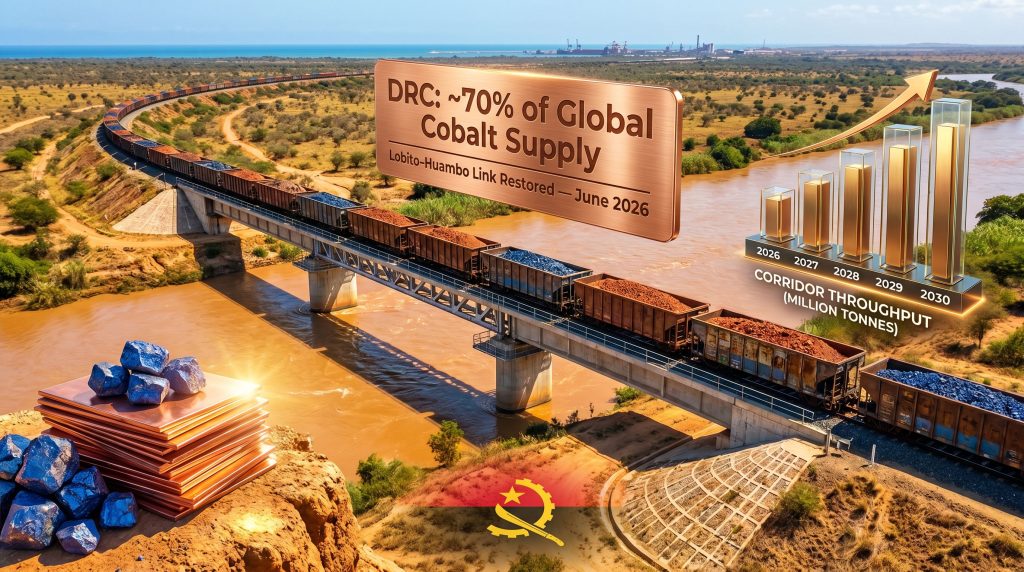
The Lobito Atlantic Railway (LAR) returned to full international operations in June 2026 following a roughly two-month suspension caused by severe flooding that damaged critical bridge infrastructure between the port of Lobito in Angola and the inland city of Huambo. The resumption, marked by the arrival of the first Lobito railway Congo copper shipment after flood repairs, confirmed the corridor's restoration as a functioning export artery for Democratic Republic of Congo (DRC) minerals. However, the episode also exposed structural vulnerabilities that deserve careful analysis beyond the headlines.
When big ASX news breaks, our subscribers know first
The DRC's Mineral Position and Why Export Infrastructure Is Non-Negotiable
The Democratic Republic of Congo is not simply a significant mining jurisdiction. It is, by most measures, the single most consequential source of cobalt on the planet, accounting for roughly 70% of global cobalt supply. It also ranks among the world's top three copper producers, with flagship operations such as the Kamoa-Kakula Copper Complex delivering production volumes that are reshaping global supply balances.
These are not abstract statistics. Cobalt is a critical input for lithium-ion battery cathodes, particularly for nickel-manganese-cobalt (NMC) and lithium-cobalt-oxide (LCO) chemistries widely used in consumer electronics and electric vehicles. Copper underpins everything from grid infrastructure to electric motor windings. The scale of global cobalt production means that any persistent disruption to the DRC's export logistics carries real consequences for downstream manufacturers worldwide.
What makes the DRC's export situation particularly sensitive is its landlocked geography. The country has no direct Atlantic or Indian Ocean port access of its own, making it entirely dependent on transit corridors through neighbouring states. Historically, the dominant export route has run eastward through Tanzania to the port of Dar es Salaam, or through Zambia and Zimbabwe toward Beira in Mozambique. These routes are long, congested, and traverse ageing infrastructure.
The Lobito corridor offers a fundamentally different geometry: a westward route to the Atlantic that, at full capacity, is shorter and potentially faster than eastern alternatives.
How the Lobito–Huambo Section Failed and What the Repair Response Revealed
The closure that preceded the Lobito railway Congo copper shipment after flood repairs was triggered by seasonal flooding severe enough to compromise bridge structures along the Lobito-to-Huambo segment. In rail engineering terms, bridges are the most critical and most vulnerable elements of any corridor. Unlike track laid on stable embankment, bridge decks and their supporting piers are exposed to hydraulic loading, scour erosion, and debris impact during high-flow events. Central Africa's rainfall patterns are intensifying under broader climatic shifts, making these events more frequent and more severe.
The disruption lasted approximately two months. During that period, the LAR operator did not simply suspend cargo flows. Instead, the team implemented a multimodal contingency solution: freight was offloaded from trains at the point where the damaged section began, transferred to trucks for road transit across the affected segment, then reloaded onto trains on the intact section beyond the damage zone. This approach preserved cargo continuity, though at increased cost and reduced throughput efficiency.
| Disruption Factor | Detail |
|---|---|
| Approximate closure duration | ~2 months |
| Affected route segment | Lobito Port to Huambo |
| Primary cause | Severe flooding and bridge damage |
| Cargo types impacted | Copper and cobalt from the DRC |
| Contingency solution | Multimodal rail-to-truck-to-rail transfer |
The successful maintenance of cargo flows during a major infrastructure failure demonstrates that modern mineral logistics planning increasingly incorporates adaptive redundancy, not just primary route management. The ability to switch seamlessly between modes under operational pressure is becoming a competitive differentiator for corridor operators.
The emergency repairs that restored the Lobito-to-Huambo link were classified as emergency rather than permanent works, an important distinction in infrastructure terms. Emergency repairs are designed to restore operational functionality quickly, typically using expedited construction methods, temporary bridging solutions, or reinforced temporary structures. They are not equivalent to the permanent rehabilitation works that would be required to bring the affected infrastructure to a standard capable of withstanding future high-intensity flood events. This distinction matters considerably for investors and supply chain planners assessing the corridor's long-term reliability.
What Does the Repair Timeline Tell Us?
Furthermore, the speed of the emergency response is itself instructive. Lobito Atlantic Railway operators mobilised contingency logistics within days of the initial closure, indicating pre-planned disruption protocols rather than improvised responses. This level of operational preparedness is not universal among African corridor operators and represents a meaningful differentiator for the LAR as a long-term supply chain partner.
Corridor Resilience in Context: How the Lobito Railway Compares
The Lobito Atlantic Railway does not operate in isolation. It competes and coexists with several other mineral export corridors serving Central and Southern Africa. Each has its own vulnerability profile.
| Corridor | Primary Minerals | Key Vulnerability | Redundancy Options |
|---|---|---|---|
| Lobito Atlantic Railway (Angola) | Copper, Cobalt | Seasonal flooding, bridge exposure | Road freight contingency |
| Tazara Railway (Tanzania-Zambia) | Copper, Coal | Ageing infrastructure, chronic underfunding | Limited |
| Beira Corridor (Mozambique) | Coal, Chrome | Cyclone damage, port congestion | Partial road diversion |
| Dar es Salaam Corridor (Tanzania) | Copper, Cobalt | Congestion, high road dependency | Port expansion underway |
What this comparison reveals is that no single Central or Southern African mineral export corridor is immune to physical disruption. The Tazara Railway, which has historically carried significant Zambian copper tonnage, suffers from decades of deferred maintenance and inconsistent funding. The Beira Corridor remains exposed to Indian Ocean cyclone cycles, as catastrophically demonstrated by Cyclone Idai in 2019. The Dar es Salaam route faces chronic port congestion that creates unpredictable delays even in the absence of physical infrastructure failures.
In this context, the Lobito corridor's flood vulnerability, while real and material, is not uniquely disqualifying. What differentiates the LAR from older corridors is the relative modernity of its rolling stock and the institutional capacity of its operator to implement contingency logistics. The multimodal response to the June 2026 disruption demonstrated a level of operational sophistication that older, underfunded corridors would struggle to replicate.
The Geopolitical Architecture Behind the Lobito Corridor
The Lobito Atlantic Railway carries strategic significance that extends well beyond its role as a freight carrier. The corridor has attracted backing from Western nations as part of a broader effort to develop Atlantic-facing mineral supply chains that reduce dependence on logistics networks running through eastern African ports, several of which operate within Chinese-financed or Chinese-managed infrastructure frameworks.
China's Belt and Road Initiative has financed significant port and rail infrastructure across Eastern and Southern Africa, creating a logistics ecosystem that channels considerable volumes of DRC copper and cobalt through supply chains with Chinese participation at multiple nodes. From the perspective of Western industrial policy, this creates a strategic exposure: critical minerals demand for energy transition technologies may flow through logistics and refining infrastructure in which Chinese state-affiliated entities hold significant positions.
The Lobito corridor offers an alternative routing that is geographically, logistically, and geopolitically distinct. By directing DRC mineral exports westward to the Atlantic, the corridor creates a pathway toward European and North American markets that does not pass through this eastern logistics ecosystem. The broader Congolese cobalt rivalry between Western and Chinese interests makes this routing distinction increasingly consequential for downstream supply chain architecture.
Angola's role in this architecture is worth examining separately. As the transit state through which the corridor passes, Angola receives significant economic benefits from corridor traffic, including transit fees, employment in railway operations and port handling, and broader infrastructure development spillovers. Angola has, in recent years, positioned itself as a pragmatic partner for both Western and multilateral infrastructure investment, a stance that has supported the corridor's development trajectory.
The Lobito corridor is best understood not as a single railway line but as a geopolitical infrastructure instrument designed to reshape the direction of Central African mineral flows at a moment when those flows carry outsized strategic importance for the global energy transition.
Copper Demand Growth and What It Means for Corridor Throughput Pressure
The energy transition is creating demand dynamics for copper that are structurally different from anything the market has experienced in previous commodity cycles. Copper intensity in clean energy applications is dramatically higher than in conventional energy systems: a single offshore wind turbine requires several tonnes of copper per megawatt of capacity, electric vehicles use roughly two to four times more copper than internal combustion engine vehicles, and grid modernisation programs require vast quantities for transmission and distribution upgrades.
Independent analysts have projected that copper demand could increase by 50% or more between now and 2040 under aggressive decarbonisation scenarios, with supply growth failing to keep pace given the long lead times required to develop new mining projects. The average timeline from discovery to first production for a major copper deposit now exceeds 15 years, meaning that today's supply pipeline is largely defined by projects already in development. The ongoing copper supply crunch is consequently placing ever-greater pressure on existing export infrastructure to perform reliably at scale.
The DRC, with its extraordinary geological endowment in the Central African Copperbelt, is one of the few jurisdictions globally with the resource base to deliver meaningful supply growth at the scale required. Operations like Kamoa-Kakula are ramping toward production levels that will make them among the world's largest copper mines by output. As DRC production scales, the throughput requirements placed on export corridors will increase substantially.
Cobalt faces a different demand trajectory. While cobalt intensity in batteries has been declining as cathode chemistry shifts toward higher-nickel, lower-cobalt formulations, the absolute volume of cobalt consumed is still expected to grow as overall battery production scales. The DRC's near-monopoly on cobalt supply means its export infrastructure will remain strategically sensitive regardless of demand-side chemistry evolution. Notably, copper supply chains are also being reshaped by tariff pressures, further amplifying the importance of reliable Atlantic-facing corridors.
The next major ASX story will hit our subscribers first
Five Structural Risks Every Critical Mineral Corridor Faces
The Lobito flood disruption provides a useful lens for examining risks that apply across mineral export infrastructure globally. These are not theoretical risks; they are recurring operational realities.
-
Climate exposure: Seasonal flooding, cyclone tracks, and the increasing frequency of extreme precipitation events threaten track integrity, bridge structures, and tunnel approaches in ways that legacy infrastructure was not designed to withstand.
-
Single-route dependency: When primary corridors fail, alternatives are often slower, more expensive, and capacity-constrained. The absence of genuine redundancy in Central African mineral logistics amplifies the impact of any single failure event.
-
Infrastructure maintenance gaps: Many African rail corridors have accumulated decades of deferred maintenance. Underfunded upkeep creates compounding vulnerability where each disruption is more severe than it would have been under a proper maintenance regime.
-
Geopolitical access risk: Cross-border railway operations require ongoing sovereign cooperation across multiple jurisdictions. Policy shifts, border disputes, or regulatory changes in any transit country can disrupt corridor operations independently of physical infrastructure conditions.
-
Cargo volume growth pressure: Corridors designed and built for historical throughput levels are being asked to carry increasing volumes as mining operations expand. Infrastructure that performs adequately at current throughput may become a binding constraint as DRC production scales toward projected levels by 2030.
What the June 2026 Resumption Signals for Supply Chain Planning
The restoration of the Lobito-to-Huambo link and the first copper exports via the repaired corridor in June 2026 carry meaning beyond the immediate operational milestone. It confirms that the LAR operator possesses the institutional and logistical capacity to respond to major disruptions without catastrophic cargo loss, a capability that is not universal among African rail corridor operators.
Consequently, it also serves as a reminder that infrastructure resilience must be actively maintained and continuously upgraded, not assumed. Emergency repairs restore functionality; they do not resolve the underlying vulnerability. The question of whether permanent flood mitigation works will follow the emergency response is one that corridor stakeholders, including shippers, insurers, and downstream off-takers, will need to monitor closely.
For investors and supply chain professionals tracking the critical minerals sector, the Lobito corridor's performance under stress is a meaningful data point. Corridors that demonstrate adaptive capacity during disruptions, maintain cargo flows through contingency planning, and restore service within reasonable timeframes are demonstrably more reliable partners for long-term supply chain architecture than those that do not. The Lobito railway Congo copper shipment after flood repairs, in this respect, represents more than a logistical milestone — it is a signal about corridor maturity.
Disclaimer: This article contains forward-looking statements and projections regarding mineral demand, infrastructure development, and supply chain evolution. These projections are based on publicly available analysis and industry forecasts and are subject to material uncertainty. Nothing in this article constitutes financial or investment advice.
Frequently Asked Questions: Lobito Railway and DRC Copper Shipments
What Is the Lobito Atlantic Railway?
The Lobito Atlantic Railway is a rail corridor running from the Angolan port of Lobito through the interior of Angola and connecting to the Democratic Republic of Congo and Zambia. It serves as a westward export route for copper, cobalt, and other minerals from Central Africa's copperbelt region.
Why Was the Lobito Railway Closed Before June 2026?
Severe flooding damaged bridge infrastructure along the Lobito-to-Huambo segment of the corridor, forcing a suspension of through-rail services for approximately two months.
How Did the Railway Maintain Cargo Flows During the Flood Disruption?
The operator implemented a multimodal contingency plan, transferring freight from trains to trucks at the damaged section boundary and reloading onto trains on the intact track beyond the affected area.
What Minerals Are Exported Through the Lobito Corridor?
The corridor primarily handles copper and cobalt exports from the DRC, along with other mineral commodities from Central and Southern Africa.
Who Operates the Lobito Atlantic Railway?
The Lobito Atlantic Railway is operated by LAR, a concession-based operator managing the corridor under a long-term agreement. For further background on the corridor's history and development, the Lobito Corridor organisation provides detailed context.
Why Is the Lobito Corridor Strategically Important?
The corridor provides a westward Atlantic-facing export route for DRC minerals, offering an alternative to eastern export routes and supporting efforts to diversify critical mineral supply chains toward Atlantic-facing markets.
How Does the Lobito Corridor Compare to Other DRC Export Routes?
Compared to eastern corridors such as Tazara and the Dar es Salaam route, the Lobito corridor offers a shorter Atlantic-facing pathway, though it shares common vulnerabilities around climate exposure and the absence of true route redundancy.
Want to Track the Next Major Mineral Discovery Before the Market Moves?
Discovery Alert's proprietary Discovery IQ model delivers real-time alerts on significant ASX mineral discoveries — including critical minerals like copper and cobalt that underpin the global energy transition — giving subscribers an immediate edge in identifying actionable opportunities the moment they are announced. Explore historic examples of exceptional discovery returns and start your 14-day free trial at Discovery Alert to position yourself ahead of the broader market.