June 14, 2026

The Copper Supply Clock Is Running Against the World's Biggest Energy Transition
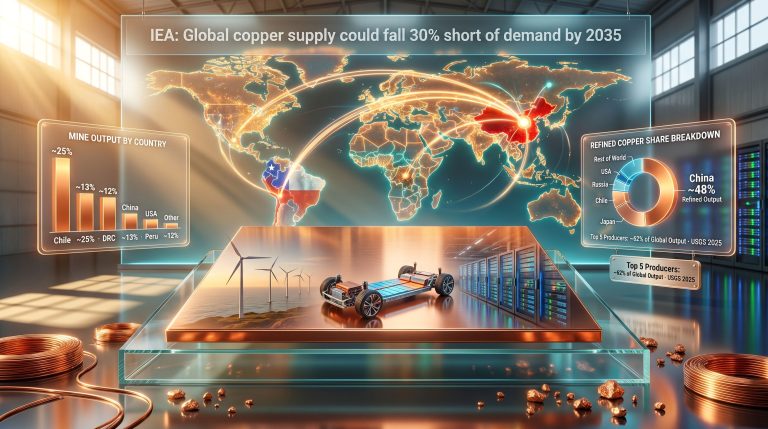
Every commodity market operates on a supply response curve, but copper's curve has quietly bent into something the industry has never encountered before. While demand forecasters and energy transition advocates project exponential growth in copper consumption across the coming decades, a structural reality on the supply side remains chronically underappreciated: the world simply cannot build new copper mines fast enough to keep pace.
This is not a temporary friction. It is a fundamental reconfiguration of how long it takes to convert copper in the ground into copper in the market, and understanding this dynamic is central to what experienced observers now describe as the Ross Beaty copper supply paradigm.
When big ASX news breaks, our subscribers know first
What the Ross Beaty Copper Supply Paradigm Actually Argues
Ross Beaty is a Canadian geologist and mining entrepreneur with more than five decades of experience building precious and base metal businesses across the Americas and beyond. He founded Pan American Silver, which became one of the Americas' leading silver mid-tier producers, and Equinox Gold, a multi-asset gold company. He is a member of the Canadian Mining Hall of Fame. When Beaty articulates a structural view on copper supply, the industry listens.
The core thesis he has developed through decades of project experience rests on three interlocking constraints that together create a supply system incapable of responding to price signals in anything resembling real time.
Constraint 1: Extended Lead Times
Large-scale copper projects now take between fifteen and twenty-five years to progress from discovery to first production. This timeline spans multiple commodity price cycles, meaning supply decisions made today will not deliver output until mid-decade in the 2030s or beyond. Higher prices today do not translate into new copper supply tomorrow.
Constraint 2: Depth and Grade Deterioration
The most accessible, near-surface, high-grade copper deposits have largely been exploited over the preceding century of industrial mining. The remaining undeveloped resources increasingly sit deeper underground, in more geologically complex settings, requiring significantly greater capital intensity per tonne of copper recovered. Furthermore, the average grade of currently producing copper mines globally has declined to below 0.6% copper equivalent in many jurisdictions, making higher-grade undeveloped deposits exceptionally valuable.
Constraint 3: Relentless Depletion From Operating Mines
Producing mines continuously consume their ore reserves. The global copper industry must develop entirely new assets simply to replace depleting production from existing operations, before any net supply growth can occur. This creates a treadmill effect where enormous capital investment is required just to stand still. The ongoing copper supply crunch makes this reality increasingly difficult to ignore.
How Long Does It Actually Take to Build a Major Copper Mine Today?
The development timeline question is perhaps the most critical and least understood dimension of the copper supply challenge. Using Lumina Metals' Nowa Sol copper-silver project in southwestern Poland as a real-world case study is instructive, because Beaty has been transparent about its development arc.
Lumina Metals, chaired by Beaty and focused on Poland's Legnica-Glogow Copper Belt, reached its Toronto Stock Exchange listing in April 2025 after approximately fifteen years of exploration, resource development, and corporate structuring. According to Beaty's own assessment of the project's forward path, the company now anticipates approximately four additional years of drilling, feasibility work, environmental studies, social licensing, and permitting before construction financing can be assembled.
Construction of a deposit of this scale and depth could then take a further five years or more. The total arc from initial discovery to first production approaches twenty-five years. This is not an outlier — it is a pattern repeated across large-scale copper projects globally.
| Development Era | Typical Discovery-to-Production Timeline | Key Constraints |
|---|---|---|
| Pre-1990s | 5–10 years | Basic permitting, financing |
| 1990s to 2010s | 10–15 years | Environmental review, social licensing |
| 2010s to Present | 15–25+ years | Depth, grade decline, permitting complexity, capital scale |
The three-phase development clock breaks down as follows:
- Exploration and Resource Definition (Years 1–5): Systematic drilling programmes, geological modelling, and initial resource estimation to establish measured and indicated categories under internationally recognised reporting standards.
- Feasibility and Environmental Studies (Years 6–10): Prefeasibility and bankable feasibility studies, environmental impact assessments spanning multiple regulatory jurisdictions, and early-stage community engagement. A robust definitive feasibility study is a critical milestone that cannot be rushed.
- Permitting and Social Licensing (Years 11–15): Regulatory approval processes, mining licence applications, and ongoing consultation with affected stakeholders including local communities and indigenous groups.
- Financing and Construction (Years 16–20): Debt and equity structuring, engineering procurement and construction management, and large-scale infrastructure development.
- Ramp-Up and Steady-State Production (Years 21–25): Commissioning, production optimisation, and full commercial output at nameplate capacity.
Each phase contains non-compressible minimum timeframes. Environmental impact assessments cannot be shortcut. Community trust cannot be manufactured on demand. Regulatory approvals follow their own statutory timelines. The cumulative result is a pipeline that cannot be accelerated regardless of how high copper prices climb.
Why Price Signals Alone Cannot Solve the Copper Supply Problem
Traditional commodity economics assumes that rising prices eventually attract new supply, restoring market equilibrium. For short-cycle commodities, this mechanism functions reasonably well. For copper, it is increasingly theoretical.
The gap between a price signal and a supply response in copper is now so wide that demand can comfortably outpace available supply across multiple commodity price cycles before a single new large-scale mine reaches production.
This is the core insight that separates the Ross Beaty copper supply paradigm from conventional supply-demand analysis. The paradigm does not argue that copper supply will never grow. It argues that supply growth is structurally time-lagged in ways that traditional commodity models systematically underweight.
There is also a cost escalation dimension that compounds the timeline problem. Several converging inflationary forces are simultaneously increasing the capital required to build new mines:
- Rising diesel and energy input costs driven by geopolitical instability in producing regions
- Sulphuric acid supply disruption affecting heap leach processing economics, partly linked to Middle East tensions
- Labour cost inflation flowing through agricultural and energy markets into mining workforce expenses
- Deeper ore body development requiring greater pre-stripping ratios and more sophisticated underground infrastructure per tonne of copper produced
The practical consequence is that higher prices are increasingly necessary simply to keep existing mines financially viable, let alone to incentivise the development of entirely new projects.
Copper Demand Is Growing Across Every Electrification Vector Simultaneously
On the demand side, the structural picture is almost the mirror image of supply. Copper consumption is being driven upward by multiple high-growth sectors simultaneously, in ways that compound rather than offset each other.
| End-Use Sector | Copper Intensity | Growth Trajectory |
|---|---|---|
| Electric Vehicles | ~80kg per EV vs ~25kg per ICE vehicle | High and accelerating |
| AI Data Centres | High wiring and cooling density | Very high and emerging |
| Renewable Energy (Wind and Solar) | 4–6x more copper per MW than fossil fuel plants | High across multiple decades |
| Grid Infrastructure | Transmission upgrades required globally | Sustained over multiple decades |
| Traditional Industrial Use | Moderate | Stable baseline |
The AI data centre demand vector is particularly underappreciated. Hyperscale computing facilities require extraordinary densities of power distribution infrastructure, copper cabling throughout server interconnect architectures, and sophisticated copper-intensive cooling systems to manage the thermal loads generated by modern GPU arrays. As artificial intelligence workloads expand and data centre construction accelerates globally, this represents an entirely new and rapidly scaling demand source that did not exist in previous copper price cycles.
As Beaty has observed, this particular cycle is characterised by demand drivers that are genuinely unprecedented in the history of copper markets. Electrification, AI infrastructure, energy storage, heat pumps, and the broader decarbonisation buildout are collectively driving copper demand in a direction that Beaty characterises as parabolic, while the supply side remains structurally constrained. In addition, the critical minerals energy transition is placing further pressure on already stretched supply chains.
Poland and the Case for European Copper Development
While Latin America has historically dominated global copper production, Europe is emerging as a frontier of significant interest to major mining entrepreneurs. Poland's Legnica-Glogow Copper Belt in the southwestern part of the country represents one of the most compelling geological jurisdictions outside the traditional producing regions.
KGHM, Poland's state-linked copper champion, produces approximately 600,000 tonnes per annum of refined copper from Polish operations and holds geological resources estimated at more than 31 million tonnes of copper and approximately 94,000 tonnes of silver. This established production history confirms the belt's geological quality and demonstrates that large-scale copper mining is commercially viable in the jurisdiction.
Lumina Metals' Nowa Sol project, which Beaty chairs, has established a measured and indicated resource of 604 million tonnes grading 1.24% copper and 38 grams per tonne silver. This grade profile is strikingly high relative to the global average for currently producing copper mines, which has declined to below 0.6% in many jurisdictions. The silver co-product credit at 38 g/t is also economically material, with silver proceeds capable of meaningfully improving the project's overall economic profile and reducing the effective copper cost of production.
Lumina CEO Jordan Pandoff has characterised the Nowa Sol discovery as ranking among the top three globally by significance, describing it as the largest copper discovery in Europe since the 1950s. The identification of this major copper system places it in the top two globally by metal content — extraordinary metrics by any standard of resource assessment.
If copper and silver prices remain at structurally elevated levels, Beaty has outlined a scenario in which Nowa Sol could produce approximately 300,000 tonnes of copper annually, placing it among Europe's largest copper producers, while simultaneously operating as one of the world's top primary silver mines given the deposit's exceptional silver endowment.
Poland's regulatory landscape for mining taxation is currently undergoing reform aimed at improving international competitiveness. If implemented, analysts suggest the country has potential to more than double domestic copper concentrate production to above one million tonnes annually. That outcome would represent a material contribution to European supply chain security in a metal the continent currently sources heavily from overseas.
The broader geopolitical context matters here. Europe, like the United States, Canada, and Australia, has sharpened its focus on domestic critical mineral supply in response to the recognition that China's dominance in metal production, refining, and smelting creates strategic vulnerabilities. Western governments have increasingly framed domestic copper production capacity as a supply chain security imperative rather than a purely commercial consideration.
The next major ASX story will hit our subscribers first
The Synchronous Bull Market and What Comes After
Beaty has observed that the period surrounding 2024 to 2025 witnessed an unusual simultaneous bull market across virtually the entire metals periodic table. He attributes this partly to geopolitical recalibration, specifically the Western policy emphasis on de-emphasising Chinese dominance in metal production and processing, which caused markets to rapidly reprice the strategic value of non-Chinese supply.
This repricing dynamic, while partly corrected since its peak, has left metal prices at structurally higher levels than the previous cycle. The reasoning is grounded in genuine supply chain arithmetic: if Western economies are serious about reducing dependence on Chinese metal processing, they must build new domestic or allied-country supply capacity. Building that capacity requires years and enormous capital. In the interim, existing supply commands a scarcity premium.
Beaty's framing of copper as genuinely deserving its historic nickname of Doctor Copper reflects the metal's unique status as an economic barometer with irreplaceable industrial utility across construction, manufacturing, power infrastructure, transportation, and now digital systems.
The combination of record copper prices, structural supply constraints, and an unprecedented demand growth environment leads Beaty to a conclusion that runs against conventional commodity cycle thinking: current elevated prices may represent a new structural floor rather than a cyclical peak. This is a speculative thesis, and commodity markets have repeatedly humbled those who called permanent paradigm shifts prematurely. However, the underlying structural argument — rooted in verified geology, documented development timelines, and quantified demand growth vectors — is more substantiated than most cycle calls.
How Experienced Mining Investors Approach Copper Development Assets
Veteran resource investors with multi-decade track records have consistently articulated a framework that separates two fundamentally different categories of risk in mining asset assessment.
Geological risk refers to the uncertainty that a deposit is not as large, as rich, or as economically extractable as geological modelling suggests. This risk is highest at the exploration stage and declines as drilling density increases and resource classifications advance from inferred to measured and indicated categories.
Price risk refers to the uncertainty that the commodity price will be at a level sufficient to generate economic returns when the project reaches production. This risk is independent of deposit quality and is driven by global supply-demand dynamics.
The investment insight that experienced operators articulate is that these two risks are separable, and that assets acquired during price troughs with confirmed geological quality carry a fundamentally different risk profile than exploration-stage assets acquired at peak valuations. Beaty's own acquisition history during the 2002 to 2003 copper price trough, when copper fell to historically depressed levels, exemplifies this counter-cyclical approach. Furthermore, thoughtful copper investment strategies account for both categories of risk simultaneously.
For investors evaluating development-stage copper assets today, the key metrics to assess include:
- Resource grade relative to global producing mine average: Higher grades compress costs and improve resilience to price volatility
- Silver or other co-product credits: Material by-product revenue streams can transform project economics
- Jurisdictional risk profile: Regulatory stability, taxation competitiveness, and permitting framework maturity
- Development stage relative to full timeline: Understanding where a project sits on the fifteen to twenty-five year clock
- Capital requirement and financing pathway: Deep, large-scale deposits require billions of committed capital before production
- Management track record: Operators who have previously navigated full development cycles carry lower execution risk
The Long View: Copper as a Long-Cycle, Geology-Constrained Critical Metal
The Ross Beaty copper supply paradigm ultimately asks investors, policymakers, and industry participants to confront an uncomfortable structural reality: the world's appetite for copper is growing faster than the world's capacity to supply it, and the mechanisms required to close that gap operate on timescales measured in decades rather than years.
The electrification megatrend is real. The AI infrastructure buildout is real. The grid expansion requirement is real. And the geological constraint — the fact that easily accessible high-grade deposits have largely been exhausted and new supply must be extracted from deeper, more complex, and more capital-intensive settings — is equally real.
Copper prices at record highs reflect this structural tension. Whether those prices hold, correct temporarily, or move substantially higher will depend on the interplay between demand growth trajectories and the pace at which the long development pipeline delivers new supply. What the paradigm makes clear is that new supply cannot arrive quickly, regardless of the price signal, and that this fundamental asymmetry between demand responsiveness and supply responsiveness is likely to define copper markets for the coming decade and beyond.
For investors, project developers, and strategists thinking about where critical metals fit in a world undergoing energy transition, the copper supply timeline is not background noise. It is the central variable.
This article contains forward-looking statements and speculative analysis regarding commodity prices, project development timelines, and market conditions. Past performance is not indicative of future results. Readers should conduct their own due diligence and consult qualified financial advisors before making investment decisions.
Readers interested in exploring additional perspectives on copper market dynamics, critical minerals supply chain strategy, and large-scale mining project development can access related industry coverage and expert commentary at Mining Beacon, which publishes ongoing analysis from global mining industry leaders and events including Resourcing Tomorrow.
Want to Know When the Next Major Copper Discovery Hits the ASX?
Discovery Alert's proprietary Discovery IQ model scans ASX announcements in real time, instantly identifying significant mineral discoveries — including copper — and delivering actionable insights to subscribers before the broader market can react. Explore historic discoveries and the returns they generated, then begin your 14-day free trial to position yourself ahead of the next major find.