June 16, 2026
Colombia's Mining Permitting Labyrinth: Why the Alacrán License Changes the Calculus for Investors
Across the Andean copper belt, the gap between geological promise and actual mine output has rarely been wider than in Colombia. While neighbouring Peru and Chile have built globally significant copper industries on the back of porphyry systems that stretch thousands of kilometres, Colombia's mineralisation sits largely undeveloped beneath some of South America's most contested regulatory and social terrain. Understanding why requires a close look not just at policy frameworks, but at the psychological and structural forces that have kept international mining capital at arm's length for decades.
The Alacrán license in Colombia mining projects has recently emerged as a focal point in this broader conversation, raising a question that extends well beyond a single copper deposit: can Colombia's regulatory institutions demonstrate the consistency and predictability that large-scale resource development demands?
When big ASX news breaks, our subscribers know first
The Structural Tension at the Heart of Colombian Mining
Colombia possesses geology that many mining geologists describe as materially underexplored relative to its Andean neighbours. The country sits within the same arc of copper-gold porphyry mineralisation that hosts some of the world's most productive deposits in Peru and Chile, yet its operating mine count remains a fraction of what comparable geology has produced elsewhere.
The explanation is not purely geological. Furthermore, Colombia's mining sector has been shaped by a layered set of structural challenges that compound one another:
- A dual-permit requirement that mandates sequential approvals from two separate government agencies before construction can begin
- Extended review periods driven by institutional capacity constraints within those agencies
- A community consultation framework that, while legally necessary, has historically been a source of project delays when not managed proactively
- Political cycles that periodically reshape the regulatory philosophy governing extractive industries
- Unresolved tensions between the country's resource revenue aspirations and its evolving environmental governance priorities
The result has been a persistent discount applied to Colombian mining assets by international investors, even where the underlying resource quality is genuinely compelling. Risk-adjusted return calculations consistently penalise jurisdictional uncertainty, and Colombia has accumulated that uncertainty over many years.
How Colombia's Two-Permit System Actually Operates
The PTO: Technical Blueprint for a Mining Operation
The Plan de Trabajos y Obras (PTO), or Mining Technical Work Plan, is the first of the two mandatory pre-construction approvals required under Colombian mining law. It is assessed and issued by the Agencia Nacional de Minería (ANM), Colombia's National Mining Agency.
The PTO functions as a detailed operational blueprint. It requires proponents to demonstrate the technical feasibility of their proposed mining method, layout, infrastructure requirements, and production sequencing. Crucially, it must align with the terms of the underlying mining concession contract. A PTO approval signals that the ANM is satisfied the project can be executed technically within the parameters of the granted concession.
The Environmental License: The More Politically Sensitive Hurdle
The second and arguably more consequential approval is the Environmental License, granted by ANLA (the Autoridad Nacional de Licencias Ambientales) following a completed Environmental Impact Assessment (EIA). The EIA process is substantially broader in scope than the PTO review, encompassing ecological baseline studies, water resource impact modelling, biodiversity assessments, and structured community consultation processes.
Under Colombian law, communities in the area of influence of a proposed mining project have formally recognised rights to participate in the EIA consultation process. This is distinct from the concept of free, prior, and informed consent (FPIC) that applies specifically to indigenous and Afro-Colombian communities, though both frameworks can be simultaneously relevant depending on project location.
| Permit Type | Issuing Authority | Primary Focus | Typical Complexity Driver |
|---|---|---|---|
| Mining Technical Work Plan (PTO) | National Mining Agency (ANM) | Technical and operational feasibility | Engineering completeness, concession alignment |
| Environmental License (EIA) | ANLA | Environmental and social impact | Community consultation, ecological sensitivity |
| Combined Approval | Both agencies | Full construction authorisation | Sequential dependency between both processes |
Historically, permitting timelines in Colombia have extended considerably longer than comparable processes in Peru or Chile. While Chile's environmental review system (SEIA) has processed major mining EIAs in three to five years for complex projects, Colombia's processes have frequently extended beyond that range, compounded by institutional bandwidth limitations at ANLA and the legal complexity introduced by constitutional rights frameworks protecting environmental and community interests.
The Alacrán PTO Approval: What August 2024 Actually Confirmed
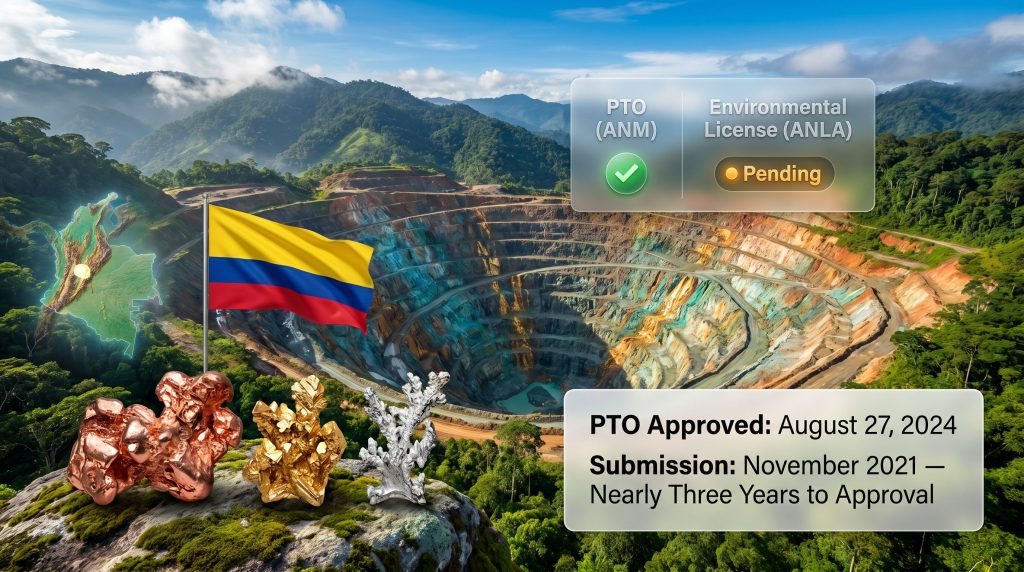
The ANM's formal approval of the Alacrán project's Mining Technical Work Plan on 27 August 2024 represented a substantive regulatory milestone, but its significance requires careful contextualisation. The original PTO submission was lodged in November 2021, placing the review period at approximately three years from filing to approval.
That timeline itself is instructive. It reflects not a straightforwardly slow bureaucracy, but a technically rigorous review process for a copper-gold-silver project of meaningful scale. A three-year PTO review suggests the ANM subjected the technical submission to serious scrutiny, which paradoxically strengthens the credibility of the approval outcome. Projects that receive rapid approvals in complex jurisdictions often face more questions later; a thorough technical review reduces the risk of approval challenges downstream.
The PTO approval for Alacrán carries significance beyond its face value as a procedural milestone. In a jurisdiction where institutional inconsistency has historically undermined investor confidence, a documented approval outcome from the ANM following rigorous review is a data point that meaningfully updates risk assessments for the entire Colombian mining development pipeline.
For project financing discussions, PTO approval is considered a genuine de-risking event. Lenders and equity investors evaluating copper development assets in emerging markets apply meaningful discounts to projects that have not yet demonstrated they can navigate the technical permitting stage. Alacrán has now cleared that bar.
The Alacrán Deposit: Geological Context and Strategic Positioning
The Alacrán license in Colombia mining projects centres on a copper-gold-silver deposit that has been characterised as one of the more significant base metals development opportunities in the country. Its commodity profile is strategically important: copper is the metal most directly exposed to accelerating electrification demand, while the gold and silver credits meaningfully improve project economics and provide natural hedging against copper price volatility during the development phase.
Colombia's geological setting for gold-copper exploration is genuinely prospective. The country occupies a position within the broader northern Andean arc where subduction-related magmatic activity has created conditions similar to those that generated a major copper system in Ecuador and Peru. What distinguishes Colombia is the relative immaturity of systematic exploration across this prospective ground, meaning Alacrán may represent the leading edge of a larger discovery cycle rather than an isolated occurrence.
From a global copper supply perspective, the timing matters considerably. The International Energy Agency and multiple independent analysts have documented a structural copper supply crunch emerging through the late 2020s and into the 2030s, driven by the lag between copper demand growth from electrification and the long lead times required to bring new mines into production. Projects like Alacrán that are advancing through permitting today could enter production during a period of acute supply constraint.
Environmental and Social Dimensions: The Outstanding Variable
The Alacrán project's environmental licensing process now represents the critical remaining pathway to construction authorisation. Industry observers consistently note that EIA processes in Colombia carry more political and community-driven variability than the technical PTO review. This is not unique to Colombia; across Latin America, social licence challenges have delayed or permanently altered major mining developments even after formal regulatory approvals were in progress.
Key environmental considerations for a copper-gold-silver project in Colombia's geographic context include:
- Water resource management: Colombia's high-rainfall tropical and sub-tropical environments create both water abundance and heightened sensitivity to contamination risk, making hydrological impact assessments particularly detailed
- Tailings storage: For a project of Alacrán's scale, tailings facility design and long-term management commitments are central to EIA outcomes and community acceptance
- Biodiversity baseline documentation: Colombia is one of the world's most biodiverse countries, and EIA requirements reflect this, often demanding multi-year ecological baseline studies before assessment conclusions can be drawn
- Community economic integration: Beyond environmental mitigation, projects are increasingly expected to articulate credible local employment and procurement commitments as part of their social licence frameworks
International financing standards add another layer of complexity. Projects seeking debt from multilateral institutions or international commercial banks typically must demonstrate alignment with IFC Performance Standards and, for larger syndicated facilities, the Equator Principles. These standards often exceed Colombian domestic regulatory minimums, meaning the environmental management framework required for project financing may be more demanding than what ANLA formally requires. Concerns around pollution and deforestation have also been raised by environmental observers monitoring the project's progress.
The next major ASX story will hit our subscribers first
What the Alacrán Precedent Means for Colombia's Broader Mining Pipeline
Scenario Modelling: Three Pathways Forward
| Scenario | Trigger Conditions | Likely Outcome for Colombian Mining Investment |
|---|---|---|
| Accelerated Development | Environmental licence approved within 12–18 months; project financing secured | Construction commences; sector confidence improves; exploration capital re-enters Colombia |
| Moderate Delay | EIA process extends 24–36 months; community consultations require design modifications | Financing timeline pushed; investor caution maintained but interest preserved |
| Stalled Development | Environmental licence denied or indefinitely deferred | Capital withdrawal from Colombian mining; reputational damage to the jurisdiction as a whole |
The stakes here extend well beyond a single project. Colombia's mining sector has accumulated a long list of projects that have stalled at various permitting stages over the past fifteen years. Investors in earlier-stage Colombian copper and gold assets are watching the Alacrán process closely because its outcome will either validate or invalidate the premise that large-scale permitting completion is achievable within the current regulatory architecture.
The Multiplier Effect on Exploration Capital
A demonstrable permitting pathway for Alacrán would carry meaningful signal value for Colombia's exploration sector. Junior mining companies and major producers evaluating grassroots copper targets in Colombia have historically discounted their risk-adjusted return assumptions for the country relative to Peru and Chile. A successful Alacrán development sequence would provide a concrete reference case that reduces the uncertainty premium applied to Colombian assets, potentially unlocking exploration capital that has been sitting on the sidelines.
This multiplier dynamic is well-documented in mining investment history. When Lundin Mining successfully developed the Chapada copper-gold mine in Brazil, it contributed to a period of meaningfully increased Brazilian exploration activity by demonstrating that complex South American jurisdictions could deliver development outcomes. A comparable demonstration in Colombia, which has been waiting for this kind of proof of concept for years, could catalyse disproportionate exploration interest relative to the direct scale of the Alacrán project itself. Indeed, the future copper mining landscape across Latin America may well hinge on precisely these kinds of jurisdictional breakthroughs.
Colombia's Mining Policy Environment: The Political Dimension
No analysis of the Alacrán license in Colombia mining projects is complete without acknowledging the political context. Colombia's mining sector has navigated significant shifts in regulatory philosophy across successive administrations, and the tension between resource revenue generation and environmental protection priorities has been particularly pronounced in recent political cycles.
The fiscal framework governing large-scale mining in Colombia includes royalty structures, capital expenditure treatment rules, and sector-specific tax provisions that influence investor return calculations alongside permitting outcomes. Changes to these fiscal parameters under different administrations have contributed to uncertainty that compounds the permitting risk premium investors apply.
What distinguishes the current moment is that the Alacrán PTO approval was formally delivered within this complex political environment, suggesting the ANM has maintained institutional consistency in its technical assessments despite the surrounding policy uncertainty. Whether ANLA demonstrates equivalent institutional stability through the EIA process will be the decisive test.
Frequently Asked Questions: Alacrán License and Colombian Mining
What is the Alacrán project in Colombia?
Alacrán is a copper-gold-silver mining development in Colombia currently advancing through the country's mandatory two-stage pre-construction permitting process. It is regarded as one of the most strategically significant base metals development projects in the Colombian mining pipeline.
What is a PTO in Colombian mining?
A PTO (Plan de Trabajos y Obras) is a Mining Technical Work Plan assessed and approved by Colombia's National Mining Agency (ANM). It documents the technical and operational design of a proposed mining operation and must be formally approved before construction can lawfully begin.
What two permits are required before construction can begin in Colombia?
Colombian law requires an approved PTO from the ANM and an Environmental License from ANLA following a completed EIA. Both must be in place before construction activity can legally commence.
When was the Alacrán PTO approved?
The ANM formally approved the Alacrán Mining Technical Work Plan on 27 August 2024, approximately three years after the original submission in November 2021.
Why does the environmental licence matter more than the PTO for investors?
The EIA and environmental licensing process involves community consultation, ecological assessment, and political dimensions that introduce considerably more variability than the technical PTO review. Historically, Colombian mining projects have encountered greater friction at the EIA stage, making ANLA's eventual determination the more consequential outstanding variable for Alacrán's construction timeline.
What would a successful Alacrán development mean for Colombian mining broadly?
It would provide a concrete proof of concept that large-scale copper mining development is achievable within Colombia's current regulatory framework, reducing the jurisdictional risk premium applied to other Colombian mining assets and potentially stimulating new exploration and development investment across the sector.
Disclaimer: This article is intended for informational purposes only and does not constitute financial or investment advice. Forecasts, scenario projections, and timeline references involve inherent uncertainty. Readers should conduct independent due diligence before making any investment decisions related to Colombian mining assets or projects discussed herein.
Want to Track the Next Major Copper Discovery Before the Broader Market Does?
Discovery Alert's proprietary Discovery IQ model delivers real-time alerts on significant ASX mineral discoveries — including copper-gold projects with the kind of transformative potential explored in this article — turning complex mineral data into actionable insights for investors at every level. Explore historic discoveries and their returns on Discovery Alert's dedicated discoveries page, or begin your 14-day free trial today to position yourself ahead of the market.