July 20, 2026
When Winter Strikes at Altitude: Understanding Operational Risk in High-Andean Copper Mining
Few industrial environments on earth combine geographic isolation, extreme weather exposure, and continuous production pressure quite like open-pit and underground copper mines operating above 2,500 metres in the Chilean Andes. Every austral winter, frontal weather systems push across the central zone of Chile, depositing heavy snowfall, suppressing visibility, and destabilising the steep terrain surrounding some of the world's most productive copper operations. For engineers, safety managers, and production planners, Codelco sistema frontal Andina y El Teniente operaciones represent managed risks, calibrated against years of meteorological data, geotechnical observation, and hard-won operational experience.
Understanding how these two divisions respond to a sistema frontal reveals something deeper than emergency protocol. It exposes the structural differences between mining models, the engineering ingenuity embedded in Andean infrastructure, and the longer-term production challenges that weather events can temporarily amplify but rarely cause on their own. Furthermore, the Chile copper price outlook adds another dimension to how operational continuity at these mines affects broader market dynamics.
When big ASX news breaks, our subscribers know first
The Anatomy of an Andean Weather Front and Its Mining Implications
A sistema frontal, in the Chilean meteorological context, refers to an organised mass of cold air advancing from the Pacific that collides with the topographic barrier of the Andes. The result is orographic lift: moisture-laden air rises rapidly, cools, and releases precipitation. At lower elevations this means rain. Above the isoterma cero (the zero-degree isotherm), which during winter storms can descend to relatively modest altitudes, the precipitation falls as snow and accumulates rapidly.
For high-cordillera mining operations, the consequences cascade across multiple dimensions simultaneously:
- Snowpack accumulation can exceed 100 centimetres in exposed open-pit sectors within a single frontal event
- The descending zero-degree isotherm elevates the snow accumulation zone, sometimes reaching haul road networks and infrastructure corridors
- Slope instability increases sharply as snow loading adds mass to terrain already subject to geological movement
- Visibility drops to levels that make equipment operation unsafe, particularly for large haul trucks and blasting crews
- Interior access roads can become impassable, severing the connection between production faces and processing infrastructure
What makes these conditions particularly demanding is their unpredictability at the micro-scale. Regional weather forecasts provide advance warning, but the precise intensity, timing, and spatial distribution of snowfall across a complex Andean topography can shift significantly within hours. This forces operational teams to maintain real-time decision frameworks rather than relying solely on pre-event planning.
The Regulatory Framework: Sernageomin and the Ministry of Mines
Chile's geological and mining safety regulator, Sernageomin, operates a continuous monitoring framework during significant weather events. During active sistemas frontales, the agency extends its mass movement surveillance across a corridor stretching from the Atacama Region in the north to La Araucanía in the south, with differentiated attention across four geographic zones:
| Geographic Zone | Primary Weather Risk |
|---|---|
| Coastal and Coastal Range | Soil saturation and landslides |
| Central Valleys | Increased river flow and bank erosion |
| Pre-Cordillera | Slope instability and access restrictions |
| High Andes | Zero-degree isotherm descent, snowpack, low caudal risk |
Large-scale mining operations are required under Chilean mining regulations to operate with certified contingency plans during high-risk weather events. Sernageomin verifies the activation of these plans and maintains structural monitoring of relaves (tailings) deposits across its jurisdiction. The Ministry of Mines issues preventive alerts reinforcing the obligation to assess conditions across road networks, slope stability, and worker exposure zones.
División Andina: Engineering for Resilience at 3,500 Metres
Operational Geography and the Challenge of High-Altitude Mining
División Andina sits in the Andes of the Valparaíso Region at altitudes exceeding 3,500 metres above sea level, making it one of the highest-elevation copper mining operations in Chile. The division runs a hybrid model, combining underground extraction with open-pit (rajo abierto) operations, and the interaction between these two extraction environments creates both operational flexibility and specific vulnerability during severe winter weather.
The open-pit component is directly exposed to surface conditions. During documented frontal events, snowfall accumulation of up to 103 centimetres has been recorded in the mina rajo sector. At these accumulation levels, continued surface operation becomes untenable from both safety and equipment performance perspectives.
The Sistema Traspaso Mina Planta: A Landmark of High-Altitude Engineering
The engineering solution that allows Andina to pursue near-continuous annual production despite its extreme climatic exposure is the Sistema Traspaso Mina Planta, a purpose-built infrastructure system that decouples the primary crushing process from surface weather conditions.
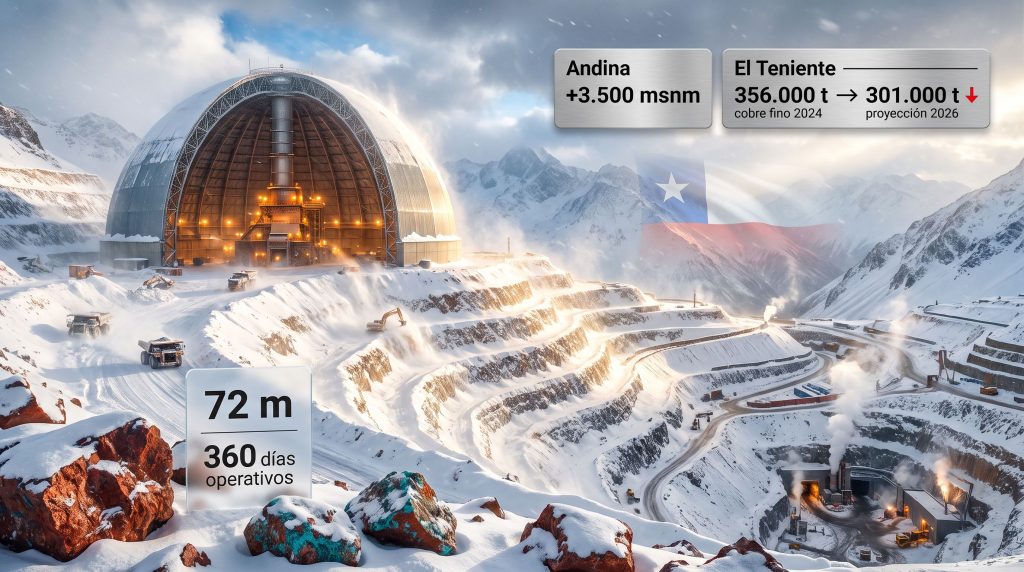
The centrepiece of this system is a primary crusher housed within an underground cavern, protected by a dome structure rising 72 metres in height. This design choice is not cosmetic. By relocating the most critical mineral size-reduction step underground, Andina eliminates weather exposure at the point in the processing chain where interruption would have the most severe downstream consequences.
The Sistema Traspaso Mina Planta is a textbook example of design-for-environment engineering: rather than hardening surface infrastructure against weather, the system relocates the critical process node to an environment where weather is irrelevant.
The result is a target operational availability of approximately 360 days per year, an extraordinary figure for a mine operating in one of the most weather-intensive mountain environments in South America. When surface operations must halt during an intense frontal system, the underground crusher continues to operate, maintaining the processing chain as long as ore feed from underground workings can be sustained.
Preventive Surface Shutdown Protocols
When a frontal system crosses defined intensity thresholds, Andina's safety teams initiate a structured preventive surface shutdown sequence. This is not a reactive emergency response but a pre-planned protocol activated according to monitored weather and geotechnical parameters. The triggers include:
- Worker exposure risk under conditions of active snowfall and restricted visibility
- Haul road instability in surface sectors connecting the open pit to processing infrastructure
- Elevated avalanche probability on slopes adjacent to active working faces
- Equipment risk from snowpack accumulation and freezing conditions on exposed machinery
Critically, the restart process following a surface shutdown is gradual and staged, with decisions made in real time by on-site safety and operations teams assessing actual ground conditions rather than weather forecasts alone. This staged reactivation minimises the risk of exposing workers and equipment to residual hazards in the immediate post-storm period.
TEM Walls and Avalanche Control Infrastructure
Beyond the Sistema Traspaso, Andina deploys TEM walls (Tierra Estructuralmente Mejorada, or Mechanically Stabilised Earth structures) in sectors exposed to avalanche risk. These engineered barriers are designed to absorb the kinetic energy of moving snow masses and protect infrastructure and personnel working in rajo sectors that cannot be fully relocated underground.
This layered approach to avalanche risk management reflects the operational philosophy at Andina: multiple redundant systems rather than reliance on any single protective measure.
Tailings Monitoring at Ovejería During Frontal Events
The depósito de relaves Ovejería and its associated transport system receive intensified monitoring during weather events. Tailings facilities represent one of the highest-consequence risk categories in Chilean mining regulation, and Sernageomin's active surveillance of this structure during winter fronts is a standard but critical component of overall risk management. Reported assessments through available event records have confirmed no structural anomalies at the facility.
División El Teniente: Structural Resilience and the Shadow of July 2024
Operational Profile of the World's Largest Underground Copper Mine
División El Teniente, located near Machalí in the O'Higgins Region approximately 80 kilometres south of Santiago at around 2,500 metres above sea level, occupies a fundamentally different operational risk profile compared to Andina. Recognised as the world's largest underground copper mine by reserve volume and annual output capacity, El Teniente's predominantly subterranean extraction model provides inherent insulation from surface weather conditions.
Recent production data underscores the division's output significance while also revealing its current vulnerabilities:
| Year | Production (Tonnes of Copper) |
|---|---|
| 2024 | 356,000 |
| 2026 (projected) | 301,000 |
The gap between these figures reflects not weather-related disruption but the lasting operational consequences of the July 2024 rockburst incident, which resulted in the deaths of six workers and forced the closure of a significant production sector. This event has reshaped the division's safety governance, regulatory oversight structure, and production outlook in ways that outlast any single winter storm. Indeed, Codelco production decline has become a pressing concern for the industry as a result.
How El Teniente Manages Frontal Systems Without Halting Core Operations
The underground nature of El Teniente's primary extraction processes means that frontal weather systems affect the division in a more contained and specific way than at Andina. During active snowfall events, the division applies targeted rather than broad-based operational adjustments:
- Ore dispatch from the open-pit rajo component is suspended when snow accumulation creates slope stability risks
- Transport routes carrying mineral from production areas to processing receive continuous condition monitoring
- Preventive controls are applied specifically to ladera (slope) sectors where snow loading could affect haulage infrastructure integrity
- Underground operations continue under reinforced operational monitoring protocols
The contrast between Andina's surface shutdown and El Teniente's selective controls illustrates a fundamental principle of high-altitude mining risk management: the dominant extraction model determines the nature and scope of weather-induced operational response.
The July 2024 Rockburst: Context, Consequences, and Protocol Transformation
The July 2024 estallido de rocas at El Teniente was not a weather event. It was a seismic-geomechanical event in which stressed rock mass released energy suddenly, with catastrophic consequences for workers in the affected sector. Understanding this distinction is essential for accurate risk categorisation in the context of Codelco sistema frontal Andina y El Teniente operaciones analysis.
The incident's impact on the division has been multi-dimensional:
| Dimension | Post-Incident Status |
|---|---|
| Annual production target | Revised downward; 2026 projection at 301,000 tonnes |
| Safety protocols | Comprehensive review and reinforcement of geomechanical risk procedures |
| Regulatory return-to-work | Phased resumption under direct Sernageomin supervision |
| Expansion planning | Revised timelines for Nivel Teniente 12 development |
Rockbursts are a known and studied hazard in deep underground mining globally. They occur when the stress concentration around excavations exceeds the strength of the surrounding rock mass, releasing stored strain energy. At El Teniente's depths, where centuries of geological loading have created highly stressed rock conditions, the management of seismicity is an ongoing technical discipline requiring continuous monitoring, modified extraction sequences, and dynamic adjustment of mine design.
Nivel Teniente 12: The Long-Term Strategic Response to Grade Decline
The production trajectory at El Teniente reflects a challenge common to mature porphyry copper deposits: declining ore grades as mining advances through the highest-grade core of the orebody. The Proyecto Nivel Teniente 12, the division's flagship development programme, addresses this through vertical mine extension rather than grade optimisation.
Located approximately 300 metres below current production levels, Nivel Teniente 12 targets an estimated 2,000 million additional tonnes of mineral reserves and is designed to extend the mine's operational life by more than 50 years. This project represents the structural answer to the long-term grade dilution challenge, though its development timeline has been subject to revision in the post-2024 operational and safety review environment. In addition, major copper project development elsewhere in the world highlights just how competitive the global pipeline of new copper supply has become.
Comparative Analysis: Andina vs. El Teniente in Climate Resilience
| Variable | División Andina | División El Teniente |
|---|---|---|
| Elevation | +3,500 m above sea level | ~2,500 m above sea level |
| Mining model | Hybrid: underground + open pit | Predominantly underground |
| Frontal system response | Preventive surface shutdown + staged restart | Selective controls, rajo ore dispatch suspended |
| Key resilience infrastructure | 72m dome + Sistema Traspaso Mina Planta | Slope monitoring + transport route protocols |
| Annual operating day target | ~360 days | High structural continuity |
| Primary climate risk | Heavy snowfall, avalanche, visibility | Slope accumulation, transport restriction |
| Active tailings monitoring | Ovejería deposit | Division-specific systems under Sernageomin oversight |
The next major ASX story will hit our subscribers first
Production Risk: Separating Weather from Structural Challenges
A critical analytical distinction for anyone assessing Codelco's production outlook is the difference between transient weather-related disruptions and structural production risks. Winter frontal systems at Andina and El Teniente generate short-term operational pauses measured in hours to days. The resilience infrastructure at both divisions, particularly Andina's underground crushing system, is specifically engineered to contain the production impact of these events.
The more consequential risk categories, however, operate on entirely different time scales:
| Risk Category | Representative Event | Production Impact Duration |
|---|---|---|
| Climatic (transient) | Winter frontal system | Hours to days |
| Geomechanical (structural) | July 2024 rockburst, El Teniente | Weeks to months |
| Geological (long-term) | Progressive grade decline | Decades |
| Development (capital) | Nivel Teniente 12 delays | Years of deferred recovery |
Weather events matter operationally, but the investor and analyst focus that matters most for Codelco's medium and long-term copper output belongs firmly in the structural and geological categories. Consequently, Codelco output recovery will depend far more on resolving these deeper challenges than on managing any individual winter season.
The sistema frontal protocols at both Andina and El Teniente are, in this sense, a demonstration of operational maturity rather than a signal of systemic vulnerability. Furthermore, the future of copper mining will increasingly depend on how operations like these continue to balance climatic resilience with the demands of long-term reserve development and safety governance.
Disclaimer: Production figures, project timelines, and reserve estimates cited in this article are sourced from publicly available information and should not be construed as forward-looking guarantees. Mining operations are subject to geological, regulatory, technical, and market risks that can cause actual outcomes to differ materially from expectations.
Want to Stay Ahead of the Next Major Copper Discovery on the ASX?
Discovery Alert's proprietary Discovery IQ model delivers real-time alerts the moment significant mineral discoveries are announced on the ASX, transforming complex geological data into clear, actionable investment insights — explore historic discoveries and their returns to understand the scale of opportunity, then begin your 14-day free trial at Discovery Alert to position yourself ahead of the broader market.