July 20, 2026
The Infrastructure Advantage Reshaping How Major Copper Mines Extend Their Lives
Across the global copper industry, a quiet strategic revolution is underway. Rather than committing billions to greenfield mine development in untested jurisdictions, the world's largest copper producers are increasingly turning inward, directing exploration capital toward the geological periphery of their existing operations. This near-mine exploration model is not simply a cost-cutting measure; it represents a fundamental rethinking of how mature mining districts create long-term value. Nowhere is this philosophy more visible than in the Carajás Mineral Province of northeastern Brazil, where Vale Base Metals Sossego satellite exploration is methodically unlocking a network of copper deposits surrounding its long-running mining complex.
The logic is compelling: proven geology, established processing infrastructure, existing workforce, and an operational regulatory relationship all reduce the risk profile of satellite development far below that of standalone projects. For investors and industry observers tracking the ongoing copper supply crunch in the context of accelerating electrification demand, the program offers a textbook case study in how mature assets can be transformed into multi-decade growth platforms.
When big ASX news breaks, our subscribers know first
Understanding the Carajás Copper District and Why It Keeps Delivering
The Carajás Mineral Province, located in the state of Pará in northern Brazil, is one of the most mineral-endowed geological corridors on the planet. Originally renowned for its extraordinary iron ore concentrations, Carajás has progressively revealed itself as a world-class copper district, hosting deposits that rival the grade profiles of Chile's Atacama region and the Democratic Republic of Congo's Copperbelt.
The district's copper endowment is predominantly expressed through Iron Oxide Copper-Gold (IOCG) mineralisation, a deposit style characterised by large volumes of iron oxide alteration hosting economic concentrations of copper and, in many cases, gold. Understanding the full IOCG deposit features is significant for several reasons that directly influence mine economics:
- They tend to form within structurally controlled corridors, meaning that once a major deposit is identified, the surrounding geology is predisposed to hosting additional satellite orebodies along the same structural trend
- Grade distributions within IOCG systems often exhibit strong continuity over substantial vertical and lateral extents, supporting long mine lives
- The alteration footprints of IOCG systems are large relative to the mineralised core, making them detectable through geophysical surveying methods before extensive drilling is required
- Carajás-style IOCG deposits routinely host copper grades that place them among the highest-quality open-pittable resources outside of Central Africa
This geological architecture is precisely why Vale Base Metals' satellite exploration thesis at Sossego carries structural credibility. The province is not simply a collection of isolated deposits; it is a mineralised system that rewards systematic, patient exploration within established corridors.
The Sossego Complex: Two Decades of Production and a New Strategic Phase
The Sossego Mining Complex has been producing copper in southeastern Pará State for more than twenty years, making it one of Brazil's most enduring copper operations. Over that period, the processing infrastructure, tailings management systems, access roads, power supply, and community relationships have been progressively refined, creating an operational platform that would cost hundreds of millions of dollars to replicate from scratch.
As with any long-life open-pit operation, Sossego now faces the natural arithmetic of resource depletion within its original pit shells. The Sequeirinho and Sossego pits, which have defined the complex's production profile for two decades, are approaching maturity. This is the inflection point at which most mining operations face a binary choice: accept production decline, or find a credible pathway to replenishment.
Vale Base Metals has chosen the latter, and the mechanism it has selected reflects the broader near-mine exploration trend gaining momentum across the global copper sector.
Mapping the Satellite Network: Five Deposits, One Platform
Surrounding the core Sossego infrastructure lies a constellation of copper deposits at varying stages of exploration and development. Each carries its own geological characteristics, timeline, and development priority, but all share the critical advantage of proximity to the existing processing hub.
Satellite Deposit Status and Development Sequencing
| Satellite Deposit | Development Stage | Key Characteristic | Near-Term Priority |
|---|---|---|---|
| Bacaba | Environmental license received (June 2025) | Validated open-pit IOCG mineralisation | Highest — production target ~2028 |
| Cristalino | Active drilling / high-grade zone extensions confirmed | Expanding mineralised footprint | Medium-term |
| Project 118 | Feasibility stage | Part of South Hub cluster | Medium-term |
| Barão Norte | Post-Bacaba development candidate | Identified open-pit resource | Longer-term |
| Visconde | Exploration stage | Identified resource | Longer-term |
Bacaba sits approximately 9 kilometres from the original Sossego processing plant, a distance short enough to enable haul road construction and reagent supply logistics at a fraction of the cost associated with remote mine development. This proximity factor is not incidental; it is the central value driver that makes satellite development economically superior to greenfield alternatives in this context.
"The near-mine exploration model effectively compresses the capital intensity curve of new mine development. Infrastructure that took decades and billions of dollars to build becomes a shared asset, dramatically altering the economics of bringing adjacent deposits into production."
The 2025 Drilling Campaign: What 31,000 Metres Revealed
Vale Base Metals conducted an extensive drilling campaign across the Sossego complex in 2025, totalling approximately 31,000 metres of drilling. The program served a dual strategic purpose: delineating the satellite deposits at surface and near-surface levels, while simultaneously testing the depth extensions of mineralisation beneath the existing Sequeirinho, Sossego, and Mata pit shells.
This dual-purpose design reflects a sophisticated understanding of how IOCG systems behave at depth. In many Carajás-style deposits, the mineralised core does not terminate at the base of the current pit design; rather, it continues downward at grades that may support underground mining economics once open-pit extraction is complete. Well-structured exploration drilling programs of this kind represent an efficient allocation of exploration capital.
Key Outcomes From the 2025 Program Included:
- Full orebody delineation at Bacaba, confirming open-pit mining suitability based on mineralisation geometry and grade continuity
- High-grade zone extensions at Bacaba beyond the previously modelled resource boundary
- Confirmation of expanding mineralised zones at Cristalino, extending the known deposit footprint in multiple directions
- Identification of subsurface mineralisation beneath the existing pit infrastructure, establishing a longer-term underground development option
The Cristalino results are particularly noteworthy from a resource growth perspective. Deposit footprint expansion in IOCG systems often follows predictable structural controls, meaning that the confirmation of continuity beyond known boundaries significantly increases the probability of discovering additional mineralisation along strike and at depth.
Bacaba: The Regulatory Inflection Point That Changes Everything
The receipt of a preliminary environmental license for Bacaba in June 2025 represents one of the most significant de-risking events in the Sossego complex's recent history. In Brazil's mining permitting framework, the preliminary environmental license (Licença Prévia) is the first of three formal licensing stages required before a mine can enter construction and production. Its receipt signals that regulatory authorities have assessed the project's environmental viability and found it acceptable in principle.
This milestone matters to industry analysts and capital allocators for a specific reason: it converts Bacaba from an exploration-stage asset with regulatory uncertainty into a development-stage asset with a defined permitting pathway. The risk-adjusted value of the deposit increases substantially at this transition point, even before a single tonne of ore has been moved.
The remaining licensing steps — specifically the Installation License (Licença de Instalação) and the Operating License (Licença de Operação) — are sequentially dependent on construction progress and operational readiness. Furthermore, while these steps carry their own timelines and conditions, the receipt of the preliminary license removes the highest-uncertainty hurdle in the Brazilian permitting process.
"Investors and analysts tracking the Brazilian mining permitting framework should note that the preliminary environmental license in Brazil is often the most contested and time-consuming stage of the approvals process. Its receipt for Bacaba in June 2025 therefore represents a disproportionately positive signal about the project's regulatory trajectory."
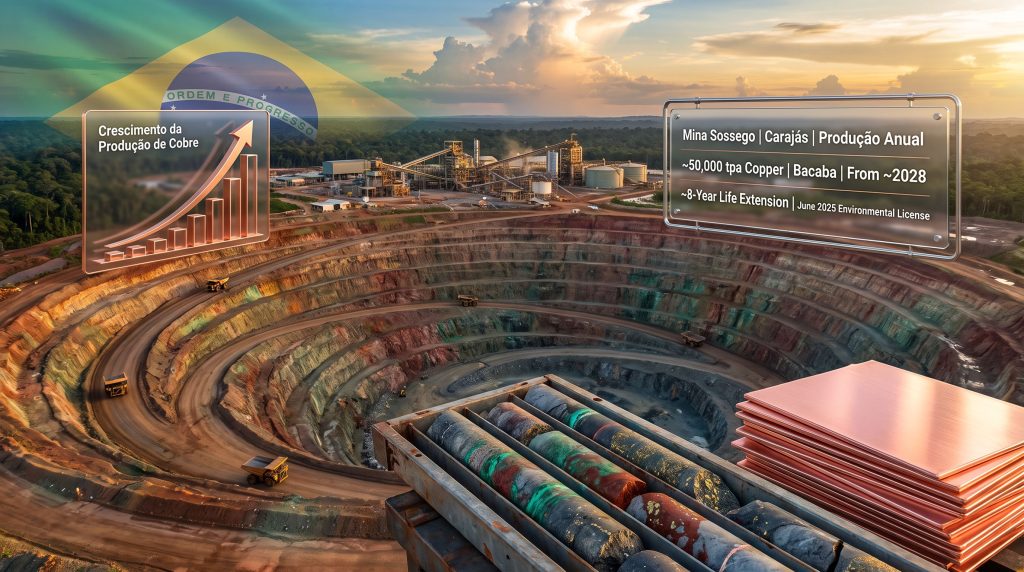
With Bacaba's development targeting a production commencement date of approximately 2028, the complex has a credible, time-bounded pathway to replacing depleting production from the original pits with approximately 50,000 tonnes of copper per annum from the new satellite operation. Vale Base Metals' 2025 exploration results confirm that copper mineral reserves and resources increased 6% to 53 million tonnes, underscoring the effectiveness of this near-mine strategy.
The next major ASX story will hit our subscribers first
Production Continuity and the Eight-Year Life Extension
The contribution of Bacaba to the Sossego complex extends beyond its annual production rate. Industry analysts tracking mine life economics understand that the value of a life extension is not linear; it compounds through the preservation of infrastructure utilisation rates, workforce continuity, and community investment already embedded in the operation.
A processing plant operating below its design throughput capacity is an expensive asset to maintain. However, Bacaba's development is projected to extend Sossego's operational life by approximately eight years, ensuring that the complex's processing capacity remains productively deployed rather than being wound down ahead of its economic expiry.
The capital efficiency of this approach is substantial. When measured on a per-tonne-of-copper basis, the cost of developing Bacaba using shared Sossego infrastructure is materially lower than constructing an equivalent standalone operation. This cost advantage flows directly through to project economics, supporting stronger margins and faster payback timelines.
Vale's Carajás Copper Ambition: The Doubling Target
The Vale Base Metals Sossego satellite exploration program does not exist in isolation. It forms a central component of Vale Base Metals' stated ambition to double copper production capacity in the Carajás region over the coming decade. This target reflects a conviction that the geological endowment of the province remains substantially underexplored relative to its potential.
The phased development pipeline at Sossego illustrates how this ambition is being translated into operational reality:
- Phase 1 (Current to ~2028): Bacaba development, leveraging the June 2025 environmental license, targeting approximately 50,000 tonnes per annum copper production
- Phase 2 (Post-Bacaba ramp-up): Advancement of Barão Norte and Visconde through feasibility and permitting stages
- Phase 3 (Parallel development): Continued drilling and feasibility work at Cristalino and Project 118, expanding the resource base for the South Hub cluster
- Longer-Term: Underground extensions beneath the existing pit shells at Sequeirinho, Sossego, and Mata, potentially unlocking a separate underground mining operation to complement open-pit production
This sequencing reflects a capital-disciplined approach to growth, prioritising the most advanced and de-risked assets first while maintaining an active exploration pipeline for future production cycles.
Why IOCG Geology Creates Structural Upside at Sossego
One dimension of the Sossego satellite story that receives insufficient attention is the geological mechanism that makes satellite discovery probable rather than merely possible. IOCG systems like those in Carajás form within large-scale structural corridors where hydrothermal fluids have migrated over geological timescales, depositing copper and iron oxide minerals in structurally favourable locations.
The critical insight is that these corridors can extend for tens of kilometres, and the known deposits within them represent the points where surface exposure, historical exploration access, or geophysical anomalies first directed drill programs. Consequently, significant mineralisation can exist between known deposits, below current pit floors, or along structural extensions that have not yet been systematically tested.
This is why the 2025 drilling results at Cristalino — specifically the confirmation of mineralisation beyond previously known boundaries — carry exploration significance beyond the immediate resource increment. Each zone extension reinforces the geological model and increases the probability of additional discoveries within the same structural corridor.
Brazilian Copper in the Global Supply Context
The global copper market is entering a period of sustained supply tightness driven by the accelerating deployment of electric vehicles, grid-scale energy storage, and renewable energy infrastructure. Major commodity research institutions have consistently projected that demand growth will outpace new mine supply additions through the late 2020s and into the 2030s, absent a significant acceleration in project development.
Brazil's Carajás district is structurally well-positioned within this supply landscape. Its IOCG deposits offer grade profiles and scale characteristics that support competitive production costs relative to the declining-grade porphyry copper deposits that dominate output at the largest copper mines in Chile and Peru. When measured against competing copper jurisdictions, Carajás benefits from:
- Lower average strip ratios compared to many mature porphyry copper open pits in the Andes
- Established export logistics through Brazil's northern port network
- A regulatory framework that, while complex, has a documented track record of approving major copper projects within the Carajás corridor
- Grade profiles that compare favourably with global copper mine averages, which have been declining steadily for decades
Key Metrics Summary: Sossego Satellite Program at a Glance
| Metric | Detail |
|---|---|
| Complex operational history | More than 20 years of copper production |
| 2025 drilling program | ~31,000 metres across satellite targets and pit depth extensions |
| Bacaba environmental license | Preliminary license received June 2025 |
| Bacaba projected copper output | ~50,000 tonnes per annum |
| Bacaba production start target | ~2028 |
| Sossego life extension from Bacaba | ~8 additional years |
| Bacaba proximity to processing plant | ~9 km |
| Vale Carajás copper growth target | Doubling production capacity over the next decade |
| Mineralisation style | Iron Oxide Copper-Gold (IOCG) |
| Known satellite deposits | Bacaba, Cristalino, Barão Norte, Visconde, Project 118 |
Frequently Asked Questions: Vale Base Metals Sossego Satellite Exploration
What Makes Bacaba Different From a Typical Greenfield Copper Project?
Bacaba benefits from proximity to more than two decades of existing Sossego infrastructure, including a processing plant, tailings facilities, access roads, and workforce. This dramatically reduces the capital expenditure required to bring the deposit into production compared with an equivalent standalone mine build in a remote location.
What Does the June 2025 Environmental License Actually Permit?
The preliminary environmental license (Licença Prévia) in Brazil's three-stage permitting system confirms regulatory acceptance of a project's environmental viability in principle. It does not authorise construction, but it is typically the most contested stage of the approvals process and its receipt significantly de-risks the subsequent permitting pathway.
Why Is IOCG Mineralisation Particularly Well-Suited to Satellite Deposit Discovery?
IOCG systems form within large structural corridors that can host multiple discrete orebodies. Once a major deposit is identified and the structural controls are understood, adjacent exploration within the same corridor carries a higher probability of success than typical greenfield exploration. This is the geological basis for Vale's satellite exploration strategy at Sossego.
How Does Bacaba Address Sossego's Depletion Challenge?
The original Sossego pit shells have been producing for more than two decades and are approaching the limits of economic open-pit extraction. Bacaba, targeting production from approximately 2028, is designed to replace this depleting production with approximately 50,000 tonnes of copper per annum, extending the complex's operational life by roughly eight years. Thorough mining feasibility studies for each satellite target underpin these projections.
What Is the Significance of the Cristalino Drilling Results From 2025?
The 2025 drilling at Cristalino confirmed mineralisation extending beyond previously mapped resource boundaries in multiple directions. In IOCG systems with strong structural controls, boundary extensions typically increase confidence in the geological model and raise the probability of further discoveries along strike and at depth. Furthermore, satellite remote sensing technology is increasingly being used to complement ground-based exploration, potentially accelerating the identification of additional targets across the broader Carajás corridor.
Disclaimer: This article contains forward-looking statements, projections, and analytical commentary based on publicly available information and geological principles. Production targets, timelines, and resource estimates are subject to change based on ongoing exploration results, permitting outcomes, and operational conditions. This article does not constitute financial advice. Readers should conduct independent due diligence before making investment decisions.
Want to Track the Next Major Copper Discovery Before the Market Does?
Discovery Alert's proprietary Discovery IQ model delivers real-time alerts the moment significant mineral discoveries are announced on the ASX, transforming complex geological data into actionable investment insights for both short-term traders and long-term investors — explore Discovery Alert's dedicated discoveries page to understand how historic finds have generated substantial returns, and begin your 14-day free trial today to position yourself ahead of the broader market.