July 20, 2026
When Climate Meets Commodity: The Hidden Vulnerability in Chile's Copper Belt
Copper mining in Chile's Atacama corridor has long been treated as one of the most predictable industrial activities on the planet. The region's hyper-arid climate, world-class ore grades, and decades of accumulated infrastructure created an operating environment that miners could almost set their watches by. Yet a quiet shift is underway. Episodic extreme precipitation events, once considered statistical anomalies in one of the driest places on Earth, are increasingly disrupting mine plans, cascading through quarterly production figures, and forcing a rethink of operational resilience across the entire corridor.
South32 Q4 copper output declines at Sierra Gorda offer a precise case study in how these climate-driven shocks interact with geological grade cycles, labour cost obligations, and energy pricing to create compounding pressure on near-term production numbers, even when the long-term asset case remains compelling.
When big ASX news breaks, our subscribers know first
Breaking Down the Q4 Production Shortfall at Sierra Gorda
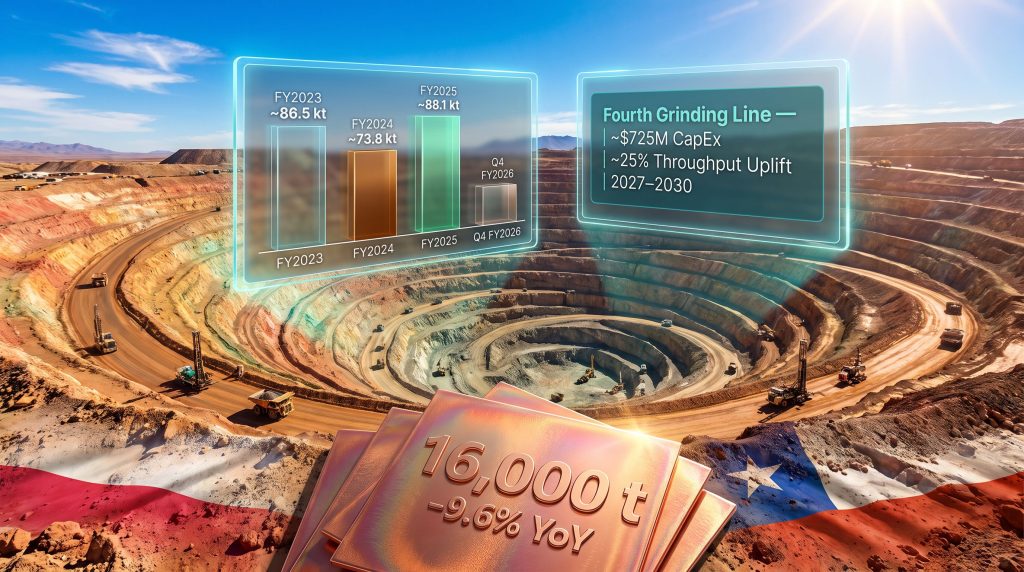
The headline number from South32's June quarter update was a payable copper output figure of 16,000 tonnes from its 45% stake in Sierra Gorda. That figure sat below the prior year's equivalent of 17,700 tonnes and missed the Visible Alpha analyst consensus of 17,500 tonnes by approximately 1,500 tonnes, representing a shortfall of roughly 8.6% against market expectations.
| Metric | Figure |
|---|---|
| Q4 FY2026 Payable Copper Output (S32 45% share) | 16,000 t |
| Prior Year Q4 Equivalent | 17,700 t |
| Analyst Consensus Estimate (Visible Alpha) | 17,500 t |
| Year-on-Year Variance | -9.6% |
| Consensus Miss | ~-8.6% |
On paper, a ~9.6% year-on-year production decline looks significant. In context, however, it reflects a specific and traceable chain of events rather than a structural breakdown in the mine's operating capability.
The Rainfall Cascade: How Weather Disruption Carries Forward Between Quarters
The root cause of the Q4 shortfall traces back to the March quarter, when heavy rainfall temporarily suspended processing operations at Sierra Gorda by restricting physical access to key mining areas. This distinction matters more than it initially appears.
When a processing plant is suspended due to access restrictions rather than equipment failure, the downstream effects are not confined to the quarter in which the disruption occurs. Lost mining momentum, deferred ore delivery schedules, and reduced stockpile buffers all create a drag that rolls into the following quarter's output. The June quarter result effectively absorbed the tail end of a March quarter disruption, which is why the weather event registered in two consecutive sets of production figures rather than one.
What makes this particularly notable is the climate context. The Antofagasta region of Chile is classified as one of the most arid environments on Earth. Yet increasing climate variability across the Atacama corridor means that rare but intense rainfall events are becoming a credible operational risk category — one that mine planners and investors will likely need to model with greater frequency in the years ahead. Furthermore, this dynamic is relevant to understanding the broader Chile copper market outlook and its implications for global supply.
FY2027 Cost Escalation: Understanding the Two-Driver Problem
Beyond the production miss, South32 flagged that operating unit costs at Sierra Gorda for FY2027 are expected to run approximately 10% above the FY2026 forecast baseline. Two identifiable factors are responsible.
1. Timing of a One-Off Workforce Payment
The first driver is a previously disclosed obligation related to a workforce payment that falls within the FY2027 cost window. This is not an unexpected cost item — it was communicated in advance — but its concentration within a single fiscal year creates a temporary spike in the unit cost profile. In large open-cut mining operations, labour agreements frequently include periodic lump-sum payments tied to enterprise bargaining cycles, and Sierra Gorda's joint venture structure under KGHM's operational majority means these agreements are governed by Chilean labour frameworks.
2. Higher Diesel Prices
The second driver is elevated diesel pricing, and this one warrants deeper analysis than it typically receives in production updates.
Open-cut porphyry copper mines are extraordinarily fuel-intensive operations. Haul trucks at large-scale operations of Sierra Gorda's size can consume thousands of litres of diesel per operating day, and the fleet count required to maintain stripping ratios at depth compounds this exposure dramatically. In remote or high-elevation operations, logistics costs further amplify the landed price of diesel relative to more accessible mine sites.
"A 10% unit cost increase driven by identifiable, time-bounded factors is meaningfully different from structural cost inflation driven by ore body deterioration or permanent energy price shifts. Investors who conflate the two risk misreading the asset's medium-term economics."
The combination of a one-off labour obligation and elevated diesel costs creates what analysts typically categorise as a cost spike rather than a cost step-change — a temporary elevation that normalises once the discrete trigger events pass.
Sierra Gorda's Production History: Grade Cycles and Recovery Patterns
To properly contextualise the Q4 FY2026 result, it is worth examining Sierra Gorda's multi-year production trajectory. The mine has demonstrated significant output variability, largely tied to ore grade sequencing within the mine plan.
| Period | Payable Cu Equivalent | YoY Change | Primary Driver |
|---|---|---|---|
| FY2023 | ~86.5 kt | Baseline | Established production profile |
| FY2024 | ~73.8 kt | -15% | Lower scheduled ore grades |
| FY2025 | ~88.1 kt | +20% | Grade recovery, improved Mo recoveries |
| Q4 FY2026 | 16.0 kt (quarterly) | -9.6% YoY | Weather disruption, operational lag |
This pattern reveals something important about Sierra Gorda's geology that is frequently underappreciated in short-term production commentary. Sierra Gorda is a large-scale porphyry copper-molybdenum deposit, and porphyry systems are inherently characterised by broad, disseminated ore zones with meaningful internal grade variability. As the open pit progressively deepens and moves through different ore domains, scheduled grade changes are a normal and planned feature of the mine sequence, not a sign of geological deterioration.
Porphyry Deposits and Grade Sequencing: What Investors Need to Know
Porphyry copper deposits are the workhorses of global copper supply, accounting for approximately 60–65% of the world's copper production. Their defining characteristics include:
- Very large tonnage ore bodies with relatively low but consistent copper grades, typically ranging from 0.3% to 0.8% copper
- Concentric zonation patterns where higher-grade cores are surrounded by lower-grade peripheral zones
- Molybdenum as a frequent by-product, which provides meaningful revenue diversification
- Open-pittable geometries that enable high-volume, low-cost bulk mining methods
- Predictable but planned grade variability as the pit progresses through different mineralisation zones
For Sierra Gorda specifically, the FY2024 output decline to approximately 73.8 kt was not a surprise to mine planners. It reflected a passage through lower-grade scheduled ore zones that was already accounted for in the long-term mine plan. The subsequent FY2025 recovery to approximately 88.1 kt confirmed that the ore body's higher-grade domains remained accessible and productive once the mine sequence progressed appropriately.
The Q4 FY2026 quarterly result should be interpreted through the same lens. Weather-driven disruptions can temporarily misalign ore delivery with processing schedules, but they do not alter the underlying geological endowment of the deposit.
The Fourth Grinding Line: A 25% Throughput Uplift in Context
The most strategically significant element of Sierra Gorda's near-term outlook is not the quarterly production miss but the joint venture's formally approved expansion of processing capacity through a fourth grinding line.
| Parameter | Detail |
|---|---|
| Expansion Type | Fourth Grinding Line |
| Throughput Capacity Uplift | ~25% |
| Total Growth CapEx | ~$725M (100% JV basis) |
| South32 Share (45%) | ~$326M |
| Capital Deployment Window | 2027-2030 |
Why Grinding Capacity Is the Binding Constraint in Porphyry Copper Processing
In large-scale porphyry copper operations, the grinding circuit is typically the most capital-intensive and capacity-constraining component of the processing flowsheet. The comminution process — which involves crushing and grinding ore to the fine particle sizes required for effective flotation concentration — consumes more energy than any other processing stage and determines the maximum throughput ceiling for the entire plant.
Adding a fourth grinding line at Sierra Gorda is not simply bolt-on capacity. It represents a fundamental increase in the plant's ability to process ore volume, which in a deposit of Sierra Gorda's scale translates directly into higher annual copper and molybdenum recoveries without requiring proportional increases in the mining fleet or acceleration of the stripping schedule.
A 25% throughput increase applied to an operation already producing in the range of 85–90 kt per year on a 100% basis suggests a post-expansion production profile that could meaningfully reshape South32's copper contribution from a single asset. The capital deployment window of 2027 to 2030 aligns with a period in which the copper price outlook points to tightening supply balances driven by electrification and grid infrastructure demand growth.
Sector Context: South32 Is Not Alone in Facing Chilean Copper Headwinds
South32 Q4 copper output declines at Sierra Gorda do not occur in isolation. BHP flagged lower copper output guidance for FY2027 at its Chilean operations, reflecting shared challenges across the Antofagasta corridor including grade variability, water management pressures, and operational cost inflation. In addition, Codelco production decline trends have added further pressure to the region's aggregate output profile.
Chile's copper supply role in global markets is substantial, accounting for approximately 25–27% of global copper supply, which makes the Antofagasta region's operational conditions a genuine systemic variable in global copper market balances. When multiple major operators in the same geography simultaneously experience grade-driven or weather-related output softness, the aggregate effect on global supply can be more meaningful than any single company's miss would suggest.
This context actually reinforces the strategic case for Sierra Gorda's expansion. In an environment where new greenfield copper projects face permitting timelines measured in decades and capital cost escalation that has made many potential developments marginal, brownfield expansions at established operations represent the most efficient pathway to incremental copper supply. The fourth grinding line at Sierra Gorda is precisely this type of capital-efficient brownfield growth, a point underscored by the broader copper supply crunch narrative shaping the sector's investment landscape.
The next major ASX story will hit our subscribers first
Interpreting Short-Term Noise Against Long-Term Asset Value
For investors assessing South32's copper exposure through the Sierra Gorda lens, the analytical framework should separate three distinct time horizons.
Near-term (FY2027): Elevated unit costs approximately 10% above FY2026 driven by a one-off workforce payment and diesel price sensitivity. Production recovery from weather-disrupted Q4 FY2026 levels is anticipated as operational momentum normalises.
Medium-term (2027–2030): Construction and commissioning of the fourth grinding line, representing approximately $326 million of capital deployment for South32's 45% share. This period carries typical construction risk but transitions the asset to materially higher throughput capacity.
Long-term (post-2030): A Sierra Gorda operating at approximately 25% higher throughput capacity, positioned within a copper market that the majority of industry analysis projects will face structural supply deficits driven by electrification demand growth.
"The convergence of near-term cost headwinds with a formally approved, capital-funded capacity expansion creates a classic short-term versus long-term tension that has historically rewarded patient capital in the mining sector, provided the underlying asset quality is genuine."
Sierra Gorda's track record of recovering from grade-cycle troughs, the geological depth of the porphyry ore system, and the strategic significance of Chilean copper supply within global markets all support the conclusion that the asset's long-term value proposition remains intact. This holds true even as South32 Q4 copper output declines at Sierra Gorda reflect the residual effects of an unusual weather event in one of the world's driest mining regions. Consequently, analysts and investors tracking South32's copper aspirations have noted that the underlying asset quality continues to support a constructive medium-term view.
Frequently Asked Questions: South32 Sierra Gorda Copper Production
What caused South32's Q4 copper output to decline at Sierra Gorda?
Heavy rainfall during the March quarter temporarily suspended processing operations at Sierra Gorda by restricting access to mining areas. The operational disruption carried its effects forward into the June quarter, contributing to a production outcome of 16,000 tonnes against a prior year figure of 17,700 tonnes and an analyst consensus of 17,500 tonnes.
How significant is the production miss relative to market expectations?
The shortfall against the Visible Alpha consensus estimate was approximately 1,500 tonnes, representing roughly an 8.6% miss against analyst forecasts. This is a meaningful variance in a single quarter but reflects an identifiable and non-recurring operational cause rather than a structural deterioration.
What is driving FY2027 cost escalation at Sierra Gorda?
South32 has indicated that FY2027 unit operating costs at Sierra Gorda are expected to be approximately 10% above FY2026 levels. The two identified drivers are the timing of a previously disclosed one-off workforce payment and elevated diesel prices, both of which are quantifiable and largely non-structural in nature.
What is the fourth grinding line expansion at Sierra Gorda?
The Sierra Gorda joint venture has approved a capital investment of approximately $725 million on a 100% basis to construct a fourth grinding line, targeting a ~25% increase in processing throughput capacity. Capital deployment is expected between 2027 and 2030, with South32's 45% share representing approximately $326 million.
Who owns the Sierra Gorda mine?
Sierra Gorda is jointly owned by KGHM, the Polish state-controlled copper producer holding a 55% majority stake, and South32, which holds the remaining 45% interest.
This article contains forward-looking statements and production forecasts based on publicly available information. Past production performance is not necessarily indicative of future results. Readers should conduct their own independent research before making any investment decisions.
Want to Stay Ahead of the Next Major Copper Discovery on the ASX?
Discovery Alert's proprietary Discovery IQ model scans ASX announcements in real time, instantly identifying significant mineral discoveries across copper and more than 30 other commodities — translating complex data into clear, actionable opportunities for both short-term traders and long-term investors. Explore how historic mineral discoveries have generated substantial returns on Discovery Alert's dedicated discoveries page, and start your 14-day free trial today to position yourself ahead of the broader market.