
August 5, 2026
When Supply Routes Become Battle Lines: The Geopolitical Stakes of Mining in Conflict Zones
The global copper supply chain has a geography problem. As demand from electrification, defence manufacturing, and digital infrastructure continues to accelerate, the mines feeding that demand are increasingly concentrated in regions where political stability cannot be taken for granted. Balochistan, Pakistan's largest and most mineralogically endowed province, sits at the sharpest edge of this tension. What is unfolding there in 2026 is not simply a security story. It is a structural test of whether state-directed foreign investment models can operate sustainably in environments where resource extraction has never translated into local economic benefit.
The Pakistan Saindak mine insurgency has moved from a background risk footnote to a front-page operational crisis, and the implications extend well beyond a single copper-gold operation in a remote desert district. Furthermore, understanding the broader geopolitical mining landscape is essential for any investor or analyst tracking resource security in frontier jurisdictions.
When big ASX news breaks, our subscribers know first
The Saindak Mine: More Than a Copper Operation
Situated in the Chagai District of Balochistan, the Saindak copper-gold mine represents one of the most durable expressions of Chinese industrial investment in South Asia. Operating continuously for more than 25 years, the project has served as a physical anchor for China's Belt and Road Initiative resource strategy in the region.
The asset's key characteristics are worth understanding in full:
- Location: Chagai District, Balochistan Province, southwestern Pakistan
- Operator: China's state-owned Metallurgical Corporation of China (MCC), under a lease active since 2001 and formally renewed in 2022
- Co-operator: Pakistan's state entity Saindak Metals Limited (SML)
- Primary outputs: Copper concentrate and gold, with the majority of production directed to Chinese smelting pipelines
- Strategic context: A flagship CPEC-linked resource asset, making it simultaneously a commercial investment and a bilateral diplomatic symbol
What separates Saindak from ordinary mining operations is the layered political economy surrounding it. China is not only the mine's operator but also Pakistan's largest bilateral lender under the BRI framework. This creates a dependency structure that is deeply unusual in global mining: the financier, the extractor, and the end-market are all effectively the same sovereign entity. Disruption at Saindak therefore resonates through diplomatic, financial, and strategic channels simultaneously.
China's domestic copper production is structurally insufficient to meet industrial demand. Overseas assets like Saindak are not optional supplements to domestic supply — they are load-bearing components of Chinese manufacturing and energy transition infrastructure. This dependency makes the mine's vulnerability a matter of national resource security, not merely project-level commercial risk.
Understanding the Balochistan Insurgency: Roots, Trajectory, and Targeting Logic
The Political Economy of Grievance
Balochistan produces a disproportionate share of Pakistan's mineral wealth yet consistently ranks among the country's most economically disadvantaged provinces. Research into resource revenue distribution in the region suggests local communities receive a minimal fraction of extraction profits, with figures commonly cited at below 6% of total proceeds flowing back to the province's population. This structural imbalance is not incidental to the insurgency. It is the insurgency's primary recruiting mechanism.
Separatist organisations operating in Balochistan, principally the Baloch Liberation Army (BLA) and the Baloch Liberation Front (BLF), advocate full independence from Pakistan and have increasingly adopted a targeting doctrine focused on economic infrastructure rather than purely military objectives. The strategic calculus is coherent: by raising the operational cost of foreign extraction, they aim to force policy changes on resource governance that political channels have failed to deliver.
CPEC infrastructure carries particular symbolic weight in this context. Chinese-linked projects are perceived by elements of the Baloch separatist movement not as development investments but as a new architecture of extraction that bypasses local communities entirely. This perception, whether entirely accurate or not, drives targeting decisions. According to reporting from Reuters, Pakistan has pledged additional security measures at the mine following renewed insurgent pressure.
Escalation in Numbers: The 2026 Security Environment
The scale of violence in Balochistan in 2026 defines the operational threat environment with unusual precision:
| Period | Incident Type | Impact |
|---|---|---|
| January 2026 | Coordinated militant attacks | Approximately 48 fatalities |
| May 2026 | Bombing in Quetta city | 20+ confirmed deaths |
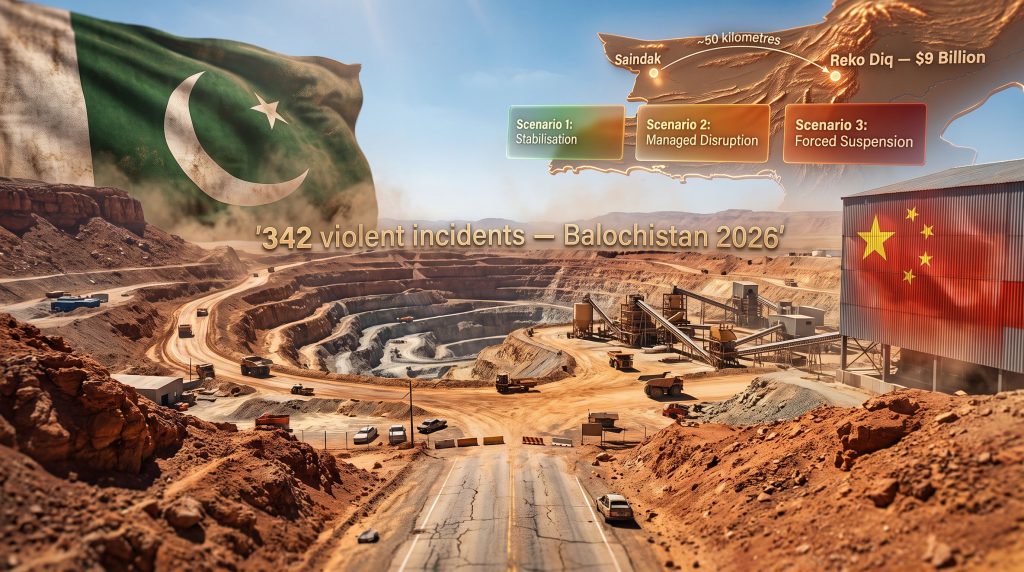
| Year-to-date 2026 | Total violent incidents across Balochistan | 342 recorded events |
| June 2026 | Supply route interdiction affecting Saindak logistics | Operational sustainability warning issued |
The figure of 342 violent incidents recorded in Balochistan through mid-2026 is particularly significant from an operational risk standpoint. High-frequency insurgencies are analytically distinct from episodic ones. When incidents accumulate at this tempo, they indicate an organisation with distributed cell structures, reliable local support networks, and an operational tempo that periodic military surges cannot suppress through attrition alone.
The Operational Crisis: What the Internal Warning Reveals
Supply Chain Interdiction as a Weapon
The mechanism through which the Pakistan Saindak mine insurgency threatens operations is not a direct assault on the mine itself. It is, however, the systematic interdiction of road-based supply routes carrying essential inputs — most critically furnace oil required for smelting and processing operations.
This is a sophisticated form of economic coercion. By targeting logistics corridors rather than hardened mine installations, insurgent groups exploit the fundamental vulnerability of remote extractive operations: they depend on long, exposed supply chains that are inherently difficult to protect at every point simultaneously.
A formal communication sent to Pakistan's energy ministry in late June 2026, subsequently reviewed by the Financial Times, stated that deteriorating security conditions had severely disrupted the transport of essential supplies. It warned that operations risked becoming unsustainable within approximately 30 days if conditions did not materially improve. Road travel across key supply corridors was characterised as increasingly hazardous.
The Credibility Gap: Internal Disclosure vs. Public Messaging
One of the most analytically revealing dimensions of the Saindak crisis is the contradiction between the mine's private risk communication and its subsequent public statements. Following disclosure of the internal warning letter, the mine's managing director publicly stated that operations had run without interruption for 25 years and denied any imminent threat of closure.
When state-affiliated operators simultaneously raise alarm with government ministries and project operational normalcy to markets, the private communication is the more reliable signal. The incentive to minimise public concern about a politically sensitive asset is obvious. The incentive to exaggerate risk to a government ministry is not.
This credibility gap is not unique to this operation. It reflects a broader pattern in state-linked mining enterprises managing assets in politically sensitive environments, where maintaining investor confidence and maintaining diplomatic relationships create competing communication pressures. For analysts assessing true operational status, internal disclosures to regulators and ministries should be weighted more heavily than public statements.
Pakistan's Security Response: Commitments and Structural Constraints
What the Government Has Pledged
Pakistan's Interior Minister ordered substantially increased security deployment covering Saindak's installations, personnel movements, and cargo logistics following disclosure of the operational warning. Pakistani officials have publicly affirmed their capacity to guarantee investor security across Balochistan, and the military has reportedly intensified counter-insurgency operations throughout the province.
Where the Structural Limits Bind
The gap between commitment and capability in Balochistan's security environment is shaped by factors that military escalation alone cannot resolve:
| Constraint | Detail |
|---|---|
| Geographic scale | Balochistan is Pakistan's largest province by land area, making comprehensive supply route protection logistically demanding at any force level |
| Insurgent adaptability | The BLA and BLF have demonstrated consistent capacity to shift attack vectors in response to military pressure, avoiding force concentrations while targeting unprotected logistics |
| Structural grievance | The resource revenue distribution imbalance that drives recruitment remains entirely unaddressed by security operations |
| Historical pattern | Prior Pakistani military commitments to guarantee CPEC infrastructure security have not prevented sustained targeting |
The fundamental limitation of a purely military response is that it addresses tactical symptoms while leaving the strategic cause intact. Baloch separatist recruitment draws from a genuine grievance about resource governance. Until extraction royalties, employment ratios, and infrastructure benefits flow meaningfully to local communities, each military operation that disrupts insurgent networks creates a recruitment environment for successor organisations.
Reko Diq: A $9 Billion Project in the Same Security Shadow
Barrick Mining's Exposure to the Balochistan Risk Environment
Located approximately 50 kilometres from the Saindak operation, Barrick Mining's Reko Diq copper-gold project occupies the same regional security environment. The project's development capital is estimated at $9 billion, positioning it as one of the most significant mining investments currently planned anywhere in South Asia.
Barrick has paused construction activity while conducting an independent security assessment. This decision reflects rational risk-adjusted project management. Reko Diq is a development-stage asset, meaning construction disruptions carry different financial consequences than operational disruptions at a producing mine: cost overruns compound over time, financing timelines face pressure, and partner confidence can erode during extended uncertainty periods.
Comparative Risk Profile
| Dimension | Saindak | Reko Diq |
|---|---|---|
| Operational status | Active producing mine under supply disruption threat | Development-stage, construction paused |
| Operator nationality | Chinese state-owned (MCC/SML) | Canadian (Barrick Mining) |
| Project valuation | Established production asset | $9 billion development pipeline |
| Insurgent targeting status | Active CPEC infrastructure target | Potential future target as construction advances |
| Current security response | Government security pledges | Independent security assessment underway |
A critical factor distinguishing the two assets is their insurgent targeting logic. Saindak is already embedded in the CPEC framework and therefore carries the symbolic weight that makes it a priority target for separatist groups. Consequently, Barrick's Reko Diq strategy must account for the shared security environment, even as a Canadian-operated project occupying a different category in the targeting calculus. The infrastructure it will require, including road corridors, fuel supply chains, and personnel transport routes, traverses the same contested territory.
The next major ASX story will hit our subscribers first
CPEC, BRI, and the Systemic Risk Premium on Balochistan Investment
The Scale of What Is at Stake
The China-Pakistan Economic Corridor represents more than $60 billion in planned infrastructure and resource investment across Pakistan. Balochistan hosts a disproportionate share of this total due to its mineral endowment and geographic position as a corridor to the Arabian Sea port of Gwadar.
Sustained insurgent targeting of CPEC infrastructure introduces a systemic risk premium that affects every project in the corridor, regardless of its individual security profile. When the flagship mining asset in the framework faces a 30-day operational sustainability warning, it signals to every other investor in the region that the security model underpinning BRI resource extraction has unresolved vulnerabilities.
China's position in this dynamic is structurally complex. As Pakistan's largest bilateral lender, Beijing possesses substantial leverage to pressure Islamabad for improved security performance. At the same time, being seen to exercise that leverage openly creates its own diplomatic complications. The result is a negotiation that happens largely out of public view, with operational disruptions at assets like Saindak serving as the pressure signals that force it forward. In addition, the Tethyan Belt copper-gold giants across the broader region face analogous governance and security pressures as extraction ambitions intensify.
Social Licence to Operate: The Missing Variable in Feasibility Models
Conventional mining feasibility studies model geological risk, capital costs, commodity price exposure, and permitting timelines. What they historically underweight in frontier and conflict-adjacent jurisdictions is social licence risk — the risk that community opposition or conflict, rooted in genuine grievances about who benefits from extraction, ultimately renders the project inoperable regardless of its technical and financial merits.
Balochistan's insurgency is a case study in what happens when social licence risk is not addressed at the project design stage. The absence of meaningful revenue sharing, local employment targets, and community infrastructure investment created conditions where separatist narratives about foreign extraction gained broad resonance. Investors assessing any Balochistan mining project in 2026 should treat social licence risk as a permanent baseline assumption, not a contingency scenario. For a deeper examination of this dynamic, the Reko Diq project analysis offers further context on how these structural pressures shape project viability.
Scenario Pathways: The Next 12 Months for Saindak and Reko Diq
Three plausible trajectories shape the near-term outlook for both assets:
Scenario 1: Military Stabilisation
Pakistan concentrates sufficient force to deter supply route attacks and restore reliable logistics corridors. Saindak operations continue at reduced but functional capacity. Reko Diq construction resumes on a revised timeline. This scenario requires sustained military commitment and assumes insurgent groups fail to adapt attack vectors effectively.
Scenario 2: Managed Disruption
The most probable near-term outcome based on current conditions. Intermittent supply route attacks create periodic operational pauses at Saindak. Strategic stockpiling and alternative logistics approaches prevent full closure but reduce output. Reko Diq's construction pause extends, compressing project timelines and increasing financing costs. The Pakistan Saindak mine insurgency, however, continues at high operational tempo without decisive resolution.
Scenario 3: Forced Operational Suspension
Sustained supply chain interdiction makes continuous operations economically unviable at Saindak. MCC and SML formally suspend operations pending security improvements. This outcome would represent a significant reputational shock for CPEC's resource extraction model and would materially affect Reko Diq's development timeline by demonstrating the severity of operational risk in the shared security environment.
Disclaimer: These scenarios represent analytical projections based on publicly available information as of mid-2026. They do not constitute investment advice. Mining investment in conflict-adjacent jurisdictions involves material risks that may not be fully captured in any scenario framework.
Key Takeaways for Investors and Analysts
The Pakistan Saindak mine insurgency is not a localised operational disruption. It is, in fact, a stress test of a resource extraction model that has prioritised bilateral state relationships over community-level social licence. Several principles emerge from this analysis that carry broader applicability:
- The credibility of public operational statements from state-linked mining operators should always be cross-referenced against private regulatory communications when both are available
- High-frequency insurgencies — defined by sustained operational tempo rather than episodic attacks — represent categorically different threat environments than the geopolitical risk models most feasibility studies are built to assess
- 342 violent incidents in a single province in a six-month period establishes Balochistan as a severe-risk operating environment by any established metric
- The proximity of Reko Diq to Saindak creates a security correlation between the two assets that makes Barrick's exposure to Balochistan risk non-trivial regardless of its status as a non-CPEC operator
- Social licence deficits in resource-rich, economically marginalised regions are structural risks, not political background noise, and must be modelled accordingly in long-duration project economics
For further reporting on Balochistan's mining sector and related developments, MiningMX provides ongoing coverage of how insurgency threatens major China-backed mining operations in Pakistan.
Want to Track the Next Major Mineral Discovery Before the Market Moves?
Discovery Alert's proprietary Discovery IQ model delivers real-time alerts on significant ASX mineral discoveries, cutting through complex data to surface actionable opportunities the moment they are announced — explore historic examples of exceptional returns on Discovery Alert's discoveries page and begin your 14-day free trial to position yourself ahead of the market.