
July 23, 2026
The Capital Allocation Logic That Separates Serious Miners from Opportunistic Ones
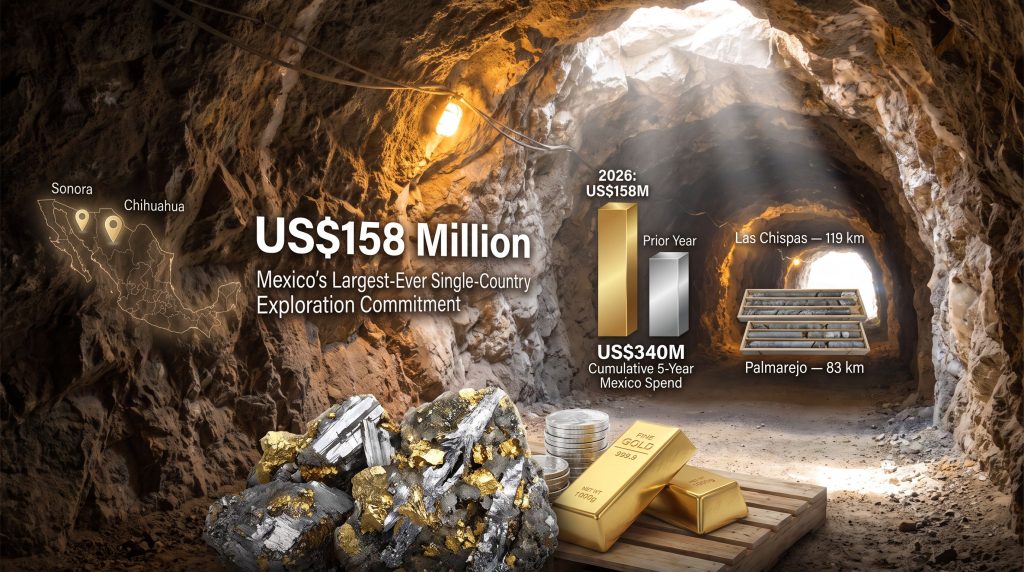
In precious metals mining, the most revealing indicator of long-term strategic conviction is rarely a production update or a commodity price outlook. It is the size and trajectory of an exploration budget. When a mid-tier producer doubles its exploration commitment in a single year, funding that decision with hard geological evidence rather than speculative optimism, the investment community tends to pay close attention. That is precisely the dynamic playing out across Coeur Mining's Mexican operations in 2026, where a US$158 million Coeur Mexico exploration budget represents not just a spending increase, but a fundamental repositioning of how the company intends to grow.
Understanding why that repositioning matters requires looking beyond the headline figure and into the geological, operational, and strategic layers that underpin it. Furthermore, broader gold-silver supply trends add further context to why this level of commitment is drawing serious attention from investors.
When big ASX news breaks, our subscribers know first
What a Doubled Exploration Budget Actually Signals
Budget doubling events in the mining sector are frequently misread by generalist investors as signs of financial aggression or risk tolerance. In practice, they more often reflect the opposite: disciplined capital deployment triggered by geological validation. A company that increases exploration spending by 100% without high-grade drill results to justify it is speculating. A company that doubles its budget in direct response to consistent, multi-target intercepts is executing a data-driven thesis.
Coeur Mining's 2026 Mexico program fits squarely into the second category. The US$158 million allocation, equivalent to approximately C$221 million, follows a series of drill results across multiple targets at both the Palmarejo operation in Chihuahua state and the Las Chispas mine in Sonora state. Crucially, this is not a first-year commitment. It brings Coeur's cumulative Mexico exploration expenditure to approximately US$340 million over five years, a compounding investment that builds geological knowledge capital with each successive drill campaign.
Multi-year exploration commitments differ fundamentally from single-year budget announcements. They reflect an organisation's belief that a geological system is large enough to warrant sustained, cyclical capital deployment, rather than a one-time test of a hypothesis.
This distinction matters for investors attempting to assess whether a budget increase is structural or cyclical in nature.
Breaking Down the $158 Million Mexico Exploration Program
The total program encompasses spending across two distinct operations, each with its own geological character, infrastructure profile, and near-term versus long-term reserve potential.
| Operation | Allocated Drill Budget | Planned Drilling Distance | State |
|---|---|---|---|
| Palmarejo | US$27 million | 83 km | Chihuahua |
| Las Chispas | US$24 million | 119 km | Sonora |
| Total Mexico Program | US$158 million | 200+ km combined | Multi-state |
The broader US$158 million Coeur Mexico exploration budget extends beyond these drill-specific line items to encompass regional target testing, satellite prospect evaluation, and expanded assessment of Coeur's significant land package across both states. The drill budgets at Palmarejo and Las Chispas represent the most capital-intensive components of that broader effort.
Why Las Chispas Receives More Drill Metres Despite a Smaller Budget
One of the more instructive details within the program's structure is the apparent inversion between budget and drilling distance at the two assets. Las Chispas has been allocated US$24 million to fund 119 km of drilling, while Palmarejo's US$27 million covers only 83 km. This discrepancy reflects fundamental differences in geological architecture and infrastructure maturity between the two sites.
Las Chispas is characterised by narrow, high-grade vein systems that require dense drill spacing to adequately define mineralisation geometry. Testing narrow veins demands more holes per unit of potential resource than broader, disseminated deposits, driving up metreage relative to cost. Palmarejo, by contrast, has operated since 2009 and benefits from established underground infrastructure that increases the cost of each drill hole but reduces the total number of holes needed to make meaningful geological inferences.
Per-kilometre drilling costs at Palmarejo are higher because underground drill programmes typically involve mobilising equipment within existing mine workings, where logistics and access constraints inflate costs compared to surface programmes. Las Chispas, with highway access from Hermosillo providing logistical advantages, maintains lower per-metre costs while pursuing a broader vein-testing mandate.
The Drill Results That Justified Expanding Capital
Geological decision-making in mining is iterative. Each drill campaign generates data that either validates or challenges existing resource models, and those outcomes directly inform the next capital allocation decision. The results underpinning Coeur's 2026 budget expansion span three distinct targets at Palmarejo, each contributing a different piece to the resource development puzzle. Understanding interpreting drill results is therefore essential for appreciating the full significance of these intercepts.
San Miguel: High-Grade Intercepts with Open-Ended Geometry
At the San Miguel target within Palmarejo's Eastern District, two standout intercepts have reshaped the geological interpretation of the zone:
- Hole SMDH-138: 11.5 metres grading 6.9 g/t gold and 1,250 g/t silver from 274 metres depth
- Hole SMDH-118: 10.8 metres grading 3.4 g/t gold and 1,083 g/t silver from 335 metres depth
Both intercepts are notable not only for their grades but for their geological context. The San Miguel deposit has been described as remaining open in all directions, meaning that no drill hole has yet encountered the outer boundary of the mineralised zone. This is a critical geological signal.
When a mineralised system is open in all directions, the implication is that the resource footprint visible in current models represents a minimum, not an estimate of total potential. Each subsequent drill hole that continues to intersect economic mineralisation expands the probable resource envelope and, by extension, justifies further drilling expenditure.
Silver grades of 1,250 g/t are particularly significant in the context of precious metals economics. At current silver prices, intercepts of this quality carry meaningful economic weight independent of their gold content, effectively creating a dual-commodity revenue stream from a single zone.
La Union: Extending Depth Profiles and Structural Continuity
La Union, another Palmarejo Eastern District target, produced two contrasting intercepts that together reveal important structural information:
- Hole LUDH-111: 14.5 metres grading 6.3 g/t gold and 19 g/t silver from 415 metres depth
- Hole LUDH-093: 7.9 metres grading 7.0 g/t gold and 14 g/t silver from 194 metres depth
The combination of a shallow intercept at 194 metres and a deeper intercept at 415 metres, both returning economic gold grades, indicates that the La Union structure maintains grade continuity across a significant vertical range. This is an important characteristic for underground mine planning, as consistent grades at depth support the economic case for developing deeper production levels without relying solely on near-surface resources.
Like San Miguel, La Union remains open in all directions, reinforcing the district-scale potential of Palmarejo's Eastern District as a multi-decade exploration front.
Independencia Sur: The Near-Term Reserve Conversion Case
While San Miguel and La Union represent longer-term exploration targets, Independencia Sur occupies a different position in Coeur's development hierarchy:
- Hole VIDH-221: 9.1 metres grading 16.5 g/t gold and 206 g/t silver from 473 metres depth
The 16.5 g/t gold intercept at Independencia Sur is among the highest-grade results reported across the entire program. Crucially, this target is classified as a near-term reserve conversion opportunity rather than a long-term exploration prospect. The geological distinction is meaningful: near-term reserve targets are zones that demonstrate sufficient grade continuity and spatial definition to potentially move into formal reserve categories within the current mine planning cycle.
Independencia Sur's proximity to Palmarejo's existing processing infrastructure further strengthens the economic case for near-term conversion, as new mineralisation adjacent to an established plant avoids the capital costs typically associated with developing standalone production capacity. For those newer to the sector, understanding permitting and grade basics provides useful context for evaluating how such results translate into mine planning decisions.
Palmarejo: 17 Years of Data and a New Growth Horizon
Palmarejo's operational history provides an important frame for interpreting the current exploration program. Located approximately 1,150 km northwest of Mexico City in Chihuahua state, the operation entered production in 2009 and has since accumulated nearly two decades of continuous geological data. That knowledge base, encompassing drill logs, grade control records, geophysical surveys, and underground mapping, dramatically improves the efficiency of new exploration targeting.
In 2025, Palmarejo produced 6.5 million ounces of silver and 101,000 ounces of gold, accounting for 36% of Coeur's total silver output and 24% of its gold production. These figures position Palmarejo as a cornerstone asset within Coeur's portfolio, and one whose sustained productivity depends on continuous reserve replenishment through exploration.
The operational infrastructure supporting Palmarejo includes three underground mines, a central processing facility, and a network of regional satellite deposits. This integrated setup means that exploration success within the Eastern District or at satellite targets like Independencia Sur can be converted into production relatively quickly, without the multi-year timelines associated with greenfield development.
Scotia Capital mining analyst Eric Winmill, writing in a note to clients following the exploration update, observed that Palmarejo's Eastern District is developing into a longer-term production corridor, while Independencia Sur presents a more immediate pathway to reserve additions. This dual-horizon framing is precisely what makes the current program strategically differentiated from simple reserve maintenance drilling.
Las Chispas: From Acquisition Target to Exploration Growth Platform
Coeur completed the Las Chispas acquisition through its US$1.7 billion purchase of SilverCrest Metals, a transaction completed in 2025. The acquisition brought into Coeur's portfolio one of the highest-grade silver-gold operations in Mexico, and arguably in the broader Americas.
Las Chispas carries an extraordinary historical pedigree. Underground silver and gold production at the site dates to as early as the 1640s, making it one of the longest-running precious metals districts in the Western Hemisphere. That multi-century extraction history speaks both to the exceptional grade of the vein systems and to the geological endurance of the mineralising system that created them.
In 2025, Las Chispas produced 5.1 million ounces of silver and 55,000 ounces of gold. The 2026 exploration program allocates 119 km of drilling, the largest single-asset metreage allocation within the entire Mexico program, reflecting Coeur's intent to systematically test the full extent of Las Chispas' high-grade vein network. Given that historical mining was largely confined to accessible near-surface zones, modern drilling techniques and improved geological modelling open up significant potential along strike and at depth.
The next major ASX story will hit our subscribers first
Five-Year Spending Trajectory and What It Tells Investors
| Metric | Coeur Mining (2026) | Contextual Significance |
|---|---|---|
| Mexico Exploration Budget | US$158 million | Largest single-country program in company history |
| Year-on-Year Budget Change | +100% (doubled) | Driven by high-grade geological validation across multiple targets |
| 5-Year Cumulative Mexico Spend | ~US$340 million | Reflects sustained, multi-cycle capital deployment strategy |
| Total Drill Programme Scale | 200+ km across two assets | Simultaneous near-term and long-term targeting |
| Las Chispas Drill Allocation | 119 km | Highest single-asset metreage in the 2026 program |
| Palmarejo 2025 Silver Output | 6.5 million oz | 36% of Coeur group-wide silver production |
The compounding nature of sustained exploration expenditure is often underappreciated in financial analysis of mining companies. A single year's drilling campaign generates data, but it is the accumulation of data across multiple years that allows geological models to mature, resource estimates to become more precise, and reserve conversion rates to improve. Coeur's US$340 million five-year Mexico commitment represents exactly this kind of knowledge compounding, with each year's results informing better targeting decisions in subsequent campaigns.
Risk Dimensions That Accompany Aggressive Exploration Scaling
No analysis of a program of this scale would be complete without acknowledging the risk landscape. Three categories of risk are particularly relevant:
- Execution risk: Coordinating 200+ km of drilling across two separate Mexican states requires significant logistical infrastructure, contractor capacity, and project management discipline. Delays in drill mobilisation, equipment availability, or assay turnaround times can compress the exploration season and reduce the volume of results available to inform resource modelling.
- Geological risk: Not every target tested across a 200+ km programme will return economically significant intercepts. The exploration success rate at any given target is probabilistic, and a proportion of planned holes will return results below economic thresholds. This is an inherent feature of exploration, not a failure of strategy.
- Regulatory and operating environment: Mining in Mexico involves navigating federal and state permitting frameworks, community engagement obligations, and environmental compliance requirements. These factors can influence drilling timelines and should be considered by investors assessing programme execution probability.
Furthermore, thorough drill result analysis remains indispensable for investors seeking to distinguish between genuine geological progress and results that merely appear impressive at face value.
This article contains forward-looking analysis and should not be construed as financial or investment advice. Exploration results do not guarantee the development of economic mineral resources. Investors should conduct independent due diligence before making any investment decisions.
Mexico's Geological Endowment as a Structural Advantage
Chihuahua and Sonora states are two of Mexico's most prolific silver-gold mining corridors, sitting within the broader Sierra Madre Occidental belt, a major epithermal and skarn mineralising province that has hosted some of the world's richest precious metals discoveries over the past four centuries. The geological conditions that created deposits like Palmarejo and Las Chispas are not isolated occurrences but repeating features across a very large land area.
This geological context explains why Coeur's expanded land package in both states carries optionality that extends well beyond the two operating mines. Regional prospect testing within a proven mineralising belt carries substantially higher prior probability of success than exploration in geologically untested terrains, a distinction that supports the risk-adjusted case for sustained capital deployment at the scale Coeur is now committing to.
Mexico also offers established mining infrastructure, a skilled technical workforce with deep experience in underground precious metals operations, and an extensive network of suppliers and contractors serving the sector. According to the Mexican Mining Chamber (CAMIMEX), these structural advantages reduce the per-tonne cost of converting exploration success into production-ready resources, making Mexico one of the most cost-competitive jurisdictions for mid-tier precious metals producers.
Frequently Asked Questions: Coeur Mining's Mexico Exploration Budget
What Is Coeur Mining's Total Mexico Exploration Budget for 2026?
Coeur Mining has committed US$158 million (approximately C$221 million) to its Coeur Mexico exploration budget in 2026, covering both the Palmarejo operation in Chihuahua state and the Las Chispas mine in Sonora state. This represents the largest exploration program in the company's history and approximately double the prior year's level of investment.
How Much Is Being Spent on Drilling Specifically at Palmarejo and Las Chispas?
Of the total program, US$27 million supports 83 km of drilling at Palmarejo, while US$24 million funds 119 km of drilling at Las Chispas. These drill-specific allocations form part of the broader US$158 million program, which also includes regional target testing and satellite prospect evaluation across Coeur's Mexican land package.
What Drill Results Triggered the Budget Increase?
High-grade intercepts across multiple targets provided the geological validation for the expanded commitment. Standout results include 16.5 g/t gold and 206 g/t silver over 9.1 metres at Independencia Sur, 6.9 g/t gold and 1,250 g/t silver over 11.5 metres at San Miguel, and 6.3 g/t gold over 14.5 metres at La Union. Crucially, both the San Miguel and La Union deposits remain open in all directions, indicating that current resource models capture only a portion of the total mineralised system.
How Does the 2026 Budget Fit Into Coeur's Longer-Term Mexico Investment?
The 2026 program will bring Coeur's cumulative Mexico exploration expenditure to approximately US$340 million over five years, reflecting a sustained, multi-cycle investment strategy grounded in progressive geological knowledge building rather than reactive commodity price opportunism.
What Is the Strategic Role of Las Chispas Within the Mexico Program?
Las Chispas, acquired through Coeur's US$1.7 billion purchase of SilverCrest Metals, functions as a second major exploration platform within Mexico. Its 119 km drill allocation represents the largest single-asset metreage commitment in the 2026 program. Consequently, this reflects Coeur's intent to systematically test the full lateral and depth extent of the asset's high-grade vein systems, many of which were only partially accessible to historical mining operations dating back to the seventeenth century.
Want to Know When the Next Major Silver or Gold Discovery Hits the ASX?
Discovery Alert's proprietary Discovery IQ model delivers real-time alerts the moment significant mineral discoveries are announced on the ASX, transforming complex geological data into clear, actionable insights for investors at every level — start your 14-day free trial today and position yourself ahead of the broader market, or explore historic discovery returns to understand just how transformative the right alert at the right moment can be.