August 6, 2026
The Geopolitical Transmission Mechanism: How Diplomacy Moves Precious Metals Markets
Few market relationships are as immediate or as legible as the one between Middle East conflict dynamics and precious metals pricing. When the risk of sustained energy disruption rises, the chain reaction that follows touches inflation expectations, central bank posture, real interest rates, and ultimately the relative attractiveness of non-yielding assets like gold and silver. Understanding this transmission mechanism is essential for anyone trying to make sense of why silver and gold climb on Middle East mediation hopes with such speed and conviction.
The logic begins with crude oil. Prolonged conflict in the Persian Gulf region raises the probability of supply disruptions, pushing energy prices higher. Elevated energy costs filter into the broader consumer price index through fuel, freight, and manufacturing inputs, reinforcing inflationary pressure that central banks are compelled to address through tighter monetary policy. Higher real interest rates increase the opportunity cost of holding non-yielding metals, which historically suppresses gold and silver prices. Conversely, any credible diplomatic signal that reduces the probability of an energy shock works the mechanism in reverse: oil softens, inflation expectations ease, rate path projections become less restrictive, and precious metals reprice higher almost immediately.
This is not a slow-moving relationship. Markets price these scenarios in real time, which is why a single ceasefire proposal, even one that has not yet been formally accepted, can move silver nearly five percent in a single session.
The U.S.-Iran Ceasefire Proposal and What Markets Are Actually Pricing In
On July 21, 2026, an Iranian official confirmed to Reuters that Tehran had received a mediator-backed proposal for a ten-day ceasefire, framed as a mechanism to preserve a provisional agreement between the parties. Almost simultaneously, the Trump administration confirmed a separate Israel-Lebanon ceasefire arrangement, providing a concrete diplomatic precedent that amplified broader optimism across the region.
It is important to be precise about what financial markets were actually responding to. Traders were not pricing in a permanent resolution to decades of geopolitical friction. The more accurate framing is that the market was reducing its probability-weighted exposure to the worst-case tail risk: a sustained energy price shock severe enough to force central banks into a prolonged high-rate environment. Even a temporary reduction in that tail risk is sufficient to trigger a meaningful repricing of precious metals, and that is exactly what occurred.
The current precious metals rally is built on diplomatic expectation, not confirmed resolution. A breakdown in ceasefire talks or a Houthi escalation in the Red Sea shipping lanes could rapidly unwind the gains recorded on July 21.
Complicating the picture is the threat from Yemen's Houthi movement, aligned with Tehran, to impose a naval blockade on Saudi Arabia. A blockade of that nature would represent a qualitative escalation beyond the current conflict perimeter, directly threatening global energy flows through the Red Sea and potentially reversing every condition that drove the July 21 rally.
When big ASX news breaks, our subscribers know first
What Are Silver and Gold Prices Doing Right Now?
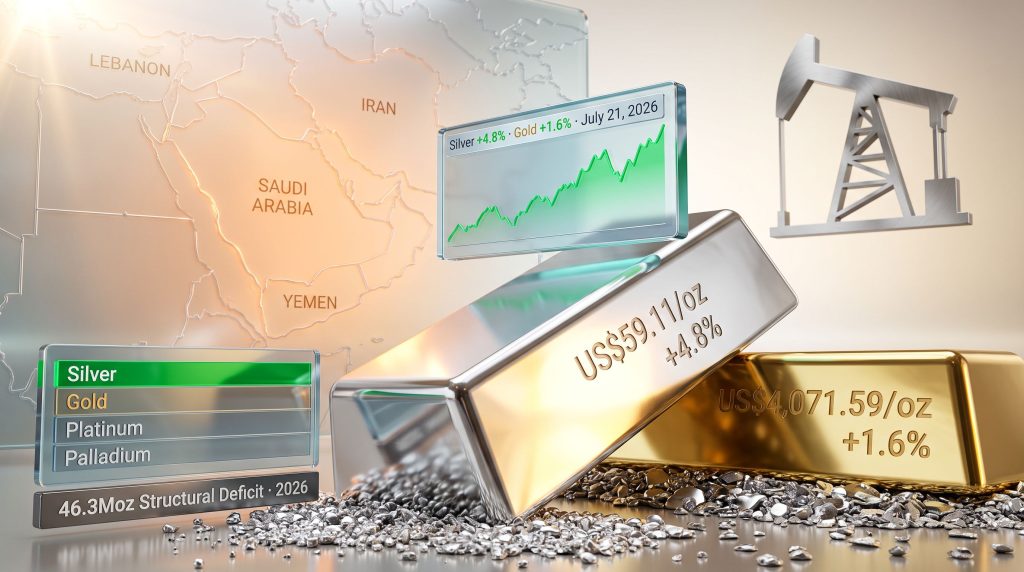
Precious Metals Price Snapshot: July 21, 2026
| Metal | Spot Price | Session Move | Futures Move |
|---|---|---|---|
| Gold | US$4,071.59/oz | +1.6% | +1.4% (Aug delivery at US$4,069.70) |
| Silver | US$58.96–$59.11/oz | +4.5–4.8% | +6%+ (futures markets) |
| Platinum | US$1,624.88/oz | +1.9% | — |
| Palladium | US$1,281.75/oz | +2.3% | — |
The breadth of the session was notable. All four major precious metals advanced, suggesting the move was not purely silver-specific but rather reflected a broad repricing of geopolitical risk across the complex. Silver's outperformance, however, was the defining feature of the day.
Why Silver Is Outperforming Gold in This Rally
Silver's larger percentage gain relative to gold is not accidental. The metal occupies a structurally distinct position in commodity markets because of silver's dual demand sources simultaneously: monetary safe-haven demand, which responds to geopolitical and macroeconomic uncertainty, and industrial demand, which tracks global manufacturing activity, photovoltaic panel production, electronics, and electric vehicle battery components.
When a geopolitical de-escalation scenario plays out, silver benefits through both channels at once. The reduction in inflation risk supports the monetary demand side, while the improved outlook for global industrial activity strengthens the industrial demand component. Gold, which functions almost entirely as a monetary reserve and safe-haven asset, captures only one of those tailwinds. This dual demand architecture is what consistently produces silver's larger percentage moves during risk sentiment shifts.
Futures market dynamics amplified the session further. Reports of a nearing diplomatic memorandum triggered algorithmic and speculative buying in silver futures, with futures prices climbing more than six percent as momentum traders piled in behind the initial spot market move.
Three Structural Drivers Behind the July 21 Precious Metals Surge
- Diplomatic momentum: The proposed ten-day U.S.-Iran ceasefire reduced the market-assigned probability of a sustained energy price shock, directly easing inflation expectations and softening the rate path outlook.
- Dollar and crude oil softening: Peace deal optimism simultaneously weakened the U.S. dollar and crude oil benchmarks, creating a dual tailwind for precious metals by compressing both inflationary pressure and bond yield expectations.
- Ceasefire confirmation effect: The separately confirmed Israel-Lebanon agreement functioned as a diplomatic proof-of-concept, reinforcing market confidence that regional de-escalation was achievable and not merely aspirational.
How Does Middle East Conflict Volatility Shape Precious Metals Pricing?
The Geopolitical Risk Premium Embedded in Gold and Silver
The July 21 rally did not occur in isolation. It was preceded by a period of sharp volatility in which the same conflict dynamics that are now easing had previously driven metals significantly lower. When Iran-related escalation intensified in the days prior, gold slipped below the psychologically significant US$4,000 level and silver shed close to four percent in a single session.
Surging energy costs had strengthened the U.S. dollar and compressed precious metal valuations through exactly the transmission mechanism described above, but working in the opposite direction. For a broader context, the precious metals market analysis for 2025 demonstrates how consistently these dynamics have shaped pricing cycles.
This bidirectional price action illustrates a critical asymmetry in how geopolitical risk premiums function in precious metals markets. Fear-driven spikes tend to be faster and more violent than relief rallies, because uncertainty generates more urgent position changes than resolution does. Traders who were short the metals going into July 21 were forced to cover rapidly, accelerating the upside move beyond what fundamental repricing alone would have produced.
The Houthi Wildcard: Why the Rally Remains Contested
The Houthi threat to blockade Saudi Arabian shipping represents the primary scenario capable of unwinding Tuesday's gains. A naval blockade would not simply reignite energy price concerns; it would create a direct threat to global commerce through the Red Sea, a critical artery for international trade that handles a substantial share of global container shipping.
The economic consequences of a sustained blockade would extend well beyond commodity markets, affecting supply chains and global growth expectations in ways that would ultimately weigh on silver's industrial demand component. Analysts treating this as the dominant downside scenario note that it sits outside the scope of the current ceasefire framework, meaning diplomatic progress between the U.S. and Iran does not automatically neutralise the Houthi risk.
What Does the Silver and Gold Climb Mean for Mexico's Mining Sector?
Mexico's Structural Exposure as the World's Largest Silver Producer
Mexico holds a position of unmatched structural exposure to global silver price movements. As the world's largest silver-producing nation, the country's mining sector revenues, state fiscal balances, and corporate earnings all carry a direct and significant correlation to spot price performance. Every leg of the 2026 precious metals cycle, both the rallies and the corrections, has reverberated through Mexican state economies, corporate balance sheets, and investment pipelines with unusual force.
The state-level evidence is particularly striking. Chihuahua, one of Mexico's primary silver and gold-producing regions, recorded a mining production value increase of more than 25% during the 2026 precious metals rally, even in periods where physical output volumes remained flat or declined. This price-volume decoupling is a critical concept for understanding how commodity-driven revenue growth works in practice.
How Major Mexican Producers Are Positioned
Grupo México offers a clear illustration of how the pricing environment flows through to corporate results. The mining giant's diversified portfolio, spanning silver, zinc, copper, and molybdenum, provides partial insulation during single-commodity corrections. However, during broad precious metals rallies, the diversification effect works in reverse, amplifying upside exposure across multiple revenue lines simultaneously.
Industry participants have consistently identified price stability at elevated levels as the decisive trigger for new capital allocation decisions in Mexican silver mining. A sustained price rally, furthermore, creates the conditions for exploration spending, project development, and infrastructure investment that could structurally expand Mexico's silver output over the medium term.
The Trade Policy Wildcard for Mexican Silver Exporters
Mexican silver producers face a second, independent layer of pricing risk that operates entirely separately from Middle East dynamics. Earlier in 2026, silver prices retreated from record levels after the U.S. administration delayed broad tariffs on critical minerals, opting instead for bilateral negotiations and potential price floor mechanisms. This policy pivot created a complex and uncertain export environment for Mexican producers, where the terms under which their silver reaches U.S. markets remain subject to ongoing negotiation.
The administration's preference for bilateral frameworks over immediate levies means that the policy risk has not been eliminated; it has been deferred. Any resumption of critical mineral tariff discussions could reintroduce a pricing headwind for Mexican exporters that is entirely independent of whether the Middle East achieves a lasting ceasefire.
Is the Structural Silver Market Deficit Amplifying the Geopolitical Rally?
Supply-Demand Fundamentals as a Price Multiplier
Understanding why silver responds so violently to geopolitical catalysts requires looking beyond sentiment and into the underlying supply-demand structure. A market running a structural deficit, where demand consistently exceeds mine supply, behaves fundamentally differently from a balanced or oversupplied one. Any positive demand catalyst, whether from safe-haven buying, industrial acceleration, or speculative positioning, encounters a market where the physical inventory buffer is already thin.
The ongoing silver supply deficits are projected to reach 46.3 million ounces for 2026, according to the World Silver Survey. Global mine production is expected to remain broadly stable while demand across industrial, photovoltaic, and investment channels continues to expand. This persistent imbalance acts as a structural amplifier, meaning the same geopolitical signal that might move a balanced market by one or two percent can produce moves of four to five percent in a structurally tight silver market.
Comparing the Structural Positions of Precious Metals in 2026
| Factor | Gold | Silver | Platinum | Palladium |
|---|---|---|---|---|
| Primary demand driver | Monetary/safe haven | Industrial + monetary | Industrial (auto) | Industrial (auto) |
| 2026 supply deficit | Moderate | 46.3Moz structural | Balanced | Surplus |
| Geopolitical sensitivity | High | Very High | Moderate | Low |
| Session gain (Jul 21) | +1.6% | +4.5–4.8% | +1.9% | +2.3% |
The table above illustrates a clear pattern: the metals with the tightest supply-demand fundamentals and the broadest demand base tend to record the largest percentage moves during geopolitical repricing events. Silver sits at the intersection of maximum structural tightness and maximum demand breadth, which consequently explains its consistent outperformance during periods of meaningful sentiment shift.
The Solar and EV Connection: Industrial Demand as a Hidden Price Driver
One dimension of silver's industrial demand that receives less mainstream attention than it deserves is the role of photovoltaic manufacturing. Solar panel production relies heavily on silver paste for electrical conductivity within cells, and the global buildout of solar capacity has been accelerating at a pace that is increasingly visible in silver demand statistics. A de-escalation scenario that reduces energy costs also supports industrial production activity more broadly.
Similarly, electric vehicle battery components and advanced electronics manufacturing consume silver in ways that are not easily substituted. These industrial demand channels mean that silver's price floor during periods of economic expansion tends to be structurally higher than it was in previous commodity cycles, because the industrial demand base is both larger and more durable than it was a decade ago.
What Are Analysts Saying About the Sustainability of This Rally?
The Floor-Seeking Thesis for Gold
Analyst Ross Norman has characterised gold safe-haven dynamics as a search for a sustainable price floor following the record-setting rally that defined the early part of 2026. His assessment is that the worst of the recent selling pressure and liquidation phase may have passed, but that genuine upward momentum remains elusive. Trader positioning continues to reflect caution rather than conviction, suggesting that the July 21 advance is more consistent with stabilisation and short-covering than with the beginning of a new directional leg higher.
The Fragility Caveat: Why Optimism Is Conditional
Multiple analyst perspectives converge on a consistent characterisation of the current environment: the price increase reflects renewed diplomatic expectations rather than confirmed geopolitical resolution, and the gains are extremely fragile to reversal if core demands between the U.S. and Iran remain fundamentally unresolved when the ceasefire window closes. Indeed, silver climbed over 4% on the back of these peace hopes, underscoring how quickly sentiment can shift precious metals pricing.
Scenario Analysis: Two Paths Forward for Precious Metals
Scenario A: Ceasefire Holds and Diplomacy Advances
- Energy price pressures ease, reducing inflation expectations across major economies
- Central banks gain flexibility to signal a less restrictive rate path, reducing the opportunity cost of holding gold and silver
- The U.S. dollar softens further, providing a sustained currency-driven tailwind for metals priced in dollars
- Silver's industrial demand component receives additional support from an improved global growth outlook
- Mexican mining sector captures elevated revenue at both state and corporate level, potentially triggering new capital allocation decisions
Scenario B: Ceasefire Collapses or Houthi Blockade Materialises
- Energy prices spike, reigniting inflation concerns and reversing the rate path optimism that drove the July 21 rally
- The U.S. dollar strengthens, compressing precious metal valuations through the currency channel
- Risk-off positioning initially provides partial support for gold as a safe haven but weighs heavily on silver's industrial premium
- Mexican producers face renewed earnings volatility and deferred capital allocation decisions, with exploration spending particularly vulnerable
The next major ASX story will hit our subscribers first
Frequently Asked Questions: Silver and Gold Prices and Middle East Diplomacy
Why do gold and silver prices rise when Middle East tensions ease?
When geopolitical tensions in the Middle East ease, oil prices typically soften, which reduces inflationary pressure globally. Lower inflation expectations reduce the likelihood that central banks will maintain elevated interest rates for extended periods. Since gold and silver are non-yielding assets, they become relatively more attractive when interest rates are expected to decline or stabilise, driving prices higher through the inverse real rate relationship.
Why did silver rise more than gold on July 21, 2026?
Silver's larger percentage gain reflects its dual role as both a monetary metal and an industrial commodity. A de-escalation scenario supports silver through two simultaneous channels: reduced inflation risk strengthening monetary demand, and improved industrial production outlook supporting industrial demand. Speculative futures positioning amplified the move, with futures prices climbing more than six percent as algorithmic and momentum traders responded to reports of a nearing diplomatic agreement.
What is the current silver market deficit and why does it matter?
The structural silver market deficit for 2026 is projected at approximately 46.3 million ounces according to the World Silver Survey. This supply-demand imbalance means global demand is expected to exceed mine supply by that margin, creating conditions where any positive demand catalyst produces amplified price responses compared to what would occur in a balanced market.
How does Middle East conflict affect Mexico's silver mining industry?
Mexico is the world's largest silver-producing nation, meaning its mining sector revenues are directly correlated with global silver price movements. Chihuahua state recorded a mining production value increase of more than 25% during the 2026 precious metals rally, illustrating the direct fiscal and economic exposure that flows from international commodity pricing through to regional economic outcomes.
What risks could reverse the July 21 precious metals rally?
The primary downside risks include a breakdown in U.S.-Iran ceasefire negotiations, a resumption of military activity, or an escalation involving Yemen's Houthi movement, particularly their threatened naval blockade of Saudi Arabia. Any of these scenarios would likely reignite energy price pressures, strengthen the U.S. dollar, and rapidly reverse the conditions that produced the gains across the precious metals complex. Furthermore, silver and gold climb on Middle East mediation hopes precisely because those hopes remain conditional, making the rally inherently vulnerable to renewed tension.
Key Takeaways
- Silver surged approximately 4.5–4.8% to around US$58.96–$59.11/oz on July 21, 2026, while gold advanced approximately 1.5–1.6% to US$4,064–$4,071/oz
- The catalyst was a proposed ten-day U.S.-Iran ceasefire combined with confirmation of a separately negotiated Israel-Lebanon ceasefire agreement, which reduced energy-driven inflation expectations
- Silver's outperformance relative to gold reflects its dual monetary and industrial demand structure, which captures both safe-haven relief and improved industrial growth expectations simultaneously
- A structural silver market deficit of 46.3 million ounces projected for 2026 acts as a fundamental amplifier, making silver prices more sensitive to any positive demand or sentiment catalyst
- Mexico, as the world's largest silver producer, carries direct revenue exposure, with Chihuahua's mining production value having already surged more than 25% during the 2026 precious metals rally
- The rally is characterised by analysts as extremely fragile to reversal, with a Houthi naval blockade or ceasefire collapse representing the primary downside scenarios capable of unwinding July 21 gains
This article contains forward-looking analysis and scenario projections. Precious metals markets are subject to rapid and unpredictable change driven by geopolitical developments, macroeconomic shifts, and changes in market positioning. Nothing in this article constitutes financial advice. Readers should conduct independent research before making any investment decisions.
Want to Catch the Next Major ASX Mineral Discovery the Moment It Hits the Market?
Discovery Alert's proprietary Discovery IQ model delivers real-time alerts on significant ASX mineral discoveries — instantly transforming complex geological data into actionable investment insights for both short-term traders and long-term investors. Explore historic discoveries and their returns to understand the potential upside, then begin your 14-day free trial at Discovery Alert to position yourself ahead of the broader market.