July 31, 2026
The Quiet Resurgence of North American Base Metals and Why One Idaho Mine Matters
The global base metals supply chain is undergoing a structural reconfiguration. Decades of offshoring, mine closures, and smelter consolidation have left many Western economies more reliant on imported zinc and lead than at any point in modern industrial history. Against this backdrop, the reactivation of dormant mining districts is no longer a niche investment story. It has become a supply chain imperative. Few restarts illustrate this dynamic more compellingly than what is unfolding in Idaho's Silver Valley, where Bunker Hill Mining ships first concentrate to Teck's Trail smelter — achieving something that seemed improbable not long ago: the first revenue-generating shipment from one of North America's most historically significant mining operations in over four decades.
When Bunker Hill Mining ships first concentrate to Teck's Trail smelter, it does not merely mark a logistical milestone. It signals a fundamental transition in the company's financial identity, from a capital-consuming development project to a producing operation with an established commercial pathway.
When big ASX news breaks, our subscribers know first
Silver Valley's Prodigal Mine: Understanding the Bunker Hill Legacy
A District With Geological Depth and Historical Weight
The Silver Valley region of northern Idaho sits atop one of the most prolific polymetallic mining districts in North American history. The Coeur d'Alene Mining District, of which the Bunker Hill complex is a central part, has historically produced enormous quantities of silver, lead, and zinc over more than a century of intermittent activity. The ore bodies in this region are characterised by replacement-style mineralisation within Belt Supergroup sedimentary sequences, a geological setting that produces high-grade, multi-metal concentrations amenable to bulk mining methods.
The Bunker Hill Mine ceased operations more than 45 years ago, a closure driven by a combination of depressed commodity prices and an accumulation of environmental liabilities that would take decades and significant capital to remediate. The Bunker Hill Superfund Site, one of the largest in United States history, required extensive cleanup work covering soil contamination, water treatment, and smelter stack remediation across a broad surrounding area. This legacy is not incidental to understanding the restart. It fundamentally shaped the timeline, the regulatory framework, and the capital structure of the redevelopment effort.
Why Environmental History Creates a Unique Compliance Baseline
For investors and industry observers, the Superfund legacy is often treated as a historical footnote. In reality, it functions as an ongoing operational constraint. Bunker Hill's redevelopment operates within an elevated compliance baseline that includes continuous water monitoring, tailings management protocols, and community liaison obligations that would not apply to a greenfield operation.
This creates a higher administrative cost burden but also, paradoxically, a more robust social licence framework. The Silver Valley community has lived with the consequences of mining's past. A demonstrably responsible restart, supported by modern environmental management, carries genuine goodwill value that is difficult to quantify but strategically meaningful. This approach aligns closely with broader mining sustainability transformation principles that are reshaping how the industry rebuilds its social licence.
How the New Processing Plant Changes the Economic Calculus
From Rehabilitation Asset to Revenue Engine
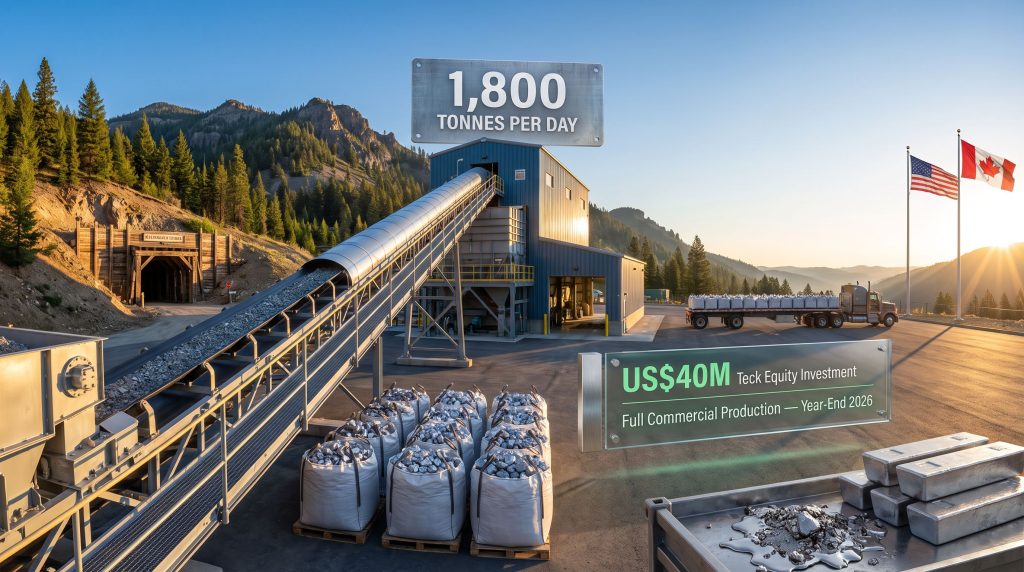
The commissioning of a new 1,800-tonne-per-day (t/d) processing plant represents the physical inflection point that transforms Bunker Hill from a redevelopment story into a producing mine narrative. The plant incorporates ore sorting and crushing infrastructure — technologies that have advanced considerably since the mine's original closure and that meaningfully improve the efficiency of concentrate production.
Furthermore, the ore sorting benefits deserve attention as a technology that is underappreciated in mainstream coverage of mine restarts. By using sensor-based systems to separate ore from waste rock before it enters the primary circuit, ore sorting can raise effective feed grades and reduce energy consumption per tonne of concentrate produced. For a mine in commissioning phase, this has direct implications for the quality and competitiveness of the first concentrate parcels delivered to a smelter partner.
The Commissioning vs. Commercial Production Distinction
Critical Investor Context: A mine reporting commissioning-phase concentrate sales is generating early revenue, but this does not yet confirm that the operation has stabilised at nameplate throughput rates. Full commercial production — the next formal milestone for Bunker Hill — signals consistent processing at or near the 1,800 t/d design capacity. This distinction matters for revenue modelling and project financing benchmarks.
The gap between commissioning revenue and full commercial production output involves several operational variables:
- Metallurgical circuit optimisation: Flotation cell performance, reagent dosing, and concentrate grade stabilisation all require iterative adjustment during ramp-up.
- Equipment reliability bedding-in: New processing plants routinely encounter mechanical availability challenges in their first operational months, requiring scheduled maintenance interventions.
- Workforce competency accumulation: Processing plant operators develop critical institutional knowledge during ramp-up that cannot be fully replicated through pre-commissioning training alone.
Management has targeted full commercial production by year-end 2026, a timeline that will serve as the primary operational benchmark for stakeholders tracking the project's progress.
Teck's Trail Smelter: Why This Processing Partner Is Strategically Irreplaceable
The Trail Complex in Context
Teck Resources' Trail Operations in British Columbia is one of the world's most comprehensively integrated base metals processing facilities. The Trail smelter processes both zinc and lead concentrates through metallurgical pathways that produce refined metal products — not intermediate materials — for delivery into global commodity markets. This level of vertical integration is rare and gives Trail a significant cost and flexibility advantage over single-metal smelting facilities.
The approximately 220-kilometre transport corridor between the Bunker Hill Mine in Kellogg, Idaho, and the Trail smelter in British Columbia represents a logistically efficient cross-border supply arrangement. For context, most zinc and lead concentrate shipments in the global market travel thousands of kilometres by sea freight before reaching a smelter, incurring substantial transport costs and treatment charge premiums. Proximity to a world-class integrated smelter is a structural cost advantage baked into Bunker Hill's economics from the outset.
The Financial Architecture of the Teck-Bunker Hill Partnership
The relationship between Teck and Bunker Hill extends well beyond a standard offtake arrangement. The table below summarises the key financial dimensions of the partnership:
| Partnership Element | Detail |
|---|---|
| Teck Equity Investment (2025) | US$40 million invested into Bunker Hill Mining |
| Standby Facility Drawdown | US$5 million drawn during commissioning ramp-up |
| Offtake Structure | Concentrate processed at Trail under existing offtake terms |
| Transport Distance | Approximately 220 km from mine to smelter |
| Quality Assurance | Independent analysis by Silver Valley Analytical prior to shipment |
Teck's US$40 million equity investment in 2025 is a strategically significant data point that differentiates this offtake relationship from a purely transactional concentrate purchase agreement. When a major smelting operator commits equity capital to a junior producer supplying its facility, it indicates a calculated decision to secure long-term, proximate feed supply. This concept — sometimes referred to as smelter feed security — is particularly important for Trail given the ongoing global consolidation of zinc and lead concentrate supply.
The US$5 million drawdown from a standby credit facility, disclosed alongside commissioning updates, functions as a working capital bridge during the period between concentrate production commencement and the receipt of initial offtake payment settlements. This is standard practice in mine restarts and reflects prudent cash flow management rather than financial stress.
How Concentrate Offtake Pricing Actually Works
For investors unfamiliar with base metals concentrate economics, the revenue model is more nuanced than a simple metal price multiplier. Key mechanics include:
- Provisional pricing: The initial payment for a concentrate parcel is calculated using the prevailing metal price at the time of shipment, subject to a provisional deduction.
- Final settlement: A second payment is made after the smelter has completed metallurgical accounting, adjusting for actual metal recovery and final market prices.
- Treatment charges (TC) and refining charges (RC): The smelter deducts a per-tonne treatment charge and a per-unit refining charge from the payable metal value. These charges are commercially negotiated and fluctuate with global concentrate supply-demand balances.
- Payability factors: Not all metal in a concentrate is paid for. Payability percentages for zinc, lead, and silver vary by contract and concentrate grade, making mineralogical quality a direct revenue driver.
This structure means that Bunker Hill's actual revenue per tonne processed is a function not just of zinc, lead, and silver prices, but of concentrate grade, treatment charge levels, and payability terms embedded in the Teck offtake agreement. Consequently, cut-off grade economics play a meaningful role in determining which ore is economically viable to process at any given point during ramp-up.
The Commodity Triangle: Zinc, Lead, and Silver as a Revenue Stack
Why Multi-Metal Concentrate Streams Create Operational Resilience
Bunker Hill's production profile — spanning zinc concentrate, lead concentrate, and silver as a co-product stream — creates a revenue structure with natural diversification properties. Each metal responds to different demand drivers:
- Zinc is the fourth most consumed metal globally, with primary demand from galvanised steel production, infrastructure construction, and, increasingly, zinc-air battery applications in stationary energy storage.
- Lead retains strong industrial relevance in lead-acid battery systems, which continue to dominate the automotive starter battery market and provide critical backup power for telecommunications and data centre infrastructure. Despite recurring narratives about lead's obsolescence, global refined lead demand has remained broadly stable.
- Silver operates across two distinct demand categories simultaneously: industrial applications including photovoltaic solar cells, electronics, and medical devices, and monetary or investment demand. Silver's dual demand introduces price volatility uncorrelated with pure industrial cycles, which can act as a natural hedge within the revenue stack.
This three-metal revenue stack means that Bunker Hill's economics are not singularly exposed to any one commodity price cycle. A period of zinc price weakness may be partially offset by silver strength, and vice versa.
The United States' Structural Import Dependence
The United States currently imports a significant proportion of its refined zinc requirements, with domestic mine production covering only a fraction of industrial demand. The country has no primary zinc smelter currently operating at scale for domestic concentrate. This structural gap means that American zinc concentrate must travel to Canadian, European, or Asian smelters for processing, adding cost and extending supply chains.
The Bunker Hill-to-Trail arrangement partially addresses this by keeping the concentrate within a tightly integrated North American corridor. Moreover, critical minerals demand trends are accelerating the urgency for Western nations to develop more self-sufficient base metals supply chains, making restarts like this one strategically significant well beyond a single balance sheet.
Operational Risks That Investors Should Monitor
Metallurgical Variability During Ramp-Up
One of the less-discussed risks in mine restarts is the variability of ore feed characteristics encountered during early production. Underground mines accessing multiple ore zones during ramp-up frequently encounter grade heterogeneity, where ore parcels from different stopes or development headings carry materially different zinc-to-lead ratios, silver grades, and deleterious element profiles.
This variability directly affects flotation circuit performance and can cause concentrate grades to fluctuate below offtake specification thresholds during early commissioning, potentially triggering pricing adjustments or quality penalties. However, the ore sorting infrastructure installed at Bunker Hill provides an additional lever for managing feed quality before it reaches the flotation circuit.
Forward-Looking Milestones to Track
| Milestone | Target Timing | Investor Significance |
|---|---|---|
| Full Commercial Production Declaration | Year-end 2026 | Primary revenue scaling catalyst |
| Nameplate Throughput Achievement (1,800 t/d) | Q3-Q4 2026 | Operational credibility validation |
| Concentrate Grade Stabilisation | Ongoing through ramp-up | Offtake pricing and payability impact |
| Subsequent Teck Facility Engagement | Medium-term horizon | Potential deepening of supply relationship |
Disclaimer: Forward-looking statements regarding production timelines, throughput targets, and revenue outcomes involve material uncertainties. Actual results may differ from management guidance due to metallurgical, operational, regulatory, and commodity market variables. This article does not constitute financial advice.
The next major ASX story will hit our subscribers first
Frequently Asked Questions
What metals does the Bunker Hill Mine produce?
The operation produces zinc, lead, and silver concentrates from mineralisation within the Silver Valley district of northern Idaho. Concentrate is shipped to Teck's Trail smelter in British Columbia for processing.
How far is the mine from Teck's Trail smelter?
The Bunker Hill Mine is located approximately 220 kilometres from the Trail smelting complex, forming a compact cross-border supply corridor between Idaho and British Columbia.
What is the rated capacity of the new processing plant?
The newly commissioned facility is designed to process 1,800 tonnes of ore per day, with full commercial production at this rate targeted for year-end 2026.
What financial commitment has Teck made to Bunker Hill?
Teck made a US$40 million equity investment in Bunker Hill in 2025 and extended a standby credit facility, from which Bunker Hill drew US$5 million to support working capital during the commissioning phase.
Why was Bunker Hill closed for so long?
The mine closed more than 45 years ago due to a combination of commodity market pressures and substantial environmental remediation obligations. Cleanup of the Bunker Hill Superfund Site required decades of work before a credible restart pathway could be established.
What is an offtake agreement and why does it matter?
An offtake agreement is a pre-negotiated contract under which a buyer — in this case Teck — commits to purchase a defined volume of concentrate at commercially agreed terms. For a mine in ramp-up, an offtake agreement removes market risk and provides revenue predictability during the period when the operation is most financially vulnerable.
What the First Shipment Ultimately Represents
The transition from rehabilitation project to producing mine is never a single event. It is a sequence of compounding milestones, each one reducing risk and expanding the credible production narrative. The moment Bunker Hill Mining ships first concentrate to Teck's Trail smelter sits at a pivotal point in that sequence. It validates the processing infrastructure, activates the commercial relationship, and begins the revenue clock that will ultimately determine whether the broader restart thesis is vindicated.
For North American base metals supply chains, the significance extends beyond one company's balance sheet. A successfully restarted historic mining district, operating with modern environmental standards and integrated into a world-class smelting network, provides a proof-of-concept for how Western mining jurisdictions can recover productive capacity from their industrial past without compromising on contemporary regulatory expectations.
The path to full commercial production by year-end 2026 carries real operational risk. Metallurgical complexity, equipment reliability, workforce development, and environmental compliance all represent variables that commissioning-phase performance cannot fully de-risk. Nevertheless, the first shipment is evidence that the foundation has been laid — and for a mine that sat silent for more than four decades, that is a genuinely meaningful beginning.
Want to Stay Ahead of the Next Major North American Mineral Discovery?
Discovery Alert's proprietary Discovery IQ model scans ASX announcements in real time, delivering instant alerts on significant mineral discoveries across zinc, lead, silver, and more than 30 other commodities — so subscribers can identify actionable opportunities well ahead of the broader market. Explore how historic discoveries have generated substantial returns on Discovery Alert's dedicated discoveries page, and begin your 14-day free trial today to position yourself at the forefront of the next major find.