July 30, 2026
Why Single-Source Ore Feed Is the Silent Killer of Processing Plant Potential
Underground base metal mining operations face a structural challenge that rarely makes headlines but consistently undermines financial performance: the dependency on a single ore source to sustain mill throughput. When one stope sequence is the sole supplier of feed to a processing plant, grade variability becomes an operational constraint that cascades through the entire production system. A high-grade block gets mined out, grades fall, silver equivalent output drops, and the processing plant sits below its engineered capacity waiting for development to catch up.
This is the fundamental problem that multi-source ore feed architecture is designed to solve. By drawing from multiple deposits with distinct grade profiles, a mill operator can blend feed streams to maintain consistent metallurgical performance, smooth out grade variability, and push plant utilisation toward nameplate capacity. It is a principle well understood across the global base metals sector, yet operationally difficult to execute because it requires simultaneous mine development across multiple fronts.
The Broken Hill Mines Rasp Mine production lift now underway in New South Wales represents a textbook application of this principle, and the June 2026 quarterly results show the financial leverage that becomes available once the feed architecture is properly assembled.
When big ASX news breaks, our subscribers know first
The Three-Source Feed System at Rasp: How It Works
Western Min: The Foundation Layer
Western Min has served as the primary ore source underpinning baseline throughput at the Rasp processing plant. Its role is that of the steady-state feed supplier, providing consistent volumes that keep the mill operating while higher-grade sources are developed. In a multi-feed blending strategy, the foundation source does not need to deliver exceptional grades. Its value lies in reliability and continuity of supply.
Main Lode: The Grade Catalyst
The introduction of Main Lode ore into the processing circuit during the June 2026 quarter represents the most significant operational development at Rasp in several years. Main Lode carries materially higher grades of silver, lead, and zinc compared to the existing Western Min feed stream, and it also contributes gold and copper credits that improve overall net smelter returns on each tonne processed.
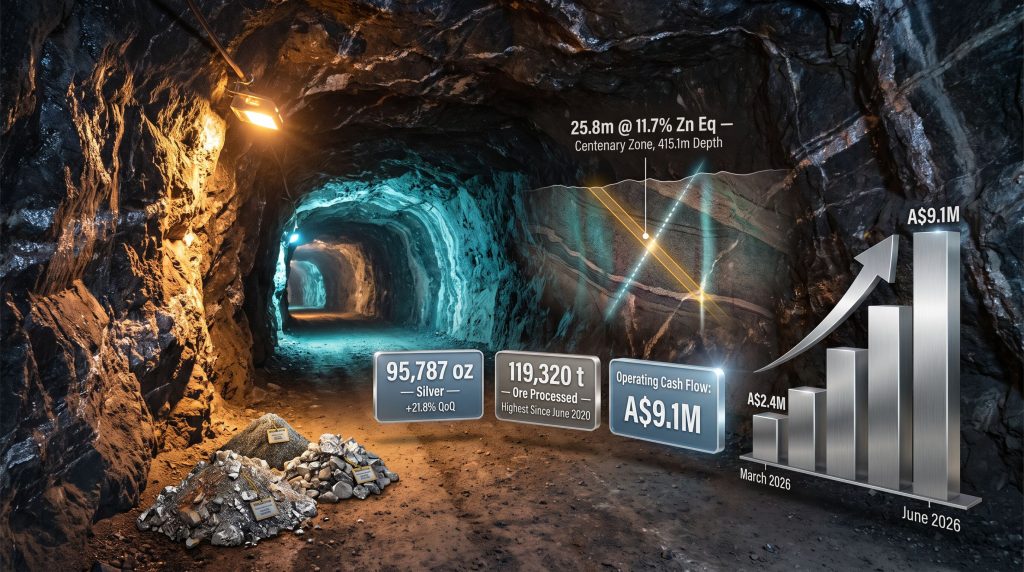
The financial effect was immediate and measurable. Silver output rose to 95,787 ounces for the quarter, a 21.8% increase over the prior period. Zinc production climbed 7.0% to 3,331 tonnes. Lead output declined marginally by 3.9% to 2,376 tonnes, reflecting the compositional mix of ore processed rather than any throughput constraint. Crucially, this happened while total ore processed increased by only 3.2% to 119,320 tonnes, confirming that grade improvement, not volume alone, drove the output gains.
In metallurgical terms, this is exactly the leverage that higher-grade supplementary feed is supposed to deliver: disproportionate output growth relative to modest throughput increases. As Main Lode stoping volumes grow progressively with underground development, this grade premium is expected to compound further.
Pinnacles Mine: The Emerging Third Vector
The first delivery of Pinnacles ore to the run-of-mine pad at the end of June 2026 marks the arrival of the third feed source, though its contribution to mill output will build over time as operational sequencing is established. Pinnacles carries grade characteristics that are expected to complement and enhance the blended feed profile, with assay results from approximately 5,800 metres of drilling completed during the quarter still pending at the time of reporting. Furthermore, as Broken Hill Mines reports, the Pinnacles restart is a central pillar of the broader production ramp-up strategy.
The convergence of three ore sources, each with distinct grade profiles, gives the Rasp processing plant a blending flexibility that single-source operations cannot replicate. This structural advantage is the primary mechanism behind the production growth trajectory now visible in the quarterly results.
June 2026 Quarterly Performance: The Numbers in Context
Quarterly Production Metrics
| Commodity | June Quarter Output | Quarter-on-Quarter Change |
|---|---|---|
| Silver | 95,787 oz | +21.8% |
| Zinc | 3,331 t | +7.0% |
| Lead | 2,376 t | -3.9% |
| Ore Processed | 119,320 t | +3.2% |
The 119,320 tonnes of ore processed during the June quarter is the highest quarterly throughput figure recorded at the Rasp plant since June 2020. That context matters enormously. Processing infrastructure in underground mines deteriorates over time without sustained investment in maintenance and optimisation. The fact that the plant is now recording its best throughput performance in six years, while simultaneously integrating new ore sources, signals genuine improvement in plant availability and operational reliability, not just a favourable ore mix.
Perhaps more telling is the plant availability data embedded in the production report: 17 of the 20 highest single-day throughput events in the Rasp Mine's operational history were recorded within this one quarter. For a processing facility with a multi-decade operating history, that concentration of peak-performance days in a single 90-day window is a meaningful indicator of maintenance scheduling improvements and sustained operational discipline.
The Financial Acceleration: Operating Cash Flow Trajectory
| Quarter | Ore Processed | Silver Output | Operating Cash Flow |
|---|---|---|---|
| March 2026 | 115,653 t | 78,649 oz | A$2.4 million |
| June 2026 | 119,320 t | 95,787 oz | A$9.1 million |
The jump from A$2.4 million to A$9.1 million in operating cash flow between the March and June quarters represents a near 280% uplift in a single reporting period. This is not a linear relationship with throughput, which grew by only 3.2%. It is the product of grade improvement multiplied across a larger volume base, set against a fixed cost structure that does not scale proportionally with silver output. This is the operational leverage that makes underground base metal mines so financially compelling when grade improvement and throughput growth coincide.
The March 2026 quarter itself was significant, representing a 45% operating cash flow increase from the preceding December period as the first financial signal of Main Lode's early contribution. The June quarter confirms that signal was real and accelerating. Investors interested in drill results for investors will find this kind of cash flow acceleration a key measure of how exploration translates into financial performance.
The Centenary Zone Discovery: What a 500% Width Variance Actually Means
Decoding the Drill Intercept
The Centenary Zone intercept at Rasp Mine returned 25.8 metres at 11.7% zinc equivalent from 415.1 metres depth. The company has reported this result to be approximately 500% wider and 27% higher grade than the existing resource model predicted for that location.
To understand why this is significant, it helps to understand how zinc equivalent grades are calculated. The metric aggregates zinc, lead, silver, and any applicable by-product credits into a single percentage figure using prevailing commodity prices and metallurgical recovery assumptions. At 11.7% zinc equivalent, the Centenary Zone intercept sits well within the range of economically compelling mineralisation for underground base metal mining in Australia. Understanding drill width interpretation is essential context here, as reported intercept widths do not always reflect the true geometry of the mineralised zone.
But the width is arguably more important than the grade. A 25.8 metre intercept has bulk-tonnage implications that a narrow, high-grade vein does not. Underground stoping methods, particularly sublevel stoping and longhole open stoping techniques commonly used in the Broken Hill district, become progressively more efficient and lower cost per tonne as the width of mineralisation increases. Wider zones reduce the proportion of development relative to ore extraction, improving the economics of each stope.
A 500% variance between a resource model prediction and an actual drill result does not simply mean the geologists got it wrong. It signals that the geological understanding of that zone was built on insufficient data, and that the true dimensions of the mineralisation are substantially larger than previously modelled. This has direct implications for resource classification upgrades.
The 42,000 Metre Drilling Program: Progress and Pipeline
The broader exploration program at Rasp and Pinnacles totals approximately 42,000 metres, with roughly 12,500 metres completed during the June quarter alone. The program is reportedly tracking ahead of schedule, with mineral resource upgrades at both operations targeted by the end of 2026. Furthermore, interpreting drill results accurately across such a large program requires consistent methodology and a clear understanding of how assay data translates into resource models.
Understanding how drill results convert into production capacity helps contextualise why this program matters beyond the headline intercepts:
- Drilling and assay define the grade and geometry of mineralisation at depth.
- Resource estimation converts assay data into classified resources, moving from Inferred through Indicated to Measured categories as confidence increases.
- Mine planning integration incorporates upgraded resources into stope designs and medium-term production schedules.
- Reserve declaration transforms resources into Proved and Probable Reserves, which underpin bankable mine life and attract project financing interest.
- Production ramp-up sees new stoping areas enter the mill feed schedule, increasing both throughput and average feed grade.
Each step requires time and capital, but the Centenary Zone result suggests the Rasp resource base may be considerably larger and higher-grade than current models reflect.
Financial Position and Capital Deployment
Liquidity Architecture at June Quarter End
| Financial Metric | Value |
|---|---|
| Total Liquidity | A$53 million |
| Cash on Hand | A$34 million |
| Operating Cash Flow (June Quarter) | A$9.1 million |
| Growth Capital Invested (June Quarter) | A$8.3 million |
The A$53 million in total liquidity at the end of June 2026, including A$34 million in cash, provides a substantial buffer for simultaneous execution of the drilling program, infrastructure investment, and production ramp-up activities. At A$9.1 million in quarterly operating cash flow and rising, the operation is demonstrating an increasing capacity to self-fund its growth ambitions rather than relying solely on balance sheet drawdown.
The Tailings Dewatering Plant: An Often-Overlooked Infrastructure Investment
The A$8.3 million in growth capital invested during the June quarter includes construction of a tailings dewatering plant, scheduled for commissioning in early 2027. This is a category of infrastructure investment that is frequently underappreciated by investors focused on headline production metrics, but its operational significance is considerable.
Tailings dewatering facilities recover process water from the fine waste material generated during ore processing, returning it to the mill circuit for reuse. In an arid environment like far western New South Wales, water is both a cost and a regulatory consideration. Reducing fresh water consumption per tonne of ore processed lowers operating costs, reduces environmental liability associated with wet tailings storage, and improves the overall sustainability profile of the operation. During a production ramp-up phase, investing in this infrastructure rather than deferring it demonstrates operational foresight.
The Path to 750,000 Tonnes Per Annum
Milestone Roadmap
| Milestone | Status / Target Timing |
|---|---|
| Main Lode ore contribution commencing | Achieved, June 2026 quarter |
| Pinnacles first material to ROM pad | Achieved, late June 2026 |
| 42,000m drilling program completion | Ahead of schedule, H2 2026 |
| Mineral resource upgrades at Rasp and Pinnacles | Targeted end of 2026 |
| Tailings dewatering plant commissioning | Early 2027 |
| 750,000 tpa plant capacity utilisation | Progressive ramp through 2026 to 2027 |
The gap between current quarterly throughput of 119,320 tonnes (approximately 477,000 tonnes annualised) and the 750,000 tpa nameplate target is substantial, representing roughly 57% additional throughput from the June quarter run rate. Closing that gap requires sustained underground development to maintain multiple active stoping fronts simultaneously, continued improvement in plant availability, and the progressive integration of Pinnacles ore as that operation ramps up.
What Full Capacity Could Mean for Output
This section involves speculative extrapolation based on current operating data and should not be construed as a production forecast or financial projection.
At current June quarter ore grades, a simple extrapolation to 750,000 tpa annualised throughput would imply silver output in excess of approximately 600,000 ounces per year, compared to the annualised June quarter run rate of roughly 383,000 ounces. If the blending of Pinnacles and Main Lode ore improves the average feed grade by 10 to 15%, the output potential compounds further. In a silver price environment that has remained elevated relative to historical averages, the revenue leverage of reaching nameplate capacity is significant. Detailed mining project feasibility studies will ultimately be required to formalise these projections into bankable estimates.
The next major ASX story will hit our subscribers first
The Broken Hill District's Long History of Multi-Source Mining Innovation
A Century of Operational Complexity
The Broken Hill orebody is one of the most geologically complex and extensively studied base metal systems on earth. Continuous mining since the 1880s has forced successive operators to develop increasingly sophisticated approaches to managing grade variability, orebody geometry, and multi-deposit sequencing. The district's structural complexity, characterised by tightly folded and faulted mineralisation that does not conform to simple tabular geometries, has historically driven multi-source mining strategies as a practical necessity rather than a theoretical preference.
Many underground base metal production techniques that are now considered standard practice across the global industry were refined and iterated in the Broken Hill field over the course of the twentieth century. Sublevel open stoping, paste fill systems for ground support, and blending strategies for polymetallic concentrate production all have deep roots in the operational history of this district.
Silver's Role as the Primary Value Driver
While Rasp produces zinc and lead in meaningful volumes, silver remains the dominant value driver in the ore system. Silver's industrial demand profile has evolved considerably in recent years, with solar photovoltaic manufacturing now one of the largest and fastest-growing consumption categories globally. The Silver Institute has reported that photovoltaic applications consumed over 200 million ounces of silver in 2023, a figure that has grown substantially year on year as solar panel deployment accelerates. This structural demand growth provides a medium-term tailwind for silver-producing operations that is distinct from the traditional precious metals investment cycle.
Gold and copper credits from Main Lode and Pinnacles provide incremental net smelter return improvements that partially insulate the operation's economics against zinc and lead price cyclicality, a characteristic that becomes increasingly valuable as commodity markets move through their respective price cycles. The Broken Hill Mines Rasp Mine production lift is consequently well positioned to benefit from this evolving commodity landscape as all three feed sources reach their operational potential.
This article is intended for informational purposes only and does not constitute financial advice. Forward-looking statements, production extrapolations, and scenario projections involve significant uncertainty and should not be relied upon as forecasts of actual outcomes. Readers should conduct their own research and consult qualified advisers before making any investment decisions. Further coverage of the Broken Hill Mines Rasp Mine production lift and related Australian mining developments is available via australianmining.com.au.
Want to Catch the Next Major ASX Base Metals Discovery Before the Market?
Discovery Alert's proprietary Discovery IQ model delivers real-time alerts on significant ASX mineral discoveries, instantly transforming complex geological data into actionable investment insights — explore historic discoveries and their extraordinary returns to understand the potential scale of opportunity, then begin your 14-day free trial at Discovery Alert to position yourself ahead of the broader market.