July 31, 2026
The Supply Architecture Behind Silver's Exploration Renaissance
The global silver market operates on a structural paradox that most investors overlook entirely. Unlike gold, where primary mining dominates supply, silver supply deficits mean silver's physical availability is largely hostage to the economics of other metals. Roughly 74% of annual silver mine output arrives as a by-product of lead, zinc, copper, and gold operations, meaning production volumes respond to base-metal price cycles rather than silver-specific demand signals. When industrial silver consumption accelerates, the supply side cannot simply pivot to match it.
This supply rigidity is now colliding with a demand profile that has fundamentally changed character. According to The Silver Institute's World Silver Survey 2026, silver's industrial demand consumed 657.4 million ounces in 2025, representing approximately 58% of total global silver demand of 1,130.6 million ounces. Solar photovoltaic cell manufacturing and electric vehicle component production are the two dominant consumption categories, both of which are structurally growth-oriented rather than cyclical. These are not demand sources that retreat during investment downturns.
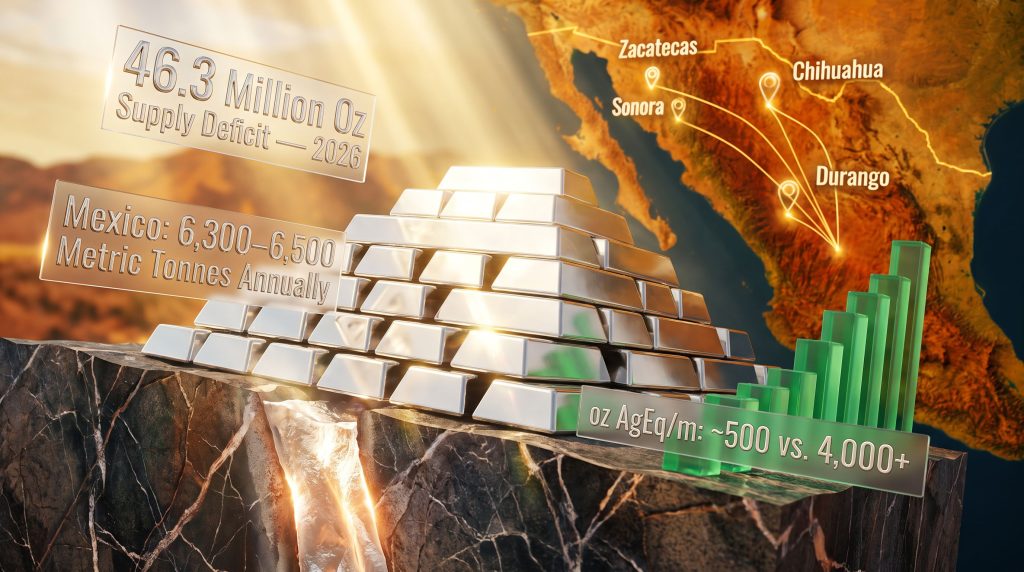
The consequence is a sustained physical deficit cycle. The Silver Institute projects a sixth consecutive annual supply shortfall of 46.3 million ounces in 2026, following a 40.3 million ounce deficit recorded in 2025. Six consecutive years of deficit is not a short-term imbalance. It represents a structural misalignment between where silver comes from and where the economy increasingly needs it to go, and it is directly reshaping how capital is allocated toward primary silver exploration in Mexico and other high-output jurisdictions.
Structural Reality Check: When the majority of global silver supply is determined by base-metal mine scheduling rather than silver price signals, primary exploration projects targeting silver as the principal economic mineral become the only reliable mechanism for adding dedicated supply capacity to a tightening physical market.
When big ASX news breaks, our subscribers know first
Why Primary Silver Exploration in Mexico Anchors the Global Supply Response
Mexico's geological endowment and production scale make it the single most important jurisdiction for primary silver exploration. Furthermore, global silver production figures confirm the country produced an estimated 6,300 to 6,500 metric tonnes of silver in 2024, maintaining its position as the world's largest silver-producing nation by annual output. No other country comes close to matching both the geological variety and the infrastructure maturity that Mexico offers primary silver developers.
Primary silver exploration activity is concentrated across five states, each hosting distinct geological settings:
- Zacatecas – home to some of Mexico's largest known silver deposits and the most developed junior exploration sector in the country
- Sonora – hosts high-grade epithermal silver-gold systems with active expansion programmes
- Durango – increasingly important for structural breccia-hosted silver mineralisation at depth
- Sinaloa – contains significant past-producing underground mine infrastructure alongside new discovery-stage targets
- Chihuahua – hosts bulk-tonnage polymetallic systems with major silver components
Mexico's Active Primary Silver Project Pipeline
| Project | Developer | State | Key Metric |
|---|---|---|---|
| San Marcial / Plomosas | GR Silver Mining (TSXV: GRSL) | Sinaloa / Durango | 20,000 m 2026 drill programme; PEA targeted H1 2027 |
| Alamos | Minaurum | Sonora | 55 Moz AgEq inferred at 320 g/t AgEq; 50,000 m expansion programme |
| Cordero | Discovery Silver | Chihuahua | 302 Mt reserve base grading 27 g/t silver |
| Cerro Las Minitas | Southern Silver | Durango | High-grade silver intercepts from ongoing drilling |
What distinguishes Mexico from competing silver jurisdictions is not simply output volume. It is the combination of established mine infrastructure, active junior exploration pipelines, a documented regulatory framework through SEMARNAT, and proximity to North American capital markets. For instance, these factors together reduce both the technical and financing risk for developers advancing primary silver projects toward production decisions. You can explore a detailed breakdown of Mexico's mining sector for further historical and regulatory context.
Capital Efficiency: The Metric That Now Governs Investor Attention
Understanding Discovery Cost Per Metre Drilled
Junior silver explorers operating in today's market face a double constraint: field costs have risen materially while institutional capital increasingly demands measurable execution discipline before allocating to development-stage companies. Consequently, the response from sophisticated operators has been a sharp pivot toward unit discovery cost, measured as silver-equivalent ounces added per metre drilled, as the primary benchmark for capital efficiency evaluation.
This metric matters because it isolates geological targeting quality from overall campaign expenditure. A company spending the same total budget as a peer but generating twice the discovery rate per metre is, by definition, allocating capital more effectively and building a more defensible resource per dollar of shareholder equity deployed.
Historical discovery rates across Mexico's primary silver projects reveal a wide variance driven primarily by deposit style:
Deposit Style Comparison: Epithermal Veins vs. Hydrothermal Breccias
| Deposit Style | Typical Width | Discovery Rate (oz AgEq/m) | Capital Efficiency |
|---|---|---|---|
| Narrow Epithermal Vein | 1–3 metres | ~500 oz/m | Lower — requires high drill density to define equivalent tonnage |
| Wide Hydrothermal Breccia | 10–50+ metres | 2,000–4,000+ oz/m | Higher — fewer holes needed per resource tonne added |
The implication for project ranking is significant. Developers targeting narrow epithermal veins, which can carry exceptionally high grades but are geometrically constrained, must execute substantially greater total drill metreage to outline equivalent resource volumes compared to teams intersecting broad hydrothermal breccia corridors. This structural difference in exploration economics is one reason why breccia-hosted silver systems in Mexico command attention from institutional capital despite sometimes carrying lower headline grades than their vein-type counterparts.
Investor Psychology Note: In the current market environment, institutional capital increasingly rewards execution discipline and capital efficiency over gross resource scale. A 50 Moz resource built with 800 oz AgEq per metre drilled is frequently valued at a discount to a 30 Moz resource built at 3,500 oz AgEq per metre, because the latter demonstrates the geological targeting quality that supports continued capital deployment at lower dilution risk.
How Structural Geological Targeting Is Transforming Drill Programme Design
From Broad Sampling Campaigns to Fault-Controlled Precision Models
The most important methodological shift occurring across Mexico's primary silver exploration sector is the transition from wide-area geochemical sampling toward structurally controlled, high-grade shoot models. Thoughtful drilling program design maps fault intersections, dilation zones, and structural inflexion points in detail before drill rigs are positioned, concentrating capital expenditure within validated mineralisation corridors rather than distributing it probabilistically across large land packages.
The practical benefits of structural targeting operate on multiple levels simultaneously:
- Higher intercept frequency – holes positioned at predicted structural traps intersect mineralisation more consistently than those placed on geochemical anomalies alone
- Reduced dilution risk – targeting specific structural corridors limits the unmineralised wall rock included in drill intervals, preserving reported grade quality
- Lower total metres to resource definition – fewer holes are needed to outline economic resource blocks when each hole is placed within a validated structural framework
- Predictive extension capability – once a structural model is confirmed, adjacent fault blocks can be targeted with significantly higher geological confidence
At the San Marcial area in Sinaloa/Durango, GR Silver Mining has tested mineralisation from surface to approximately 450 metres depth, using structural mapping along fault inflexions to project high-grade shoots down-dip. The predictive power of this model was demonstrated concretely in drill results released in May 2026, when step-out drilling at a predicted fault intersection returned an intercept of 45.1 metres true width grading 1,623 g/t silver, including 8.25 metres at 8,579 g/t silver. Results of this character validate the structural model across adjacent fault blocks, compounding capital efficiency gains across each successive drill campaign.
Down-Dip Projection and the San Marcial Intrusive System
One of the less widely appreciated aspects of the San Marcial system is the scale of its unexplored perimeter. The intrusive system that hosts mineralisation has only had approximately 20% of its perimeter systematically tested, leaving the remaining 80% as prospective ground for future drill campaigns. This geometry matters for resource growth potential calculations: confirmed high-grade intercepts along a limited portion of a known intrusive contact imply meaningful discovery upside across the untested perimeter, provided the structural model holds consistent with depth projections already validated within the drilled zone.
Operational Risk Management: Mexico's Security and Logistics Realities
Why Single-Route Logistics Dependencies Are an Underpriced Risk Factor
Security conditions in certain Mexican silver districts create an operational risk category that is frequently underweighted in early-stage project valuations but can have immediate and material consequences for development timelines and market re-rating velocity. Blocked access roads delay core shipments to assay laboratories, pushing drill result release timelines out by weeks or months and directly disrupting the news flow cadence that development-stage companies rely upon to sustain investor engagement.
In Sinaloa, cartel activity along the Rosario access road created access constraints for the Plomosas Project through 2025. GR Silver Mining's operational response to this challenge illustrates a risk mitigation strategy applicable more broadly across Mexico's silver exploration sector: leveraging the project's adjacency to the Sinaloa-Durango state border, the company relocated its primary operational base to Durango City in November 2025, establishing an alternate logistics corridor that reroutes personnel, equipment, and core shipments through Durango state infrastructure. This reorganisation restored the operational continuity required to maintain three drill rigs running continuously throughout the 20,000-metre 2026 programme.
Operational Risk Mitigation Framework
- Multi-state logistics routing: Establishing operations through adjacent states with stable road networks eliminates single-route access dependency
- Pre-positioned equipment and consumables: Maintaining on-site inventory buffers reduces exposure to short-duration access interruptions
- Permit diversification across concession areas: Concurrent permits across multiple project areas limit delay impacts from any single regulatory approval process
Residual Risk Factors Investors Should Monitor
Despite effective mitigation strategies, meaningful residual risks persist across Mexico's primary silver exploration sector:
- Ongoing regional security volatility in active silver districts across Sinaloa, Durango, and Chihuahua
- Road maintenance dependencies during extreme weather events in mountainous terrain
- Secondary permit approval delays from SEMARNAT for new concession areas adjacent to existing permitted zones
- Silver price volatility and its sensitivity impact on NPV and IRR calculations within PEA models
- Equity dilution risk from the continuous financing requirements of development-stage companies
- Metallurgical recovery variances between distinct breccia mineralisation types within the same project area
Disclaimer: Investment in development-stage mining companies involves material risk including, but not limited to, the factors listed above. Past exploration results do not guarantee future resource definition or production outcomes. Investors should conduct independent due diligence before making investment decisions.
Infrastructure Re-Use: The Brownfield Advantage in a Capital-Constrained Market
Why Past-Producing Mines Change the Project Economics Equation
A greenfield silver project in Mexico requires full infrastructure construction, an upfront capital commitment that can reach hundreds of millions of dollars, and an environmental permitting timeline of 5 to 7 years for previously undisturbed concessions. These requirements effectively price out junior developers who cannot access project finance at development stage and create a structural ceiling on how quickly new primary silver supply can reach the market from a greenfield discovery.
Past-producing underground mines with existing permits, accessible workings, and surface infrastructure represent a fundamentally different risk and cost profile. The Plomosas Mine, which operated from 1986 to 2000 and contains 7.4 kilometres of accessible underground workings, exemplifies this brownfield advantage. Existing operating permits eliminate the most time-consuming element of the permitting pathway, while established underground infrastructure reduces initial development capital and provides immediate access to bulk-sample test-mining programmes that generate the metallurgical data required for economic study preparation.
Bulk Sampling as a Triple-Function De-Risking Tool
A bulk-sample programme operating through a 60 to 200 tonne per day pilot plant facility serves three simultaneous functions that are individually valuable but compoundingly powerful when combined:
- Metallurgical data generation – processing performance data from actual high-grade underground material underpins the assumptions embedded in PEA economic models
- Regulatory compliance record establishment – operating under existing Plomosas permits builds a documented compliance history with SEMARNAT that supports environmental applications for the adjacent San Marcial discovery
- Resource conversion confidence – underground test-mining access to high-grade zones allows geological teams to refine resource block models with physical sampling data unavailable from surface drilling alone
Key Insight: A past-producing mine with 7.4 kilometres of accessible underground workings and existing operating permits can compress the timeline to a PEA by several years relative to a comparable greenfield discovery. In a market where execution velocity drives institutional valuation multiples, this infrastructure advantage is not a minor convenience but a material competitive differentiator.
The next major ASX story will hit our subscribers first
The 2026 to 2027 Catalyst Sequence: Milestone Progression and Valuation Inflections
How Institutional Capital Re-Rates Primary Silver Developers at Each Stage
Primary silver developers advancing toward production decisions move through a sequence of technical milestones, each of which corresponds to a distinct valuation framework and a specific risk reduction event. Understanding this progression is essential for positioning around re-rating catalysts rather than simply reacting to them after announcement. Project study milestones such as PEA completion represent particularly significant valuation inflection points for institutional allocators.
| Development Stage | Primary Valuation Metric | Key Risk at This Stage |
|---|---|---|
| Active Exploration | oz AgEq discovered per metre drilled | Drill targeting accuracy and geological model reliability |
| Resource Estimation | Grade-thickness continuity across the deposit | Geological model fidelity across infill spacing |
| PEA Completion | NPV and IRR sensitivity to silver price assumptions | Capital cost estimation accuracy and metallurgical recovery assumptions |
| Permitting Advancement | Timeline to production decision | SEMARNAT approval sequencing and community engagement |
For GR Silver Mining, the 12-month development roadmap integrates all four stages within a fully funded programme structure. The operational sequence runs from continuous drilling news flow, through a mineral resource estimate update that converts new drill data into compliant indicated and inferred resource categories, toward an integrated PEA covering both Plomosas and San Marcial, targeted for the first half of 2027. Each transition point represents a potential valuation re-rating as the company migrates from exploration-phase metrics toward economic study-phase metrics.
What the PEA Milestone Means for Market Positioning
A completed PEA changes the analytical framework entirely. Pre-PEA, institutional analysts value primary silver developers primarily on discovery rate and resource grade continuity. Post-PEA, however, the conversation shifts to NPV multiples, capital intensity per annual silver-equivalent ounce of production, and payback period sensitivity to silver price assumptions. Projects with lower capital intensity relative to their NPV, typically those leveraging existing brownfield infrastructure rather than greenfield construction costs, tend to receive higher market multiples at the PEA stage because their economics require less silver price optimism to generate acceptable returns.
Frequently Asked Questions: Primary Silver Exploration in Mexico
Why does Mexico dominate primary silver exploration globally?
Mexico combines the world's highest silver output (approximately 6,300 to 6,500 metric tonnes annually), geological diversity spanning both high-grade epithermal vein systems and bulk-tonnage hydrothermal breccias, established mining infrastructure, and proximity to North American capital markets. No competing jurisdiction currently offers this combination at comparable scale.
What distinguishes primary silver mining from by-product silver production?
Primary silver operations designate silver as the principal economic mineral and primary revenue source. By-product silver is recovered incidentally during base-metal mining. Because roughly 74% of global silver mine supply originates from by-product operations, their output volumes respond to base-metal economics and cannot flex in response to silver-specific demand growth, creating the structural supply gap that primary exploration projects are positioned to address.
How do institutional investors evaluate silver exploration quality in Mexico?
The primary metrics applied are unit discovery cost (silver-equivalent ounces per metre drilled), grade-thickness intercepts (true width multiplied by silver-equivalent grade), deposit style characteristics (vein versus breccia geometry), infrastructure availability and permit status, and execution velocity toward economic study completion. Projects combining high-grade structural discoveries with existing permitted brownfield infrastructure command the highest valuation multiples in the current institutional allocation environment.
What geological deposit styles generate the highest capital efficiency in Mexico?
Wide hydrothermal breccia systems consistently deliver discovery rates ranging from 2,000 to over 4,000 oz AgEq per metre drilled, compared to approximately 500 oz AgEq per metre for narrow epithermal vein systems. While epithermal veins can deliver exceptional bonanza-grade intercepts in narrow intervals, their geometric constraints require substantially higher drill density to define equivalent resource volumes, reducing overall capital efficiency.
How long does advancing a primary silver project to a production decision typically take in Mexico?
Greenfield projects requiring full infrastructure construction and new SEMARNAT environmental permits typically require 5 to 7 years from discovery to production decision. Brownfield projects reusing existing permitted underground workings can compress this timeline significantly, with advanced developers holding past-producing infrastructure potentially reaching PEA completion within 12 to 18 months of completing a major resource update.
The Structural Outlook for Primary Silver Exploration in Mexico
Six consecutive annual supply deficits, with the 2026 shortfall projected at 46.3 million ounces, establish a durable and measurable rationale for allocating capital toward primary silver exploration in Mexico. Industrial demand growth from solar manufacturing and electric vehicle production is structurally embedded in global energy transition investment patterns and is unlikely to reverse on any timeframe relevant to current project development decisions.
Mexico's geological endowment, brownfield infrastructure base, and active junior exploration sector position it as the dominant jurisdiction for closing the global primary silver supply gap over the next decade. Within that context, the three variables that determine competitive positioning for individual developers are:
- Discovery efficiency driven by structural geological targeting precision, measured in oz AgEq per metre drilled
- Infrastructure advantage from existing permits and underground workings that compress development timelines and reduce initial capital requirements
- Execution velocity in converting drill results to resource estimates, economic studies, and ultimately production decisions ahead of competing supply additions
Final Perspective: In a market defined by sustained physical deficits and rising industrial consumption, primary silver developers in Mexico that combine fault-controlled structural targeting expertise with permitted brownfield infrastructure are best positioned to attract institutional financing and advance toward production decisions within the window that the supply deficit cycle creates. Those that cannot demonstrate capital efficiency at the unit discovery cost level will find institutional capital increasingly difficult to access, regardless of gross resource size.
Readers seeking additional context on primary silver supply dynamics and Mexico-based exploration activity can explore related editorial analysis published by Crux Investor at cruxinvestor.com, which covers institutional-grade mining analysis across the silver sector. Furthermore, those interested in profiling active operators can review current Mexico mining stocks listed on the Junior Mining Network for an overview of the broader developer landscape.
Ready To Position Ahead of the Next Major Silver Discovery on the ASX?
Discovery Alert's proprietary Discovery IQ model delivers real-time alerts the moment significant mineral discoveries — including silver and precious metals — are announced on the ASX, transforming complex geological data into actionable investment insights for both short-term traders and long-term investors. Explore historic examples of major mineral discoveries and their market returns, then begin your 14-day free trial to ensure you are positioned ahead of the broader market when the next significant discovery is announced.