August 3, 2026
When Execution Becomes the Differentiator in Silver Development
The mining industry has a well-documented problem at the inflection point between feasibility and construction: projects with world-class economics stall not because the ore is insufficient, but because the organisational infrastructure needed to execute is absent. Across Latin America, permitting delays, community opposition, and regulatory complexity have derailed or significantly delayed projects that looked compelling on paper. The question sophisticated investors increasingly ask is not whether a project can produce silver, but whether the team assembled can navigate the operational gauntlet between a completed feasibility study and first pour.
This is the context in which Vizsla Silver appoints Luis Lázaro as President Mexico, a strategic hire that deserves examination not just as a personnel announcement, but as a signal of where the Panuco silver-gold project sits on the development curve and what the company believes is required to advance it.
When big ASX news breaks, our subscribers know first
The Panuco Project: Economics That Stand Apart from the Peer Group
Understanding why this appointment matters requires first appreciating what is being advanced. The Panuco silver-gold project, wholly owned by Vizsla Silver Corp. (TSX: VZLA | NYSE: VZLA), is located in Sinaloa, Mexico and represents one of the most economically compelling primary silver development assets globally based on its November 2025 Feasibility Study.
The headline figures are striking by any measure:
| Economic Metric | Feasibility Study Value |
|---|---|
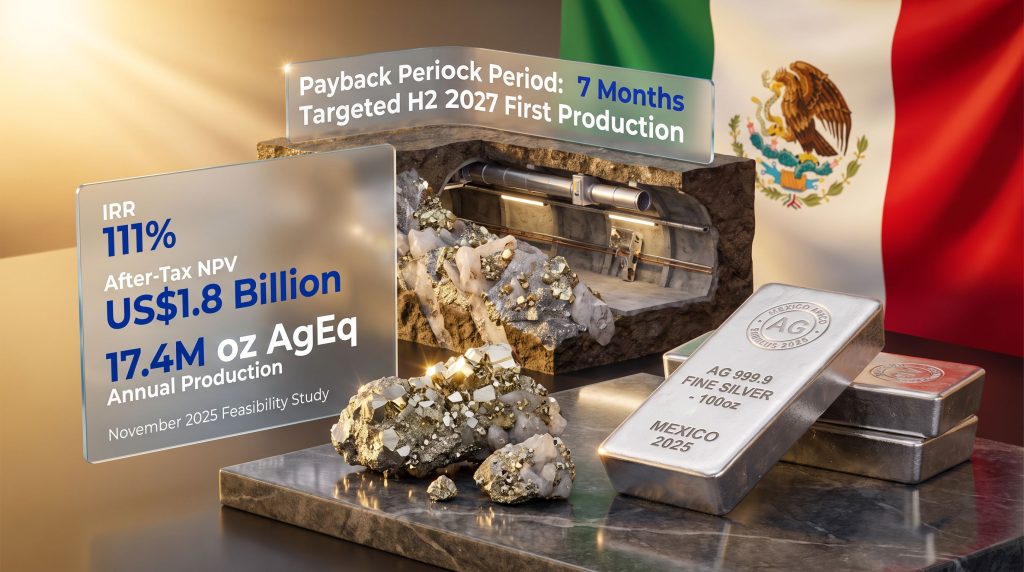
| Annual Silver Equivalent Production | 17.4 million ounces |
| Initial Mine Life | 9.4 years |
| After-Tax NPV (5% discount rate) | US$1.8 billion |
| Internal Rate of Return (IRR) | 111% |
| Payback Period | 7 months |
| Silver Price Assumption | US$35.50/oz |
| Gold Price Assumption | US$3,100/oz |
A 111% IRR is not merely strong for a silver development project; it is exceptional within the broader mining development universe. Primary silver developers that reach feasibility with IRRs in the 20% to 60% range are typically considered well-positioned for financing. An IRR above 100% places Panuco in a category occupied by very few projects globally, and the 7-month payback period compounds this advantage significantly.
Furthermore, what makes the economics even more compelling for investors monitoring the project in mid-2026 is that spot silver has been trading above US$60 per ounce, roughly 69% above the US$35.50 per ounce assumption embedded in the definitive feasibility study. This price delta does not simply widen the NPV linearly; silver's high operating leverage means that every dollar of silver price above the base case assumption translates into a disproportionately large improvement in project cash flows and returns.
Important disclaimer: The Panuco project economics are derived from a November 2025 Feasibility Study and represent forward-looking estimates only. Vizsla Silver Corp. has not made a formal production decision. All timelines and financial projections are subject to detailed engineering completion, financing arrangements, and receipt of all required permits and approvals. Investors should not rely on these figures as guarantees of future performance.
Why a 7-Month Payback Period Changes the Financing Conversation
In a higher-for-longer interest rate environment, capital recovery speed has become one of the most scrutinised metrics by project financiers. A 7-month payback period fundamentally alters the risk calculus for potential lenders and streaming partners.
Consider what a short payback means in practical terms for different financing structures:
- Senior debt lenders face dramatically reduced exposure windows, making debt service coverage ratios easier to satisfy and reducing covenant complexity.
- Streaming and royalty counterparties can model their return profiles against a project that recovers capital almost immediately after commissioning, reducing the risk of a prolonged ramp-up period consuming their upfront payment returns.
- Equity investors benefit from the signal that cash generation will begin almost immediately after production starts, rather than requiring years of operation before the project moves into genuine free cash flow generation.
For a primary silver developer seeking project financing partnerships in the current market, the 7-month payback is arguably as important a data point as the absolute NPV figure, because it speaks directly to lender risk exposure duration. In addition, project financing partnerships of this nature are increasingly shaped by how quickly a project can demonstrate capital recovery potential.
Luis Lázaro: Decoding Why Industrial Leadership Translates to Mining Execution
The instinct to question why a citrus juice processing executive has been appointed to lead a silver mining project's in-country operations is understandable. However, this instinct misunderstands what the construction and production ramp-up phase of a large-scale Mexican mining project actually demands.
Lázaro's career trajectory across three decades spans some of Mexico's most operationally demanding industrial environments:
| Organisation | Function | Key Transferable Skill |
|---|---|---|
| CEMEX | Early leadership operations | Large-scale logistics, industrial site management |
| Grupo PINSA | Head of Fishing Division | Resource extraction, complex supply chain coordination |
| THAES (founded) | Founder and operator | Agri-industrial processing, ethanol production |
| Citrofrut | Chief Executive Officer | Business transformation, stakeholder management at scale |
His most recent role at Citrofrut is particularly instructive. Leading Mexico's largest citrus juice processor required navigating federal food safety regulations, managing a diverse agricultural supply chain, engaging regional communities in multiple states, and executing a business transformation strategy that repositioned the company toward higher-margin specialty products.
These are not peripheral skills for a mining construction project. They are precisely the capabilities required to manage permitting negotiations with Mexican regulatory authorities, build relationships with Sinaloa communities, and develop the organisational systems needed to take a project from feasibility paperwork to operating mine.
His academic formation reinforces this profile. A chemical engineering degree from Tecnológico de Monterrey provides the technical systems thinking that underpins process-oriented industries. An MBA from IMD International in Lausanne, one of the world's most rigorous management institutions, adds the strategic and financial framework. Completion of the Stanford Executive Program layers on leadership methodology from Silicon Valley's most influential executive education environment.
This combination of engineering fundamentals, elite international business education, and Mexican market operational depth is genuinely unusual.
The appointment also reflects an increasingly recognised truth among sophisticated mining investors: the skills that determine construction-phase success are primarily organisational and relational, not geological. Once a feasibility study is complete, the geological case has been made. What remains is execution.
In-Country Leadership as a Risk Reduction Mechanism in Mexican Mining
Mexico presents a distinctive operational environment for mining companies advancing large-scale projects. Sinaloa state has historically been host to significant mining activity, but the regulatory and community engagement landscape requires culturally embedded leadership that understands how institutional relationships function in the Mexican context.
The key stakeholder categories that a President, Mexico role must actively manage include:
- Federal regulators through Mexico's Secretaría de Economía and SEMARNAT for environmental impact assessments and permits.
- State and municipal authorities in Sinaloa whose cooperation affects practical project advancement timelines.
- Local communities whose free, prior, and informed consent processes under Mexican law must be navigated with cultural competence.
- Labour organisations relevant to workforce development and labour relations during construction.
- Federal environmental authorities overseeing the Environmental Impact Assessment (MIA) process, which is among the most consequential permitting milestones for any major Mexican mining project.
An executive who has spent three decades operating across Mexico's industrial landscape brings an understanding of these relationships that cannot be replicated by remote corporate governance from Vancouver. The timing of the appointment, effective August 5, 2026, roughly 12 to 18 months ahead of the targeted H2 2027 first production window, reflects deliberate strategic thinking. Construction-phase leadership must be embedded before major capital commitments are made, not after.
The Geological Transition at Panuco: Why Timing Reduces the Risk
Concurrent with the Lázaro appointment, Vizsla Silver announced that Jesus Velador, the project's Chief Geologist and a Qualified Person under National Instrument 43-101, has resigned effective August 27, 2026. Guillermo Hernandez, Vice President of Exploration, will absorb the expanded geological responsibilities.
Geological leadership transitions are not uniformly risky. The risk level depends critically on where a project sits in its development cycle:
- During active resource expansion drilling: A chief geologist transition creates genuine continuity risk because ongoing interpretation of new data requires deep institutional knowledge.
- At the feasibility-to-construction stage: The primary geological programme is substantially complete. The November 2025 Feasibility Study represents the culmination of the resource definition and economic modelling work. The geological function at this stage shifts from discovery toward mine planning support and grade control, a mandate that an experienced VP of Exploration is well-positioned to absorb.
Velador's contribution to advancing Panuco to feasibility was substantial and acknowledged by the company's leadership. Hernandez's existing familiarity with the Panuco district's geology ensures that the institutional knowledge accumulated over the exploration programme is not lost. Consequently, the transition carries lower execution risk at this specific project stage than it would have at any earlier point in the development cycle.
The next major ASX story will hit our subscribers first
The Critical Path to First Silver Production at Panuco
The road between today's project status and a targeted H2 2027 production start involves a defined sequence of interdependent milestones. Understanding this critical path is essential for investors evaluating the credibility of the timeline.
- Permitting completion: Receipt of all required permits and regulatory approvals from Mexican federal and state authorities, including the environmental impact assessment process.
- Detailed engineering finalisation: Completion of front-end engineering and design work sufficient to support a formal construction decision with high capital cost certainty.
- Financing arrangements: Securing project financing through an appropriate combination of senior debt, equity, streaming, and royalty structures.
- Formal construction decision: Board approval to proceed with full construction, contingent on satisfactory completion of the three preceding steps.
- Construction execution: Physical development of processing facilities and mine infrastructure under Lázaro's operational leadership.
- Commissioning and first production: Targeted for the second half of 2027.
Each of these steps carries its own risk profile. Permitting timelines in Mexico can be affected by regulatory workload and the quality of community consultation processes. Construction cost escalation in the current inflationary environment represents a capital cost risk that detailed engineering must quantify. Silver price volatility, while currently favourable relative to feasibility assumptions, could shift the financing landscape if prices retreated materially.
None of these risks invalidate the project's underlying economics. They represent the standard execution risk spectrum that differentiates development companies from producers, and they are precisely the risks that a credible in-country operational leadership appointment is designed to address.
What the Silver Market Context Adds to the Investment Equation
Silver's structural dynamics in 2026 provide important macroeconomic context for evaluating Panuco's development timeline. The silver supply deficits have now persisted across six consecutive annual cycles, a streak that reflects the sustained gap between mine supply growth and demand from industrial applications. Furthermore, silver's industrial demand continues to expand across photovoltaic solar manufacturing, electronics, and electrification infrastructure.
With spot silver holding above US$60 per ounce as of mid-2026, the Panuco feasibility study's US$35.50 per ounce base case assumption is deeply conservative. This conservatism is not accidental; feasibility studies are typically designed to demonstrate project viability under cautious price assumptions, with higher commodity prices representing optionality rather than base-case dependence.
For a primary silver developer with 17.4 million silver equivalent ounces of planned annual production and a 9.4-year initial mine life, the leverage to sustained elevated silver prices is substantial. Every meaningful increment in realised silver price above the feasibility assumption flows almost directly to project cash flows given the low payback period's implication for fixed cost recovery speed.
Moreover, mining industry consolidation trends in 2025 and 2026 have elevated the strategic value of fully permitted, construction-ready silver assets, adding a further dimension to how institutional investors are assessing projects like Panuco.
Frequently Asked Questions: Vizsla Silver Appoints Luis Lázaro as President Mexico
Who is Luis Lázaro and what experience does he bring to Vizsla Silver?
Luis Lázaro is a Mexican business executive with 30 years of operational and leadership experience across multinational corporations, founded ventures, and privately owned businesses in Mexico. His most recent position was Chief Executive Officer of Citrofrut, Mexico's largest citrus juice processor. He also held senior roles at Grupo PINSA, founded agri-industrial venture THAES, and began his career at CEMEX.
His academic credentials include a chemical engineering degree from Tecnológico de Monterrey, an MBA from IMD International in Lausanne, and completion of the Stanford Executive Program.
What does the President, Mexico role involve at Vizsla Silver?
Effective August 5, 2026, Lázaro leads all in-country operations and oversees the Panuco silver project's advancement through permitting, construction, and potential production phases. He reports directly to President and CEO Michael Konnert and works with the broader executive team on stakeholder relationships, team development, and operational execution.
What are the key economics of the Panuco Feasibility Study?
The November 2025 Feasibility Study outlines annual production of 17.4 million silver equivalent ounces over an initial 9.4-year mine life, with an after-tax NPV of US$1.8 billion at a 5% discount rate, an IRR of 111%, and a 7-month payback period. These figures are based on silver at US$35.50 per ounce and gold at US$3,100 per ounce.
When is Vizsla Silver targeting first production at Panuco?
The company's target is first silver production in the second half of 2027. No formal production decision has been made. Advancement remains contingent on completion of detailed engineering, securing financing arrangements, and receipt of all required permits and approvals.
What happened with Vizsla Silver's Chief Geologist?
Jesus Velador resigned as Chief Geologist effective August 27, 2026. Guillermo Hernandez, Vice President of Exploration, has assumed expanded responsibility for the company's geological function. This transition is considered lower risk given the project's feasibility-to-construction stage position, where the geological discovery and resource definition work is largely complete.
Readers seeking additional information on Vizsla Silver Corp. and the Panuco project can explore related company profiles and coverage at Crux Investor.
Ready to Capitalise on the Next Major Silver Discovery Before the Market Does?
Discovery Alert's proprietary Discovery IQ model scans ASX announcements in real time, instantly identifying high-potential mineral discoveries across silver and 30+ other commodities — turning complex data into clear, actionable opportunities for investors at every experience level. Explore how historic discoveries have delivered extraordinary returns and begin your 14-day free trial today to secure a genuine market-leading edge.