July 24, 2026
The Economics of Exploration Reinvestment in Precious Metals Mining
Mid-tier silver and gold producers face a structural challenge that rarely surfaces in quarterly earnings calls: the relentless depletion of underground ore reserves. Every tonne of rock extracted brings a mine incrementally closer to its end date, and the only way to offset that countdown is through sustained, capital-intensive exploration drilling. For companies operating high-grade underground systems, the economics of reserve replacement are compelling.
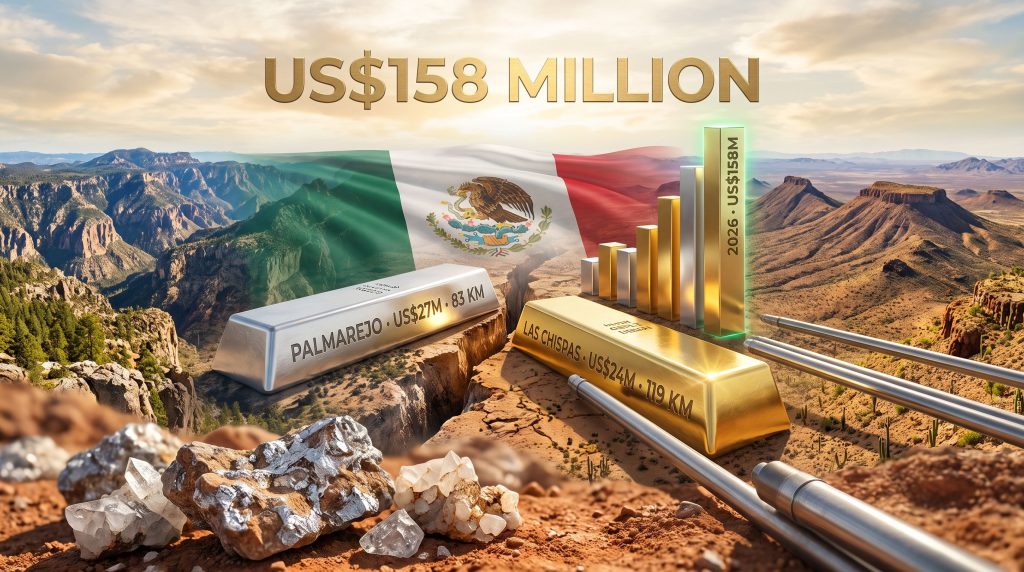
Adding an ounce of gold or silver equivalent through near-mine drilling typically costs a fraction of what it would cost to acquire that same ounce through a corporate transaction or develop it through a greenfield project. This fundamental arithmetic sits at the heart of Coeur Mining investment in Mexico, with the company deploying US$158 million toward its Mexican operations in 2026 — a commitment representing both a record exploration investment and a clear strategic signal about long-term value creation potential.
Understanding why Coeur Mining investment in Mexico has reached this scale requires looking beyond a single budget cycle and examining the geological, financial, and operational logic that has been building for years across its two flagship Latin American assets.
When big ASX news breaks, our subscribers know first
Palmarejo and Las Chispas: Two Assets, Two Geological Stories
Coeur Mining operates two wholly owned producing mines in Mexico, and while both sit within the country's prolific silver-gold corridor, they represent quite different geological and operational profiles.
Palmarejo, located in the Sierra Madre Occidental range of Chihuahua state, is one of Mexico's most significant underground silver-gold operations. The deposit is hosted in epithermal vein systems typical of the region, where precious metals concentrate along structural corridors that can extend laterally and at depth for considerable distances. Palmarejo has been in production for over a decade, meaning the low-hanging geological fruit has already been harvested. The current exploration push targets structural extensions to the east of the existing mine footprint.
Las Chispas, situated in Sonora state, is a younger, higher-grade asset that came into production more recently. Following the Las Chispas acquisition, Sonora's geology has demonstrated the kind of mineralisation intensity that justifies aggressive near-mine exploration. The higher drilling intensity per dollar allocated at Las Chispas relative to Palmarejo reflects both the grade potential and the earlier-stage nature of the geological understanding at this asset.
How the 2026 Drilling Programs Break Down
| Asset | State | Budget | Planned Drilling | Primary Focus |
|---|---|---|---|---|
| Palmarejo | Chihuahua | US$27 million | 83 km | Structural extensions, mine-life extension |
| Las Chispas | Sonora | US$24 million | 119 km | High-grade resource conversion |
| Combined | Mexico | US$51 million | 202 km | Reserve growth, production continuity |
The combined drilling program of 202 kilometres across both assets is a substantial physical undertaking. To contextualise that scale, 202 kilometres of underground and surface drilling involves multiple drill rigs operating simultaneously across months of continuous field activity. The cost per metre drilled varies significantly between surface programs, which are generally cheaper, and underground programs, which require more complex logistics but often yield higher-quality geological intersections.
Technical Note: In underground silver-gold vein mining, the distinction between resource category upgrades and new discovery drilling matters enormously for capital allocation. Upgrading resources from the inferred category to indicated or measured status through infill drilling is a lower-risk, higher-probability activity compared to step-out exploration. Furthermore, interpreting drill results accurately is critical when allocating capital between infill and extension programs. Coeur's programs appear to combine both approaches.
Five Years of Sustained Capital: What US$340 Million Buys
The 2026 program does not exist in isolation. Coeur Mining has now deployed approximately US$340 million in Mexican exploration capital over the five-year period preceding 2026, averaging roughly US$68 million per year before the dramatic acceleration represented by the 2026 commitment.
This kind of sustained, multi-year exploration investment has a compounding effect on mine-life projections that is not always immediately visible in annual results. Reserve replacement is a lagging indicator: drilling programs conducted in one year generate geological data that must be modelled, interpreted, and converted into resource estimates before they flow through to reserve updates. The full value of exploration spending often takes two to three years to manifest in reported reserve figures.
For investors tracking Coeur Mining investment in Mexico, this pipeline dynamic is important. The US$158 million committed for 2026 will not produce its full reserve replacement benefit within the 2026 financial year. Instead, it builds the geological database and resource inventory that underpins production planning for 2028 and beyond.
Why Reserve Replacement Ratios Matter More Than Production Rates
Many investors focus primarily on quarterly production figures when evaluating mining companies, but for long-life underground operations, the reserve replacement ratio is arguably the more important leading indicator of asset quality. A mine replacing more than 100% of its annual depletion through exploration is effectively growing its life expectancy, while one replacing less than 100% is drawing down a finite resource base.
Key metrics worth monitoring across Coeur's Mexican portfolio include:
- Reserve replacement ratio at both Palmarejo and Las Chispas on an annual basis
- Cost per ounce of reserve addition, calculated as exploration capex divided by new silver-equivalent ounces added to reserves
- Resource category distribution, tracking the proportion of resources in inferred versus indicated and measured categories
- Drilling success rates, particularly the percentage of holes intersecting economic mineralisation above cutoff grades
- Mine life in years, updated with each annual reserve statement
The Concession Acquisition: Why Unencumbered Ground Matters
Beyond the drilling programs themselves, Coeur's Mexican subsidiary executed a strategically significant land acquisition adjacent to Palmarejo, paying US$25 million in cash for mining concessions described as filling critical gaps to the east of the existing mine boundary. The deal also includes a future royalty payable to the vendor linked to any new resource discoveries made on the acquired ground.
The phrase outside stream-encumbered areas deserves particular attention because it reveals a sophisticated understanding of the economic architecture governing Palmarejo's revenue streams.
Streaming Mechanics Explained: A precious metals streaming agreement is a financing arrangement where a streaming company provides upfront capital to a miner in exchange for the right to purchase a fixed percentage of future production at a predetermined, below-market price. Discoveries made outside the stream boundary allow Coeur to capture 100% of the economic value from any new mineralisation found on the acquired concessions.
The acquisition increases Coeur's unencumbered land position around Palmarejo by approximately 20%, which represents meaningful optionality for future value creation. The royalty mechanism embedded in the deal structure also aligns vendor incentives with Coeur's exploration success, reducing the effective upfront cost if drilling on the concessions proves unproductive.
Scenario Analysis: Eastern Concession Outcomes
| Scenario | Exploration Result | Economic Outcome |
|---|---|---|
| Base Case | Incremental resource additions | Mine-life extension of 3 to 5 years |
| Bull Case | Structurally significant discovery outside stream boundary | High-margin standalone resource, full economic capture |
| Bear Case | Low-grade or structurally complex results | Limited economic value, royalty partially offsets acquisition cost |
Mexico's Regulatory Environment: Navigating Policy Complexity
No serious analysis of Coeur Mining investment in Mexico can avoid the regulatory dimension. Mexico's mining policy environment has evolved considerably since 2021, with changes to concession renewal frameworks, environmental permitting processes, and royalty taxation affecting the operational calculus for foreign-owned mining companies across Chihuahua and Sonora.
Coeur's long-established presence in both states provides a degree of institutional familiarity that newer entrants cannot replicate quickly. Operating relationships with state governments, local communities, and regulatory bodies are built over years and represent a genuine competitive advantage in jurisdictions where social licence and regulatory continuity matter as much as geology. Coeur's strategic transformation over recent years has been partly shaped by navigating precisely these kinds of complex jurisdictional dynamics.
The VAT Arbitration: Understanding the Dispute
Coeur has been engaged in an investment arbitration proceeding against Mexico related to VAT refund claims connected to royalty arrangements at Palmarejo. This is not an isolated situation; several international mining companies operating in Mexico have pursued investment treaty arbitration over fiscal and regulatory disputes in recent years.
Mexican VAT law permits mining companies to claim refunds on input taxes, but the mechanism for processing these claims has been contested in various cases, particularly where royalty payment structures interact with VAT obligations in complex ways. The financial materiality of the Palmarejo VAT dispute to Coeur's balance sheet remains subject to ongoing proceedings, and investors should treat this as a contingent liability requiring ongoing monitoring rather than a resolved matter.
Jurisdictional Risk Comparison
| Jurisdiction | Regulatory Stability | Infrastructure | Political Risk | Cost Environment |
|---|---|---|---|---|
| Mexico (Chihuahua/Sonora) | Moderate | High | Medium | Competitive |
| Nevada, USA | High | High | Low | High cost |
| British Columbia, Canada | High | Moderate | Low | Moderate |
| Peru | Moderate | Moderate | Medium-High | Competitive |
| Argentina | Volatile | Variable | High | Variable |
The Portfolio Concentration Logic: What the La Preciosa Exit Reveals
Coeur's strategic evolution in Mexico is also illuminated by what it chose not to retain. The company previously held the La Preciosa silver-gold project in Mexico, which it agreed to divest in 2021 for fixed and contingent consideration plus royalty entitlements. The decision to exit La Preciosa while simultaneously deepening investment at Palmarejo and Las Chispas reflects a deliberate portfolio concentration philosophy.
Rather than managing three Mexican assets with competing capital demands, Coeur channelled its exploration budget into the two operations with the strongest established resource bases, existing infrastructure, and clearest paths to mine-life extension. This concentration effect has been validated by the US$340 million deployed over five years — a capital commitment that would have been spread thinner across a three-asset portfolio.
The La Preciosa royalty retained from the divestment also provides residual upside exposure if the acquirer successfully develops that project, without requiring Coeur to absorb the development capital or operational complexity.
The next major ASX story will hit our subscribers first
Why Mexico Outcompetes the US Domestic Mining Environment
A counterintuitive aspect of Coeur's capital allocation is the implicit comparison it draws with US domestic mining development. American mining projects face structural headwinds that have lengthened development timelines significantly over the past decade. Indeed, US mining permit delays have become an increasingly significant factor in how companies allocate exploration capital across jurisdictions.
Specifically, the challenges facing US domestic projects include:
- Federal permitting processes under the National Environmental Policy Act can extend over seven to ten years for new mines
- Environmental review backlogs across Bureau of Land Management jurisdictions have accumulated substantially
- Cost escalation in US labour, equipment, and regulatory compliance has compressed project economics
- Social and political opposition to mining in certain western US states has added further uncertainty to project timelines
Against this backdrop, Coeur's established producing assets in Mexico offer something that no US greenfield project can match: the ability to deploy exploration capital immediately into operating mines with existing infrastructure, processing facilities, and workforces. Furthermore, the gold and silver supply constraints emerging globally make near-mine reserve replacement at existing operations even more valuable relative to greenfield development.
Mexico's established mining services ecosystem across Chihuahua and Sonora — comprising specialist underground contractors, equipment suppliers, and technical professionals with deep regional experience — further supports large-scale exploration programs by reducing mobilisation times and operational friction. According to Coeur Mining's corporate strategy, this established operational presence is central to the company's long-term value creation framework in the region.
Investor Consideration: The decision to concentrate US$158 million in Mexico rather than divert capital toward US domestic development is not simply a geological judgement. It reflects a sophisticated capital efficiency calculation: established operating infrastructure in Mexico generates faster, cheaper, and more predictable reserve additions than equivalent spending on greenfield development in the US domestic context. This article is not financial advice. Investors should conduct their own due diligence and consult qualified financial advisers before making investment decisions.
Key Investment Metrics and Risk Framework
For analysts and investors following Coeur's Mexican strategy, the following framework organises the key variables into a structured monitoring approach.
Bullish indicators to watch:
- Annual reserve replacement ratios exceeding 100% at both Palmarejo and Las Chispas
- Drilling intercepts from eastern Palmarejo concessions confirming structural continuity at economic grades
- Positive resolution or provisioning of the Mexico VAT arbitration dispute
- Continued precious metals price strength supporting exploration NPV calculations
Risk factors requiring ongoing assessment:
- Mexican regulatory changes affecting concession security, environmental permitting, or royalty taxation
- Exploration program results delivering below-expected grade or structural complexity
- Streaming agreement obligations limiting economic capture from within-boundary discoveries
- Balance sheet implications of the unresolved VAT dispute
- Currency effects of Mexican peso movements on operating cost structures denominated in local currency
Structural advantages providing downside protection:
- Existing underground infrastructure reducing execution risk on exploration programs
- Decades of operational presence providing regulatory and community relationship continuity
- Portfolio concentration creating deeper geological understanding of both ore systems
- Royalty retention from La Preciosa providing residual upside without capital exposure
The US$158 million 2026 exploration commitment is best understood not as a discrete capital event but as the most visible expression of a multi-year geological conviction that has been building through US$340 million of cumulative investment across Palmarejo and Las Chispas since 2021. Whether that conviction is vindicated will ultimately be measured not in dollars spent, but in ounces added to the reserve base and years added to mine life.
This article is provided for informational purposes only and does not constitute financial advice, investment recommendations, or an offer to buy or sell securities. Forecasts, projections, and scenario analyses are speculative in nature and subject to material uncertainty. Readers should seek independent financial advice before making investment decisions.
Want to Track the Next Major Precious Metals Discovery Before the Market Does?
Discovery Alert's proprietary Discovery IQ model scans ASX announcements in real time, instantly identifying significant mineral discoveries across gold, silver, and over 30 other commodities — turning complex geological data into actionable investment insights for traders and investors at every level. Explore Discovery Alert's discoveries page to understand how historic finds have generated substantial returns, and begin your 14-day free trial today to position yourself ahead of the broader market.