
July 24, 2026
The Invisible Architecture of a Graphite Market in Crisis
The battery materials sector has long operated on an assumption: that demand growth from electric vehicle adoption would steadily pull new supply into commercial viability. For natural graphite producers outside China, that assumption is being tested in ways that quarterly production figures alone cannot capture. The forces reshaping output decisions at operations like Syrah's Balama mine in Mozambique are not simply market corrections. They represent the collision of commodity economics, geopolitical disruption, regulatory evolution, and a value chain that has not yet restructured fast enough to reward upstream producers.
Understanding why Syrah cuts Mozambique graphite output in Q2 2026 requires moving beyond the headline numbers and examining the layered pressures that made reduced production the most rational available choice. Furthermore, the graphite supply challenges that underpin this decision have been building across the sector for some time.
When big ASX news breaks, our subscribers know first
What the Q2 2026 Production Data Actually Reveals
The raw figures from Syrah's April to June 2026 operational update are striking in their apparent contradictions.
| Metric | Q2 2026 | Q2 2025 | Quarter-on-Quarter Change |
|---|---|---|---|
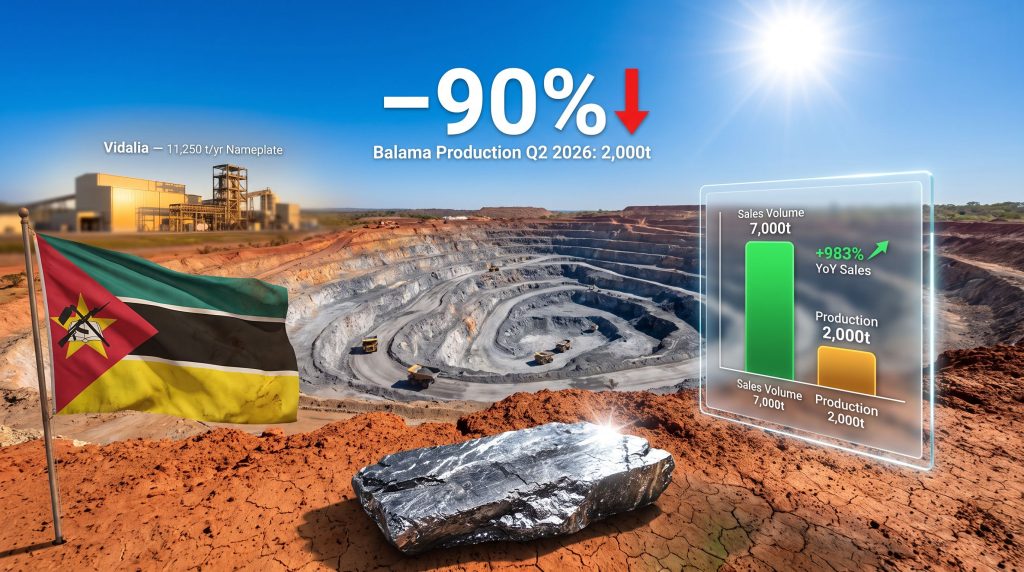
| Balama Production (t) | 2,000 | 5,700 (approx.) | -90% |
| Sales Volume (t) | 7,000 | 648 (approx.) | +983% |
| Inventory (t) | 11,000 | 57,000 (approx.) | -31% QoQ |
Production collapsed by 65% year-on-year and 90% quarter-on-quarter, settling at just 2,000 tonnes. Yet sales volumes surged by nearly tenfold compared to the same period a year earlier, reaching 7,000 tonnes. Inventory fell from approximately 57,000 tonnes to 11,000 tonnes over the same period.
This is not a contradiction. It is a textbook inventory drawdown strategy: selling from stockpile while minimising new production costs in an environment where the economics of fresh output are temporarily unfavourable.
Crucially, the Q2 2025 comparison period was severely distorted by civil unrest at the Balama site, which disrupted mine access for approximately six months before operations resumed in May 2025. The 983% sales increase therefore reflects an abnormally depressed base rather than genuine demand acceleration, a distinction that investors assessing momentum need to internalise carefully.
The Q2 2026 production output itself represented residual tonnes carried over from the prior quarter's campaign. The next dedicated production run was deliberately deferred to Q3 2026, with planned maintenance completed during the downtime to position Balama for more reliable throughput across the second half of the year.
Campaign-Mode Mining: The Economics of Intermittent Production
Syrah's adoption of campaign-style mining at Balama is one of the less-discussed structural adaptations occurring within the natural graphite sector. Rather than maintaining continuous operations regardless of market conditions, campaign mining concentrates extraction into discrete, time-bounded production runs aligned with actual demand signals and sales capacity.
The practical advantages of this model in a weak pricing environment include:
- Significant reduction in variable operating costs during non-production periods, particularly diesel consumption
- Preservation of cash reserves that would otherwise be absorbed by maintaining full operational staffing and equipment utilisation
- Flexibility to scale output rapidly once demand signals or pricing thresholds improve, given Balama's modular infrastructure design
- Ability to align inventory levels with forward sales commitments rather than accumulating unsaleable stockpiles
The trade-off is real: fixed cost absorption weakens when production volumes are low, and extended campaign gaps can erode workforce capability and equipment readiness. However, in a market where Chinese synthetic graphite pricing sets the effective floor for natural graphite fines globally, the alternative — full-throughput production into an oversupplied market — carries greater financial risk than intermittent operations.
Three Forces Driving the Decision to Cut Mozambique Graphite Output
Demand Destruction Outside China
Natural graphite fines face a structural commercial challenge that goes beyond short-term pricing weakness. China dominates both the production and processing of graphite anode materials, manufacturing synthetic graphite at scale and pricing it at levels that make African natural graphite fines economically marginal for many battery manufacturers. The battery raw materials market dynamics further compound this pressure for producers operating outside China's integrated supply chains.
Western battery supply chain participants, particularly those in the United States and European Union, remain in relatively early procurement cycles and have not yet developed the purchasing volume or supply chain infrastructure needed to absorb African graphite at commercially viable price points.
This creates a paradox: the strategic case for diversifying graphite supply away from China is widely acknowledged by governments and industry, yet the commercial demand pull that would make non-Chinese production economically self-sustaining has not materialised at the scale or speed required. Inventory overhang accumulated during prior production periods further suppresses buyer urgency, as procurement teams can delay new purchase orders while existing stocks persist.
Mozambique Operating Cost Escalation
Diesel fuel prices in Mozambique rose approximately 50% above typical levels during Q2 2026, driven by geopolitical disruption in global energy markets, most notably the US-Iran conflict referenced in market reporting during this period. For a large-scale, remote hard-rock mining operation like Balama, energy input costs are not peripheral.
Diesel powers haulage equipment, processing facilities, and site infrastructure across a mine located in northern Mozambique's Cabo Delgado province, far from established energy grid infrastructure.
This energy cost sensitivity is disproportionately acute at operations in sub-Saharan Africa compared with graphite-producing jurisdictions that benefit from lower electricity costs or grid connectivity. The combination of weak graphite pricing and elevated fuel costs compressed Balama's operating margins to the point where campaign deferral became the economically dominant strategy.
Regulatory Uncertainty Under Mozambique's New Mining Law
Perhaps the most consequential long-term development from Q2 2026 is the legislative change enacted by the Mozambican parliament in early June. The revised mining law raises mandatory government equity participation in mining projects from 5% to 15% and introduces stricter requirements around domestic value addition and in-country processing.
Regulatory Risk Watch: The Mozambican government currently holds a 5% stake in the Balama operation through Twigg Exploration and Mining. The pathway through which this participation reaches 15% — whether through dilution, purchase, or other mechanisms, and at what valuation — remains undefined. Mining law transitions in resource-dependent economies frequently produce multi-year gaps between legislative enactment and operational clarity, creating capital allocation uncertainty that affects both ongoing operations and any future expansion decisions.
The domestic processing requirements add a further layer of complexity. Syrah's core value proposition has been exporting natural graphite fines from Balama and processing them into active anode material at its US-based Vidalia facility. A regulatory framework that requires greater in-country beneficiation in Mozambique would challenge this model and potentially necessitate significant capital investment in local processing infrastructure.
Balama's Capacity Gap: What the Numbers Don't Show
Balama is engineered for substantial throughput. Its infrastructure was designed to support rapid production scaling, and the mine's modular layout allows variable scheduling without requiring full operational restarts. The 2,000 tonnes produced in Q2 2026 represents a fraction of what the facility is capable of delivering when market conditions support full-capacity utilisation.
The timeline of disruptions across 2024 to 2026 illustrates how rarely Balama has operated at anything approaching its design capacity in recent years:
- Civil unrest period — Mine access was disrupted and operations suspended for approximately six months, with the site not resuming normal functioning until May 2025.
- Force majeure declarations — Security incidents at the Balama site triggered formal contractual protections, suspending delivery obligations to offtake counterparties.
- Market-driven voluntary curtailments — Weak pricing and accumulated inventory prompted deliberate production reductions independent of any physical operational constraint.
- Q2 2026 campaign deferral — The next production run was pushed to Q3 2026 following the draw-down of residual output from the prior quarter.
This pattern is not unique to Syrah. Consequently, large-scale African graphite operations have consistently struggled to translate significant resource endowments into stable, commercially viable production trajectories, largely because the market infrastructure — consistent demand, bankable offtake, and processing access — that would underpin reliable operations has not developed alongside mining capacity. These broader graphite industry challenges mirror what producers across multiple jurisdictions are experiencing.
Vidalia as the Strategic Counterweight
While Balama navigates cyclical and structural headwinds, Syrah's Vidalia facility in Louisiana represents a fundamentally different value proposition and a deliberate attempt to escape the commodity trap that afflicts upstream graphite producers.
| Product Type | Balama Output | Vidalia Output | Value Characteristic |
|---|---|---|---|
| Natural Graphite Fines | Commodity grade | N/A | Low margin, price-taker |
| Active Anode Material (AAM) | N/A | 150t Q2 2026 (testing) | High margin, specification-driven |
| Nameplate AAM Capacity | N/A | 11,250 t/yr | Customer-qualified throughput |
| Expansion Target | N/A | 45,000 t/yr | Subject to financing confirmation |
Vidalia produced 150 tonnes of active anode material during Q2 2026, solely for testing and quality validation purposes as Syrah progresses through customer qualification processes. An 8,000 t/yr offtake agreement with Tesla covers approximately 70% of the facility's current nameplate output, providing meaningful revenue certainty once commercial qualification is achieved. Sales from Vidalia are expected to commence before the end of 2026, pending the completion of customer approval processes.
Why Active Anode Material Changes the Investment Calculus
Active anode material is not simply processed graphite. It is a specification-driven, performance-critical battery component that must meet exacting standards for particle size distribution, surface chemistry, and electrochemical behaviour before a battery manufacturer will qualify it for use. This qualification process is lengthy, technically demanding, and commercially protective once achieved: switching anode material suppliers mid-production cycle introduces risk that most battery manufacturers prefer to avoid.
This creates a meaningfully different competitive dynamic than natural graphite fines, where Chinese producers can and do undercut pricing on a spot basis. AAM produced at Vidalia, particularly under a long-term offtake agreement with a major EV manufacturer, carries contractual and technical moats that commodity fines cannot replicate.
The planned expansion to 45,000 t/yr at Vidalia would significantly amplify this advantage, but no confirmed financing timeline has been disclosed. For investors, this gap between strategic ambition and capital commitment represents one of the most material uncertainties in Syrah's forward outlook.
What Syrah's Situation Tells Us About the Broader Natural Graphite Market
Mozambique accounts for a meaningful share of Africa's natural graphite production capacity, and Syrah's repeated curtailments have contributed to measurable declines in the country's national graphite output metrics. The broader implications extend well beyond a single producer. In addition, the critical minerals demand picture globally underscores why these disruptions carry such significant consequences for downstream battery supply chains.
The structural challenges facing non-Chinese graphite producers include:
- China's integrated control of both natural and synthetic graphite anode production allows it to set effective price floors that make African operations economically marginal during periods of subdued demand
- Western battery supply chain localisation, while a stated policy priority in the US, EU, and Australia, has not translated into commercial purchase volumes sufficient to sustain full-capacity African operations
- Infrastructure deficits in sub-Saharan Africa, including energy, logistics, and processing capability, elevate operating costs relative to Asian competitors in ways that cannot be resolved through operational efficiency alone
- Repeated production volatility at major operations like Balama erodes investor confidence in African graphite projects, potentially restricting the capital flows needed to develop the next generation of producing assets
Supply Chain Perspective: The graphite market's current oversupply condition combines cyclical and structural elements. While EV battery demand is projected to grow substantially through 2030, the pace at which Western supply chains localise graphite procurement remains genuinely uncertain. Producers like Syrah face a prolonged holding pattern: the strategic case for their existence is sound, but the commercial conditions that would make that existence profitable have not yet arrived at sufficient scale.
The next major ASX story will hit our subscribers first
Key Risk Factors Investors Should Monitor
Separating short-term operational noise from long-term strategic signals requires tracking a specific set of variables across multiple timeframes.
- Regulatory implementation trajectory — How Mozambique translates its new mining law into operational directives, particularly regarding the 10-percentage-point equity participation increase and domestic processing requirements
- Diesel cost normalisation — Whether energy price relief materialises as geopolitical pressures in global oil markets evolve
- Vidalia qualification timeline — Customer approval processes in the battery materials sector are technically demanding and commercially sensitive; delays could push AAM revenue commencement into 2027
- Vidalia expansion financing — The 45,000 t/yr target remains aspirational without a publicly confirmed capital structure
- Chinese graphite market dynamics — Any shift in Chinese export policy, domestic inventory behaviour, or pricing strategy would materially alter the competitive position of non-Chinese producers
Scenario Analysis: Three Paths for Balama Through 2026-2027
| Scenario | Trigger Conditions | Balama Output Trajectory | Strategic Implication |
|---|---|---|---|
| Recovery | Ex-China demand accelerates, fuel costs normalise | Rapid scale-up toward mid-capacity | Revenue recovery, reduced inventory pressure |
| Holding Pattern | Market conditions unchanged, law ambiguity persists | Continued campaign-mode operations | Cash preservation, Vidalia prioritised |
| Further Curtailment | Regulatory disruption, sustained price weakness | Extended suspension or force majeure | Heightened counterparty risk for offtake partners |
Frequently Asked Questions
Why did Syrah cut graphite production at Balama in Q2 2026?
Production was reduced to 2,000 tonnes during April to June 2026, representing a 65% decline year-on-year and a 90% fall from the prior quarter. The primary drivers were weak demand for natural graphite fines outside China, diesel fuel costs running approximately 50% above normal levels in Mozambique due to global energy market disruption, and a strategic decision to defer the next production campaign to Q3 2026 while conducting planned maintenance.
What is campaign-mode mining and why is Syrah using it at Balama?
Campaign mining refers to operating a mine in concentrated, time-limited production bursts rather than continuously. Syrah has adopted this approach to align output with actual sales demand, reduce fixed and variable operating costs during periods of weak pricing, and maintain the flexibility to scale production rapidly when market conditions improve. Balama's modular infrastructure is well-suited to this model.
How does Mozambique's new mining law affect Syrah?
Legislation enacted in early June 2026 raises mandatory government equity participation in mining projects from 5% to 15% and introduces stricter domestic processing requirements. The Mozambican government currently holds 5% of the Balama operation through Twigg Exploration and Mining. The mechanism and timeline for reaching 15%, as well as the implications for any planned expansions, remain undefined pending implementation guidance.
What is the Vidalia facility and why does it matter strategically?
Syrah's Vidalia plant in Louisiana processes natural graphite into active anode material for lithium-ion batteries. With a nameplate capacity of 11,250 t/yr and an 8,000 t/yr offtake agreement with Tesla covering approximately 70% of that output, Vidalia represents Syrah's primary near-term revenue growth pathway. Commercial AAM sales are expected to begin before the end of 2026, subject to customer qualification completion.
What caused the apparent sales surge despite lower production?
The near-tenfold year-on-year increase in sales volume to 7,000 tonnes reflects an extremely depressed comparison period. Q2 2025 sales were severely curtailed by civil unrest at Balama that restricted site access for approximately six months. The Q2 2026 sales were fulfilled primarily from existing inventory rather than new production, reflecting deliberate stockpile drawdown rather than genuine demand growth.
A Microcosm of the Critical Minerals Transition
The decisions playing out at Balama and Vidalia are not isolated corporate choices. They reflect the fundamental tension at the heart of the global critical minerals transition: the strategic necessity of non-Chinese graphite supply exists in clear policy frameworks and long-term demand projections, but the commercial infrastructure needed to make that supply economically self-sustaining is still being built.
African graphite producers face a structural disadvantage in a market where Chinese integrated producers set price floors and dominate processing technology. Campaign-mode operations, inventory drawdowns, and regulatory navigation are the tools available to bridge this gap. Whether producers like Syrah can sustain that bridge long enough for Western battery supply chain localisation to generate real commercial demand pull remains the defining question for the sector.
Syrah's pivot toward AAM production at Vidalia may ultimately represent the template through which ex-China graphite producers survive the current market cycle: escape the commodity pricing trap upstream, capture value through downstream processing, and build specification-locked customer relationships that Chinese spot pricing cannot easily disrupt. The execution risk is substantial. However, the strategic logic is sound.
Readers seeking additional context on global graphite market dynamics and critical mineral supply chain developments may find value in exploring commodity intelligence resources such as Argus Media's battery materials coverage, which tracks pricing, trade flows, and market developments across the graphite and anode material sectors. For broader policy context, the International Energy Agency's critical minerals outlook provides comprehensive analysis of supply chain vulnerabilities and energy transition dependencies.
This article contains forward-looking analysis and scenario projections. All forecasts, timelines, and strategic assessments are subject to change based on market conditions, regulatory developments, and company disclosures. This content does not constitute financial advice. Readers should conduct their own independent research before making investment decisions.
Want to Stay Ahead of the Next Major Critical Mineral Discovery?
Discovery Alert's proprietary Discovery IQ model scans ASX announcements in real time, instantly identifying significant mineral discoveries across graphite, lithium, and more than 30 other commodities — turning complex data into actionable investment opportunities before the broader market reacts. Explore how major discoveries have historically generated substantial returns on Discovery Alert's dedicated discoveries page, and begin your 14-day free trial today to position yourself ahead of the market.