
July 23, 2026
Why UK Energy Policy Is at a Structural Inflection Point
Mature hydrocarbon basins have a way of forcing political honesty. As reserves thin, extraction costs rise, and import dependency grows, governments face a narrowing set of credible choices. The UK finds itself at precisely this juncture in 2026, navigating the intersection of a leadership transition, a geopolitical energy shock, and a legislative agenda already committed to deep decarbonisation. Understanding how Andy Burnham UK energy policy will evolve requires looking past the headline political changes and examining the regulatory architecture, stakeholder pressures, and structural market forces that actually determine outcomes.
The Systemic Pressures Driving Policy Reform
Three interlocking pressure points define the current environment. Household electricity affordability remains strained despite progressive interventions. North Sea production is in measurable, accelerating decline. And import dependency has moved from a medium-term strategic concern to an immediate vulnerability, sharpened by ongoing conflict involving Iran and disruptions to Strait of Hormuz transit routes.
These pressures do not resolve neatly into a single policy direction. Reducing bills points toward structural market reform. Preserving domestic supply points toward pragmatic engagement with existing North Sea assets. Decarbonisation commitments point toward closing the exploration pipeline entirely. Any new administration inherits all three simultaneously.
What Policy Continuity Actually Means in Practice
A critical distinction often lost in political commentary is the difference between manifesto-level commitments and operational regulatory decisions. The 2024 Labour manifesto contained specific commitments: no new offshore exploration licences, a maintained fracking ban, and a trajectory toward net zero. These function as politically binding constraints that cannot be reversed without either a general election mandate or a significant loss of internal party credibility.
However, within this framework, substantial executive discretion remains. Field-level development decisions for assets that already hold consent from the previous Conservative government occupy a different regulatory category to new exploration licensing. Approving Rosebank or Jackdaw does not technically constitute a manifesto reversal. This distinction carries enormous practical significance for market participants and investors trying to map the boundaries of the new administration's operational flexibility.
When big ASX news breaks, our subscribers know first
Andy Burnham UK Energy Policy: A Three-Pillar Framework
Andy Burnham assumed the office of Prime Minister on 20 July 2026, following Keir Starmer's resignation announcement on 22 June. The subsequent cabinet reshuffle brought Miatta Fahnbulleh into the energy brief and John Healey to the Treasury. Burnham entered office without having articulated an exhaustive energy policy platform, but three structural pillars are visible from his prior statements and first-day executive actions. Furthermore, analysts examining the broader energy landscape note that the transition from Starmer to Burnham represents an evolution rather than a revolution in energy direction.
| Policy Pillar | Core Objective | Mechanism |
|---|---|---|
| Household Cost Relief | Reduce the financial burden on domestic consumers | VAT removal on electricity from 1 October 2026 |
| Public Control Expansion | Greater state oversight of essential utility infrastructure | Regulatory reform and potential ownership changes |
| Clean Energy Continuity | Maintain decarbonisation trajectory | Honour manifesto commitments; extend existing reforms |
Pillar 1: Household Cost Relief
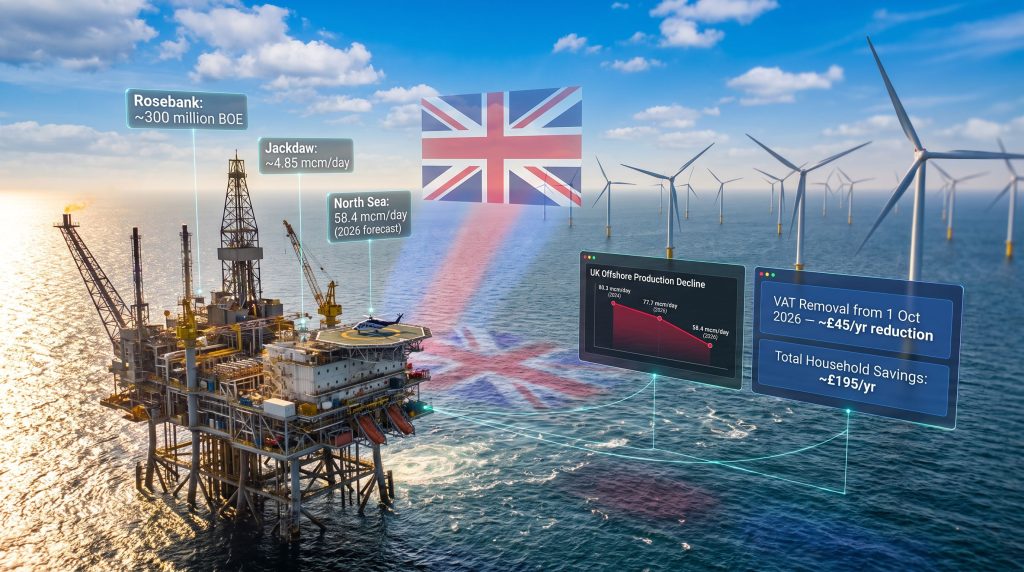
On his first day in office, Burnham removed the 5% VAT rate on household electricity bills, effective from 1 October 2026. The government projects this will reduce the October energy price cap by approximately £45 per year per household. This follows a £150 reduction delivered at the preceding budget cycle, bringing the combined annual saving relative to prior cap levels to approximately £195 per household.
This is a meaningful intervention in the context of the regulated price framework, though it does not fundamentally restructure the economics of energy delivery. It represents fiscal relief rather than systemic reform.
Pillar 2: Public Control Expansion
Both Burnham and Fahnbulleh share a philosophical alignment toward expanding state control over essential services. This does not translate into wholesale nationalisation of generation and retail markets. Instead, the focus is on network infrastructure and distribution systems, where public management models operate across several European jurisdictions without displacing competitive generation markets. Regulatory implications could include changes to Ofgem's mandate, network ownership structures, and the access terms for private generators using publicly managed transmission infrastructure. Indeed, Burnham has previously advocated for bringing energy and water under public control, a position that distinguishes his agenda from more cautious predecessors.
Pillar 3: Clean Energy Scaling and Continuity
Burnham has pledged adherence to the 2024 Labour manifesto. His record as Mayor of Greater Manchester, where he set a 2038 net-zero target significantly ahead of the national 2050 commitment, signals genuine decarbonisation ambition rather than performative compliance. The renewable energy transition underway across multiple sectors reinforces the structural logic of this trajectory, making continuity the path of least resistance for the new administration.
How Burnham Differs From the Starmer Energy Direction
The most analytically important distinction between the two administrations is not one of policy reversal but of rhetorical posture and pragmatic flexibility. In a BBC interview in May 2026, Burnham indicated openness to dialogue on North Sea production that the Starmer administration had largely discouraged, while affirming continued commitment to the broader decarbonisation agenda.
Key Analytical Distinction: The underlying regulatory architecture remains intact. What shifts under Burnham is the degree of pragmatic latitude applied to pre-consented fossil fuel assets, not the fundamental direction of the energy transition.
This creates a dual-track dynamic. At the executive level, approvals for Rosebank and Jackdaw become more politically plausible. At the departmental level, Fahnbulleh's strong decarbonisation orientation continues to tighten the regulatory environment around fossil fuel extraction. These two tracks are structurally coherent in the short term but carry credibility risks if their divergence becomes publicly visible.
Fahnbulleh's institutional background reinforces this tension. A joint report published in 2021 by the New Economics Foundation, where she served as chief executive, and Friends of the Earth concluded that the government should immediately end all support for new fossil fuel extraction domestically and internationally, cancel future North Sea licensing rounds, revoke undeveloped licences, and reject new development consent applications. Her parliamentary voting record includes support for the Energy Profits Levy windfall tax on North Sea operators and affirmative votes on climate legislation. Her departmental priorities are therefore unlikely to align with any softening of the structural regulatory environment for upstream operators.
The North Sea Question: Regulatory Limbo and the Path Forward
Understanding the Energy Independence Bill Framework
Prior to Starmer's resignation, the UK government was preparing the Energy Independence Bill, legislation designed to permanently prohibit new offshore exploration licences while introducing a new mechanism called Transitional Energy Certificates. These certificates would allow operators to produce gas from areas adjacent to existing licensed blocks, effectively maximising the productive potential of the current licensed estate without opening new frontier exploration.
| Policy Mechanism | Purpose | Market Impact |
|---|---|---|
| Permanent ban on new exploration licences | Closes new field discovery pipeline | Reduces long-term upstream investment |
| Transitional Energy Certificates | Production from adjacent unlicensed areas | Extends output from existing infrastructure |
| Existing field lifespan management | Maximises mature asset production | Provides medium-term supply continuity |
This framework represents a regulatory compromise: closing the exploration door while optimising extraction from what remains. Industry participants and unions have argued this balance is insufficient, but it reflects the political constraints facing any Labour administration committed to its 2024 manifesto. Consequently, understanding natural gas price trends becomes increasingly important for assessing how these supply decisions will affect broader market pricing.
Rosebank and Jackdaw: The Fields That Define the Policy Boundary
Two specific projects have become the litmus test for how far pragmatic flexibility extends under Burnham.
Jackdaw Gas Field (Shell-operated, North Sea)
- Originally projected to commence production in the second half of 2025
- Peak production capacity estimated at approximately 4.85 million cubic metres per day of gas and 7,500 barrels per day of condensate
- Timeline has slipped by at least 12 months, with regulatory approvals still outstanding
- The Offshore Petroleum Regulator for Environment and Decommissioning opened a public consultation on Jackdaw in July 2026, running until 10 August 2026
Rosebank Oil and Gas Field (Equinor-majority, West of Shetland)
- Estimated recoverable reserves of approximately 300 million barrels of oil equivalent, predominantly crude oil
- Drilling commenced in Q1 2026 across a planned seven-well programme over 18 months
- Operations suspended in April 2026 due to a rig fault requiring an estimated three to four months to rectify
- An environmental impact assessment review was scheduled for 23 July 2026, with further public consultation required before any development consent can proceed
Policy Scenario: Approving Rosebank and Jackdaw would not technically constitute a reversal of the manifesto ban on new exploration licences. Both fields received development consent under the previous Conservative government. Their approval can therefore be framed as operational continuity, a regulatory distinction with significant political utility for an administration seeking to satisfy union allies without abandoning manifesto commitments.
Is North Sea Production in Structural Decline?
The volume argument for North Sea approval decisions is weaker than the political debate suggests. UK offshore production data tells a consistent story of structural decline:
- 2024 production: approximately 80.3 million cubic metres per day
- 2025 production: approximately 77.7 million cubic metres per day
- 2026 forecast: approximately 58.4 million cubic metres per day (North Sea Transition Authority)
This trajectory reflects the geological maturity of the basin. No policy decision within a near-term planning horizon reverses this trend. Even a complete removal of all exploration restrictions would require years of appraisal, development, and construction before any additional volumes reached market. The North Sea debate has therefore shifted from a volume question to one of symbolism, investor confidence, and industrial policy. This reframing is essential for understanding why the Rosebank and Jackdaw decisions carry significance beyond their physical output.
Who Is Pushing Back? The Stakeholder Pressure Map
Industry and Union Positions
| Stakeholder Group | Position | Core Argument |
|---|---|---|
| GMB Union | Pro-North Sea production | Reducing import reliance; domestic energy security |
| Unite Union | Pro-Rosebank and Jackdaw approval | Immediate field development; manufacturing employment |
| Offshore Energies UK (OEUK) | All-energy transition approach | North Sea as manufacturing commitment, not just energy supply |
| Friends of the Earth / NEF | Full fossil fuel phase-out | No new extraction; revoke undeveloped licences |
GMB General Secretary Gary Smith argued publicly in July 2026 that growing dependence on imported energy creates a strategic vulnerability that the UK should not accept. OEUK Chief Executive David Whitehouse framed North Sea production as a dual commitment to both energy sovereignty and the health of UK industrial capacity, extending well beyond the energy supply question itself.
The tension is acute because both GMB and Unite are traditional Labour-affiliated unions whose conditional support for Burnham's leadership creates a political obligation that purely technocratic energy policy cannot satisfy. The fact that a reversal of the oil and gas exploration ban did not appear in Unite's formal list of nomination conditions is analytically significant: it suggests the union calculates that field-level approvals for Rosebank and Jackdaw represent a sufficient concession without requiring a full manifesto reversal.
How the Iran Conflict Reshaped the Energy Security Calculus
The outbreak of war involving Iran in early 2026 transformed what had been a medium-term strategic concern into an immediate operational risk. Vessel traffic through the Strait of Hormuz fell to approximately 11% of pre-war levels, according to vessel tracking data. US-assisted transits through the southern Hormuz corridor dropped to zero by late July 2026 as Iranian attacks intensified. Eight LNG cargoes scheduled for French terminals in August were redirected to higher-priced Asian markets, illustrating the cascading effect of Hormuz disruption on European supply chains.
This geopolitical context provides political cover for pragmatic adjustments to North Sea policy. The trade war oil impact on global supply chains has compounded these pressures, further reinforcing the case for domestic energy resilience. Framing field-level approvals as energy security measures rather than fossil fuel support allows the administration to navigate the tension between its environmental commitments and its obligation to ensure affordable, reliable domestic supply.
The Gas-Power Price Delinking Reform: The Structural Change That Matters Most
Among all the policy interventions under discussion, the reform with the greatest long-term significance receives the least political attention. The Starmer administration initiated a structural change to the electricity market by extending long-term fixed-price contracts to low-carbon generators not already operating under Contracts for Difference. The objective is to sever the link between wholesale electricity prices and natural gas benchmarks.
This matters because of a fundamental market design characteristic: the marginal pricing mechanism in electricity markets means that the most expensive generation source sets the clearing price for all generators in any given period. When gas-fired generation sets the marginal price, all low-carbon generators, regardless of their actual cost of production, receive electricity revenues benchmarked to the prevailing gas price. Consumers therefore pay gas-linked prices even when the majority of electricity comes from wind, solar, or nuclear generation.
Breaking this link through long-term fixed-price contracts would deliver durable bill reductions without requiring ongoing fiscal intervention. It would also fundamentally alter the revenue model for low-carbon generators and reshape the risk profile of long-term clean energy investment in the UK. The Burnham administration is expected to continue and potentially accelerate this reform, making it the single most consequential structural change in the near-term energy policy landscape.
The next major ASX story will hit our subscribers first
Comparing the Burnham and Starmer Energy Policy Frameworks
| Policy Area | Starmer Administration | Burnham Administration (Projected) |
|---|---|---|
| New North Sea exploration licences | Banned; Energy Independence Bill proposed | Manifesto commitment maintained; pragmatic flexibility signalled |
| Rosebank and Jackdaw | Held in regulatory limbo | Potential approval under existing consent framework |
| Household electricity VAT | Standard rated | Removed from 1 October 2026 |
| Gas-power price delinking | Initiated via CfD extension | Expected to continue and expand |
| Public ownership of utilities | Partial reform agenda | More explicit public control orientation |
| Fracking ban | Maintained | Maintained |
| Net zero commitment | 2050 national target | Continued; Burnham's 2038 Greater Manchester target signals ambition |
What the Burnham Energy Agenda Means for Markets and Investors
Near-Term Regulatory Signals to Watch
Three near-term decision points will define the operational character of Andy Burnham UK energy policy:
-
Jackdaw consultation outcome (closing 10 August 2026): The result of the Offshore Petroleum Regulator's public consultation will provide the clearest early signal of operational stance on pre-consented North Sea development.
-
Rosebank environmental impact assessment review (23 July 2026): Further consultation requirements will be confirmed, establishing the timeline for any development consent decision.
-
Energy Independence Bill legislative schedule: Statements from Fahnbulleh's department on the Bill's progress will indicate how quickly the exploration ban becomes permanent statute, affecting investor planning horizons across the upstream sector.
The Symbolic Versus Structural Distinction
Market participants would be well served by maintaining a clear analytical distinction between decisions that carry symbolic political weight and those that alter the structural economics of UK energy.
- Symbolic significance: Rosebank and Jackdaw approvals signal pragmatic flexibility and satisfy union allies. Their physical volume contribution to UK supply will be limited given the basin's production trajectory.
- Structural significance: Gas-power price delinking, VAT removal, and public ownership reforms to network infrastructure carry multi-decade investment implications. These changes alter the fundamental economics of energy delivery, not just the political narrative around it.
Investor Note: The asymmetry between symbolic and structural decisions is a consistent feature of energy policy transitions. Announcements that generate the most political media attention are frequently those with the least structural market impact, while regulatory architecture changes that receive less coverage carry greater long-term consequence for investment models. This analysis reflects publicly available information and projections and should not be construed as investment advice.
Medium-Term Structural Implications
Several medium-term dynamics will shape the investment environment regardless of near-term political decisions. In addition, global trade war impacts on commodity pricing and supply chain logistics add a further layer of complexity to these projections.
- North Sea production decline to approximately 58.4 million cubic metres per day in 2026 makes the regulatory environment for existing operators increasingly important relative to new exploration policy
- Public ownership expansion in network infrastructure could affect the investment thesis for regulated utility assets and alter the cost of capital for grid development programmes
- The gas-power price delinking reform, if extended, could fundamentally change the revenue risk profile for low-carbon generators and reduce the premium currently priced into long-term clean energy investment
- Critical minerals demand linked to accelerating clean energy deployment will shape the broader investment environment for infrastructure and technology across the UK energy sector
Frequently Asked Questions: Andy Burnham UK Energy Policy
Will Burnham Reverse the North Sea Drilling Ban?
A full reversal of the manifesto commitment to halt new exploration licences is considered unlikely without a general election mandate. Approval of pre-consented projects such as Rosebank and Jackdaw occupies a distinct regulatory category and does not require a formal policy reversal.
How Much Will the VAT Cut Reduce Energy Bills?
The removal of the 5% VAT rate on household electricity is projected to reduce the October 2026 energy price cap by approximately £45 per year. Combined with the £150 reduction from the preceding budget, total annual savings reach approximately £195 per household relative to prior cap levels.
What Is the Energy Independence Bill?
Proposed legislation that would permanently prohibit new offshore exploration licences while introducing Transitional Energy Certificates allowing gas extraction from areas adjacent to existing licensed blocks. The aim is to maximise output from the current licensed estate without extending the exploration frontier.
What Is Burnham's Position on Public Ownership of Energy?
His platform favours expanding public control over essential utility infrastructure, particularly grid networks and distribution systems, while maintaining a mixed-market structure in generation and retail. This mirrors governance models operating across several European jurisdictions.
How Has the Iran Conflict Affected UK Energy Policy?
Hormuz disruption has elevated the strategic premium on domestically sourced energy and provided political justification for pragmatic engagement with pre-consented North Sea developments. It has shifted the framing of North Sea policy from an environmental debate toward an energy security discussion without requiring any formal change in legislative commitments.
This article incorporates publicly available data and projections from the North Sea Transition Authority, Argus Media, and publicly reported statements from government officials and industry representatives. Production forecasts and policy projections involve inherent uncertainty and should not be treated as definitive outcomes. Nothing in this article constitutes financial or investment advice.
For ongoing market intelligence on UK natural gas, North Sea developments, and energy policy, Argus Media publishes regular analysis at argusmedia.com.
Want to Position Ahead of the Next Major Energy-Linked Mineral Discovery?
As the UK's energy transition accelerates and critical minerals demand intensifies, Discovery Alert's proprietary Discovery IQ model delivers real-time ASX mineral discovery alerts — turning complex data across 30+ commodities into clear, actionable insights. Explore historic discoveries and their exceptional market returns, then begin a 14-day free trial to ensure you're never behind the market when the next significant discovery is announced.