July 23, 2026
Why the Refining Bottleneck Has Become the Defining Supply Chain Challenge of the 2020s
For decades, the global mining industry directed its greatest attention and capital toward the upstream end of the value chain: exploration, extraction, and ore delivery. Refining and processing were treated as downstream commodities, often outsourced to Asian industrial hubs with cheaper energy and established infrastructure. That assumption has now collapsed under geopolitical pressure, and the consequences are reshaping where capital flows across the entire critical minerals sector.
The emergence of domestic refining businesses as high-priority investment targets is not simply a function of commodity demand cycles. It reflects a structural recognition that processing capacity, not raw ore, is the true leverage point in battery, defence, and clean energy supply chains. This shift in thinking is central to understanding why the Nth Cycle SPAC merger has attracted significant institutional attention heading into the second half of 2026.
When big ASX news breaks, our subscribers know first
The Geopolitical Case for Domestic Critical Mineral Processing
China's dominance over global critical minerals demand refining is not accidental. It was built over decades through deliberate industrial policy, subsidised energy, and the systematic development of hydrometallurgical and pyrometallurgical processing expertise. Today, China controls an estimated 60 to 80 percent of global rare earth refining capacity, according to widely cited assessments from the U.S. Geological Survey and various governmental supply chain reviews. For battery metals including cobalt, the concentration is similarly pronounced.
This processing monopoly creates a vulnerability that extends well beyond commodity price risk. A country that mines its own ore but cannot refine it domestically is still functionally dependent on its geopolitical rivals at the most value-added stage of production. Furthermore, the energy security implications of this dependency are significant — Western governments, particularly in the United States, have spent several years building policy frameworks intended to address this gap through legislation such as the Inflation Reduction Act and the CHIPS and Science Act.
It is within this structural backdrop that Nth Cycle, a Massachusetts-based critical mineral refining company, has chosen to enter public markets through the Nth Cycle SPAC merger with Kensington Capital Acquisition Corp. VI.
What Nth Cycle Actually Does and Why Its Model Is Structurally Differentiated
A Refiner Operating at Two Strategic Chokepoints Simultaneously
Nth Cycle's core business involves the refining and processing of rare earth elements, copper, and battery metals. What distinguishes the company from conventional miners or single-stream recyclers is its ability to source material from two fundamentally different feedstock pathways:
- Primary mined feedstock: ore concentrates sourced from active mining operations requiring downstream processing to produce commercially usable material
- Secondary recycled feedstock: end-of-life batteries, electronic components, and industrial scrap containing recoverable critical minerals that would otherwise enter waste streams
This dual-input model positions Nth Cycle at the intersection of two distinct but strategically linked industries. Mining companies need refining partners capable of handling complex ore chemistries. In addition, the battery recycling advances reshaping this sector mean that recyclers increasingly need processing infrastructure capable of extracting high-purity metals from degraded and mixed material streams. Nth Cycle is building the infrastructure to serve both markets simultaneously.
The Technology Layer: Moving Beyond Conventional Hydrometallurgy
Conventional critical mineral refining relies heavily on hydrometallurgical processing, a method involving the use of aqueous chemical solutions to dissolve, separate, and recover target metals from ore or scrap. While effective, traditional hydrometallurgical approaches are energy-intensive, generate significant chemical waste streams, and require substantial capital investment in acid plants, solvent extraction circuits, and effluent treatment systems.
Nth Cycle's proprietary refining approach, drawing on advanced extraction technology, is designed to improve upon this baseline through electrochemical separation methods, reducing reliance on aggressive chemical inputs and improving the efficiency of the separation process. This matters for two reasons beyond environmental optics:
- Operating cost structure: lower chemical consumption and reduced waste treatment requirements translate directly into better refining economics at scale
- Permitting and social licence: a lower environmental footprint simplifies regulatory approval processes and reduces community opposition risks that have historically delayed conventional refining projects
While Nth Cycle has not published detailed comparative efficiency figures in public disclosures, the company's technology positioning is central to its investment thesis as it approaches NYSE listing.
How the Nth Cycle SPAC Merger Is Structured
The Transaction at a Glance
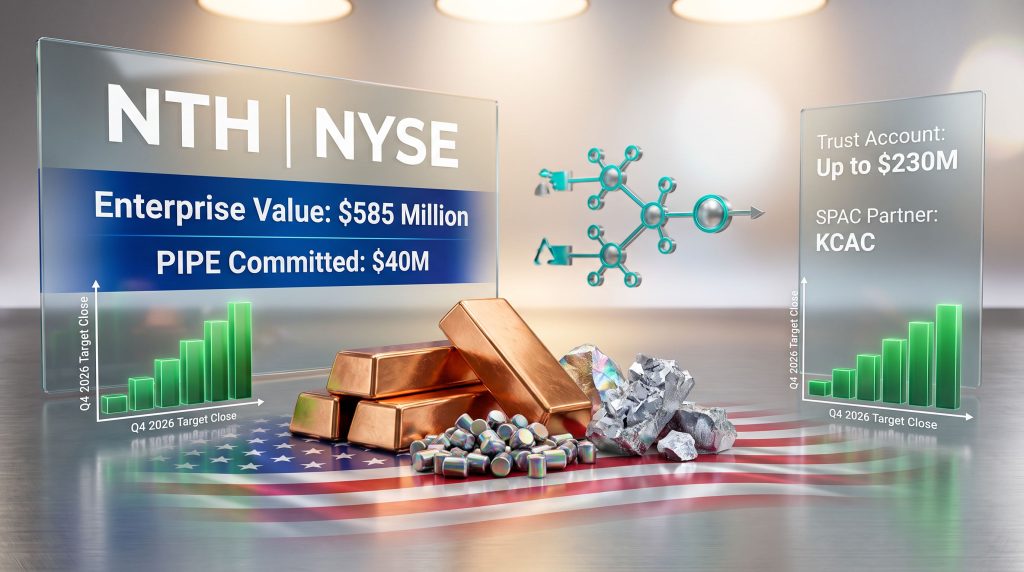
The Nth Cycle SPAC merger pairs the company with Kensington Capital Acquisition Corp. VI, a repeat SPAC sponsor with prior transaction experience across industrial and energy transition sectors. The combined entity will be renamed Nth Cycle Holdings Inc. and is targeted for listing on the NYSE under the ticker symbol NTH.
| Deal Parameter | Detail |
|---|---|
| SPAC Partner | Kensington Capital Acquisition Corp. VI (NYSE: KCAC) |
| Combined Entity Name | Nth Cycle Holdings Inc. |
| Proposed NYSE Ticker | NTH |
| Enterprise Value | USD $585 million |
| Trust Account (Maximum) | Up to USD $230 million (subject to redemptions) |
| PIPE Financing (Target) | Up to USD $100 million |
| PIPE Committed at Announcement | USD $40 million |
| Target Close | Q4 2026 |
Understanding the Capital Architecture
The Nth Cycle SPAC merger employs a layered capital structure that is characteristic of how complex industrial transactions navigate the uncertainty inherent in the SPAC format. Understanding how this works is essential for investors evaluating the deal.
Trust account proceeds represent the capital pool raised by Kensington at its original SPAC IPO. These funds are held in trust and become available to fund the merger upon shareholder approval. The maximum available from this source is $230 million, but the actual amount delivered at closing depends on how many existing SPAC shareholders elect to redeem their shares at the original IPO price rather than roll their investment into the combined company.
PIPE financing provides a parallel capital injection from institutional investors who commit at a negotiated price prior to deal close. The transaction has secured $40 million in committed PIPE capital at announcement, with a total PIPE target of $100 million. The $40 million committed figure signals that at least a subset of institutional investors have completed preliminary due diligence and view the transaction favourably at its stated valuation.
"The combination of trust proceeds and PIPE financing is specifically designed to provide capital certainty even in scenarios where SPAC shareholder redemptions are high" — a problem that plagued many SPAC transactions in the 2022 to 2024 downcycle.
Why SPACs Are Re-Emerging for Deep-Tech Industrials
The SPAC vehicle fell deeply out of favour between 2022 and 2024 following a wave of transactions that failed to deliver on ambitious post-merger revenue projections. However, a selective revival is underway for a specific category of company: capital-intensive businesses with hard asset backing, long-duration demand tailwinds, and clear strategic rationale.
Critical mineral refiners match this profile closely. Their assets are tangible, their addressable market is driven by secular trends in electrification and defence procurement, and their strategic importance provides a narrative that resonates with both institutional and retail investors. The SPAC format offers these companies pre-negotiated valuations, faster access to public capital than a traditional IPO process, and the ability to communicate forward-looking projections within the merger prospectus framework.
Key Risks Every Investor Should Understand
Redemption Risk Remains the Central Structural Vulnerability
The single largest structural risk in any SPAC transaction is the redemption mechanism. SPAC investors who participated in Kensington's original IPO retain the right to redeem their shares at the trust account value before the merger closes. In recent SPAC cycles, redemption rates above 80 percent have been common, which can reduce trust proceeds from a headline figure of $230 million to a fraction of that amount.
The PIPE backstop of up to $100 million provides partial mitigation, but the gap between committed capital ($40 million) and the total PIPE target ($100 million) introduces its own execution uncertainty.
The Valuation Question at $585 Million
At a $585 million enterprise value, Nth Cycle enters the public market at a scale that will attract continuous scrutiny from investors seeking to validate the pricing against operational output. Key metrics that public market participants will apply include:
- Tonnes of critical mineral material processed per annum
- Revenue per tonne across the rare earth, copper, and battery metal product streams
- Gross margin trajectory as refining volumes scale
- Feedstock supply agreement coverage (contracted volumes versus spot purchasing)
Because the valuation is set through negotiation rather than open-market price discovery, there is inherent uncertainty about whether $585 million reflects a fair entry price. Comparable public company analysis and precedent transaction multiples in the battery raw materials market will be the primary benchmarking tools available to investors.
A Summary Risk Framework
| Risk Factor | Nature | Severity | Mitigation Available |
|---|---|---|---|
| SPAC Shareholder Redemptions | Structural | High | Partial, via PIPE backstop |
| PIPE Shortfall | Financing | Medium | $40M committed anchor |
| Regulatory or Approval Delay | Procedural | Low-Medium | Standard approval timeline |
| Valuation Premium vs. Peers | Market | Medium | Dependent on milestones |
| Commodity Price Exposure | Macro | Medium | Diversified mineral basket |
| Feedstock Supply Continuity | Operational | Medium | Dual-source model provides flexibility |
The Broader Investment Landscape for Critical Mineral Refining
A Structural Demand Thesis That Extends Well Beyond 2030
The demand fundamentals underpinning Nth Cycle's market position are driven by intersecting long-term trends rather than short-term commodity cycles. Global electric vehicle penetration is projected to continue climbing through the 2030s, creating compounding demand for battery-grade lithium, cobalt, nickel, and manganese. Rare earth elements, particularly neodymium and praseodymium used in permanent magnets for EV motors and wind turbines, face supply constraints at the refined product level rather than at the ore level.
Copper demand presents a parallel structural driver. Electrification of transportation infrastructure, grid upgrades required for renewable energy integration, and data centre expansion are all copper-intensive activities. The International Energy Agency has projected that copper demand from clean energy applications alone could more than double by 2040 under accelerated transition scenarios.
The Recycling Dimension: An Often Underestimated Market
One aspect of Nth Cycle's business model that receives less attention than its primary refining operations is its recycled feedstock capability. The battery recycling sector is in early-stage commercial development, and the economics of closing the loop on lithium-ion batteries depend critically on the availability of domestic processing infrastructure capable of handling degraded, mixed-chemistry material streams.
As the first generation of mass-market electric vehicles approaches end-of-life in the late 2020s and early 2030s, the volume of spent battery material available for recycling will increase substantially. Companies with established processing infrastructure and the technical capability to handle this material will be well-positioned to capture value from this emerging feedstock source. This dimension of Nth Cycle's business model provides an optionality layer that is not yet reflected in near-term revenue projections.
The next major ASX story will hit our subscribers first
How Investors Should Evaluate Nth Cycle as a Newly Public Entity
A Framework Built Around Operational Milestones
For investors approaching Nth Cycle Holdings Inc. following the completion of the Nth Cycle SPAC merger, the analytical framework should centre on sequential operational milestones rather than near-term profitability metrics. At this stage of development, the company is a processing infrastructure business whose value creation depends on capital deployment speed, feedstock access, and refining throughput growth.
The most important post-listing developments to monitor, in rough priority order, are:
- Actual cash received at close: the difference between the headline $230 million trust figure and actual proceeds after redemptions
- Completion of full PIPE financing: whether the remaining $60 million gap between committed and target PIPE capital is closed
- Refining capacity expansion progress: construction timelines, commissioning milestones, and first production from expanded facilities
- Feedstock supply agreements: contracts with mining companies and battery recyclers that establish visible revenue streams
- Quarterly throughput and revenue disclosures: building the financial track record that institutional investors require to size positions
- Strategic partnership announcements: joint ventures, offtake agreements, or technology licensing deals that extend the company's market reach
The SPAC Pricing Dynamic and Its Post-Listing Implications
Investors with experience in the SPAC market will be aware that post-merger trading performance is highly variable and often disconnected from fundamental value in the months immediately following listing. Early trading in Nth Cycle Holdings shares will be influenced by the level of redemptions from the trust, the lock-up structures applied to PIPE investors, and the general sentiment toward the critical minerals sector at the time of listing.
Consequently, this creates a specific behavioural dynamic worth understanding: institutional PIPE investors who supported the transaction at a negotiated entry price may not be able to sell immediately. However, their eventual liquidity window can create technical selling pressure even when underlying business fundamentals are improving. According to the official deal announcement, investors with longer time horizons may find that the period immediately following PIPE lock-up expiration represents a more rational entry point than the initial post-listing period.
This article does not constitute financial advice. All investment decisions should be made in consultation with a qualified financial adviser. Forward-looking statements and projections referenced herein involve significant uncertainty, and actual outcomes may differ materially from those anticipated.
Frequently Asked Questions About the Nth Cycle SPAC Merger
What is the Nth Cycle SPAC merger?
The Nth Cycle SPAC merger is a transaction in which Nth Cycle, a U.S.-based critical mineral refining company, is merging with Kensington Capital Acquisition Corp. VI to become a publicly listed company. The deal assigns an enterprise value of $585 million to the combined business, which will trade on the NYSE under the ticker NTH as Nth Cycle Holdings Inc.
What minerals does Nth Cycle refine?
Nth Cycle processes rare earth elements, copper, and battery metals including materials relevant to lithium-ion battery production. The company draws feedstock from both active mining operations and recycled end-of-life battery and electronic material.
What is PIPE financing and why does it matter in this deal?
PIPE stands for Private Investment in Public Equity. In the context of the Nth Cycle SPAC merger, PIPE financing represents committed capital from institutional investors that supplements the SPAC trust account proceeds. With up to $100 million in targeted PIPE financing and $40 million already committed at announcement, the PIPE component provides a capital backstop in scenarios where SPAC shareholders choose to redeem their shares before the deal closes.
When is the transaction expected to close?
The transaction is targeted to close in Q4 2026, conditional on regulatory clearance and approval votes from shareholders of both Nth Cycle and Kensington Capital Acquisition Corp. VI.
What are the main risks in this transaction?
The primary risks include high SPAC shareholder redemption rates reducing actual trust proceeds, failure to close the full $100 million PIPE target, regulatory or approval timeline delays, and ongoing public market scrutiny of the $585 million enterprise valuation relative to operational output metrics.
For ongoing technical and industry analysis of the critical mineral processing sector, Mining Magazine at miningmagazine.com provides comprehensive coverage of refining, processing technology, and supply chain developments relevant to the evolving domestic mineral economy.
Want to Stay Ahead of the Next Major Critical Mineral Discovery?
Discovery Alert's proprietary Discovery IQ model scans ASX announcements in real time, instantly identifying significant mineral discoveries across rare earths, copper, and battery metals — translating complex data into actionable opportunities before the broader market reacts. Explore how historic discoveries have delivered substantial returns on Discovery Alert's dedicated discoveries page, and begin a 14-day free trial to position ahead of the next major find.