
May 18, 2026
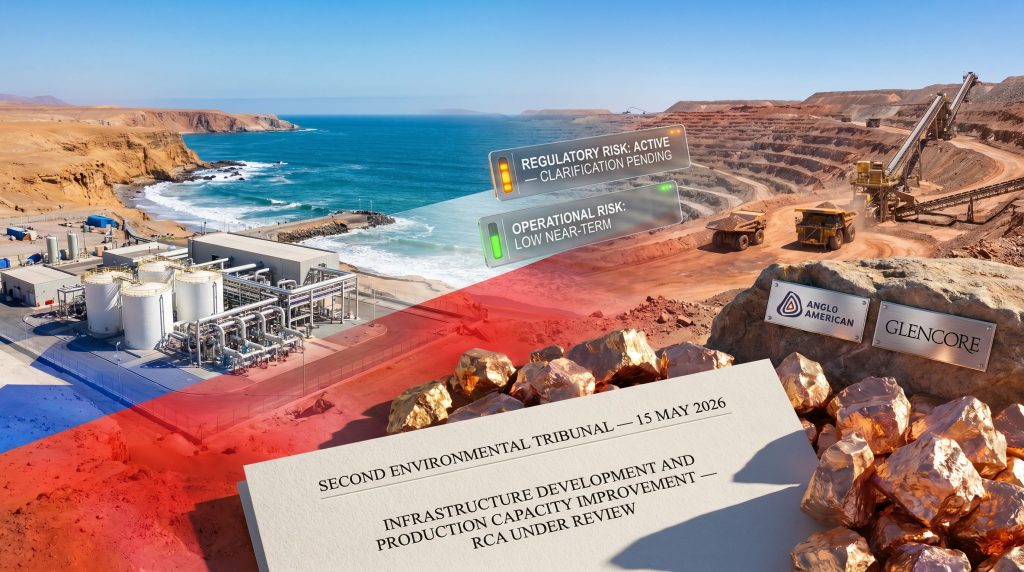
The Regulatory Tightrope: When Environmental Law Meets Copper's Critical Role
Few industries face a more complex web of competing obligations than large-scale copper mining. On one side sits the accelerating global demand for copper driven by electrification, grid modernisation, and the buildout of renewable energy infrastructure. On the other stands an increasingly assertive body of environmental law that places water rights, coastal ecosystems, and indigenous community interests at the centre of resource project governance. When these forces collide in a jurisdiction as legally sophisticated as Chile, the consequences reverberate well beyond the mine gate.
The Collahuasi environmental permit ruling, handed down by Chile's Second Environmental Tribunal on 15 May 2026, is precisely this kind of collision. A near-complete desalination plant, billions of dollars in expansion capital, and the water supply future of one of the world's great copper mines now sit within the orbit of a legal clarification process whose outcome remains genuinely uncertain.
When big ASX news breaks, our subscribers know first
Why Chile's Environmental Tribunal System Creates Real Stakes for Mining
Chile's environmental governance architecture is more sophisticated than many observers outside the region appreciate. The Constitutional Organic Law No. 20.417, enacted in 2010, overhauled the country's environmental institutions by creating the Environmental Assessment Service (SEA) as the primary technical reviewer of major project applications, and establishing three regionally specialised Environmental Tribunals to adjudicate disputes arising from those assessments.
The RCA, or Resolución de Calificación Ambiental, sits at the heart of this system. It is the formal environmental authorisation without which no major mining infrastructure project can legally proceed. Obtaining one requires proponents to submit a comprehensive Environmental Impact Assessment addressing multiple mandatory subject areas, followed by a SEA technical review, a public participation phase, and finally a decision that can itself be challenged before the relevant Environmental Tribunal within 30 days of issuance.
The Second Environmental Tribunal and Its Jurisdiction
The Second Environmental Tribunal, headquartered in Antofagasta, holds jurisdiction over northern Chile, the country's most productive mining corridor. Its caseload reflects this geography, with water infrastructure projects and indigenous consultation disputes consistently representing the most contested categories of cases.
What distinguishes this Tribunal from ordinary courts is its technical specialisation. Panel members include legal judges alongside environmental scientists and resource economists, allowing rulings to engage with highly technical subject matter in a way generalist courts cannot. This structural feature makes its decisions difficult to overturn on appeal and lends its interpretations considerable weight within the broader regulatory system.
The Collahuasi mine itself sits in Chile's Tarapacá Region at an altitude exceeding 4,400 metres above sea level, an environment characterised by extreme freshwater scarcity. The Atacama Desert, which dominates this part of northern Chile, is among the driest regions on Earth, making water access not merely an operational convenience but an existential requirement for sustained production. This geographic reality is precisely what drove the decision to invest in coastal desalination infrastructure in the first place, and it is that same infrastructure that now sits at the centre of the Collahuasi environmental permit ruling.
The Collahuasi Mine: Scale, Ownership, and Copper Market Significance
Collahuasi consistently ranks among the five largest copper-producing mines on the planet. Anglo American and Glencore each hold significant ownership stakes in the operation, making it a material asset for both companies and one whose performance is closely tracked by copper market participants worldwide. The Chile copper outlook for the coming years is therefore deeply intertwined with how this regulatory situation resolves.
The mine's relevance has grown considerably as the energy transition narrative has tightened copper demand forecasts. Electric vehicles require roughly 3.5 to 4 times more copper than conventional internal combustion engine vehicles. Offshore wind installations consume approximately 9.5 tonnes of copper per megawatt of generating capacity. Power grid upgrades necessary to accommodate renewable generation are similarly copper-intensive. In fact, critical minerals energy transition planning increasingly centres on assets precisely like Collahuasi. Against this backdrop, any development that could constrain production expansion at a mine of Collahuasi's scale carries disproportionate significance for supply models.
Collahuasi's joint venture structure also means that any material regulatory development requires coordinated disclosure and response from both Anglo American and Glencore, a governance protocol that was clearly activated following the 15 May 2026 ruling.
What the May 2026 Tribunal Ruling Actually Decided
Unpacking the Narrow Scope of the Decision
The ruling issued on 15 May 2026 targets the RCA associated with Collahuasi's Infrastructure Development and Production Capacity Improvement project, an authorisation originally granted in December 2021 by the SEA and subsequently confirmed by the Ministers Committee in August 2023.
A critical technical distinction must be understood here. The Tribunal's decision does not appear to invalidate the entire environmental authorisation. According to Glencore's published statement, the ruling is confined to two specific impact categories:
- Impacts on an identified local community
- Effects on the marine environment
This is what environmental lawyers refer to as a partial annulment, a mechanism that directs the SEA to reconsider only those specific elements of the RCA rather than reopening the entire assessment. The practical difference between a partial and total annulment is substantial. Partial annulments in Chilean mining cases have historically resulted in SEA reconsideration timelines averaging significantly shorter than total annulments, with targeted reviews frequently resolved within four to five months when the scope of deficiency is clearly defined.
"The distinction between a partial and total annulment carries significant operational weight. A narrowly scoped ruling allows construction and commissioning activities on non-contested project elements to potentially continue while the SEA addresses the identified deficiencies."
The Desalination Plant at the Legal Crossroads
The infrastructure project under scrutiny includes a desalination plant reported to be near completion at the time the ruling was issued. This timing creates a genuinely unusual legal and operational situation. The facility was built under the authority of an RCA that has now been at least partially challenged, yet the physical asset is substantially complete.
Desalination infrastructure occupies a uniquely complex position in Chile's regulatory landscape. Unlike purely terrestrial mining facilities, desalination plants require environmental authorisation that spans both onshore and coastal marine environments. The marine outfall component, which returns concentrated brine to the ocean after the desalination process, triggers separate marine environmental permitting requirements under Chile's General Law of Fisheries and Aquaculture.
This dual regulatory exposure makes desalination projects structurally more vulnerable to environmental tribunal challenges than other mining infrastructure types. The marine impact assessment requirements and the community consultation obligations related to coastal communities create multiple independent grounds on which a challenge can be mounted, which is precisely what appears to have occurred in the Collahuasi case.
What the Ruling Does Not Touch
Both Anglo American and Glencore publicly confirmed that no immediate production impact is expected from the ruling. The mine's existing operational permits remain intact. Collahuasi has access to alternative water sources that provide a buffer against the desalination plant's commissioning being delayed, meaning near-term copper output is not contingent on the disputed facility.
The clarification currently being sought from both the Tribunal and the SEA centres on three questions:
- The precise legal effect of the ruling on existing and future construction activities
- Which specific elements the SEA must re-examine
- Whether any operational constraints will flow from the reconsideration process
How Anglo American and Glencore Have Responded
Both companies issued coordinated disclosures acknowledging the Tribunal ruling within the same reporting cycle. The synchronised nature of this response reflects standard joint venture governance protocols for material regulatory developments, where co-owners are obligated to disclose information of potential significance to investors simultaneously.
Neither company characterised the ruling as an immediate operational threat. Anglo American's official response confirmed that Collahuasi stated its original permitting process was conducted in full compliance with applicable Chilean environmental regulations, under the relevant environmental assessment framework, and with indigenous consultation processes as defined by the competent regulatory authority. This position emphasises procedural compliance rather than disputing the Tribunal's jurisdiction to review the decision.
This is a strategically important posture. Companies that contest Tribunal jurisdiction tend to extend proceedings and elevate reputational risk, while those that engage constructively with the reconsideration process typically achieve faster resolution.
The ESG Dimensions: Water, Community, and Marine Permitting as Structural Flashpoints
The Collahuasi environmental permit ruling does not exist in isolation. Furthermore, it fits within a well-established pattern of environmental tribunal activity in northern Chile where three recurring flashpoints consistently generate contested RCA decisions:
| Regulatory Pressure Point | Relevance to Collahuasi Ruling |
|---|---|
| Marine environmental impact assessments | Directly cited within the Tribunal's ruling scope |
| Coastal desalination permitting | Central infrastructure element under review |
| Indigenous and community consultation | Cited as one of the two grounds for the ruling |
| RCA validity post-Ministerial confirmation | August 2023 Ministers Committee approval now under scrutiny |
| Brine discharge marine ecology | Core technical concern in coastal desalination challenges |
Indigenous Rights and the ILO Convention 169 Dimension
The ruling's reference to community impacts raises substantive questions about indigenous consultation standards under Chilean law. Chile ratified ILO Convention 169 in 2008, obligating the state to conduct prior, free, and informed consultation with indigenous communities before approving projects that may affect their lands, territories, or rights.
The evolution of Chilean jurisprudence on this obligation has been significant. Early interpretations treated consultation as a procedural formality, essentially an information-sharing exercise. More recent Tribunal and Supreme Court decisions have elevated the standard to one requiring genuine dialogue with a real possibility of influencing project outcomes. This shift has created retrospective exposure for RCAs approved under older, lower consultation standards, even when those approvals subsequently received Ministerial confirmation.
The growing frequency of community-based legal challenges to large mining project authorisations in Latin America reflects a structural trend rather than isolated incidents. Peru, Colombia, and Ecuador have all experienced significant legal challenges to mining projects on indigenous consultation grounds in recent years, with outcomes ranging from temporary suspension to permanent project cancellation in extreme cases. This broader mining geopolitical landscape has made regulatory risk a central consideration for investors across the region.
The Strategic Paradox of Desalination Investment
There is a genuine strategic irony embedded in the Collahuasi situation that deserves explicit analysis. High-altitude copper mines in northern Chile face existential freshwater scarcity. The environmental and community response to freshwater extraction from local aquifers and rivers has been intensely negative, rightly, given the fragile hydrology of the Atacama region. Desalination from the ocean offers an alternative that eliminates dependence on scarce continental water sources.
However, building a desalination plant creates its own regulatory exposure through marine permitting requirements, coastal community impacts, and brine discharge assessments. The very solution to one environmental pressure point generates a new set of regulatory vulnerabilities. This paradox is not unique to Collahuasi but represents a structural challenge for the entire northern Chilean copper industry as it seeks to expand production capacity without intensifying pressure on already-stressed inland water resources.
The next major ASX story will hit our subscribers first
Legal Pathways and Operational Scenarios Following the Ruling
The Clarification Process: Step by Step
Collahuasi's immediate legal pathway involves a structured engagement with two separate institutions:
- Seek formal clarification from the Second Environmental Tribunal on the ruling's precise scope and legal effect
- Engage the SEA to determine exactly which elements of the original assessment must be reconsidered
- Assess whether the SEA reconsideration process triggers any pause on construction or commissioning activities
- Evaluate whether the near-complete desalination plant can be commissioned pending reconsideration of specific issues
- Consider appeal or further challenge options if the ruling's scope is confirmed as broader than initially indicated
Three Operational Scenarios
The resolution of the Collahuasi environmental permit ruling could follow materially different paths, each with distinct implications for production capacity and copper supply.
Scenario 1: Narrow Ruling, Limited Operational Impact
The Tribunal's scope is confirmed as restricted to the two identified issues. The SEA conducts a targeted reconsideration without halting infrastructure commissioning. The desalination plant becomes operational with minor delays, and copper production expansion proceeds broadly on schedule.
Scenario 2: Broader SEA Reconsideration Required
The SEA determines that a more comprehensive review of the RCA is warranted given the interconnected nature of the marine and community impacts. Desalination plant commissioning is delayed pending re-authorisation. Collahuasi relies on alternative water sources for an extended period, potentially constraining its production capacity expansion timeline by 12 to 18 months.
Scenario 3: Sustained Legal Challenge
Community or environmental organisations pursue further legal action building on the Tribunal's ruling. Extended proceedings delay the infrastructure project by 24 months or more. Copper production expansion plans are deferred, with measurable implications for Collahuasi's contribution to global supply growth during a period of structurally tightening copper demand.
Copper Market Implications and Investor Risk Framework
Collahuasi's position among the world's top five copper producers means that any sustained constraint on its production expansion trajectory carries measurable implications for global copper supply balances, particularly during a period when demand forecasts tied to electrification and grid infrastructure are pointing firmly upward through the late 2020s. The broader copper supply crunch narrative makes timing on this kind of regulatory disruption especially consequential for market participants.
The significance of the desalination plant to long-term production growth cannot be overstated. Without expanded water access at the site's high altitude, throughput expansion is physically constrained regardless of ore availability or processing capacity. The facility is not merely a regulatory formality but a genuine production enabler.
Copper markets are likely to interpret the ruling as near-term noise rather than a medium-term supply threat, given both companies' statements about alternative water availability. However, if clarification reveals a broader scope than currently indicated, or if community groups pursue further legal action, market perception could shift toward acknowledging a meaningful supply risk premium at this specific operation.
| Risk Category | Nature of Risk | Current Assessment |
|---|---|---|
| Regulatory risk | RCA validity under legal challenge | Active, clarification pending |
| Operational risk | Water supply for current production | Low near-term, alternatives available |
| ESG risk | Community and marine environment impacts | Elevated, cited directly in ruling |
| Capital project risk | Desalination plant commissioning delay | Moderate, near-complete but uncertain |
| Reputational risk | Indigenous consultation adequacy | Under scrutiny |
| Market supply risk | Expansion capacity timeline deferral | Contingent on scenario outcome |
Anglo American and Glencore: Portfolio Context
For Anglo American, the Collahuasi ruling arrives during a period of broader portfolio and strategic review activity. Collahuasi represents a tier-one copper asset, and the company's investor communications have consistently described copper as central to its long-term value proposition given the metal's demand outlook.
For Glencore, Collahuasi sits within a diversified copper portfolio that includes other major producing assets. The concentration of regulatory risk at Collahuasi is therefore partially offset at the portfolio level, though the asset's absolute scale means no investor with meaningful Glencore exposure can treat this development as immaterial.
Neither company has flagged material financial impact to date. For that assessment to change, the clarification process would need to reveal either a broader ruling scope requiring extended reconsideration or a commissioning delay that pushes production expansion timelines beyond current guidance. Consequently, copper investment strategies must account for this kind of regulatory uncertainty when modelling tier-one asset exposure.
Comparing Chile's Regulatory Risk Profile to Other Copper Jurisdictions
The Collahuasi environmental permit ruling reinforces Chile's position as a jurisdiction where environmental governance genuinely constrains resource development timelines, a distinction that separates it from several other major copper-producing regions.
| Jurisdiction | Environmental Tribunal System | Community Consultation Requirements | Marine Permitting Complexity |
|---|---|---|---|
| Chile | Independent, specialised tribunals with full RCA challenge powers | ILO 169 mandatory; increasingly substantive standard | High, coastal desalination projects face full marine impact review |
| Peru | SENACE review; judicial challenge through ordinary courts | Prior consultation law; implementation historically inconsistent | Moderate |
| Democratic Republic of Congo | Limited independent oversight; weaker institutional capacity | Underdeveloped formal consultation frameworks | Low, landlocked operations dominate |
| Australia | State environmental courts plus federal EPBC Act oversight | Native Title Act; FPIC increasingly applied in practice | Moderate, project-specific |
| Canada | Federal and provincial environmental assessment agencies | Duty to consult established by Supreme Court; UNDRIP adopted | Variable by province |
This comparative context is important for investors calibrating country-specific regulatory risk. Chile's system is more rigorous and more predictable than many peer jurisdictions, and the existence of the Tribunal structure means that adverse rulings, while disruptive, tend to follow transparent legal processes with defined reconsideration pathways rather than arbitrary regulatory reversals.
Frequently Asked Questions: Collahuasi Environmental Permit Ruling
What is the RCA that was challenged?
The RCA is Chile's formal environmental authorisation required for major infrastructure projects. Collahuasi's RCA for its infrastructure expansion, including the desalination plant, was originally issued in December 2021 and confirmed by the Ministers Committee in August 2023 before being targeted by the Second Environmental Tribunal's May 2026 ruling.
Will copper production be affected?
As of the ruling date, both Anglo American and Glencore have confirmed they do not anticipate any immediate impact on copper output. Collahuasi has access to alternative water sources that reduce short-term dependency on the desalination plant currently under construction.
What are the specific grounds for the ruling?
The Tribunal's published press release indicates the ruling is scoped to impacts on a local community and effects on the marine environment, the two most commonly contested dimensions of large mining infrastructure approvals in Chile's coastal and northern regions.
Why does this matter beyond Collahuasi?
The ruling demonstrates the environmental tribunal system's willingness to revisit RCAs that have already received Ministerial confirmation, elevating the regulatory risk profile for other major copper projects currently in permitting or construction phases across Chile's northern mining corridor.
Key Takeaways
- The Second Environmental Tribunal's 15 May 2026 ruling targets the Collahuasi infrastructure expansion RCA, with scope confined to community and marine environment impacts
- The ruling challenges an authorisation originally granted in December 2021 and upheld by the Ministers Committee in August 2023, demonstrating that Ministerial confirmation does not immunise an RCA from subsequent Tribunal review
- A near-complete desalination plant lies at the operational centre of the dispute, raising critical questions about water infrastructure commissioning and long-term production capacity growth
- Anglo American and Glencore have both confirmed no immediate production impact, with alternative water supply providing a short-term operational buffer
- The SEA and Tribunal clarification process will determine whether this remains a contained legal matter or escalates into a broader constraint on production expansion timelines
- The ruling reinforces water access, community consultation, and marine permitting as the three structural regulatory flashpoints for Chilean copper mining, a pattern all major operators in the region must actively manage
- For investors, the near-term market impact appears limited, but the medium-term scenario range is genuinely wide, warranting close attention to clarification developments over the coming months
Disclaimer: This article contains forward-looking analysis and scenario projections that involve assumptions about regulatory, legal, and operational outcomes. These represent analytical frameworks rather than guaranteed outcomes. Readers should conduct independent research and seek professional financial advice before making investment decisions based on information contained herein. Regulatory and legal developments in the Collahuasi matter remain ongoing and subject to material change.
Want To Identify The Next Major ASX Copper Discovery Before The Market Does?
Discovery Alert's proprietary Discovery IQ model delivers real-time alerts the moment significant mineral discoveries hit the ASX, cutting through complex data across more than 30 commodities to surface actionable opportunities instantly — explore historic discoveries and their returns to understand the scale of what early positioning can mean, then begin your 14-day free trial to secure your market-leading edge.