August 11, 2026
The High-Altitude Frontier: How Electrified Haulage Is Reshaping Open-Pit Mining Economics
The economics of haul truck operation have remained largely unchanged for decades. Enormous diesel-powered machines grind uphill under crushing payloads, burning fuel at rates that would make most industrial operators wince, releasing emissions that the mining sector has increasingly struggled to reconcile with modern environmental expectations. That calculus is now shifting, not through the replacement of entire fleets, but through a precise, surgical intervention at the single most energy-intensive point in the haulage cycle: the uphill ramp.
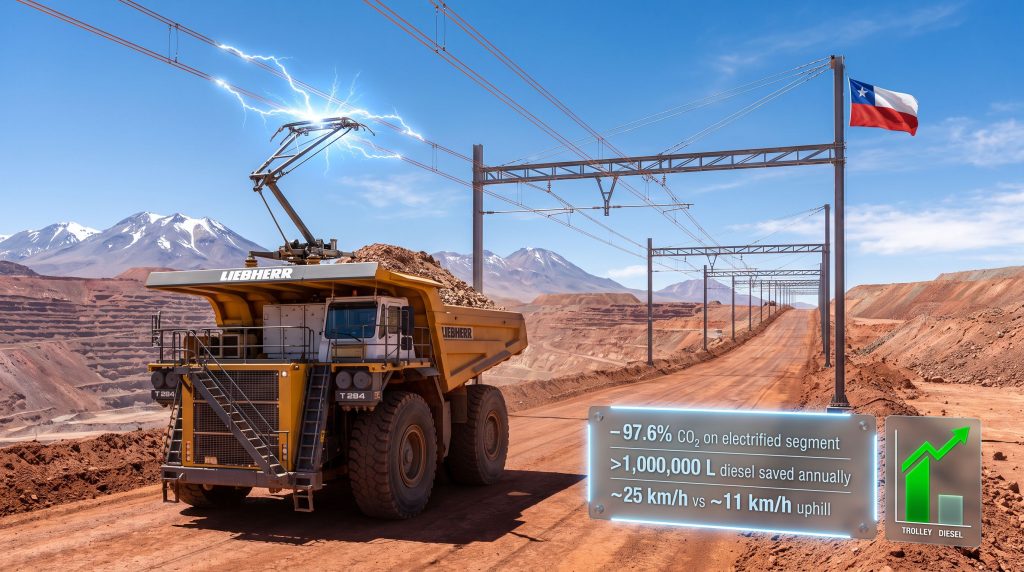
The Collahuasi Trolley Assist system, commissioned in July 2025 at one of South America's most significant copper operations, represents a landmark proof-of-concept for this approach. It is the first electrified haul truck infrastructure of its kind to enter commercial operation anywhere in Chile or South America, and its performance data is already forcing a reappraisal of what near-term decarbonisation in mining can realistically achieve in open-pit environments.
When big ASX news breaks, our subscribers know first
Understanding the Trolley Assist Mechanism and Why It Works
How Catenary-Powered Haulage Actually Functions
At its core, a trolley assist system borrows from technology that urban transit networks have used for well over a century. An overhead catenary wire carries electrical current along a fixed route. A pantograph, which is a spring-loaded, roof-mounted conductive arm, extends upward from the truck to make contact with the wire. While that connection is maintained, the truck's electric drive motors receive power directly from the grid rather than from its onboard diesel generator.
This matters enormously in operational terms. Diesel-electric haul trucks, the dominant configuration in ultra-class open-pit fleets, already use diesel engines primarily to generate electricity for their wheel motors. The trolley system simply substitutes the diesel generator with grid power on the electrified segment, requiring no fundamental redesign of the truck's drivetrain. When the truck reaches the end of the catenary line, the pantograph retracts, and the vehicle seamlessly reverts to diesel-electric operation.
Why the Uphill Ramp Is the Decisive Target
Not all segments of a haul truck's cycle are equal in their energy demands. The physics of moving a fully loaded truck up a grade are brutal: fuel consumption on an uphill ramp can be five to eight times higher per kilometre than on flat or downhill terrain. For operations where loaded trucks travel long distances uphill before dumping their payload, this single segment dominates the entire cycle's fuel budget.
At Collahuasi, the targeted segment connects the Rosario pit to the waste dump. This 1-kilometre ramp is the highest-intensity energy consumption point in the haulage cycle, and electrifying it captures the majority of available efficiency gains without requiring the operation to overhaul its broader fleet or logistics structure.
The Collahuasi Operation: Why Location Amplifies the Technology's Value
Operating Above 4,600 Metres: An Engineering and Environmental Context
Collahuasi sits in the Tarapacá Region of northern Chile, within the Pica commune, at elevations exceeding 4,600 metres above sea level. This extreme altitude creates conditions that compound the inefficiencies of diesel combustion in ways that are not always appreciated at lower-altitude mines.
At high altitude, atmospheric pressure drops significantly, which reduces the oxygen density available for combustion. Diesel engines operating at 4,600 metres are effectively running in a fuel-rich, oxygen-poor environment, meaning combustion is inherently less complete and less efficient than at sea level. This translates to higher fuel consumption per tonne moved and greater emissions per unit of work performed, compared to what the same truck would produce at a coastal or low-elevation site.
Trolley electrification eliminates this altitude penalty entirely on the electrified segment. An electric motor's performance is largely independent of atmospheric conditions, delivering consistent torque and speed regardless of elevation. Consequently, the productivity and emissions benefits of the Collahuasi Trolley Assist system are structurally amplified relative to what an equivalent system would deliver at a lower-altitude operation.
Collahuasi's Position in the Global Copper Market
Collahuasi is Chile's second-largest copper producer and ranks among the six largest copper mines globally by production volume. Understanding broader copper market trends helps contextualise why operational efficiency at this scale matters so profoundly. With copper prices averaging 596.5 US cents per pound through July 2026, accumulating a year-on-year increase of 38.7% according to Chilean industry data, the financial stakes are substantial. Even marginal reductions in cost-per-tonne delivered translate into significant absolute dollar figures when multiplied across annual production volumes.
The mine's scale also means its environmental footprint is proportionally large. Furthermore, innovations that deliver meaningful emissions reductions here carry greater aggregate impact than equivalent deployments at smaller operations.
Measured Outcomes: The Performance Case for the Collahuasi Trolley Assist System
Quantified Results from the Electrified Ramp
The performance data from the Collahuasi Trolley Assist system is notable for the degree of improvement it demonstrates across multiple dimensions simultaneously. The following table summarises the key metrics:
| Performance Metric | Diesel Baseline | Trolley Assist Result | Change |
|---|---|---|---|
| CO₂ emissions on electrified segment | Conventional diesel output | Reduced by 97.6% | -97.6% |
| Diesel consumption on segment | Conventional diesel volume | Reduced by ~98% | -98% |
| Annual diesel saved | Baseline volume | More than 1,000,000 litres | Significant |
| Annual CO₂ avoided | Baseline emissions | Up to 2,500 tonnes | Significant |
| Uphill truck speed | ~11 km/h | ~25 km/h | +127% |
| Trucks integrated | N/A | 4 Liebherr T 284 units | N/A |
These figures are drawn from operational data reported by Compañía Minera Doña Inés de Collahuasi (Reporte Minero, August 2026).
The Commercial Logic Behind the Speed Improvement
The increase in uphill speed from approximately 11 km/h to 25 km/h is not simply an operational curiosity. It is a direct commercial benefit that compounds across the fleet and the shift schedule.
Consider the mechanics:
- A truck travelling 1 kilometre at 11 km/h takes approximately 5.5 minutes to traverse the ramp
- At 25 km/h, the same distance takes approximately 2.4 minutes
- That is a saving of roughly 3 minutes per loaded uphill run, per truck
- Across four trucks completing multiple cycles per shift, across a full operating year, the cumulative time recovered is substantial
- Each recovered cycle translates directly into additional tonnes moved without deploying additional equipment or labour
This productivity gain also reduces thermal stress on the truck's drivetrain components during the most demanding phase of the haul cycle. Extended operating under heavy load at low speed with high diesel output is precisely the condition that accelerates engine wear and shortens service intervals. Removing that stress on the uphill ramp extends maintenance cycles and reduces downtime, creating a secondary cost benefit that is harder to quantify but operationally meaningful.
The Renewable Energy Foundation
The catenary infrastructure at Collahuasi draws exclusively from renewable electricity sources. Renewable energy in mining has been progressively transforming Chile's northern grid, which has absorbed large-scale solar generation capacity from the Atacama Desert — a region that possesses some of the highest direct normal irradiance readings recorded anywhere on Earth. Wind resources in the region further contribute to a structurally low-carbon electricity supply.
This renewable power connection is what enables the near-total elimination of scope 1 emissions on the electrified segment and produces near-zero scope 2 emissions as well, given the renewable generation mix. The combination is what pushes the system's CO₂ reduction figure to 97.6% rather than a more modest figure that would result from grid power with a higher carbon intensity.
Comparing Decarbonisation Pathways: Where Trolley Assist Sits in the Technology Landscape
A Practical Framework for Evaluating Haul Truck Electrification Options
Mining operators evaluating haul truck decarbonisation face a landscape of competing technologies, each with distinct cost profiles, maturity levels, and operational trade-offs. The following comparison situates trolley assist within that broader context:
| Strategy | Infrastructure Cost | Emissions Reduction | Productivity Impact | Commercial Maturity |
|---|---|---|---|---|
| Trolley Assist (catenary) | High (fixed route) | Up to 98% on electrified segment | Significant speed gain | Proven (Collahuasi operational) |
| Battery Electric Trucks | Very High (truck + charging) | Up to 100% with renewable charging | Comparable | Early commercial stage |
| Hydrogen Fuel Cell Trucks | Very High (truck + supply chain) | Up to 100% with green H₂ | Comparable | Pre-commercial/pilot |
| Diesel-Hybrid Trucks | Moderate | 15-30% reduction | Marginal improvement | Commercially available |
The Retrofit Advantage: Why This Matters More Than It First Appears
One of the less-discussed advantages of trolley assist technology is that it works with existing diesel-electric truck fleets rather than requiring their replacement. The Liebherr T 284 units at Collahuasi were retrofitted with pantograph systems rather than being replaced outright. Each T 284 carries a 365-tonne payload, making them among the largest haul trucks in active service globally.
Replacing a fleet of ultra-class haul trucks with battery electric or hydrogen alternatives would require not only the capital expenditure on new vehicles, but also the write-down of existing fleet value, the development of entirely new maintenance competencies, and the construction of charging or fuelling infrastructure from scratch. Trolley assist avoids most of these transition costs, making it a structurally more accessible near-term option for operations with existing diesel-electric fleets and suitable ramp geometry.
Honest Constraints: What the Technology Cannot Deliver
A balanced assessment requires acknowledging the genuine limitations of the trolley assist model:
- Emissions reductions are confined to the electrified segment only. Trucks operating outside the catenary zone continue to consume diesel at conventional rates
- Fixed overhead infrastructure creates route inflexibility. Unlike battery or hydrogen trucks that can follow any haul road, trolley-capable trucks are bound to the electrified corridor for their efficiency advantage
- High upfront civil and electrical engineering costs, including substations, transformers, rectifier stations, and catenary line installation, require sufficient haul volume to justify deployment over the mine's remaining life
- The system's economics are most compelling on long, consistent, high-traffic ramps with predictable routing over multi-decade timeframes
The Broader Replication Question: Which Operations Could Follow Collahuasi's Lead
Identifying Candidate Sites Across the Andean Copper Belt
The Collahuasi Trolley Assist system's commissioning has effectively demonstrated that the technology can function reliably at extreme altitude with a renewable power input. This proof-of-concept removes one of the primary uncertainties that had previously made other operators hesitant to commit capital to trolley infrastructure in South American conditions.
The profile of a strong candidate site for trolley assist deployment includes:
- Long, geometrically consistent uphill haul routes with high daily truck traffic density
- Access to Chile's northern Sistema Interconectado del Norte Grande (SING) grid or equivalent renewable-connected infrastructure in Peru
- An existing diesel-electric truck fleet compatible with pantograph retrofitting
- Sufficient remaining mine life to amortise the fixed infrastructure investment
- High-altitude location where diesel combustion inefficiency amplifies the relative benefit of electrification
High-altitude open-pit copper operations in northern Chile and southern Peru represent the strongest candidates by this framework. Operations with large ultra-class fleets, where each individual truck carries payloads above 300 tonnes, generate the highest per-kilometre savings from trolley electrification because the energy demand per vehicle is proportionally enormous.
Scalability: What Expansion Could Deliver
The current Collahuasi deployment covers a single 1-kilometre ramp segment with four trucks. The following table illustrates the potential scale of outcomes if the trolley model were extended, though it is important to note that these projections are illustrative rather than confirmed operational plans:
| Scenario | Electrified Ramp Length | Estimated Annual CO₂ Avoided | Trucks Supported |
|---|---|---|---|
| Current Phase 1 (Collahuasi) | 1 km | Up to 2,500 tonnes | 4 trucks |
| Hypothetical Phase 2 | 3 km | Up to 7,500 tonnes | 10-12 trucks |
| Hypothetical Full-Ramp | 5+ km | 12,000+ tonnes | 20+ trucks |
These expansion figures are illustrative projections based on linear scaling of reported Phase 1 outcomes and do not represent confirmed project plans or commitments by Collahuasi or any other operator.
The next major ASX story will hit our subscribers first
A Lesser-Known Dimension: The Grid Infrastructure Economics Behind the System
Why Northern Chile's Power Market Makes This Work
What is not widely appreciated outside specialist circles is that Chile's northern grid has experienced significant changes in its generation mix over the past decade. The Atacama Desert's solar irradiance, which ranks among the highest measured anywhere globally, has attracted large-scale photovoltaic investment that has periodically driven spot electricity prices in the region to near-zero or even negative values during peak generation hours.
This creates a structurally advantageous environment for industrial electricity consumers willing to invest in fixed grid-connected infrastructure. An operation like the Collahuasi trolley system, which consumes electricity continuously during daylight haul cycles, is positioned to benefit from the long-term trend toward lower and more variable northern Chilean grid prices as renewable penetration deepens. The fixed catenary infrastructure consequently becomes more economical as renewable generation capacity in the region continues to expand.
The Ministerial Visit: Policy Alignment Without Assuming Project-Specific Support
During Chile's National Mining Day celebrations in August 2026, Chile's Minister of Economy and Mining visited the Collahuasi operation and inspected the trolley assist infrastructure directly. The minister's presence and remarks about the importance of innovation to Chile's regional development signal that the technology aligns with the country's broader industrial and environmental policy directions.
Chile has committed to achieving carbon neutrality by 2050, with the mining sector identified as a primary source of emissions requiring structural change. The clean energy transition within Chilean mining aligns with that trajectory, and the clean energy transition being driven commercially — rather than by government mandate — lends it additional credibility as a replicable model.
Frequently Asked Questions: Collahuasi Trolley Assist System
What is a trolley assist system in mining?
A trolley assist system uses an overhead catenary wire and a pantograph mounted on a haul truck to supply grid electricity to the truck's electric drive motors while travelling uphill. On the electrified segment, the truck draws power from the grid rather than its onboard diesel generator, eliminating fuel consumption and emissions on that portion of the route.
Where is the Collahuasi trolley assist system located?
The system operates at the Collahuasi copper mine in the Tarapacá Region of northern Chile, within the Pica commune, at elevations exceeding 4,600 metres above sea level, specifically on the ramp connecting the Rosario pit to the waste dump.
When did the system become operational?
The Collahuasi Trolley Assist system was commissioned in July 2025, making it the first operational electrified haul truck line in Chile and across South America.
How much diesel does the system save annually?
The system saves more than one million litres of diesel per year on the electrified segment alone, representing approximately a 98% reduction in diesel consumption across that ramp section.
What trucks are used?
Four Liebherr T 284 ultra-class haul trucks, each with a 365-tonne payload capacity, were retrofitted with pantograph units to operate on the catenary line.
How much faster do trucks travel on the trolley segment?
Uphill speed increases from approximately 11 km/h under diesel power to approximately 25 km/h under trolley power, representing an increase of more than double and significantly compressing ramp cycle times across the fleet.
Is the electricity sourced from renewable generation?
Yes. The catenary line is supplied exclusively with renewable electricity, meaning the electrified segment produces near-zero direct carbon emissions during operation.
How much CO₂ does the system avoid annually?
The system avoids up to 2,500 tonnes of CO₂ per year on the electrified segment, representing a 97.6% reduction compared to conventional diesel haulage on the same route.
Key Takeaways: Why This Benchmark Matters Beyond One Mine
The Collahuasi Trolley Assist system is not simply a single operator's efficiency upgrade. It is the first South American validation of a technology model that has the potential to address one of mining's most stubborn decarbonisation challenges: the difficulty of eliminating diesel consumption from haul trucks at scale, without requiring full fleet replacement or accepting the operational limitations of battery and hydrogen alternatives in their current developmental states.
In addition, broader advances in mining electrification are beginning to converge with proven infrastructure models like trolley assist, suggesting the pace of change across the sector may accelerate considerably. The core insights from this deployment are worth summarising clearly:
- A single 1-kilometre catenary segment delivers a 97.6% CO₂ reduction and 98% diesel displacement on the electrified ramp, proving that surgical electrification of high-intensity route segments produces outsized environmental returns
- The speed improvement from 11 km/h to 25 km/h converts directly into commercial productivity gains that partially offset infrastructure investment through cycle time savings
- High-altitude operation at 4,600 metres structurally amplifies the efficiency advantage of electrification over diesel combustion due to altitude-related combustion penalties
- The retrofit model, applying pantograph technology to existing Liebherr T 284 trucks, demonstrates that near-term decarbonisation does not require fleet write-downs or wholesale capital replacement
- Northern Chile's renewable energy grid structure provides a low-carbon electricity foundation that maximises the emissions benefit per kilometre of catenary deployed
- The system establishes a replicable blueprint for large-scale open-pit copper operations throughout the Andean copper belt, with high-altitude, high-traffic ramp profiles representing the strongest candidate sites for future deployment
Collahuasi's confirmation of this continental first at the Rosario pit underscores how significant this operational milestone is for the broader mining industry. Further context on mining electrification and sustainability milestones across Chile's copper sector is available through Reporte Minero, which reports on technology and operational developments within Chile's mining industry.
Want to Identify the Next Major Mining Opportunity Before the Broader Market Does?
Discovery Alert's proprietary Discovery IQ model delivers real-time alerts on significant ASX mineral discoveries — instantly converting complex data across more than 30 commodities into clear, actionable insights for both short-term traders and long-term investors. Explore historic discoveries and their exceptional market returns, then begin your 14-day free trial at Discovery Alert to secure your market-leading edge.