August 11, 2026
The Energy Equation Behind Africa's Most Ambitious Copper Target
Industrial-scale mining has always been an energy-intensive pursuit, but few countries face the electricity challenge as starkly as Zambia does today. The Copperbelt, straddling Zambia and the Democratic Republic of Congo, represents one of the world's most concentrated repositories of copper ore, a metal whose demand trajectory is being reshaped by electric vehicles, renewable energy grids, and the broader electrification of global infrastructure. The problem is not the copper. It is the power needed to extract, process, and refine it at the volumes the market increasingly requires.
What makes Zambia's situation distinctive is not merely the scale of its production ambitions, but the speed at which its energy market is being structurally redesigned to support them. The introduction of Zambia open access electricity for copper mines through the Electricity (Open Access) Regulations No. 40 of 2024 represents one of the most consequential shifts in sub-Saharan African energy market architecture in recent years. Understanding it requires looking beyond the regulatory text and into the commercial mechanics, the infrastructure gaps, and the very real risks that could determine whether this transformation delivers on its promise.
When big ASX news breaks, our subscribers know first
Why the Old Model Could Not Survive Zambia's Production Ambitions
For decades, Zambia's electricity supply operated through a centralised model anchored by ZESCO, the state utility that served simultaneously as generator, transmission operator, and commercial supplier. For an economy with modest industrial demand, this concentration was manageable. For a country targeting a near-fourfold increase in copper production, it became a structural liability.
Mining already accounts for roughly 50% of Zambia's total national electricity consumption, according to the World Bank's May 2026 report, Powering Zambia's Transformation: From Electricity Crisis to Catalyst for Growth and Jobs. That figure is striking on its own, but it becomes especially significant when set against the government's declared ambition: increasing annual copper output from approximately 800,000 tonnes to 3 million tonnes by 2031 under the National Three Million Metric Tonnes Copper Production Strategy. Furthermore, the Zambia copper growth forecast underpins just how significant these targets are for global supply chains.
The arithmetic creates an unavoidable challenge. Adding roughly 2.2 million tonnes of annual copper production demands proportionally enormous increases in electricity supply. No single utility, regardless of its operational efficiency, could realistically absorb that incremental demand alone. Something in the commercial architecture had to change.
The 2024 drought made the urgency impossible to ignore. Zambia's generation mix is dominated by hydropower, a structurally vulnerable configuration that the World Bank explicitly identifies as a systemic risk. When rainfall deficits reduced reservoir levels across the country's major hydro schemes, mines faced power constraints precisely when production pressure was intensifying. That combination of structural concentration and climate vulnerability created the conditions for accelerated reform.
How Zambia Open Access Electricity for Copper Mines Actually Works
The open access framework fundamentally alters the commercial relationship between electricity producers, the national grid, and large industrial consumers. Rather than purchasing all electricity through ZESCO under a single-supplier model, qualifying consumers including copper mines can now procure power directly from independent producers and route it across the national grid via a wheeling arrangement. This shift directly addresses the looming copper supply crunch that analysts have been warning about for several years.
Wheeling is the technical term for transmitting electricity generated by one party across grid infrastructure owned by another. In Zambia's case, that infrastructure remains under ZESCO's ownership and operation. A mine negotiating directly with an independent power producer does not bypass ZESCO's network; it pays a wheeling fee to use it while ZESCO transitions from dominant commercial supplier toward regulated network operator.
The three-layer commercial structure looks like this:
| Layer | Participant | Function |
|---|---|---|
| Generation | Independent Power Producers, regional traders | Produce or source electricity |
| Transmission | ZESCO (network owner) | Provides grid access for a wheeling fee |
| Offtake | Copper mines, large industrial consumers | Procure power via direct bilateral agreements |
Any entity consuming above 1 MW may participate under the framework, but legal eligibility and operational delivery are not the same thing. Before supply can commence, a mine must complete technical feasibility studies, confirm available transmission capacity, negotiate a Power Purchase Agreement or Power Supply Agreement with a generator or trader, submit that agreement to the Energy Regulation Board for approval, and finalise wheeling terms with ZESCO. The process is sequential and multi-party, meaning that even well-capitalised miners with willing counterparties may face extended timelines.
The ERB's mandate, as confirmed in its May 2026 Guidelines for the Review of Power Purchase and Supply Agreements, extends to approving and regulating all such agreements for both domestic and export markets. This regulatory checkpoint introduces important oversight but also a potential bottleneck as application volumes grow.
Step-by-Step: How a Mine Secures Power Under the Open Access Regime
-
Identify a qualifying generator or trader licensed under the open access regulations
-
Commission technical studies confirming transmission capacity and wheeling feasibility
-
Negotiate a Power Purchase Agreement or Power Supply Agreement covering pricing, volume, and delivery terms
-
Submit the completed agreement to the ERB for regulatory review and formal approval
-
Negotiate wheeling terms with ZESCO, including applicable network access fees
-
Commence electricity supply once all regulatory and commercial conditions are satisfied
Which Mining Companies Are Already Participating
The shift from policy text to commercial reality is already visible in the ERB's own published records. The regulator's 2025 Annual Statistical Bulletin confirms several significant supply arrangements involving copper mining operations:
| Mining Company | Counterparty | Agreed Capacity |
|---|---|---|
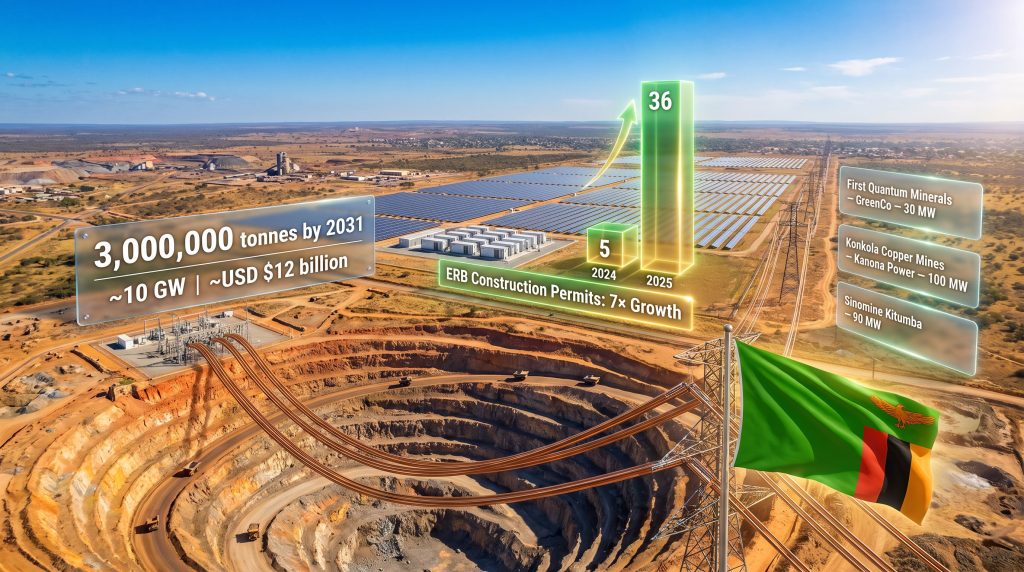
| First Quantum Minerals | GreenCo Power Services | 30 MW |
| Konkola Copper Mines | Kanona Power Company | 100 MW |
| Sinomine Kitumba Minerals | Various arrangements | 90 MW |
Additional large industrial consumers also appear in the ERB's records, indicating the transition toward multi-supplier procurement extends beyond these three cases. First Quantum Minerals is separately reported to have arrangements for up to 50 MW of run-of-river hydropower wheeled directly to its Kansanshi and Sentinel operations, illustrating how individual companies can layer multiple supply structures simultaneously to diversify their energy sourcing and manage price risk.
Africa GreenCo has emerged as a notable electricity trading intermediary within this emerging market structure, with miners reportedly sourcing imported power through such traders during periods of acute grid stress. This role reflects a broader market dynamic: the open access framework does not just enable direct mine-to-generator relationships, it creates space for specialist trading intermediaries that can aggregate supply, manage cross-border power trade arrangements, and provide flexibility services that a single bilateral contract cannot easily deliver.
The Scale of Regulatory and Investment Activity
The pace of regulatory activity since the framework's introduction provides a useful indicator of market momentum. According to the ERB's 2025 Annual Statistical Bulletin, electricity construction permits increased from 5 in 2024 to 36 in 2025, a sevenfold increase in a single year. Electricity trading volumes rose 11.9% year-on-year across the same period.
Project approvals continued accelerating into 2026. In February alone, the ERB approved 29 new licenses and 5 construction permits across the energy sector, including a permit for a 60 MWp solar photovoltaic project paired with a 5 MW / 20 MWh battery storage system in Choma. This hybrid renewable-plus-storage configuration is significant: it signals that new generators entering the market are not simply adding undifferentiated baseload capacity, but are designing projects capable of providing dispatchable power that can buffer the intermittency limitations that have historically constrained Zambia's solar potential.
By mid-2026, the ERB reported that it had supported 16 utility-scale projects representing more than 1.1 GW of combined generation capacity, alongside approving ZMW 19.7 billion (approximately USD $1.04 billion) in energy sector investments during the same six-month window.
Context: A sevenfold jump in construction permits within a single year is an unusually sharp acceleration by any comparative standard in African energy markets. It suggests the open access framework is functioning as an investment signal, not merely a regulatory change.
Quantifying the Energy Infrastructure Gap
Copperbelt Energy Corporation, an operator with direct exposure to both electricity generation, transmission, trading, and mining customers, estimated in a February 2026 statement following the African Mining Indaba that supporting Zambia's copper expansion ambitions would require approximately 10 GW of new generation capacity and close to USD $12 billion in energy investment by 2030.
Important framing: These are CEC's independent commercial estimates, not official government projections. However, given CEC's operational position directly at the intersection of Zambia's mining and energy sectors, the figures carry meaningful industry credibility and represent the most detailed publicly available quantification of the challenge.
The scale of that estimated requirement places Zambia's energy challenge in stark perspective:
| Metric | Current Position | Target / Required |
|---|---|---|
| Annual copper output | ~800,000 tonnes | 3,000,000 tonnes by 2031 |
| Mining share of electricity consumption | ~50% of national total | Expected to increase significantly |
| New generation capacity required (CEC est.) | Baseline | ~10 GW by 2030 |
| Required energy investment (CEC est.) | Baseline | ~USD $12 billion by 2030 |
| ERB-supported utility-scale projects (H1 2026) | 16 projects | 1.1+ GW pipeline |
ZESCO's own project portfolio also reflects the anticipated scale of future mining demand. The utility's planned grid investments include upgrades specifically designed to increase power-transfer capacity for large-scale future mining loads, with project documentation citing growing electricity demand in both the Copperbelt and North-Western provinces as primary drivers. The World Bank has separately identified a planned 330 kV transmission line as a critical reinforcement measure to support copper belt expansion and new mine development.
The next major ASX story will hit our subscribers first
The Policy Architecture Supporting Private Investment
The open access framework does not operate in isolation. The Ministry of Energy released a Competitive Procurement Framework for Private Sector Investment in Renewable Energy in May 2026, accompanied by a tax and non-tax incentives package and a financing roadmap aligned with Zambia's Integrated Resource Plan.
The procurement framework is notable for its candour about the obstacles it is designed to address. The Ministry explicitly identifies three primary barriers to new generation development:
-
Financing constraints limiting developer access to capital on commercially viable terms
-
Regulatory barriers creating uncertainty for prospective investors
-
Project bankability challenges affecting lenders' willingness to provide debt financing
The framework responds to these by establishing standardised procurement processes and incorporating credit and liquidity support mechanisms designed to reduce the perceived investment risk that deters private capital from early-stage project development. In addition, the growing role of critical minerals and energy transition pressures globally has further elevated Zambia's profile among international investors seeking reliable copper supply chains.
Bankability, in particular, is a concept that often receives insufficient attention outside specialist energy finance circles. A project may be technically sound, commercially logical, and legally compliant, yet still fail to attract debt financing if lenders cannot be satisfied that revenue streams are sufficiently certain and offtaker creditworthiness is sufficiently robust. In Zambia's context, where utility sector financial viability remains an ongoing structural concern flagged by the World Bank, addressing bankability through standardised contracts and credit support is not peripheral but central to the investment mobilisation task.
Critical Risks That Could Constrain the Transition
Physical Grid Capacity Cannot Be Legislated Into Existence
Open access regulations create legal entitlement to wheeling. They do not create the physical transmission capacity needed to operationalise it. Bottlenecks in the Copperbelt and North-Western provinces, where mining demand is most concentrated, require capital-intensive grid upgrades that take years to plan, finance, and construct. Large-scale mine expansions may outpace grid upgrade timelines, particularly if investment decisions are made on the assumption that adequate wheeling capacity will be available before it is physically in place.
Hydropower Dependency Persists as a Climate Risk
Even with a diversifying generation pipeline, hydropower continues to dominate Zambia's installed capacity. Climate variability, as the 2024 drought demonstrated, can rapidly reduce available generation across the entire system regardless of the commercial arrangements in place. Solar and storage projects like the Choma facility represent meaningful steps toward diversification, but the aggregate scale of new non-hydro capacity approved to date remains modest relative to the systemic risk being managed. Consequently, the expansion of renewable energy in mining operations has become an increasingly urgent priority for both government and industry stakeholders.
Regulatory Capacity Under Growing Pressure
The ERB's role as the mandatory approval authority for all PPAs and PSAs introduces an institutional bottleneck risk. Application volumes grew sharply between 2024 and 2026, and if the pipeline continues expanding at this rate, the regulator's capacity to review, negotiate, and approve agreements in commercially relevant timeframes will be tested. Standardised agreement templates and streamlined review processes are essential, but institutional capacity strengthening is equally important.
The Bankability Gap Remains Unresolved
Credit and liquidity support mechanisms described in the Ministry's procurement framework are designed to address bankability constraints, but their operational effectiveness will only be demonstrated over time. The gap between a well-designed framework and the point at which lenders are genuinely willing to provide project finance on commercially viable terms involves sustained institutional credibility and consistent policy implementation, neither of which can be compressed through regulatory action alone.
What Zambia's Approach Signals for the Broader African Mining-Energy Nexus
Zambia's reform trajectory carries lessons that extend well beyond its own borders. Several African resource economies face structurally similar challenges: mining sectors with outsized electricity demand, generation infrastructure dominated by a single fuel source or a single utility, and production ambitions that inherited grid capacity cannot plausibly support. The combination of open access wheeling regulations, competitive procurement frameworks for renewables, and structured incentive packages represents a replicable policy architecture, albeit one whose effectiveness will ultimately be judged by whether private capital actually flows into new generation at the required scale and pace.
Copper's deepening role in global decarbonisation infrastructure, as a core material in electric vehicle motors, charging networks, wind turbines, and grid expansion projects across Europe, North America, and Asia, means that Zambia's production trajectory carries consequences well beyond its national economy. Reliable and competitively priced electricity is increasingly a prerequisite for attracting the foreign mining investment that could push annual output toward the 3-million-tonne target. Investors exploring copper investment strategies will find Zambia's energy reform trajectory a critical variable in assessing long-term project viability.
The open access framework creates the conditions for that investment. Closing the financing gap, expanding transmission infrastructure, and diversifying generation away from climate-exposed hydropower will determine whether those conditions translate into operational reality. For further context on how Zambian copper mines are navigating energy constraints, industry reporting provides useful on-the-ground perspective from operators directly affected by the transition.
Readers seeking ongoing coverage of African energy market reforms and their intersection with critical minerals investment can explore related analysis from Ecofin Agency at ecofinagency.com, which provides sector-focused reporting across African energy, mining, and public policy developments.
This article contains forward-looking estimates and projections, including capacity and investment figures sourced from Copperbelt Energy Corporation and the Energy Regulation Board of Zambia. These figures reflect the views and estimates of the cited organisations at the time of publication and should not be interpreted as guarantees of future outcomes. Readers considering investment decisions should conduct independent research and seek professional financial advice.
Want to Track the Next Major Copper Discovery Before the Market Does?
Discovery Alert's proprietary Discovery IQ model delivers real-time alerts on significant ASX mineral discoveries — including copper — instantly translating complex geological announcements into actionable investment insights for both short-term traders and long-term investors. Explore historic examples of major mineral discoveries and their returns, then begin your 14-day free trial to position yourself ahead of the market.