August 11, 2026
The Geological Case for Carajás as a Copper Development Address
Few mineral provinces on Earth have delivered the consistency of world-class discoveries that the Carajás Mineral Province in Pará State, Brazil, continues to produce. Formed through ancient tectonic processes that concentrated iron, copper, and gold in structurally controlled corridors across the Amazon Basin, Carajás is not simply a mining district. It is a geological archive of some of the most economically significant IOCG systems ever identified, and it is still revealing new chapters.
Iron oxide copper-gold deposits, the mineralisation class that defines Carajás, are among the most sought-after geological targets in modern exploration. Their appeal lies in a combination of factors rarely found together: large tonnage, polymetallic revenue streams, predictable structural controls, and, critically, the tendency to grow larger with depth. Where many deposit types thin or pinch out as drill programs extend downward, well-structured IOCG systems in Carajás have historically surprised to the upside as mineralisation continues along plunge and at depth. This geological behaviour is not incidental to the investment thesis around the Ero Copper Furnas project in Carajás. It is central to it.
When big ASX news breaks, our subscribers know first
Understanding the IOCG Deposit Model Before Evaluating Furnas
What Makes IOCG Systems Economically Distinctive?
Before examining the Furnas deposit itself, it is worth understanding what makes IOCG mineralisation so commercially compelling. Unlike porphyry copper systems, which are often disseminated and require very high throughput to generate economic grades, IOCG deposit model mineralisation is structurally hosted, meaning it is typically concentrated along fault corridors and breccia zones. This geometry can produce higher grades in smaller footprints, and where large-scale structural systems are involved, the mineralised envelope can be extraordinarily large.
Classic IOCG characteristics include:
- Strong copper and gold associations with iron oxide alteration (magnetite and hematite)
- Silver as a meaningful co-product, adding revenue diversification
- Depth continuity often confirmed through directional drilling, extending the resource beyond what surface or near-surface drilling reveals
- Structural controls that, once understood, allow geologists to target mineralised corridors with high drill-intercept probability
The Carajás Province hosts the world's largest primary copper IOCG mine in Vale's Salobo operation, which has consistently exceeded initial resource projections as underground development exposed deeper mineralisation. Furnas sits approximately 50 kilometres southeast of Salobo, within the same geological belt.
This proximity is not merely a marketing point. It establishes a geological benchmark. Salobo's trajectory from discovery to operation provides a real-world analogue for how Carajás-hosted IOCG systems scale over time, and Furnas' early drilling results suggest it is tracking a comparable pattern.
How the Earn-In Partnership With Vale Structures the Risk Profile
The Strategic Logic Behind a Staged Acquisition
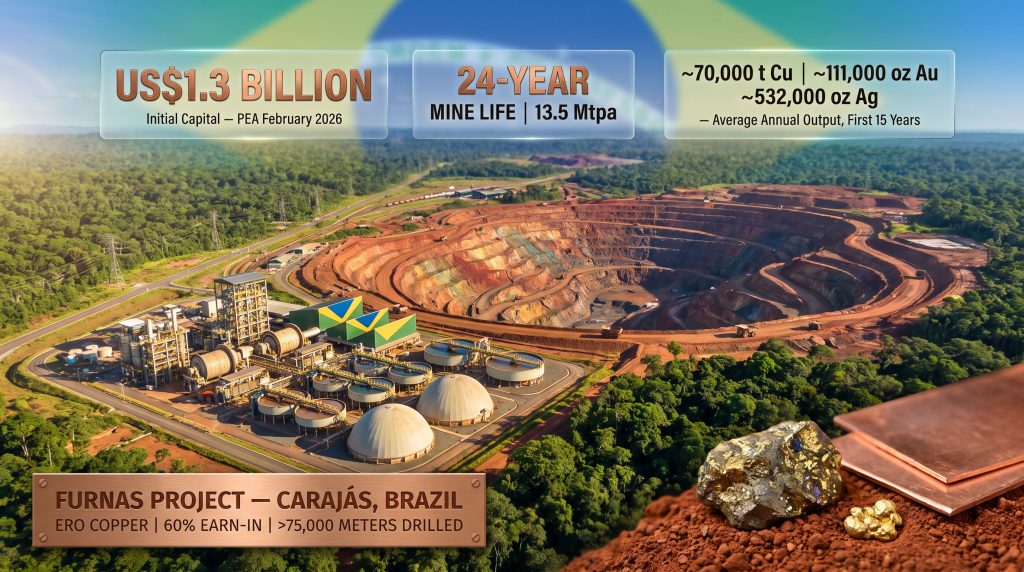
In July 2024, Ero Copper and Vale Base Metals formalised a definitive earn-in agreement with Salobo Metais S.A., a subsidiary of Vale Base Metals, granting Ero the right to acquire a 60% interest in the Furnas project over a five-year window tied to staged exploration, engineering, and development milestones.
| Parameter | Detail |
|---|---|
| Agreement Type | Earn-In with Staged Milestones |
| Ero's Target Interest | 60% |
| Vale's Retained Interest | 40% |
| Agreement Signed | July 2024 |
| Earn-In Duration | Five Years |
| Vale Subsidiary Involved | Salobo Metais S.A. |
The structure is deliberately calibrated to minimise upfront capital exposure. Rather than acquiring a full interest at a premium valuation, Ero is progressively proving economic viability before committing full development capital. Vale, meanwhile, retains a 40% stake that preserves its long-term value participation while transferring exploration execution responsibility to a company with demonstrated operational capability in the same region.
This arrangement also carries a less-discussed strategic advantage: Vale's retained interest means Furnas benefits from proximity to an operator that has spent decades navigating Brazil's environmental licensing framework, understanding regional infrastructure logistics, and building relationships with local communities and regulators. That institutional knowledge does not appear on a balance sheet, but it is a meaningful de-risking factor for a project of this scale.
Why the Carajás Address Matters for Infrastructure Economics
The Furnas project covers approximately 2,400 hectares and sits within a corridor already served by paved road networks, an operational power substation, a cement plant, and Vale's railroad loadout facility. In large-scale mining development, infrastructure proximity is often underweighted in early-stage analysis, yet it can represent hundreds of millions of dollars in capital cost differentials between otherwise comparable projects.
For context, greenfield mining developments in remote jurisdictions frequently require purpose-built haul roads, power transmission lines, and port facilities. Furnas, by contrast, inherits an infrastructure environment built around one of the world's most productive mining corridors. This compresses the effective capital intensity of the project's US$1.3 billion development estimate relative to equivalent-scale projects developed in isolation.
Drilling at Furnas: What 75,000 Metres Reveals About the System's Scale
Phase 1 Completion and the Depth Continuity Signal
Ero's Phase 1 drilling program at Furnas concluded in July 2025, delivering intercepts that extended mineralisation both along strike and at depth. The results validated the structural model underpinning the IOCG interpretation and provided sufficient confidence to advance toward a Preliminary Economic Assessment. By September 2025, Ero publicly characterised the deposit as having the potential for a large-scale, long-life operation, based on the significant copper and gold grades confirmed through directional drilling.
By the end of May 2026, cumulative drilling at Furnas had surpassed 75,000 metres, a figure that warrants attention not just for its volume but for what it implies about the geological system being delineated. Sustained directional drilling programs at this scale are rarely deployed unless early intercepts strongly support resource continuity. Furthermore, the June 2026 drilling update confirmed that mineralisation continued to respond positively both along strike and at depth, reinforcing confidence in three-dimensional continuity.
A deposit that continues to return significant mineralisation at depth as drilling intensifies is exhibiting exactly the behaviour that distinguishes a genuinely large IOCG system from a shallower, structurally limited occurrence. This geological response is one of the most important signals investors should track in Furnas' ongoing drill releases.
When interpreting drill results from Furnas, it is essential to consider both the grade and the spatial distribution of intercepts, as these together define the true three-dimensional shape and continuity of the mineralised system.
The October 2024 Resource Estimate: Baseline and Upside
The inaugural NI 43-101 compliant mineral resource estimate, published in October 2024, established:
- 35.2 million tonnes Indicated resource
- 61.3 million tonnes Inferred resource
- Applied cut-off grade of 1.00% copper equivalent (CuEq)
The ratio of inferred to indicated tonnage is an important technical signal. A large inferred component relative to indicated resources reflects an early-stage, widely spaced drilling program. As infill drilling tightens the drill pattern across the mineralised envelope, a significant proportion of the inferred resource is expected to convert to indicated status, which is the classification required for inclusion in a bankable feasibility study. The trajectory of this conversion ratio across future resource updates will be one of the most closely watched metrics in Furnas' development timeline.
The February 2026 PEA: Economic Architecture of a 24-Year Operation
Headline Numbers That Define Tier-2 to Emerging Tier-1 Scale
The maiden PEA published for Furnas in February 2026 established the economic framework with a level of detail that moves the project firmly out of the speculative exploration category and into serious development consideration.
| Economic Metric | PEA Projection |
|---|---|
| Initial Capital Requirement | US$1.3 billion |
| Mine Life | 24 years |
| Processing Plant Capacity | 13.5 Mtpa |
| Average Annual Copper Output (First 15 Years) | ~70,000 tonnes |
| Average Annual Gold Output (First 15 Years) | ~111,000 oz |
| Average Annual Silver Output (First 15 Years) | ~532,000 oz |
| Average Annual CuEq Output (First 15 Years) | ~108,000 tonnes |
| Life-of-Mine Copper Production | Over 1.2 million tonnes |
| Life-of-Mine Gold Production | ~2.0 million oz |
| Life-of-Mine Silver Production | ~9.0 million oz |
Several features of this economic profile deserve deeper analysis. The 13.5 million tonnes per annum centralised processing plant is a scale that places the Ero Copper Furnas project in Carajás in the same operational tier as major IOCG producers globally. Large-throughput centralised processing facilities are characteristic of deposits where low-to-moderate grades are offset by sheer volume and polymetallic revenue streams.
The Polymetallic Revenue Model and Cost Curve Positioning
One of the most commercially significant aspects of the Furnas economic model is its three-metal revenue architecture. Copper forms the primary production stream, but gold and silver co-production at the projected rates materially alters the project's effective cost structure.
In copper mining economics, by-product credits from gold and silver are applied against the cash cost of copper production, reducing the reported C1 cost per pound. At prevailing metal prices, projects with meaningful gold and silver co-production routinely land in the lower half of the global copper cost curve, which translates directly to margin resilience during copper price downturns. Furnas, with its projected 111,000 oz of gold and 532,000 oz of silver annually in the first 15 years, carries a by-product credit profile that could substantially reduce its effective copper cost of production.
This is a detail that is frequently overlooked in high-level analyses of copper development projects. The headline copper output figure of 70,000 tonnes per year is meaningful, but the economic durability of that production over a 24-year mine life depends as much on the gold and silver contribution as it does on the copper price.
Benchmarking Furnas Against the Global IOCG Peer Group
| Project | Location | Annual Cu Output | Mine Life | Status |
|---|---|---|---|---|
| Furnas (Ero/Vale) | Carajás, Brazil | ~70,000 t/y (first 15 yrs) | 24 years | PEA Stage |
| Salobo (Vale) | Carajás, Brazil | ~200,000 t/y | 40+ years | Operating |
| Prominent Hill (BHP) | South Australia | ~80,000 t/y | 20+ years | Operating |
| Olympic Dam (BHP) | South Australia | ~140,000 t/y | Multi-decade | Operating/Expanding |
Furnas is not yet in the same production tier as Salobo or Olympic Dam. However, what the comparison does establish is geological and structural credibility: the same province that produced Salobo, which has itself consistently grown through successive drilling programs, is now yielding another structurally controlled IOCG system with a confirmed 24-year mine life at PEA stage. That is a meaningful peer comparison.
The Cristalino deposit, another Carajás-hosted IOCG system, provides a further analogue for how grade distribution and resource growth can evolve through systematic directional drilling. Cristalino's development history demonstrated that early-stage drill programs in this geological environment often understate the true extent of mineralisation, a precedent that lends weight to the speculative but geologically grounded view that Furnas' resource could grow materially beyond its current NI 43-101 estimate.
The next major ASX story will hit our subscribers first
Ero Copper's Operational Platform: The Financial Engine Behind Furnas
Three Operating Assets Funding a Fourth Development Project
Furnas does not exist in isolation. It is the growth-stage asset sitting atop a producing platform that generated a full-year copper production record of 64,000 tonnes in 2025 and a net profit attributable to shareholders of US$263.7 million, equivalent to US$2.53 per share.
| 2025 Performance Metric | Result |
|---|---|
| Full-Year Copper Production | 64,000 tonnes (record) |
| Net Profit Attributable to Shareholders | US$263.7 million |
| Earnings Per Share | US$2.53 |
| 2026 Capital Investment Guidance | US$245M to US$320M (portfolio-wide) |
This financial performance provides the balance sheet foundation from which Furnas exploration and development spending can be sustained without immediately pressuring debt metrics or shareholder returns. The Q1 2026 update confirmed 17,287 tonnes of copper in concentrate and 5,495 ounces of gold, maintaining the production trajectory established through 2025.
The three operating assets each carry distinct characteristics:
- Caraíba Operations (MCSA Mining Complex, Bahia): The company's longest-running underground copper mining complex, which has delivered grade improvements in recent quarters contributing to the 2025 production record.
- Tucumã Operation (Pará State): The newer copper concentrate operation that has been the primary driver of quarterly production records and sits approximately 190 kilometres northeast of Furnas, establishing a regional operational cluster in Pará.
- Xavantina Operations (Mato Grosso): Identified as Brazil's highest-grade gold mine, with an NI 43-101 compliant measured and indicated resource of 2.359 million tonnes at 8.75 g/t gold, representing 664,000 ounces. Ero has also initiated recovery from previously processed concentrate stockpiles of approximately 60,000 cubic metres, with an initial inferred resource of approximately 29,000 ounces from sampling of roughly 20% of the total stockpile volume.
Development Timeline and the Risks That Will Define Furnas' Trajectory
Critical Path From PEA to Production Decision
The roadmap from the February 2026 PEA to a construction decision involves several sequential and potentially overlapping workstreams:
- 2026: Continued extensional and infill drilling beyond the 75,000-metre milestone; updated resource estimate incorporating Phase 2 results; metallurgical test work supporting plant design refinement.
- 2027 to 2028: Pre-Feasibility Study and potentially a definitive feasibility study; initiation of Brazil's IBAMA environmental licensing process, which for large-scale mining developments typically involves multiple assessment stages and public consultation requirements.
- 2029 to 2030+: Final Investment Decision contingent on feasibility outcomes, financing structure, prevailing copper market conditions, and licensing clearances.
Risk Factors That Investors Should Actively Monitor
Brazil's environmental licensing framework, administered through IBAMA, is one of the more complex regulatory environments for large-scale mining development in South America. The process involves multiple assessment phases, engagement with federal and state authorities, and consultation with affected communities. For projects of Furnas' scale, this process can extend across several years and represents a non-trivial source of timeline risk that does not appear in project economics but significantly affects the probability-weighted development schedule.
Capital cost inflation is a second variable deserving scrutiny. The US$1.3 billion PEA estimate reflects study-stage accuracy typically associated with a confidence range of plus or minus 35 to 45 percent. In a global construction environment that has experienced sustained cost pressure across labour, steel, and energy inputs, the gap between PEA-stage estimates and executed project costs has widened for multiple large mining developments in recent years.
A PEA is a conceptual study. The gap between a US$1.3 billion PEA estimate and an executed project cost has historically been where large mining developments encounter their most significant surprises. The progression through Pre-Feasibility and Definitive Feasibility studies will be the critical interval for refining this figure.
On the upside, the inferred resource of 61.3 million tonnes, if converted to indicated status through systematic infill drilling, would dramatically strengthen the bankability profile of the project and could extend the mine life or support throughput optimisation in feasibility-stage studies.
Furnas Within the Copper Supply Gap Narrative
Why New Tier-2 Developments Matter in the 2030s Supply Picture
The copper supply crunch developing through the 2030s is well-documented, with global demand projections from multiple independent research institutions converging on a pronounced shortfall driven by the compounding requirements of electric vehicle manufacturing, utility-scale battery storage, grid infrastructure modernisation, and renewable energy deployment. Each of these applications is copper-intensive in ways that substitute materials cannot fully displace at scale.
The supply response to this demand trajectory is constrained by a structural feature of the mining industry: the lead time between discovery and production for a large copper mine now averages between 16 and 20 years. Projects that reach PEA stage in 2026 and achieve Final Investment Decisions by 2029 or 2030 are targeting first production in the mid-2030s, precisely the interval where supply analysts have identified the most pronounced potential deficit.
Furnas, with its life-of-mine copper production exceeding 1.2 million tonnes over 24 years, represents exactly the type of large-scale, long-duration supply addition that the market will require in that window. Its Carajás address, combined with existing regional infrastructure and a technically credible PEA, positions it as one of the more advanced large-scale copper development projects in South America outside of assets already in feasibility or construction.
The combination of Ero's record operating performance, Vale's geological and logistical familiarity with the region, and the structural characteristics of the IOCG system being delineated at Furnas creates a multi-layered growth thesis that extends well beyond a single commodity call. Consequently, copper investment strategies focused on the 2030s supply window will increasingly need to account for development-stage assets such as the Ero Copper Furnas project in Carajás, where the combination of geological credibility, infrastructure advantage, and a credible operating partner creates a differentiated risk-reward profile. Whether that thesis is fully realised will depend on the resource conversion trajectory over the next two to three years and the company's ability to navigate Brazil's regulatory environment on a timeline consistent with capturing the copper demand cycle it is positioning to serve.
Readers seeking additional context on developments across Brazil's mining sector can explore coverage published by Brasil Mineral, a leading Brazilian mining industry publication tracking resource developments across the country.
Want to Catch the Next Major Mineral Discovery Before the Market Does?
Discovery Alert's proprietary Discovery IQ model scans ASX announcements in real time, instantly identifying significant mineral discoveries — including copper and gold IOCG systems — and delivering actionable alerts to subscribers ahead of the broader market. Explore Discovery Alert's discoveries page to see how historic mineral discoveries have generated substantial returns, and begin your 14-day free trial today to position yourself at the forefront of the next major find.