
August 10, 2026
Benchmark Integrity in Commodities: Why the Way We Calculate Prices Matters More Than the Prices Themselves
Price benchmarks in commodity markets are not passive observers of trade. They are active infrastructure. When a miner in South America ships copper concentrate to a smelter in China, the treatment and refining charges embedded in that contract are almost certainly pegged to a published index. If that index fails to reflect the actual distribution of market activity, every contract referencing it carries a hidden pricing distortion. That distortion compounds across thousands of tonnes and hundreds of millions of dollars in annual settlements.
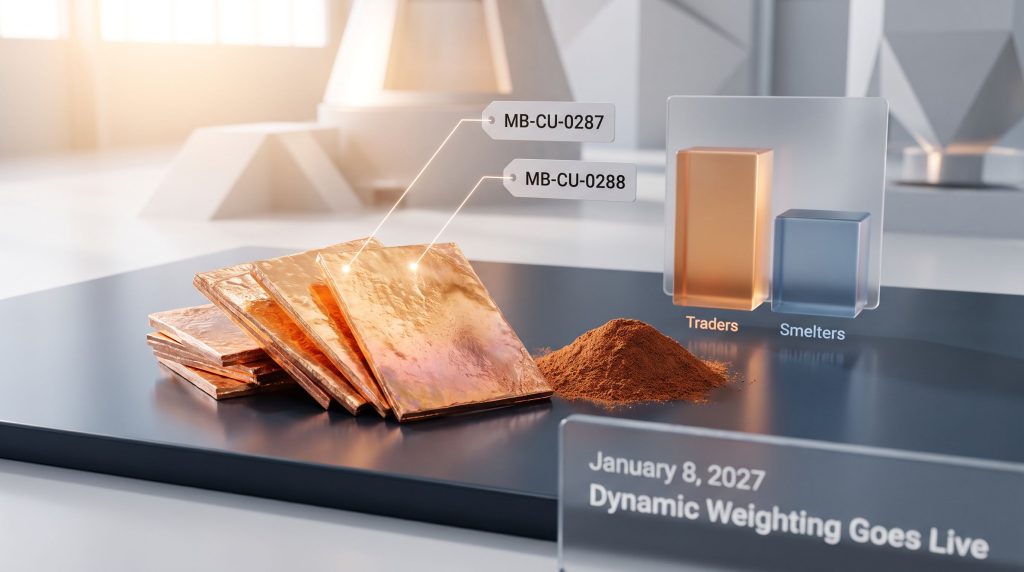
This is the structural tension that has driven one of the most significant methodology changes in copper concentrate pricing in recent years: the transition of the copper concentrates TC/RC index dynamic weighting framework, replacing a static 50:50 model with a volume-responsive approach that adjusts weekly based on actual reported market participation.
When big ASX news breaks, our subscribers know first
Understanding TC and RC: The Price of Processing Copper
Before examining the methodology change itself, it helps to understand what treatment and refining charges actually represent in the copper supply chain. Copper concentrate, the intermediate product produced at mine sites through crushing and flotation, cannot be used directly in manufacturing. It must be processed by smelters into refined copper cathode. The copper leaching process and smelting operations represent distinct but complementary pathways to refined metal.
The fees charged for this processing are split into two components:
- Treatment charges (TC) are expressed in US dollars per dry metric tonne ($/dmt) and cover the cost of smelting concentrate into blister or anode copper.
- Refining charges (RC) are expressed in US cents per pound of copper content and cover the subsequent refining of blister copper into refined cathode.
TC and RC levels are not arbitrary. They reflect the fundamental balance of power between concentrate suppliers and smelters. When global smelting capacity is abundant relative to available concentrate supply, smelters compete aggressively for feed and TC/RC levels fall, favouring miners. When concentrate is plentiful and smelter capacity is constrained, TC/RCs rise, improving smelter economics.
This dynamic has made the TC/RC index a closely watched barometer of stress and surplus across the entire copper supply chain. The benchmark is published weekly, every Friday at 4:00 PM London time, on a CIF Asia Pacific basis, reflecting the dominant role of Asian smelters in seaborne concentrate trade.
The Problem With Treating Both Sides of the Market as Equal
Why the 50:50 Model Became Outdated
The combined TC/RC index has historically been calculated as a straight average of two distinct sub-indices:
- The implied traders' purchase TC/RC (MB-CU-0509 / MB-CU-0511)
- The implied smelters' purchase TC/RC (MB-CU-0508 / MB-CU-0510)
Under the outgoing methodology, each sub-index carried exactly 50% of the weight in the combined index, regardless of how much physical volume each counterparty type actually represented in any given period. The assumption embedded in this design is that traders and smelters participate in the spot market symmetrically at all times. That assumption has become increasingly difficult to defend.
Fastmarkets' public consultation, which drew responses from more than 30 companies across the copper concentrate supply chain, confirmed what practitioners had long observed: spot market activity is not evenly distributed between the two counterparty types. Trading patterns and data submitted by market participants had evidenced a widening spread between the trader-purchase and smelter-purchase components of the index, meaning the fixed 50:50 average was systematically misrepresenting prevailing market conditions for an extended period.
A benchmark that applies equal weight to two counterparty types regardless of their actual market participation does not measure the market. It measures a theoretical construct that may have little relationship to the prices at which physical tonnes are actually changing hands.
What Representativeness Means for a Price Reporting Agency
Price reporting agencies (PRAs) operate under a clear obligation: their published price series must remain reasonably aligned with prevailing transaction levels in the spot market. This is not simply a commercial consideration. It is a structural requirement of benchmark governance, reinforced by international standards including the IOSCO Principles for Financial Benchmarks, which emphasise that benchmarks should reflect observable transactions and verifiable data.
When the volume of transactions across counterparty types diverges materially, a fixed-weight average introduces a representativeness gap. The resulting index may be internally consistent but externally misleading — a distinction that matters enormously to risk managers, contract lawyers, and treasury teams using it for settlement.
How the New Dynamic Weighting Methodology Works
The Core Mechanics
Under the new framework, the weight assigned to each sub-index within the copper concentrates TC/RC index dynamic weighting model will be determined by the proportion of reported physical transaction volumes attributable to each counterparty type. This is not a deal-count approach; the number of transactions reported by traders versus smelters is irrelevant. What matters is the tonnage those transactions represent.
The weighting calculation will be reviewed and updated weekly, drawing on a rolling six-month window of reported transaction data. The use of a rolling six-month window is a deliberate design choice: it is long enough to smooth out short-term volume spikes from either side that could cause erratic weekly swings in the combined index weight, while remaining responsive enough to capture genuine structural shifts in market participation over time.
Only formally reported transactions are eligible for inclusion. Consequently, this creates a direct incentive for greater transparency: any market participant whose transactions go unreported effectively reduces their sub-index's influence on the combined benchmark.
The Six Price Series in Scope
| Price Series Code | Description | Unit | Affected By |
|---|---|---|---|
| MB-CU-0287 | Copper concentrates TC index, cif Asia Pacific | $/tonne | Dynamic weighting change |
| MB-CU-0288 | Copper concentrates RC index, cif Asia Pacific | US cents/lb | Dynamic weighting change |
| MB-CU-0508 | TC implied smelters purchase, cif Asia Pacific | $/tonne | Gold/silver normalization only |
| MB-CU-0510 | RC implied smelters purchase, cif Asia Pacific | cents/lb | Gold/silver normalization only |
| MB-CU-0509 | TC implied traders purchase, cif Asia Pacific | $/tonne | Gold/silver normalization only |
| MB-CU-0511 | RC implied traders purchase, cif Asia Pacific | cents/lb | Gold/silver normalization only |
It is important to note what the dynamic weighting change does not affect. The individual trader-purchase and smelter-purchase sub-indices are calculated independently and remain unchanged by this update. Only the mechanism combining them into the headline index is being modified.
How Fastmarkets' Approach Compares to Competing Benchmark Providers
Methodology Comparison Across Major PRAs
| Feature | Fastmarkets (New) | Argus | CRU |
|---|---|---|---|
| Weighting basis | Reported tonnage, dynamic | Volume-weighted average of eligible deals | Volume-weighted average with normalization |
| Update frequency | Weekly (rolling 6-month) | Per assessment cycle | Per assessment cycle |
| Counterparty structure | Dynamic trader/smelter sub-indices | Separate indexes published | Integrated with double-count avoidance |
| Sub-index design | Trader + smelter combined dynamically | Counterparty-specific indexes | Normalized integrated output |
The broader trend across the PRA industry is clearly toward transaction-anchored benchmarks. Argus already applies volume-weighted averaging logic scaled to reported deal flow, and CRU incorporates additional safeguards against double counting when both buy-side and sell-side data for the same physical transaction are available. Furthermore, Fastmarkets' shift to dynamic weighting places it firmly within this direction of travel while introducing a uniquely responsive weekly recalculation cadence.
Full Technical Specification of the TC/RC Index
Index Parameters at a Glance
| Parameter | Specification |
|---|---|
| Copper content | 26% Cu |
| Gold (Au), current | 1.1 g/dmt |
| Gold (Au), proposed | 1.0 g/dmt |
| Silver (Ag), current | 75 g/dmt |
| Silver (Ag), proposed | 30 g/dmt |
| Sulphur (S) | 32% |
| Iron (Fe) | 28% |
| Lead (Pb) | 0.07% |
| Zinc (Zn) | 1% |
| Arsenic (As) | 0.17% |
| Antimony (Sb) | 0.018% |
| Mercury (Hg) | 2.5 ppm |
| Bismuth (Bi) | 145 ppm |
| Minimum quantity | 5,000 tonnes |
| Location | CIF Asia Pacific |
| Timing | Within 13 weeks |
| Payment terms | Letter of credit, QP M+3 |
| Publication | Weekly, Friday 4pm London time |
The next major ASX story will hit our subscribers first
The Gold and Silver Normalization Proposal: A Deeper Comparability Problem
Why Precious Metal Assumptions Distort Cross-Transaction Comparability
Copper concentrates are rarely pure. Most commercially traded material carries economically meaningful quantities of gold and silver as by-products, and those precious metals significantly affect the effective TC/RC value of any given cargo. The challenge for index construction is that the treatment of gold and silver in TC/RC reporting varies considerably across market participants.
Differences in reported gold and silver content, the deduction thresholds applied, payable percentages, and the quotational period (QP) used to value those metals can produce materially different effective TC/RC figures for two cargoes with nearly identical physical characteristics. When these transactions are aggregated into a single index without normalization, the result is an index that is partially measuring differences in precious metal accounting conventions rather than differences in the underlying copper processing market.
The proposed normalization framework would standardise the following variables across all reported transactions before aggregation:
- Reported gold and silver content, adjusted to a common base specification
- The applicable deduction or payable threshold, normalized to the revised base
- The payable percentage, standardised across counterparties
- The prevailing precious metal price on the date of the reported transaction
- Standard unit conversions aligned to market convention
Proposed Changes to Precious Metal Base Specifications
| Metal | Current Base | Proposed Base | Maximum (Unchanged) |
|---|---|---|---|
| Gold (Au) | 1.1 g/dmt | 1.0 g/dmt | 30 g/dmt |
| Silver (Ag) | 75 g/dmt | 30 g/dmt | 350 g/dmt |
The proposed reduction in the silver base specification from 75 g/dmt to 30 g/dmt is particularly significant. Silver content in copper concentrates varies widely depending on the deposit type and geographic origin of the ore. Many concentrates traded in the Asia Pacific market carry silver well below 75 g/dmt, meaning the current base specification sits above the actual content of a large proportion of traded material. This has historically created comparability problems that the normalization framework is designed to resolve.
Quotational Period Standardisation
The proposed framework would set the base QP for gold and silver normalization at M+1 (one month forward from the transaction month). Transactions reported under alternative QP structures would be converted to an M+1 equivalent basis using the futures forward curve. This matters because different QP assumptions can produce materially different effective precious metal valuations for the same physical cargo, with the gap widening significantly in periods of precious metal price volatility.
Important Clarification: The gold and silver normalization applies only to material where precious metal content falls below the revised base specification, and where TC/RC credits for those metals have not already been reflected in the reported TC/RC figure. Transactions at or above the base specification, or where credits are fully embedded in the reported number, are outside the scope of this adjustment.
Why the Consultation Period Has Been Extended
Market participants have not yet submitted sufficient data on gold and silver content, deduction thresholds, payable basis, and payable amounts to allow a thorough analysis of the normalization proposal's impact. The consultation and data collection period has accordingly been extended, with market feedback now due by October 30, 2026. This is a meaningful pause: the gold and silver normalization is technically more complex than the weighting change, and its consequences for specific counterparty types depend heavily on the distribution of precious metal content across the pool of reported transactions.
Timeline: From Consultation to Implementation
| Date | Event |
|---|---|
| February 3, 2026 | Initial open consultation published on counterparty weighting and gold/silver normalization |
| April 8, 2026 | Formal proposal published |
| July 31, 2026 | Extended feedback deadline for gold/silver normalization consultation |
| August 10, 2026 | Decision announced: dynamic weighting confirmed; gold/silver consultation extended |
| October 30, 2026 | Deadline for further market feedback on gold/silver normalization |
| January 8, 2027 | Dynamic weighting methodology goes live |
The original go-live date of September 4, 2026 was revised to January 8, 2027 in direct response to requests from market participants for additional lead time. This reflects a practical reality that is easy to overlook: TC/RC indices are embedded in long-term physical supply contracts, and a methodology change without adequate transition time can create settlement ambiguity for contracts that reference the current index without specifying a methodology version. Contract lawyers reviewing existing agreements that reference MB-CU-0287 or MB-CU-0288 should assess whether those agreements will be materially affected by the weighting change prior to January 2027.
Market Implications: What Changes for Miners, Traders, and Smelters
The New Dimension of Basis Risk
The introduction of dynamic weighting adds a layer of index variability that did not previously exist. Under the fixed 50:50 model, the relative contribution of trader and smelter sub-indices was constant. Under the new methodology, that contribution will shift week to week as the rolling six-month volume distribution evolves. Those interested in understanding broader copper price drivers will recognise that the copper supply crunch has intensified scrutiny of every mechanism underpinning contract settlement.
Consider a scenario where smelter-direct purchases account for 70% of reported spot volumes over a rolling six-month period. The combined index would weight the smelter sub-index at 70% and the trader sub-index at 30%. If the two sub-indices are trading at materially different levels, the headline benchmark would shift toward smelter TC/RC levels, potentially affecting settlement values for any contract pegged to the combined index.
| Stakeholder | Key Consideration Under New Methodology |
|---|---|
| Copper miners | Effective TC/RC settlement values may shift depending on which counterparty dominates reported volumes |
| Traders | Trader-side reported volumes will directly determine the trader sub-index's weight in the combined benchmark |
| Smelters | Smelter-dominated reported data will increase the smelter sub-index's influence on the headline index |
| Contract lawyers | Existing contracts should be reviewed for methodology-specific language before January 2027 |
| Risk managers | The rolling six-month weighting window introduces a new temporal dimension to index basis risk |
The Reporting Incentive Effect
One underappreciated consequence of the new methodology is that it creates a structural incentive for market participants to ensure their transactions are formally reported. Under the fixed 50:50 model, whether a trader reported its transactions or not had no effect on its sub-index's weight. Under dynamic weighting, unreported volumes simply disappear from the weighting calculation, reducing the reporting party's sub-index influence in the combined benchmark.
This self-reinforcing transparency incentive could gradually improve data coverage quality over time, which would in turn strengthen the statistical robustness of the weighting calculation itself. In addition, understanding the copper price drivers behind current market conditions is increasingly relevant for participants assessing how index shifts flow through to contract economics. Miners operating across the largest copper mines globally will be particularly attentive to how these reporting dynamics evolve.
Frequently Asked Questions on the TC/RC Index Methodology Change
What is the difference between the TC and RC components?
Treatment charges (TC) cover the cost of converting copper concentrate into blister or anode copper and are denominated in US dollars per dry metric tonne. Refining charges (RC) cover the subsequent step of refining blister copper into finished cathode and are denominated in US cents per pound of payable copper. Both charges are typically negotiated together and move in the same direction relative to the tightness of the global concentrate market.
Which price series are directly affected by the dynamic weighting change?
Only MB-CU-0287 (TC index) and MB-CU-0288 (RC index) are affected. The four sub-indices covering trader and smelter purchase charges separately are not modified by the weighting change. They may be affected in the future by the separate gold and silver normalization proposal, which remains under consultation.
How does the rolling six-month window affect index stability?
Because the weighting is recalculated weekly from a six-month rolling dataset, short-term spikes in volume from either counterparty type are smoothed rather than immediately amplified in the combined index weight. This design balances responsiveness to structural market shifts with day-to-day stability.
Where can market participants submit feedback on the gold and silver normalization?
Responses should be submitted by October 30, 2026 to pricing@fastmarkets.com and basemetals@fastmarkets.com with the subject line Re: Copper concentrates TC/RC Index. Participants should indicate whether their comments are confidential. Further methodology documentation is available at fastmarkets.com.
What This Evolution Signals for Commodity Benchmark Construction
The copper concentrates TC/RC index dynamic weighting methodology change is not an isolated event. It reflects a broader structural shift in how commodity benchmarks are governed. As physical markets grow more complex and counterparty participation patterns evolve, the case for static, assumption-based weighting models weakens. Transaction-anchored, dynamically responsive benchmarks are becoming the baseline expectation rather than a premium feature.
For the copper market specifically, this change arrives at a time when the concentrate supply chain is under significant structural pressure. Tightening TC/RC environments in recent years have exposed just how consequential benchmark accuracy is for smelter profitability and miner contract negotiations alike. However, a benchmark that better reflects the actual distribution of spot market activity will serve all parties more reliably, regardless of the direction TC/RC levels move. Those evaluating copper investment strategies should factor in how benchmark methodology changes can affect the risk profile of concentrate-linked positions.
The extended consultation on gold and silver normalization signals that further refinements are still to come. If implemented, that proposal would represent an equally significant improvement in cross-transaction comparability, addressing a long-standing source of noise in the index construction process that has disadvantaged participants with above-average precious metal content in their concentrate streams. S&P Global's move to publish daily outright price assessments for clean copper concentrate TC/RCs further illustrates how the broader industry is converging on greater transparency and granularity in pricing methodology.
This article is informational in nature and does not constitute financial or investment advice. Readers with contractual exposure to the referenced price series should seek independent professional guidance on the implications of methodology changes for their specific agreements.
Want to Track the ASX Copper Discoveries Driving the Next Wave of Concentrate Supply?
Discovery Alert's proprietary Discovery IQ model delivers real-time alerts the moment significant copper and base metal discoveries are announced on the ASX, translating complex mineralisation data into actionable opportunities before the broader market reacts. Explore Discovery Alert's discoveries page to understand how historic mineral finds have generated exceptional returns, and begin a 14-day free trial to position yourself ahead of the next major discovery.