August 10, 2026
The Deepening Copper Deficit and What It Means for American Industry
The United States is heading toward a structural copper shortfall that no amount of recycling or efficiency improvement can fully offset. Global copper demand is projected to roughly double by 2035, driven by the simultaneous acceleration of electric vehicle adoption, utility-scale grid modernisation, hyperscale data centre construction, and advanced defence manufacturing. Resolution Copper awards $110 million in US mining contracts at a moment when this pressure is becoming impossible to ignore.
The US copper production overview has remained largely stagnant for years, creating a widening gap between what the country consumes and what it can produce within its own borders. Furthermore, the US currently relies heavily on imports from Chile and Peru, which together account for well over 40 percent of global refined copper supply. Chile's copper supply role introduces price volatility, logistical exposure, and geopolitical fragility into supply chains underpinning everything from the national electrical grid to semiconductor fabrication.
| US Copper Demand Driver | Key Characteristic | Supply Sensitivity |
|---|---|---|
| Power grid modernisation | Requires heavy-gauge conductor wire at scale | Highly sensitive to domestic availability |
| Electric vehicles | Approximately 2.5x the copper of an ICE vehicle | Forecast demand surge through 2035 |
| Data centre infrastructure | Busbars, cooling systems, cabling | Accelerating with AI compute buildout |
| Defence manufacturing | Precision copper components in weapons systems | Requires traceable, domestically sourced supply |
| Advanced manufacturing | Motors, transformers, industrial equipment | Broad-base industrial dependency |
When big ASX news breaks, our subscribers know first
Understanding the Resolution Copper Project: Scale, Location, and Ownership
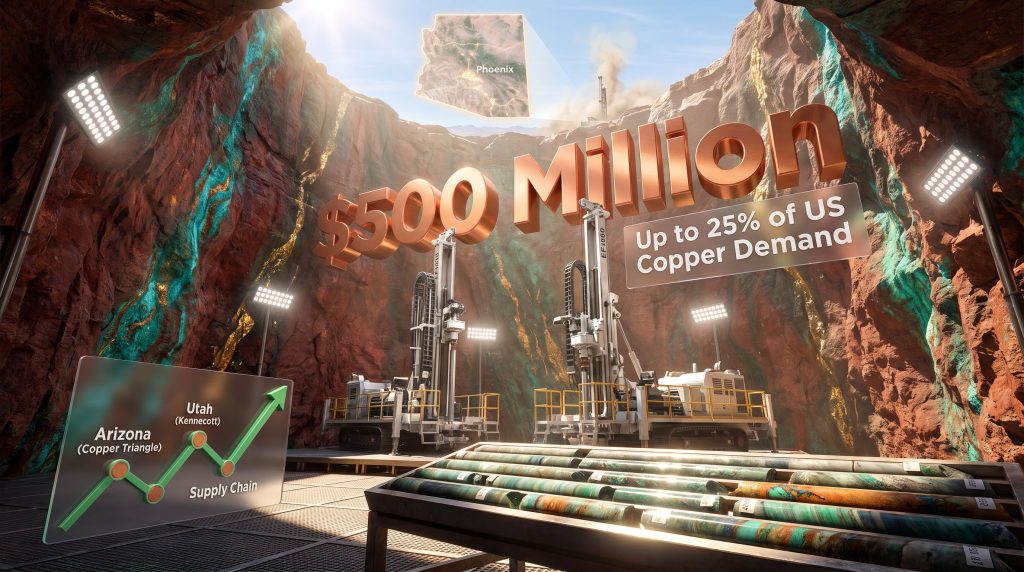
Resolution Copper is a proposed large-scale underground copper mine situated in Arizona's Copper Triangle, approximately 60 miles east of Phoenix. The region has a deep historical connection to American copper production, having hosted some of the most productive copper operations in the country's industrial history.
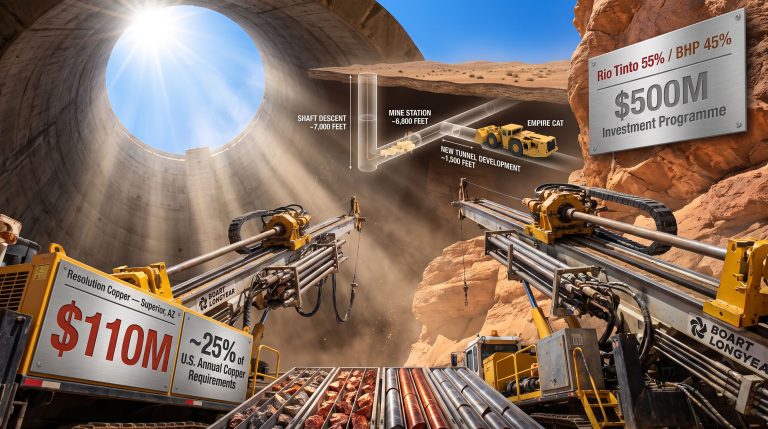
The project is structured as a 55:45 joint venture between Rio Tinto and BHP, two of the world's largest diversified mining companies. What makes Resolution geologically distinctive is not just the size of its ore body, but its depth. The primary mineralisation sits at approximately 6,800 to 7,000 feet below the surface, placing it among the deepest proposed copper mines in North American history.
This depth creates extraordinary engineering challenges but also reflects the project's potential longevity. Deeply buried porphyry copper systems tend to host large, structurally coherent deposits with consistent grades over extensive footprints. Consequently, Resolution Copper has indicated the project could potentially supply up to 25 percent of US copper demand for multiple decades, subject to a successful development pathway and a formal final investment decision.
Geological Note: Porphyry copper deposits are the world's primary source of mined copper, typically formed through magmatic-hydrothermal processes associated with subduction zone volcanism. Their large tonnage and relatively uniform mineralisation make them ideal candidates for large-scale, long-life mining operations, though depth and rock mechanics pose escalating engineering demands.
What the $110 Million Contract Structure Actually Reveals
Breaking Down the Two-Contractor Execution Model
When Resolution Copper awards $110 million in US mining contracts, the decision to split the work between two specialist contractors is not a coincidence. It reflects a deliberate risk-staged capital allocation approach, where exploration delineation and physical infrastructure development proceed in parallel rather than sequentially. This compresses the project timeline without overcommitting capital before key technical and regulatory milestones are confirmed.
| Contractor | Headquarters | Contract Scope | Duration | Key Activity |
|---|---|---|---|---|
| Major Drilling America Inc. | Salt Lake City, UT | Deep directional diamond core drilling | ~2.5 years | Surface and underground ore body delineation |
| Redpath USA Corporation | Nevada | Underground mine development | Phase 1 | Shaft conversion, mine station, lateral tunnelling |
Major Drilling America Inc., headquartered in Salt Lake City, Utah, has been engaged for a two-and-a-half-year programme of deep directional diamond core drilling. The programme involves drilling from both the surface and from approximately 6,800 feet underground, using a dual-platform approach that enables far more precise triangulation of the ore body's geometry than surface-only programmes can achieve.
Redpath USA Corporation, operating out of Nevada, has been awarded the first phase of underground development. This work involves converting two existing 7,000-foot shafts from their sinking configuration into operational development configuration, installing structural steel, constructing a new mine station at approximately 6,800 feet depth, and developing around 1,500 feet of lateral tunnels including truck bays, drill bays, and a maintenance workshop.
New underground equipment, including a production drill and two Caterpillar loaders sourced through Empire CAT in Mesa, Arizona, will support this phase. Notably, every contract within this initial phase has been awarded to US-headquartered companies, reflecting a deliberate domestic supply chain preference. According to the official contract announcement, this procurement approach is embedded throughout the project's strategy.
Deep Directional Diamond Drilling: The Technical Reality at Extreme Depth
How Ore Body Delineation Works at 6,800 Feet
Directional diamond core drilling is the gold standard for deep hard-rock ore body characterisation. Unlike percussion drilling, which shatters the rock and produces chips, diamond core drilling uses an annular drill bit embedded with industrial diamonds to cut a continuous cylindrical core sample from the host rock. This core is then extracted, logged, and assayed, providing geologists with a precise, spatially located record of rock type, structure, mineralisation style, and grade at depth.
What makes Resolution's drilling programme technically demanding is the combination of extreme depth, hard-rock geology, and the need for directional precision. At depths exceeding 6,800 feet in a porphyry copper environment, boreholes must be steered through dense, abrasive rock while maintaining trajectory accuracy within tight tolerances. Deviation from the planned borehole path at this scale can introduce significant errors in ore body modelling.
The rig fleet deployed for this programme is purpose-built for these conditions:
- Two LF-350 high-capacity surface core drilling rigs supplied by Utah-based Boart Longyear are already operational at site
- Two next-generation LF-300 rigs are currently in manufacture, with delivery to site scheduled before the end of the year
- All rigs incorporate remote-controlled drilling operation systems and mechanised rod-handling technology, designed to minimise personnel exposure to moving mechanical components
The simultaneous use of surface and underground drilling platforms allows geologists to build a three-dimensional picture of the ore body that would be impossible from a single vantage point. Underground drill holes, initiated from the new mine station at depth, can intersect the mineralised system from angles that surface holes cannot reach.
Technical Insight: In deep porphyry systems, the highest-grade copper mineralisation often occurs in distinct structural corridors controlled by faulting and hydrothermal fluid pathways. Identifying these corridors precisely requires multi-directional drilling at depth, making the dual-platform approach at Resolution strategically important for mine planning accuracy.
The $500 Million Programme: Capital Logic and Remaining Gating Factors
What Came Before, and What Still Needs to Happen
The $110 million in contracts represents the opening tranche of a broader $500 million investment programme. This larger programme was made possible by the completion of three sequential regulatory prerequisites:
- Finalisation of the Final Environmental Impact Statement (FEIS) process
- Issuance of a Record of Decision confirming the preferred project pathway
- Execution of the congressionally mandated land exchange that transferred specific parcels of federal land required for the project's footprint
Each of these steps represented years of regulatory process, environmental analysis, and interagency coordination. Their completion created the legal and procedural foundation upon which capital commitment could be made with reasonable confidence.
Important Distinction: The $110 million in contracts represents an early-stage execution commitment, not a final decision to commence mining operations. Resolution Copper has confirmed that a formal final investment decision remains contingent on further technical data collection, state-level permitting outcomes, and joint venture partner approvals.
Remaining gating factors include ongoing state permitting processes in Arizona, continued geological data collection from the drilling programme, and alignment between joint venture partners Rio Tinto and BHP on project economics and development sequencing. These are not trivial hurdles. State permitting for a project of this scale and complexity involves environmental, water, and land-use approvals that operate independently of the federal process already completed.
The Arizona-to-Utah Supply Chain Corridor: A Potential Mine-to-Metal Pathway
One of the less-discussed but strategically significant dimensions of the Resolution project is its potential relationship with Rio Tinto's existing Kennecott copper smelter and refinery in Utah. Kennecott is one of the few fully integrated copper processing facilities in the United States, capable of taking copper concentrate through smelting and refining to produce finished copper cathode.
If a commercially viable processing arrangement were established between Resolution's Arizona ore body and Kennecott's Utah facilities, it would create a genuinely domestic mine-to-metal supply chain covering every stage from extraction to refined product. This would carry significant implications for:
- National electrical grid resilience, reducing exposure to imported copper price swings
- Advanced manufacturing competitiveness, providing US fabricators with traceable, domestically refined copper
- Data centre supply chains, where large-scale copper procurement decisions increasingly incorporate supply chain transparency criteria
- Defence and national security procurement, where domestic sourcing of strategic materials is increasingly prioritised
Any such processing arrangement remains subject to technical feasibility assessment, commercial negotiation, and additional permitting requirements. It is a conditional scenario, not a confirmed outcome.
Resolution Copper's Potential Supply Chain Architecture
| Supply Chain Stage | Location | Operator | Status |
|---|---|---|---|
| Ore body exploration | Arizona (Copper Triangle) | Resolution Copper (Rio Tinto 55% / BHP 45%) | Active |
| Underground development | Arizona | Redpath USA Corporation | Phase 1 underway |
| Deep drilling programme | Arizona | Major Drilling America Inc. | Mobilised |
| Copper concentrate processing | Utah (Kennecott) | Rio Tinto | Potential future pathway (subject to approvals) |
The next major ASX story will hit our subscribers first
The Oak Flat Dimension: Social Licence in a Contested Landscape
No analysis of Resolution Copper is complete without confronting the deeply contested social and cultural dimensions of the project. The land exchange at the centre of the project's regulatory pathway involves the Oak Flat area of Arizona, a site of profound spiritual, cultural, and historical significance to the San Carlos Apache Tribe and other Indigenous communities.
Apache tradition holds Oak Flat as a sacred site used for ceremonies, prayers, and cultural practice extending back generations. The congressionally mandated land exchange has been the subject of sustained legal challenges and significant political opposition from Tribal nations, civil liberties organisations, and faith communities.
The distinction between regulatory approval and genuine community consent is critical here. Receiving a Record of Decision from a federal agency confirms regulatory compliance within the existing statutory framework. However, it does not resolve the deeper question of whether affected communities accept the project's social licence to operate. For a project of this scale and duration, unresolved Tribal opposition represents a material risk variable that capital commitments alone cannot neutralise.
Resolution Copper has stated that environmental stewardship commitments will be embedded throughout the project lifecycle, and that Tribal and community engagement will continue as development progresses. The practical resolution of these tensions remains one of the most closely watched dimensions of the project's development trajectory.
Building the Deep Underground Workforce: A Long-Lead-Time Challenge
Recruitment Roadmap and Skills Pipeline Development
Deep underground mining demands a fundamentally different skills profile than open-pit operations. The confined working environment, extreme depth, complex ventilation requirements, ground support engineering, and safety protocols of a shaft-sunk underground mine require specialised training that takes years to develop. These cannot be rapidly imported from surface mining backgrounds.
Resolution Copper's initial $110 million contract phase is expected to generate 100 new full-time positions across the project, with recruitment already underway.
| Phase | Positions | Disciplines | Timeline |
|---|---|---|---|
| Phase 1 | 50 full-time | Geology, electrical, mechanical, instrumentation, hydrogeology, supervision, core handling | Underway |
| Phase 2 | 50 full-time | Additional specialist roles | Within 6 months |
| Contractor hiring | Additional (undisclosed) | Drilling and underground development trades | Ongoing |
| Apprenticeships | Entry-level | Geology, geotechnical, underground mining | Planned |
Beyond direct employment, Resolution Copper is developing partnerships with local schools, vocational training providers, and apprenticeship schemes to build a structured education-to-employment pipeline. Both Major Drilling America and Redpath USA are independently developing local hiring plans and are expected to advertise additional positions as their contract scopes expand.
The apprenticeship programmes spanning geology, geotechnical, and underground mining disciplines are particularly significant from a long-term industry perspective. The US deep underground mining workforce is thin, and building the human capital pipeline for a project that, if it proceeds to production, would operate for decades requires investment in skills development that begins years before the first tonne of ore is extracted.
Frequently Asked Questions: Resolution Copper's $110 Million US Mining Contracts
What is the Resolution Copper project?
Resolution Copper is a proposed large-scale underground copper mine located in Arizona's Copper Triangle, approximately 60 miles east of Phoenix. It is structured as a 55:45 joint venture between Rio Tinto and BHP.
What does the $110 million contract award cover?
The contracts cover two primary work streams: deep directional diamond core drilling awarded to Major Drilling America Inc., and first-phase underground infrastructure development awarded to Redpath USA Corporation.
Has a final investment decision been made to begin mining?
No. The $110 million in contracts represents an early-stage development commitment. A formal final investment decision remains subject to additional technical data collection, state permitting outcomes, and joint venture partner approvals.
What is the total investment programme value?
The broader programme is valued at approximately $500 million, of which the current contracts represent the initial committed tranche.
How deep is the Resolution Copper ore body?
Drilling and underground development activities are occurring at approximately 6,800 to 7,000 feet below the surface.
What is the Oak Flat controversy?
Oak Flat is a site of deep cultural and spiritual significance to the San Carlos Apache Tribe and other Indigenous communities. The congressionally mandated land exchange that enabled the project's regulatory pathway has been opposed by Tribal nations on the grounds that it would irreparably damage a sacred site. This opposition continues and represents an ongoing social licence challenge for the project.
What is the potential supply contribution of Resolution Copper?
The project has been described as capable of supplying up to 25 percent of US copper demand for decades, subject to successful development and a positive final investment decision.
From Capital Commitment to Industrial Reality: What Comes Next
The awarding of $110 million in contracts by Resolution Copper marks a transition from regulatory process to physical industrial activity. Drilling rigs are running, underground development crews are mobilising, and a recruitment pipeline is being assembled for one of the most technically demanding mining environments in North American history.
Whether this momentum translates into a producing mine depends on variables that remain genuinely open. State permitting in Arizona must proceed through its own independent review process. The geological data emerging from the drilling programme will either reinforce or refine the ore body model underpinning the project's economics.
The unresolved tension between the project's regulatory clearance and the continuing opposition of Indigenous communities will, furthermore, remain a defining feature of the project's risk profile. In addition, understanding the broader copper supply crunch is essential context for assessing why projects like Resolution attract such significant capital at this stage of development.
For investors and industry observers, exploring copper investment strategies alongside the future of copper mining helps to contextualise Resolution's place within a rapidly evolving domestic production landscape.
What is beyond dispute is the industrial scale of what Resolution Copper could represent if it reaches production. A domestic copper mine capable of supplying a quarter of national demand for multiple decades would be the most consequential addition to US mineral production capacity in a generation, with cascading effects on energy transition infrastructure, advanced manufacturing, and national security supply chains that extend far beyond the boundaries of Arizona's Copper Triangle.
Disclaimer: This article contains forward-looking statements and projections, including references to potential supply contributions and downstream processing arrangements, which remain conditional on regulatory approvals, technical outcomes, and joint venture partner decisions. Nothing in this article constitutes investment advice. Readers should conduct their own research and consult qualified advisers before making any investment decisions.
Want to Track the Next Major Copper Discovery Before the Market Does?
Discovery Alert's proprietary Discovery IQ model scans ASX announcements in real time, instantly alerting subscribers to significant mineral discoveries — including copper plays positioned to benefit from the deepening supply deficit driving projects like Resolution Copper — turning complex geological data into clear, actionable opportunities. Explore historic discoveries and their returns to understand the potential scale of early positioning, then start your 14-day free trial at Discovery Alert to gain a market-leading edge.