August 10, 2026
The Engineering Challenge Hidden Beneath Arizona's Copper Triangle
Block cave mining at extreme depth is one of the most technically demanding disciplines in the entire extractive industries sector. Unlike open-pit operations where geology is exposed and accessible, underground block caving at depths approaching 7,000 feet requires engineers to work within conditions where rock pressure, ventilation, heat, and logistics converge into a set of challenges that few projects globally have ever confronted at commercial scale. Understanding this technical reality is the starting point for appreciating what the Resolution Copper Arizona mine contracts actually represent, and why the $110 million commitment now underway carries significance well beyond its headline figure.
When big ASX news breaks, our subscribers know first
Why Arizona's Copper Triangle Holds Outsized Strategic Importance
The United States currently imports a substantial portion of its refined copper requirements, with domestic mine production meeting only a fraction of the country's consumption needs. According to the U.S. Geological Survey, the country remains a net importer of refined copper, with demand forecast to accelerate sharply as grid infrastructure expansion, electric vehicle manufacturing, and defence procurement programmes collectively intensify pressure on domestic supply chains.
Against this backdrop, the Resolution Copper deposit near Superior, Arizona, approximately 60 miles east of Phoenix, occupies a rare position. It sits within one of North America's most copper-rich geological corridors, a region that has produced copper continuously for over a century. What distinguishes Resolution from its regional predecessors is not surface geology but depth.
The ore body extends to approximately 7,000 feet below surface, placing it far beyond the reach of conventional open-pit methods and into territory that demands block cave underground mining, a technique where the ore mass is undercut so that gravity progressively fractures and draws it downward into collection points. This growing critical minerals demand further underscores the urgency of advancing projects at this scale.
The deposit's scale is difficult to overstate. Once operational, Resolution Copper is estimated to be capable of supplying up to 25% of annual U.S. copper requirements from a single underground source. No currently producing domestic copper mine comes close to that figure, which is why the project is frequently categorised alongside national infrastructure assets rather than purely commercial mining ventures. The widening copper supply gap between global demand and available production makes this potential contribution even more strategically significant.
How the Resolution Copper Deposit Compares
| Attribute | Resolution Copper | Typical U.S. Copper Mine |
|---|---|---|
| Mining method | Underground block cave | Open pit (majority) |
| Depth | ~7,000 feet | Surface to ~1,500 feet |
| Estimated U.S. supply contribution | Up to ~25% | Typically under 5% |
| Development stage | Pre-production (Phase 1 drilling/development) | Operational |
| Joint venture ownership | Rio Tinto 55% / BHP 45% | Varies |
Resolution Copper Arizona Mine Contracts: What $110M Is Actually Buying
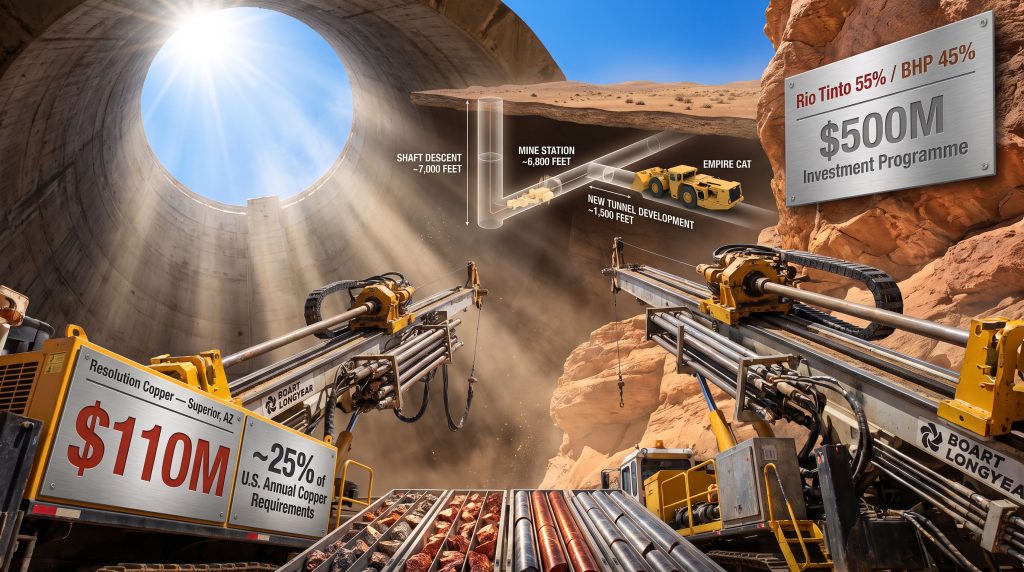
The Resolution Copper Arizona mine contracts awarded in August 2026, totalling approximately $110 million, represent the first substantive capital deployment within a broader $500 million investment programme. Three agreements form the foundation of this phase, each targeting a distinct operational requirement.
Contract 1: Major Drilling America and the Science of Deep-Hole Directional Drilling
Major Drilling America, headquartered in Salt Lake City, Utah, has been engaged to execute a 2.5-year deep-hole directional diamond core drilling programme. The programme operates from two platforms simultaneously: surface-level drill sites and underground positions at approximately 6,800 feet below ground.
Four large surface core drilling rigs form the backbone of this effort. Two rigs were already on-site at contract commencement, with two additional units due for delivery by the end of 2026. All four rigs are supplied by Boart Longyear, a Utah-based drilling technology firm with global operations, and feature remote-controlled operation combined with mechanised rod handling systems.
The engineering rationale behind these safety features deserves specific attention. At depths approaching 6,800 feet, drill rods operate under extreme thermal and pressure conditions. Rod handling at these depths is physically hazardous when performed manually, and remote-controlled mechanised systems directly reduce the exposure of drilling crews to the most dangerous phases of the operation. This is not merely a comfort upgrade; it is a meaningful risk management intervention in an environment where conventional manual handling protocols would face serious limitations.
Directional diamond core drilling differs from conventional vertical drilling in a critical way. Rather than drilling straight down, directional techniques allow the drill bit to be steered along a pre-calculated trajectory through the ore body, enabling geologists to intersect multiple zones of mineralisation from a single entry point. This approach generates significantly more spatial data per drill hole and allows resource models to be refined with greater precision, reducing uncertainty before any final investment decision is made.
Contract 2: Redpath USA and the Complexity of Shaft Conversion
Redpath USA Corporation, based in Nevada, has been assigned the first phase of underground development. The scope covers the conversion of two existing 7,000-foot shafts from their current sinking configuration into a full development setup, a transition that is technically and logistically distinct from either shaft sinking or production mining.
Shaft sinking refers to the process of excavating a vertical opening downward through rock. Once complete, the shaft infrastructure must be reconfigured to support sustained underground operations, including the installation of permanent hoisting systems, ventilation infrastructure, power and communications cabling, and operational staging areas. Redpath's scope captures this conversion phase in detail:
- Establishment of a new underground mine station at approximately 6,800 feet depth
- Excavation of approximately 1,500 feet of new tunnel development
- Construction of supporting bays and underground facility infrastructure
- Integration of production drilling equipment and Caterpillar loaders supplied by Empire CAT of Mesa, Arizona
The 1,500-foot tunnel development figure is worth contextualising. In underground mining terminology, tunnel development at this depth is not an exploratory activity. It is a prerequisite for ore access, equipment movement, and personnel logistics. Without this foundational tunnel network, no production-phase activity can proceed regardless of how well-defined the ore body becomes from the drilling programme above.
Contract 3: Facility Operations Under the Master Supply Agreement
The third element of the Resolution Copper Arizona mine contracts involves Johnson Controls Inc. in partnership with U.A. Local 469, covering ongoing facility maintenance and operational support across the surface infrastructure of the Resolution site. While less technically dramatic than the drilling and underground development programmes, this agreement is integral to maintaining site readiness during the multi-year development phase.
Investment Phasing: Understanding the $500M Programme Architecture
| Investment Phase | Estimated Allocation | Primary Activities |
|---|---|---|
| Phase 1 (Current, 2026) | ~$110M | Drilling, shaft conversion, underground tunnelling, facility maintenance |
| Remaining Programme | ~$390M | Full underground development, processing infrastructure, surface facilities |
| Final Investment Decision | Pending | Subject to permitting, data collection, and JV partner approvals |
The gap between the $110 million currently deployed and the $500 million total is not a planning inconsistency. It reflects the structured logic of large-scale underground mine development, where each phase of spending is conditional on the knowledge generated by the phase preceding it. The drilling programme underway with Major Drilling America will produce geological data that directly informs the feasibility and configuration of any subsequent production-phase investment.
Furthermore, understanding how a definitive feasibility study shapes these decisions is essential context for appreciating why the phased approach is standard practice at projects of this scale.
No final investment decision has been made as of August 2026. Future development of the Resolution Copper mine remains subject to ongoing permitting processes, data collection outcomes, and formal approval from both Rio Tinto and BHP as joint venture partners.
The Regulatory Sequence That Enabled Phase 1
Three specific regulatory milestones created the legal conditions for the current phase of investment:
- Completion of the Final Environmental Impact Statement (FEIS) process
- Receipt of a Record of Decision from the relevant federal authority
- Conclusion of a congressionally mandated land exchange with the U.S. Forest Service, finalised in March 2026
The land exchange, in particular, represented a process decades in the making. The mechanism required an act of Congress to authorise the transfer of federal forest land to Resolution Copper in exchange for other parcels, a legislative pathway that faced multiple rounds of political challenge before reaching conclusion. Its finalisation in March 2026 removed the single largest structural impediment to project progression.
Joint Venture Dynamics: What Rio Tinto and BHP's Partnership Means in Practice
Resolution Copper operates under a joint venture structure with Rio Tinto holding a 55% majority stake and BHP holding 45%. Both are among the largest mining companies in the world by market capitalisation, and their combined balance sheet capacity means the $500 million investment programme does not represent a capital availability challenge for the project.
What the JV structure does create, however, is a dual approval requirement for major spending decisions. Any Final Investment Decision requires alignment between two organisations with their own strategic priorities, capital allocation frameworks, and portfolio management pressures. This dynamic has been a feature of large-scale mining JVs globally, and it explains why FID timelines at projects of this complexity can extend well beyond what purely technical readiness would suggest.
The strategic incentive for both partners to advance the project is substantial. A deposit capable of supplying 25% of U.S. copper demand represents a long-duration, large-scale revenue stream with exposure to one of the metals most directly tied to global electrification trends. Consequently, those exploring copper investment strategies will find Resolution's trajectory particularly relevant. Copper demand from EV manufacturing alone is projected to grow significantly over the coming decades, with each electric vehicle requiring roughly three to four times the copper content of a conventional internal combustion engine vehicle.
Economic and Employment Dimensions of the Resolution Copper Contracts
The 100 full-time positions created through the current contract phase represent direct employment across drilling crews, underground development teams, equipment operators, and facility maintenance personnel concentrated in and around Superior, Arizona.
Beyond direct employment, the procurement decisions embedded in the contract structure carry their own economic logic. All three primary contract recipients are U.S.-headquartered firms. Equipment supply has been directed to Empire CAT in Mesa, Arizona and Boart Longyear in Utah, reflecting a preference for in-state and in-country procurement that generates secondary economic activity beyond the contract values themselves.
The longer-term employment potential, should the full $500 million programme proceed to FID and ultimately to production, would substantially exceed the current 100-position baseline. Large-scale underground block cave operations of the scale contemplated at Resolution typically sustain several thousand direct and indirect positions across their operating lives.
The next major ASX story will hit our subscribers first
What Comes Next: Milestones and Development Scenarios
Near-Term Milestones (2026–2028)
- Completion of the four-rig surface drilling programme and integration of underground drilling data into updated resource models
- Redpath's progress on shaft conversion and the 1,500-foot tunnel development programme
- Delivery of the two additional Boart Longyear surface drilling rigs by end of 2026
- Continued permitting processes and community engagement outcomes
Three Development Scenarios
Scenario A: FID Approved — The full $500 million programme proceeds on schedule. Underground development transitions from the current Phase 1 configuration toward production-readiness. Direct employment scales materially beyond the initial 100 positions, and the project moves toward becoming the most significant domestic copper supply development in the United States in generations.
Scenario B: FID Delayed — Permitting complexity, community consultation requirements, or geological data outcomes require additional analysis. The Phase 1 drilling programme extends beyond its current 2.5-year timeline, pushing any production decision further into the decade.
Scenario C: JV Restructuring — Strategic shifts at either Rio Tinto or BHP, whether driven by portfolio rebalancing, capital allocation pressures, or broader M&A activity, alter the ownership or funding structure of the project. Historically, large-scale copper JVs have navigated ownership changes without fatal impact on underlying project development, however restructuring events do introduce timeline uncertainty.
In addition, it is worth noting how Resolution's potential compares against the largest copper mines currently in operation globally, which further illustrates the deposit's extraordinary scale and long-term significance.
Key Data Reference: Resolution Copper Arizona Mine at a Glance
| Metric | Detail |
|---|---|
| Total contracts awarded (Phase 1) | ~$110 million |
| Broader investment programme | ~$500 million |
| Drilling programme duration | ~2.5 years |
| Shaft depth | ~7,000 feet |
| Underground mine station depth | ~6,800 feet |
| New tunnel development | ~1,500 feet |
| Surface drilling rigs deployed | 4 (2 on-site, 2 arriving by end 2026) |
| Drilling rig supplier | Boart Longyear (Utah) |
| Equipment supplier (underground) | Empire CAT (Mesa, Arizona) |
| Jobs created (direct) | 100 full-time positions |
| Potential U.S. copper supply | Up to ~25% of annual U.S. requirements |
| Joint venture ownership | Rio Tinto 55% / BHP 45% |
| Land exchange completed | March 2026 (with U.S. Forest Service) |
| Project location | ~60 miles east of Phoenix, Superior, AZ |
Frequently Asked Questions: Resolution Copper Arizona Mine
What is the Resolution Copper mine?
Resolution Copper is a proposed underground copper mine located near Superior, Arizona, approximately 60 miles east of Phoenix. The deposit is considered one of the largest undeveloped copper resources in the world, with the potential to supply up to 25% of annual U.S. copper requirements once in production. The broader critical minerals demand driven by the global energy transition makes this deposit increasingly strategically important.
Has a final decision been made to mine at Resolution Copper?
No. As of August 2026, no Final Investment Decision has been made. The current phase focuses on drilling and underground development to generate the geological and technical data required before any production commitment can be formalised.
Who owns Resolution Copper?
The project is jointly owned by Rio Tinto, which holds a 55% controlling stake and operates as project manager, and BHP, which holds the remaining 45%.
What federal approvals preceded the contract awards?
Resolution Copper completed the FEIS process, received a Record of Decision, and finalised a congressionally mandated land exchange with the U.S. Forest Service in March 2026. These milestones collectively established the legal foundation for the current phase of investment.
Why does Resolution Copper require underground rather than open-pit mining?
The ore body extends to depths of approximately 7,000 feet below surface, far beyond the economic and technical reach of open-pit methods. Block cave underground mining, which uses gravity to progressively fracture and draw ore downward to collection points, is the only commercially viable extraction approach at this depth.
This article contains forward-looking statements and scenario projections based on publicly available information. No final investment decision has been made by Resolution Copper, Rio Tinto, or BHP as of the date of publication. Readers should not interpret project development milestones as guarantees of future outcomes. Investors should conduct their own due diligence before making any financial decisions related to companies or projects referenced in this article.
Want to Stay Ahead of the Next Major Copper Discovery on the ASX?
Discovery Alert's proprietary Discovery IQ model delivers real-time alerts the moment significant mineral discoveries — including copper — are announced on the ASX, transforming complex geological data into clear, actionable investment insights for both short-term traders and long-term investors. Explore how historic mineral discoveries have generated extraordinary returns and begin your 14-day free trial today to ensure you're positioned ahead of the broader market.