August 9, 2026
The Processing Gap That Separates Resource Wealth from Economic Wealth
Across the global mining industry, a persistent and often underappreciated reality shapes which mineral-rich regions actually capture long-term economic value: it is rarely the size of the ore reserve that determines prosperity, but rather the availability of processing infrastructure to transform raw material into a tradeable commodity. Regions endowed with world-class deposits have repeatedly failed to generate lasting economic outcomes because the downstream capacity to treat, concentrate, and refine ore simply did not exist nearby.
Conversely, areas with modest resources but strong processing foundations have built enduring industrial economies. North West Queensland sits at precisely this inflection point. The North West Minerals Province contains one of Australia's critical minerals push most significant concentrations of copper, cobalt, and associated critical minerals, yet the region has historically exported value rather than capturing it.
The decision that Queensland backs Rocklands copper expansion with A$15 million through the Queensland Investment Corporation's Queensland Critical Minerals Fund represents a deliberate attempt to close this infrastructure gap, and the implications extend well beyond a single processing facility.
When big ASX news breaks, our subscribers know first
Why Processing Bottlenecks Are the Hidden Constraint on Queensland's Copper Ambitions
The Stranded Asset Problem in Remote Mineral Provinces
One of the least-discussed dynamics in junior mining is what industry practitioners call the stranded asset problem: a technically viable ore deposit that cannot reach production because the capital required to build standalone processing infrastructure is simply too large relative to the project's scale. This is not a geological failure but an economic one, and it disproportionately affects remote regions where shared infrastructure is scarce.
Queensland's Natural Resources and Mines Minister has explicitly identified insufficient processing capacity as one of the most significant structural barriers preventing new critical minerals demand projects from entering production. This acknowledgement carries real weight, because it reframes the conversation away from exploration success and toward infrastructure availability as the primary lever for regional resource development.
In practical terms, a junior explorer holding a copper deposit in North West Queensland faces a binary choice: raise the substantial capital required to construct a standalone concentrator and associated plant, or wait for a processing hub to emerge nearby. The first option is frequently unviable at smaller resource scales. The second option has, until recently, remained largely theoretical.
The North West Minerals Province: Geology, Geography, and the Infrastructure Deficit
The North West Minerals Province is geologically significant for several reasons that are not always obvious to observers outside the sector:
- The province sits within a Proterozoic-age geological terrane that hosts iron oxide copper-gold (IOCG) deposit styles, the same mineralisation system responsible for the Olympic Dam deposit in South Australia
- Copper mineralisation in the region is frequently associated with cobalt, gold, and in some cases rare earth elements, making individual deposits potentially multi-commodity in nature
- The Cloncurry district specifically has produced copper for over a century, with historical operations dating to the late 1800s, providing extensive geological data across the tenement landscape
- Despite this geological richness, the region remains underserved by grid-connected power, sealed road networks to remote tenements, and critically, operating processing facilities with available capacity
This combination of geological prospectivity and infrastructure scarcity is precisely what makes the Rocklands expansion strategically significant. It does not simply serve Austral Resources' own production pipeline; it changes the economic calculus for every operator within economic haulage distance of Cloncurry.
What the Rocklands Expansion Actually Involves
From Idle Plant to Regional Processing Hub
The Rocklands copper processing facility near Cloncurry was previously placed on care and maintenance, a mining industry term describing a state of suspended operation in which a site is preserved for potential future restart without active production. This status, while commercially dormant, typically involves ongoing expenditure on site security, environmental compliance, and equipment preservation, making it a cost centre rather than a revenue generator.
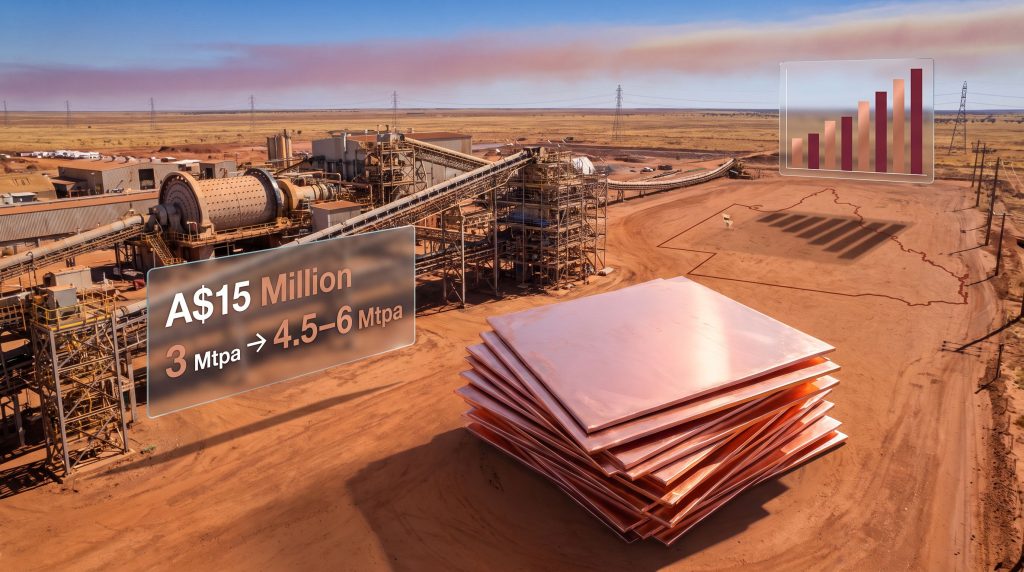
Austral Resources has been working toward restarting the facility, and the A$15 million commitment via the Queensland Critical Minerals Fund provides the capital support to pursue not just a restart but a meaningful capacity expansion. The core metrics of the expansion are as follows:
| Parameter | Pre-Expansion | Post-Expansion Target |
|---|---|---|
| Annual Processing Capacity | 3 million tonnes per annum | ~4.5 million tonnes per annum |
| Capacity Increase | Baseline | Approximately 50% uplift |
| Funding Source | N/A | QIC Queensland Critical Minerals Fund |
| Capital Committed | N/A | A$15 million |
| Target Recommencement | Under refurbishment | Mid-2027 (as reported) |
| Third-Party Processing | Not available | Regional toll processing model |
The Toll Processing Model: Why Shared Infrastructure Changes Regional Economics
The most consequential element of the Rocklands expansion is not the capacity number itself but the commercial model it enables. Toll processing, also called contract milling, allows a resource developer to transport ore to an existing facility and pay a per-tonne fee for processing, rather than constructing their own plant. This model is well-established in certain Australian resource provinces but has been largely unavailable in North West Queensland due to the absence of spare processing capacity.
When a regional toll processing hub operates at sufficient scale, it fundamentally lowers the economic threshold for new project development. Consider the following scenario: a junior developer with a copper resource 60 to 100 kilometres from Cloncurry holds a deposit that is marginal when standalone processing capital is included in the project economics. Under a toll processing arrangement with the expanded Rocklands facility, that same deposit may achieve commercially attractive returns without the developer needing to raise the tens to hundreds of millions of dollars typically required for a standalone concentrator.
This shift is not theoretical. In Western Australia's Goldfields region, the availability of toll milling capacity through established gold processing plants has allowed numerous junior developers to reach production at project scales that would otherwise be uneconomic. A similar dynamic could unfold across the North West Minerals Province if Rocklands achieves its regional hub ambitions.
This is why Queensland backs Rocklands copper expansion with a rationale that extends beyond Austral Resources itself. The infrastructure serves as a platform for broader regional development, potentially catalysing exploration investment, feasibility studies, and employment across a cluster of emerging projects. Furthermore, copper investment strategies for smaller developers in the region are fundamentally transformed when shared processing capacity becomes available.
The Queensland Critical Minerals Fund: Strategic Capital, Not a Grant
How the QIC Fund Differs from Conventional Government Subsidies
A critical distinction that is frequently overlooked in coverage of state government minerals investment is the difference between a grant and a strategic investment vehicle. The Queensland Critical Minerals Fund, administered by the Queensland Investment Corporation, operates as the latter. QIC is a government-owned investment corporation managing substantial assets across infrastructure, private equity, and fixed income on behalf of Queensland public sector clients.
This structure matters because it implies a return expectation on deployed capital, not a pure subsidy. The Fund is designed to unlock private sector co-investment by reducing the risk profile of strategic infrastructure projects that might otherwise struggle to attract purely commercial financing. In this sense, the A$15 million commitment to Rocklands is intended to mobilise additional private capital rather than simply replace it.
The 2026-27 Queensland Budget allocated an additional $100 million to the Fund, signalling that Rocklands is one deployment within a broader, multi-year capital program targeting the minerals value chain. The types of projects the Fund prioritises include:
- Processing and beneficiation infrastructure that serves multiple operators
- Developments capable of establishing or anchoring regional industrial clusters
- Projects aligned with the Delivering Queensland's Critical Minerals Future 2026-2030 strategy
- Investments that capture downstream value rather than simply facilitating raw ore export
The 2026-2030 Critical Minerals Strategy: A Framework for Value Capture
Queensland's Delivering Queensland's Critical Minerals Future 2026-2030 strategy explicitly targets a shift from an extraction-oriented minerals economy toward one that captures processing and manufacturing value within the state. This is a meaningful policy ambition because, historically, a significant proportion of Australia's mineral output has been exported as unprocessed or partially processed material, with the associated refining and manufacturing value accruing offshore.
The strategy identifies local processing, regional employment, and manufacturing capability as its three central pillars. The Rocklands expansion addresses the first two directly and creates conditions for the third by establishing the industrial precedent of a functioning regional processing hub.
CopperString and the Energy Dimension
Why Power Supply Is as Important as Processing Capacity
Processing facilities are energy-intensive operations. Copper concentrators require reliable, cost-competitive electricity to run grinding mills, flotation circuits, and ancillary equipment, and the economics of processing are highly sensitive to energy costs. In remote North West Queensland, access to grid-connected power has historically been either unavailable or prohibitively expensive, forcing operations to rely on diesel generation with significant associated costs and emissions.
The CopperString transmission project, a planned high-voltage transmission line designed to connect North West Queensland's resource regions to the state's main electricity grid, is a parallel infrastructure investment that directly enables the kind of processing expansion underway at Rocklands. Without a reliable and affordable power supply, expanded processing capacity is operationally constrained regardless of the ore available to treat.
The relationship between CopperString and the Rocklands expansion illustrates an important principle in regional resource development: infrastructure investments are rarely independent. The full value of a processing facility expansion is only realised when the enabling infrastructure, in this case energy, is also in place.
Queensland's Treasurer and Minister for Energy has described CopperString and the Rocklands expansion as complementary investments, each strengthening the conditions for the other to succeed. The power alternatives study underway as part of Rocklands' Stage 2 feasibility work will determine whether grid connection or alternative energy supply provides the most viable path to reliable, cost-competitive power ahead of the mid-2027 recommencement target.
State-Level Critical Minerals Strategy: Where Queensland Sits Nationally
A Comparative View of Australian State Positioning
Queensland's investment in processing infrastructure through the Critical Minerals Fund reflects a broader national trend of state governments competing to establish downstream minerals capabilities. Each jurisdiction is pursuing a somewhat different strategy based on its specific resource endowment and industrial history:
| State | Primary Critical Minerals Focus | Notable Processing or Infrastructure Investment |
|---|---|---|
| Queensland | Copper, cobalt, vanadium, rare earths | Rocklands processing hub, CopperString energy corridor |
| Western Australia | Lithium, nickel, rare earths | Downstream lithium hydroxide refining in the Kwinana industrial precinct |
| South Australia | Copper, uranium, rare earths | Olympic Dam expansion, Whyalla critical minerals precinct |
| Northern Territory | Rare earths, manganese | Darwin positioned as an export and early-stage processing corridor |
Queensland's approach, concentrating on shared processing infrastructure in mineralised regions, is arguably more accessible to a wider range of project developers than the large-scale, vertically integrated model pursued in Western Australia's lithium sector. The toll processing model at Rocklands requires smaller developers to contribute only ore and transport costs, rather than substantial capital for dedicated facilities.
The next major ASX story will hit our subscribers first
Regional Economic Implications Beyond the Plant Boundary
Why Processing Infrastructure Creates More Durable Regional Outcomes Than Extraction Alone
Remote mining communities in Queensland have historically experienced significant economic volatility tied to commodity price cycles. When copper prices fall and extraction operations reduce throughput or temporarily close, the economic impact on towns like Cloncurry is immediate and severe. Processing facilities, particularly those serving multiple operators through toll arrangements, offer a degree of insulation from single-operator risk because their revenue stream is diversified across a portfolio of clients.
The employment profile of processing operations also differs meaningfully from extraction. Processing roles tend to involve:
- Higher technical skill requirements, attracting and retaining workers with specialist metallurgical and engineering expertise
- More consistent shift patterns driven by continuous plant operation, as opposed to the variable rosters associated with open-pit extraction
- Longer employment tenure, as processing plant operators develop site-specific knowledge that is difficult to replicate
- Indirect employment in maintenance, logistics, reagent supply, and technical services, creating a broader local economic multiplier
Permanent processing infrastructure also sends a signal to ancillary businesses, professional services, and education providers that the regional economy has a structural foundation beyond the current commodity cycle. This confidence effect, while difficult to quantify, has been observed in other Australian mining regions where major processing facilities have anchored long-term community development.
Key Milestones and Risk Considerations for the Rocklands Restart
The Staged Path to Mid-2027 Recommencement
The pathway from the current refurbishment phase to operational restart involves several discrete stages, each carrying its own execution risk:
- Funding secured — A$15 million committed through the QIC Queensland Critical Minerals Fund, providing the capital base for Stage 2 expansion work
- Plant refurbishment — Rehabilitation of existing infrastructure to meet operational and safety standards prior to any restart
- Stage 2 feasibility assessment — Engineering studies and capacity uplift modelling to confirm the 4.5 million tonne per annum target
- Power supply determination — Evaluation of grid connection via CopperString versus alternative energy options for cost-competitive operations
- Third-party toll processing framework — Commercial development of agreements with regional operators to underpin utilisation of expanded capacity
- Target recommencement — Mid-2027, as reported by Australian Mining
Each of these milestones carries associated risks that informed observers should consider when assessing the project's trajectory:
| Risk Category | Nature of the Risk | Relevant Mitigation |
|---|---|---|
| Commodity Price Risk | Copper price volatility affects project economics and toll processing demand | Revenue diversification across multiple clients provides partial buffer |
| Operational Risk | Refurbishment complexity and potential timeline slippage | Phased approach with feasibility gating before major capital commitment |
| Energy Supply Risk | Remote location and grid access uncertainty inflate operating cost projections | Active power alternatives study underway as part of Stage 2 work |
| Demand Risk | Third-party processing volumes dependent on regional project pipeline maturity | North West Province mineralisation density supports the demand thesis |
| Regulatory Risk | Environmental approvals and heritage considerations in remote Queensland | Alignment with state strategy provides a degree of process clarity |
Disclaimer: The project timeline, capacity targets, and financial projections referenced in this article are based on publicly reported information. Investors and industry observers should note that mining infrastructure projects are subject to material risks including commodity price movements, operational delays, and financing conditions. Nothing in this article constitutes financial advice.
Copper's Structural Role and the Value of Sovereign Processing Capacity
Why the Timing of Queensland's Investment Matters
Copper occupies a foundational role in the global energy transition that is frequently underappreciated in public discourse. Every electric vehicle requires between two and four times the copper content of a conventional internal combustion engine vehicle. Grid-scale renewable energy systems, including wind turbines, solar arrays, and associated transmission infrastructure, are among the most copper-intensive applications in modern engineering. Defence systems, data centre infrastructure, and advanced manufacturing all share the same dependency.
Global copper demand projections from major commodities research institutions consistently point toward a significant copper supply crunch through the late 2020s and into the 2030s, driven by electrification demand growing faster than new mine supply can be brought online. Australia holds approximately 10% of the world's known copper reserves, yet historically processes a disproportionately small share of that ore domestically before export.
The Rocklands expansion represents one component of a deliberate effort to shift this balance. By establishing and expanding sovereign processing capacity within Queensland, the state creates the conditions for Australian copper to move further up the value chain before leaving the country, capturing a greater share of the economic return from a resource that belongs to Australian communities.
This broader ambition connects the project-level investment to a national strategic conversation about what Australia's minerals economy should look like in a decade. Furthermore, the future of copper mining will increasingly depend on whether countries like Australia can transform their extraordinary resource endowment into processed goods and manufacturing inputs domestically, rather than continuing to export raw material.
Frequently Asked Questions: The Rocklands Copper Expansion
What is the Rocklands copper project and who operates it?
Rocklands is a copper processing facility situated near Cloncurry in North West Queensland, operated by Austral Resources Australia. The facility was previously placed on care and maintenance before Austral began working toward a restart and expansion program.
How much has been invested and through what mechanism?
A$15 million has been committed through the Queensland Investment Corporation's Queensland Critical Minerals Fund. The Fund operates as an investment vehicle rather than a conventional grant program, with a mandate to unlock private sector co-investment in strategic minerals infrastructure.
What will the expansion achieve in processing capacity terms?
The expansion is designed to lift annual processing throughput from 3 million tonnes to approximately 4.5 million tonnes, representing roughly a 50% increase in capacity. This additional capacity is intended to serve both Austral's own production pipeline and third-party operators through toll processing arrangements.
Why does processing infrastructure matter so much for critical minerals development?
Processing capacity is often the binding constraint on converting mineral discoveries into producing mines. Deposits that are technically and geologically viable frequently remain stranded assets when the capital required for standalone processing infrastructure is prohibitive. A shared regional hub model removes this barrier for smaller developers, reducing the economic threshold for new project development across the province.
What is the connection between CopperString and the Rocklands expansion?
CopperString is a planned high-voltage transmission project designed to connect North West Queensland's resource regions to the state electricity grid. Reliable and cost-competitive power is essential to economically viable processing operations. The Rocklands expansion and CopperString are, consequently, complementary infrastructure investments, each enhancing the conditions under which the other can deliver its full intended value.
What This Investment Signals for Australian Critical Minerals Policy
The decision that Queensland backs Rocklands copper expansion through the QIC Critical Minerals Fund illustrates a genuinely maturing model of state-level resource policy. Earlier iterations of critical minerals strategy in Australia focused primarily on exploration incentives, geological survey programs, and tenure administration. The current generation of policy is moving decisively toward direct infrastructure investment, recognising that the absence of processing capacity is a more binding constraint on regional development than the absence of geological knowledge.
As global competition for critical minerals processing capacity intensifies, particularly between Australia, Canada, and various Southeast Asian nations positioning themselves as alternative processing hubs, the early-mover advantage of establishing functioning regional infrastructure will compound over time. Projects that can point to existing, operating processing capacity nearby carry a materially different risk profile for project financiers, offtake partners, and strategic investors than those requiring greenfield infrastructure construction.
For the North West Minerals Province specifically, the Rocklands expansion has the potential to function as a catalyst investment — the kind of foundational infrastructure commitment that changes what is possible for the cluster of exploration and development-stage projects surrounding it. Whether that potential is fully realised will depend on execution across the refurbishment program, the power supply resolution, and the commercial development of third-party toll processing agreements through to the reported mid-2027 recommencement target.
Readers seeking broader context on Queensland's critical minerals sector and the North West Minerals Province can explore ongoing industry coverage at Mining Weekly.
Want to Stay Ahead of the Next Major Copper Discovery on the ASX?
Discovery Alert's proprietary Discovery IQ model delivers real-time alerts the moment significant ASX mineral discoveries are announced, transforming complex geological data into clear, actionable insights for both short-term traders and long-term investors — exactly the kind of edge that matters as Queensland's copper sector accelerates. Explore historic examples of how major mineral discoveries have generated extraordinary returns and begin your 14-day free trial today to position yourself ahead of the broader market.