August 8, 2026
The Energy Transition Has a Copper Problem, and Zambia Holds Part of the Answer
Every electric vehicle rolling off a production line, every kilometre of offshore wind cable laid on the seabed, and every grid-scale battery installation brought online requires copper in quantities that would have seemed implausible just a decade ago. The International Energy Agency has projected that clean energy technologies alone could drive critical minerals demand to levels that strain current global supply capacity well before 2040. Against this backdrop, the political decisions made in a landlocked southern African nation in August 2026 carry consequences that extend far beyond its borders.
Zambia copper mining elections have become one of the most closely watched intersections of politics and commodities in Africa this year, and understanding why requires looking at the structural forces shaping both the industry and the electorate simultaneously.
When big ASX news breaks, our subscribers know first
Why Copper Is Zambia's Everything
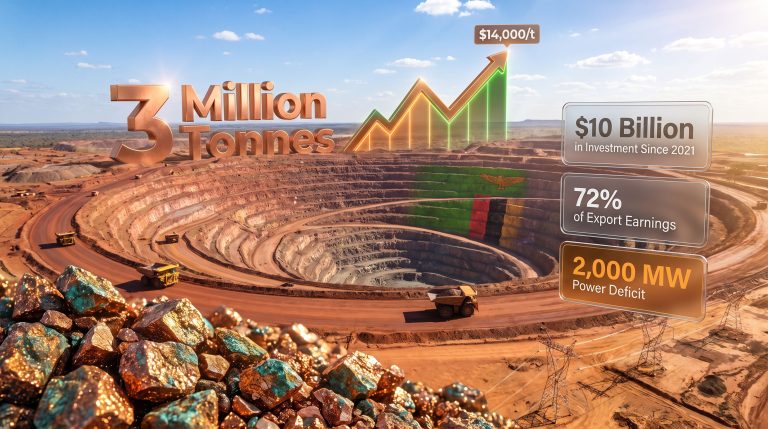
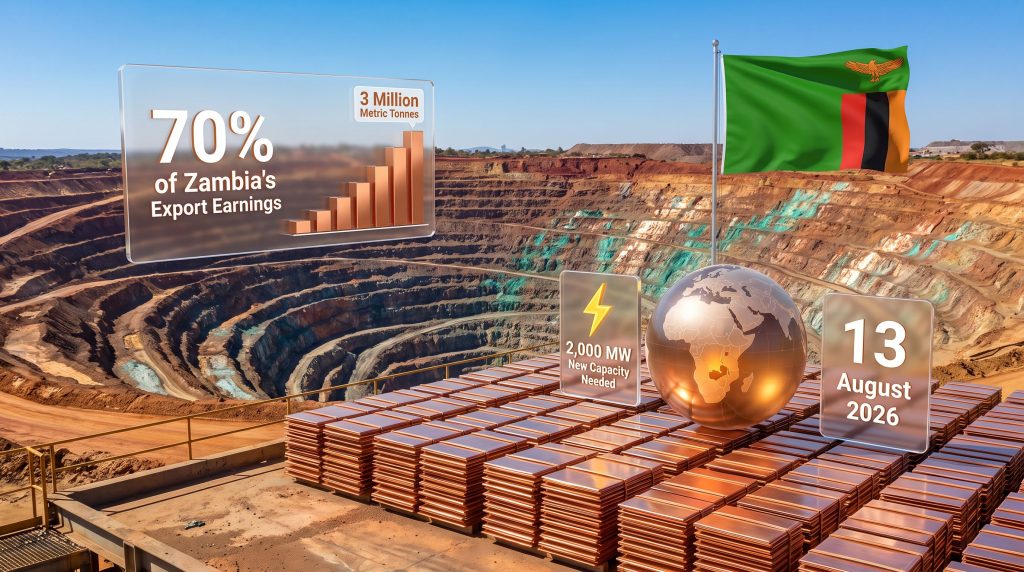
Few countries are as economically concentrated in a single commodity as Zambia is in copper. The metal accounts for approximately 70% of the country's total export earnings, meaning that copper price cycles, production disruptions, and policy decisions ripple almost instantly through government revenues, foreign exchange reserves, and public service delivery.
This is not merely a macroeconomic observation. It is the lived reality of millions of Zambians whose employment, community infrastructure, and public services are directly tied to what happens in the pits and processing facilities of the Copperbelt and North-Western Province. When mining executives talk about regulatory reform, they are, in practical terms, discussing the fiscal architecture of an entire nation.
For capital allocators, this concentration cuts both ways. It creates a government with an exceptionally strong incentive to keep mining investment attractive, but it also creates political conditions where mining policy becomes deeply sensitive to electoral pressures, community grievances, and populist sentiment.
Zambia's 3 Million Tonne Ambition: The Numbers Behind the Target
Zambia's stated production goal of approximately 3 million metric tonnes of copper per year represents one of the most ambitious mineral output targets on the African continent. Current production sits in the range of 900,000 to 1,000,000 tonnes annually, meaning the country would need to roughly triple its output to reach that ceiling.
No single lever can close that gap. Achieving the target requires simultaneous progress across at least four distinct growth dimensions:
| Growth Driver | Current Status | Required Action |
|---|---|---|
| Exploration and New Discoveries | Underexplored relative to geological potential | Faster licensing, junior miner incentives |
| Existing Mine Expansions | Several projects advancing | Capital certainty, streamlined approvals |
| Downstream Processing Capacity | Limited value-add infrastructure | Policy incentives, industrial zone development |
| Power Supply | Significant deficit | Approximately 2,000 MW of new generating capacity |
The exploration dimension deserves particular attention. Zambia's geological endowment sits within the Central African Copperbelt, one of the most mineralogically significant sediment-hosted copper-cobalt systems on Earth. The ore bodies here are characterised by stratiform deposits within Katangan Supergroup sedimentary sequences, typically yielding copper grades that remain competitive by global standards. Yet a meaningful portion of Zambia's prospective ground remains systematically underexplored relative to what modern geophysical techniques could reveal.
Junior and mid-tier explorers represent the discovery engine that major producers depend on, yet these companies operate on thin capital margins and make licensing and exploration decisions based on perceived regulatory friction as much as geological promise. When permitting timelines are opaque or unpredictable, exploration capital migrates to competing jurisdictions, regardless of how compelling the underlying geology may be. Furthermore, the Zambia copper growth forecast depends heavily on resolving these structural barriers at the exploration stage.
Industry observers consistently identify exploration licensing speed as among the top three barriers to Zambia reaching its full production potential, ranking it alongside energy supply constraints and taxation predictability as the critical bottlenecks that must be addressed.
The August 2026 Election: What Investors Are Actually Tracking
Zambia goes to the polls on 13 August 2026, with voters simultaneously electing a president, parliamentary representatives, and local government officials. Incumbent President Hakainde Hichilema, who came to power in 2021 on a platform that emphasised economic reform and improved investor relations, is seeking a second term against what most political analysts describe as a fragmented opposition field.
The broad expectation of policy continuity has helped maintain a degree of stability in investor sentiment leading into the vote. However, sophisticated capital allocators are not simply watching for who wins. The more consequential question is how quickly and credibly the post-election administration moves on structural reforms that have been discussed but only partially delivered.
Long-cycle mining investments, which typically span 20 to 40 years from initial discovery through to full production, require governments that can demonstrate consistency across multiple election cycles, not just within a single term. A mine committed today based on current tax arrangements and regulatory assumptions will still be operating in the 2050s. The political risk calculus extends well beyond any single electoral outcome.
Key reform areas being monitored by industry participants include:
- Accelerated and transparent exploration licensing processes
- Fiscal incentives for downstream mineral processing and value addition
- Regulatory streamlining to reduce permitting delays for new developments
- Long-term taxation frameworks that provide certainty for multi-decade capital commitments
- Energy infrastructure investment sufficient to support expanded production
Mining firms in Zambia have consistently highlighted stronger fiscal frameworks and regulatory clarity as their top priorities heading into election week, reflecting how directly policy outcomes shape investment decisions.
The FQM Controversy: Mining Capital and Political Influence
The relationship between major mining companies and political financing has emerged as a significant point of scrutiny ahead of the August vote. First Quantum Minerals (FQM), one of the largest copper producers operating in Zambia, has faced allegations from the investigative organisation Global Witness of having provided substantial financial support to the ruling party across election cycles. FQM has publicly denied involvement in the 2026 campaign.
Editorial Note: The allegations concerning FQM and political party funding remain contested and are subject to ongoing independent scrutiny. Readers are encouraged to consult primary investigative sources for the most current verified information before drawing conclusions.
Beyond the specific allegations, the controversy highlights a structural dynamic common to resource-dependent democracies: when a single industry generates such a dominant share of national revenue, the boundary between corporate interest and political influence can become difficult to define clearly. This tension is not unique to Zambia, but it carries particular weight in an election year where mining policy reform is itself the central economic debate.
Concerns around copper poverty and tax dodging have further intensified public debate, with civil society groups arguing that greater fiscal transparency is essential to ensuring that mineral wealth genuinely benefits Zambian communities.
The 2,000 Megawatt Problem: Energy as the Hidden Constraint
One of the least-discussed but most consequential barriers to Zambia's copper ambitions is not geological or regulatory. It is electrical. Large-scale copper mining and processing operations are among the most energy-intensive industrial activities in existence. Smelting, electrolytic refining, and continuous hoisting operations require uninterrupted, high-volume power supply that Zambia's current grid cannot reliably provide at the scale needed.
Analysts estimate the country needs to add approximately 2,000 megawatts of new generating capacity to support its long-term production targets. Periodic electricity shortfalls have already constrained output at existing operations, meaning the energy deficit is not a future risk but a present-day production ceiling.
Strategic options for closing this gap include:
- Renewable energy expansion: Solar and wind projects offer scalable lower-cost generation pathways aligned with Zambia's clean energy commitments
- Independent Power Producers (IPPs): Private sector energy investment reduces fiscal pressure on state infrastructure budgets
- Southern African Power Pool (SAPP) integration: Cross-border power trading within the regional transmission network could provide supply flexibility during deficit periods
- Mine-site captive generation: Some operators are already investing in behind-the-meter renewable installations to reduce their dependence on the national grid
The next government's energy infrastructure agenda will likely prove as consequential for copper output growth as any direct mining sector reform. This creates an unusual policy design challenge where the mining ministry and the energy ministry must develop genuinely coordinated long-term strategies rather than operating in separate lanes. In addition, energy transition minerals policy at the international level increasingly rewards producers who can demonstrate integrated energy and resource governance frameworks.
The next major ASX story will hit our subscribers first
Zambia vs. the DRC: Understanding the Competitive Landscape
Zambia does not operate in isolation. Its most direct competitor for copper investment capital is the Democratic Republic of Congo, which currently produces in excess of 2.5 million tonnes of copper annually and hosts some of the world's highest-grade copper-cobalt deposits. Understanding how Zambia compares on key investment dimensions helps contextualise both its advantages and its gaps.
| Dimension | Zambia | DRC |
|---|---|---|
| Political Stability | Moderate-High | Low-Moderate |
| Regulatory Predictability | Improving | Variable |
| Infrastructure Quality | Developing | Severely constrained |
| Current Copper Output | ~900,000-1,000,000 t/year | ~2.5 million+ t/year |
| Investment Climate Trend | Positive since 2021 | Mixed |
| Energy Availability | Constrained | Severely constrained |
Zambia's consistent democratic transitions and improving regulatory environment represent genuine competitive advantages over the DRC, even if absolute production volumes remain lower. For risk-adjusted capital allocation, political stability and institutional quality carry significant weighting, particularly for projects with decadal time horizons.
Since 2021, Zambia's mining sector has attracted billions of dollars in new investment, spanning mine expansions, exploration programmes, and supporting infrastructure. This capital inflow reflects a meaningful and measurable improvement in investor confidence that the incoming administration will need to sustain.
Beyond Raw Ore: The Value-Addition Imperative
Zambia currently exports the majority of its copper in relatively unprocessed forms, capturing only a fraction of the full value chain that the metal can generate. The economics of value addition are compelling: moving from blister copper or copper concentrates into cathode production, wire rod manufacturing, and semi-fabricated products can dramatically increase the economic return extracted per tonne of ore processed.
The global clean energy supply chain is increasingly demanding processed copper inputs rather than raw material. Electric vehicle manufacturers, grid infrastructure developers, and renewable energy system integrators all require copper in forms that carry substantially higher price realisations than basic concentrate.
Building this downstream capacity requires a specific policy architecture:
- Processing incentives such as tax concessions or accelerated depreciation for smelting and refining capital investment
- Graduated export levy structures that create financial incentives for in-country beneficiation over raw ore exports
- Technical skills development pipelines to build the workforce required for higher-complexity processing operations
- Industrial zone co-investment to reduce private sector entry costs for new processing facilities
As global manufacturers actively seek to de-risk critical mineral supply chains, geographically stable and democratically governed producers gain a strategic premium that transcends pure cost comparisons. Zambia's combination of geological endowment, improving governance, and proximity to growing African industrial demand positions it as a potential anchor supplier in both regional and global copper networks.
What the Copperbelt Electorate Actually Wants
The investment narrative around Zambia copper mining elections tends to focus on what institutional capital needs from the government. Equally important, and frequently underweighted in external analysis, is what mining-affected communities expect from any incoming administration.
Voter priorities in the Copperbelt and North-Western Province extend well beyond macroeconomic production targets:
- Employment localisation: Strong community pressure to maximise Zambian workforce participation at all skill and management levels, not just in entry-level labour roles
- Environmental accountability: Growing grassroots awareness of land degradation, water contamination risks, and tailings facility management as lived community issues rather than abstract regulatory compliance matters
- Revenue distribution: Community expectations that royalties and taxes translate into visible local services, roads, schools, and health infrastructure rather than disappearing into consolidated national accounts
- Foreign ownership scrutiny: Voter sensitivity to the perceived dominance of foreign capital in an industry that extracts nationally strategic and non-renewable resources
These concerns create a recurring structural tension in resource-rich democracies where election cycles generate pressure for short-term interventions, such as windfall taxes or forced local ownership mandates, that can undermine the long-term investment frameworks that drive production growth. Zambia has navigated this tension with varying degrees of success across previous administrations, and the 2026 cycle shows early signs of similar pressure dynamics.
Three Post-Election Scenarios for Zambia's Copper Sector
Rather than treating the election as a binary event, sophisticated investors are scenario-planning across a range of plausible outcomes. Developing sound copper investment strategies means stress-testing allocations against each of these trajectories before committing capital.
Scenario 1: Accelerated Reform Pathway
A strong election mandate enables early post-election policy action on exploration licensing reform, energy infrastructure investment, and downstream processing incentives. International investor confidence strengthens and new capital commitments bring the 3 million tonne target within a credible medium-term horizon. Probability: Moderate-High, contingent on parliamentary composition.
Scenario 2: Continuity Without Acceleration
The election confirms existing policy direction but delivers no significant new reform momentum. Existing investments continue and production grows incrementally, but falls short of ambitious targets within the medium term. Probability: High, representing the baseline expectation of most market observers.
Scenario 3: Electoral Disruption or Policy Reversal
A contested result, unexpected opposition gains, or post-election populist pressures trigger regulatory uncertainty. Capital deployment slows, exploration programmes are deferred, and the production trajectory stalls. Probability: Low but not negligible, given the structural tensions between investor priorities and grassroots voter demands.
However, investors who understand the copper supply crunch dynamics at a global level will recognise that even Scenario 2 keeps Zambia as a critical supplier in a tightening market, offering meaningful returns for patient capital.
Frequently Asked Questions: Zambia Copper Mining and the 2026 Elections
When is the Zambia 2026 election?
Zambia's general election is scheduled for 13 August 2026, with presidential, parliamentary, and local government contests held simultaneously.
What is Zambia's copper production target?
Zambia has set an ambition to reach approximately 3 million metric tonnes of annual copper production, requiring substantial new exploration activity, mine development, and energy infrastructure investment to achieve.
How much does copper contribute to Zambia's economy?
Copper accounts for approximately 70% of Zambia's total export revenues, making it the dominant driver of foreign exchange earnings, government fiscal receipts, and formal sector employment in the extractive industries.
Why does the election matter for copper mining investment?
Long-cycle mining investments require policy stability across decades. Electoral uncertainty that signals potential regulatory or fiscal change can delay capital allocation decisions worth billions of dollars, directly affecting production timelines and employment outcomes.
How much additional power does Zambia need?
Industry analysts estimate Zambia requires approximately 2,000 megawatts of additional electricity generating capacity to support its long-term copper production targets, making energy infrastructure investment a parallel priority to mine development itself.
What is the FQM political funding controversy?
Global Witness has alleged that First Quantum Minerals became a significant financial supporter of Zambia's ruling party across election cycles. FQM has denied involvement in the 2026 campaign. The allegations have intensified broader scrutiny of the relationship between major mining capital and political party financing in resource-dependent economies.
The Global Stakes of Getting Zambia's Next Chapter Right
The August 2026 election is, at one level, a domestic political event. At another level entirely, it is a signal to global capital markets about the trajectory of one of Africa's most strategically significant mineral economies at precisely the moment when the world's appetite for copper is entering a new structural phase.
Zambia copper mining elections serve as a bellwether for how resource-dependent democracies balance investor priorities with genuine community development imperatives. Zambia's geological endowment, its improving governance track record, and its alignment with clean energy demand create a genuinely compelling long-term investment case. However, the gap between geological potential and actual production has historically been filled, or left empty, by the quality and consistency of policy execution.
A Zambia that reaches 3 million metric tonnes annually, develops meaningful downstream processing capacity, resolves its energy deficit, and maintains institutional stability would become one of the most strategically important mining jurisdictions on the planet. The path toward that outcome runs directly through the policy decisions that the next administration chooses to prioritise in its first term.
This article is intended for informational purposes only and does not constitute financial or investment advice. Forward-looking statements, production targets, and scenario assessments involve uncertainty and should not be relied upon as guarantees of future outcomes. Readers should conduct independent due diligence before making any investment decisions related to Zambia's mining sector or related equities.
Want to Track the Next Major Copper Discovery Before the Market Does?
Discovery Alert's proprietary Discovery IQ model delivers real-time alerts on significant ASX mineral discoveries — instantly translating complex geological data into actionable investment opportunities for both short-term traders and long-term investors. Explore Discovery Alert's dedicated discoveries page to understand how major mineral finds have historically generated substantial returns, and begin your 14-day free trial today to position yourself ahead of the broader market.