June 19, 2026
The Clock Is Ticking on Australia's Most Urgent Regional Workforce Crisis
Across advanced economies, the shift away from fossil fuels has consistently revealed a structural vulnerability in policy design: the speed of energy transition decisions routinely outpaces the capacity of regional communities to absorb the economic consequences. Collie, Western Australia, is now living that reality in real time. Located approximately 200 kilometres south of Perth, this coal town of roughly 7,000 people faces a hard closure deadline of 2030 for its state-owned coal mines and power stations, and the replacement economy it was promised is still largely on paper.
The debate around Collie coal transition federal funding has intensified sharply in mid-2026, with the Cook Government formally calling on Canberra to unlock resources from the $15 billion National Reconstruction Fund. What began as a state-managed transition is rapidly becoming a test of whether Australia's federal architecture can respond to concentrated regional job displacement before it becomes irreversible.
When big ASX news breaks, our subscribers know first
Understanding the Full Scale of WA's Financial Commitment
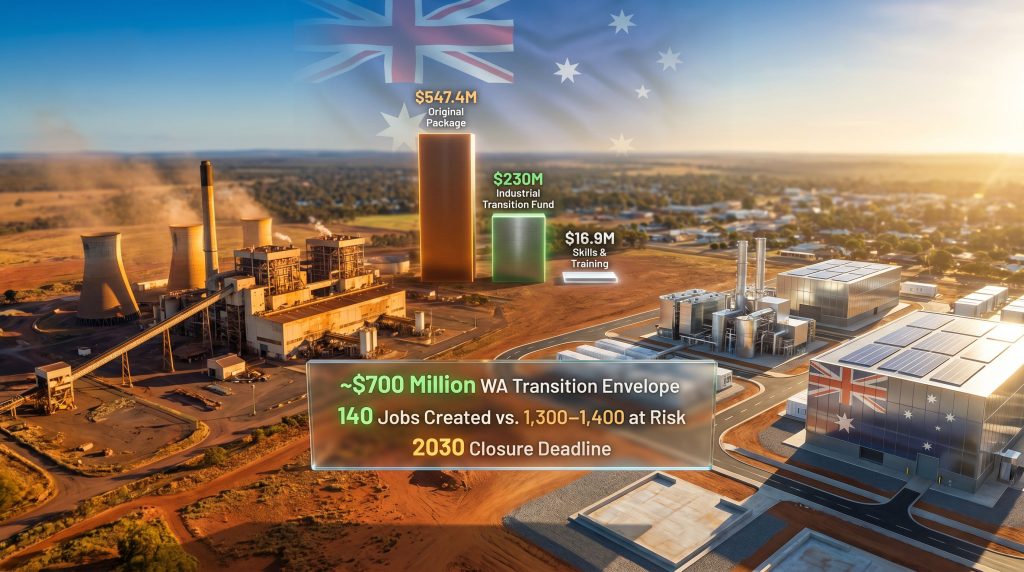
Western Australia's financial commitment to Collie's transformation is substantial on paper. The total transition envelope has grown to close to $700 million, but understanding what that figure actually covers is essential to assessing whether it represents genuine economic renewal or a managed retreat. The WA resources contribution to the state's broader economy makes this transformation all the more consequential.
| Funding Component | Allocated Amount |
|---|---|
| Total WA Transition Envelope | ~$700 million |
| Original 2022 Collie Transition Package | $547.4 million |
| Collie Industrial Transition Fund | $230 million |
| Muja and Collie Power Station Decommissioning | ~$300 million |
| Skills, Training and Career Support | $16.9 million |
| Pre-2022 Diversification Funding (since 2017) | $115+ million |
A critical distinction that is frequently lost in headline figures is the difference between decommissioning expenditure and job-creation investment. A significant portion of the near-$700 million total is allocated to the cost of safely shutting down state-owned power infrastructure at Muja and Collie power stations, a necessary but economically inert expense. The funding that is actually directed at building new industries and retraining workers represents a considerably smaller share of the overall envelope.
This distinction matters enormously. The $230 million Collie Industrial Transition Fund is the primary engine for replacement industry development. Against projected job losses of 1,300 to 1,400 positions by 2030, only approximately 140 ongoing roles have been created so far, according to figures attributed to local MP Jodie Hanns. The arithmetic is unambiguous: the current trajectory falls well short of what is needed.
The Replacement Industries: Promising but Pre-Operational
The Green Industries Pipeline
The industrial candidates positioned to replace coal in Collie represent genuinely credible sectors, but their current status is the source of the most acute uncertainty. Furthermore, these sectors connect directly to the broader critical minerals transition reshaping global supply chains.
The three flagship projects in development include:
- Generation Steel – a green iron production proposal designed to leverage Collie's existing industrial infrastructure and workforce skills in heavy industry
- International Graphite – a downstream graphite processing facility that would position Collie within the battery materials supply chain, targeting the lithium-ion battery sector
- Magnium Australia – a magnesium refinery that would process magnesium for use in lightweight alloy manufacturing, a material increasingly critical to automotive and aerospace industries
Battery storage infrastructure has also emerged as an anchor concept, with Collie's grid-connected location and existing energy workforce providing a logical foundation for large-scale storage deployment.
The Final Investment Decision Problem
What is not widely understood outside of industrial policy circles is the difference between a project receiving feasibility support and a project reaching a Final Investment Decision (FID). In resources and heavy industry, FID is the point at which private capital formally commits to construction and operation. Without FID, a project remains a possibility rather than a certainty.
The $230 million Collie Industrial Transition Fund has provided the groundwork for these projects to advance through early-stage development. However, as of mid-2026, none of the major replacement industry candidates have publicly confirmed a final investment decision. This is the core of the workforce uncertainty facing Collie's coal workers.
"The gap between feasibility funding and committed investment is where regional transitions most commonly fail. Infrastructure can be studied indefinitely; it is the commitment of private capital that transforms a pipeline into an economy."
The National Reconstruction Fund and the Federal Funding Debate
How the NRF Works and What WA Is Seeking
The federal government's $15 billion National Reconstruction Fund was established to support industrial development, diversification, and transformation across Australia. It operates primarily through concessional loans, guarantees, and equity investments rather than outright grants, making it a catalytic tool designed to de-risk private investment rather than replace it.
WA Energy Minister Amber-Jade Sanderson has formally called on the federal government to direct NRF resources toward Collie's industrial pipeline, framing the ask as comparable in logic to the commitment of up to $500 million made available to the Whyalla Steelworks in South Australia. The WA government's position is that several millions, potentially extending to tens of millions of dollars, would be needed to support the infrastructure underpinning new industries in the region.
As of June 2026, no federal funding commitment for Collie had been confirmed. You can find further detail on the Collie just transition framework directly through the WA government's official resources.
The Whyalla Precedent and What It Means for Collie
The comparison to Whyalla is not incidental. It is a deliberate framing strategy by the Cook Government, designed to establish that federal intervention in struggling regional industrial economies is already established federal practice.
A similar logic applied to the federal-Victorian partnership that supported the automotive manufacturing sector during its wind-down. As John Spoehr, former director of the Australia Industrial Transformation Institute, has observed, the co-investment model between federal and state governments in managing large-scale workforce transitions has deep historical roots in Australian industrial policy. His assessment is clear: managing these transitions is an expensive undertaking, and the expectation that state governments can carry the cost alone runs contrary to how these challenges have historically been resolved.
| Factor | Collie (WA) | Whyalla (SA) |
|---|---|---|
| Primary Industry | Coal mining and power generation | Steel manufacturing |
| Closure/Transition Timeline | State-owned assets by 2030 | Ongoing restructure |
| State Funding Committed | ~$700 million | State co-investment |
| Federal Funding Committed | None confirmed (June 2026) | Up to $500 million (NRF) |
| Replacement Industry Focus | Green steel, graphite, magnesium, batteries | Steel transformation |
| Jobs at Risk | ~1,300 to 1,400 | Thousands across steelworks |
| Federal Intervention Status | Actively lobbied, not yet secured | Committed |
The Political Battleground: Three Competing Narratives
Labor's Case for Federal Co-Investment
The Cook Government's position is that the scale of Collie's transition challenge structurally exceeds what state funding alone can resolve. The argument is not simply about money but about the risk profile of industrial investment. Large-scale manufacturing projects in green steel, critical minerals processing, and magnesium refining carry significant capital requirements and technology risks that require federal backing to attract private investors.
The state acknowledges that existing funding has not generated replacement employment at the pace required. Rather than treating this as evidence of failure, Labor frames it as the predictable consequence of attempting a transformation of this scale without a federal co-investment partner. In addition, Australia's broader green metals leadership ambitions depend partly on demonstrating that transitions like Collie's can succeed.
The Opposition's Critique
WA Liberal Energy spokesperson Steve Thomas has drawn attention to a revealing statistic: since the original 2022 Collie Transition Plan was announced with a budget of $547.4 million, total expenditure has risen toward $700 million, while employment in Collie has not improved commensurately. The recent announcement of job cuts at Premier Coal, understood to affect between 70 and 100 workers, has sharpened this critique.
For the opposition, the calls for federal funding represent an acknowledgement that the transition strategy as designed has not delivered, rather than a natural evolution of a co-investment approach.
The Union Movement's Escalation
The decision by coal miners and their unions to rally outside WA Parliament House reflects a level of community anxiety that has moved beyond political debate into direct action. Electrical Trades Union state secretary Adam Woodage articulated the central concern: the replacement industry pipeline exists in concept but has yet to be financially activated, and the window to do so before 2030 closures is narrowing to the point where urgency is no longer optional.
Chad Mitchell, a third-generation coal miner with 36 years at Griffin Coal, represented a perspective that is difficult to reduce to political argument. His family's entire working history is embedded in Collie's coal economy, and his presence at the rally underscored that the stakes extend well beyond employment statistics into community identity and intergenerational economic security. The Collie futures initiative outlines the broader regional vision underpinning these community concerns.
What Workforce Transition Economics Actually Tell Us
The Cost of Timing in Industrial Transitions
Industrial transition economics contains a well-documented principle that rarely receives adequate attention in policy debates: early intervention consistently produces better employment outcomes than reactive rescue funding. The reasons are structural rather than political.
When replacement industries are established before closures occur, workers can transition directly without experiencing prolonged unemployment, skills atrophy, or relocation. When federal support arrives after closures, it must contend with a workforce that has already begun dispersing, a community experiencing population decline, and a reduced investor appetite for a location visibly struggling with transition.
John Spoehr's assessment reflects this principle: the federal government's contribution would have been more effective had it arrived earlier in the process, given that alternative employment opportunities have not materialised in the required volumes despite sustained retraining efforts. Furthermore, the dynamics affecting Collie share certain characteristics with broader shifts in the metallurgical coal market that are reshaping regional economies across Australia.
Regional Workforces as Strategic National Assets
An emerging but significant dimension of the Collie debate is the reconceptualisation of skilled regional workforces as strategic national assets rather than purely local economic concerns. A workforce with deep expertise in heavy industrial operations, energy systems, and large-scale plant maintenance represents a capability that takes decades to build and can be lost within a single employment generation.
This framing has implications for how the federal government should weigh inaction. The cost of not intervening is not simply the social welfare cost of unemployment; it includes the permanent loss of industrial capability that would be required for precisely the green manufacturing industries Collie is meant to host.
Beyond Zero Emissions has modelled that full state-federal mobilisation in the Collie-Bunbury region could attract approximately $13 billion in renewable and industrial investment, supporting around 1,750 jobs. This figure represents a potential outcome scenario rather than a confirmed commitment, and should be treated as indicative modelling rather than assured investment.
The next major ASX story will hit our subscribers first
A Framework for What Must Happen Before 2030
Given the timeline constraints, the pathway to a successful Collie coal transition federal funding outcome requires a sequenced and disciplined response across multiple dimensions:
- Federal co-investment through the NRF must be confirmed in a timeframe that allows industrial proponents to finalise investment decisions during 2026 and 2027, providing sufficient construction lead time before 2030 closures
- Final investment decisions on the green steel, graphite, and magnesium projects must be accelerated, with the NRF's concessional financing model used to de-risk private capital participation
- Workforce retraining scale needs to be expanded beyond the current $16.9 million allocation, with programmes designed around the specific technical requirements of the incoming industries rather than generic upskilling
- Measurable employment targets tied to specific milestones and reporting obligations should be established, creating accountability mechanisms that allow progress to be assessed against the 2030 deadline
- Community economic resilience programmes including local procurement mandates for incoming operators and small business support grants should be implemented to preserve the commercial ecosystem that will serve incoming industrial workers
The 2026 to 2027 window represents the last viable period for proactive industrial investment before the transition becomes purely reactive. Once Premier Coal and the state-owned operations begin winding down in earnest, the community confidence and population retention dynamics that attract further investment will begin deteriorating in ways that are difficult to reverse.
Disclaimer: Modelling figures such as the Beyond Zero Emissions investment and employment projections for the Collie-Bunbury region represent scenario-based estimates and are not confirmed investment commitments. Readers should not interpret such figures as guaranteed outcomes. Policy decisions, private investment timelines, and market conditions may differ materially from modelled scenarios.
Frequently Asked Questions: Collie Coal Transition Federal Funding
How much has WA invested in Collie's transition away from coal?
Western Australia has committed close to $700 million in total transition funding, encompassing decommissioning of state-owned power infrastructure, the $230 million Collie Industrial Transition Fund, and workforce retraining programmes. However, a significant portion of this total covers decommissioning costs rather than direct job-creation investment.
Why is WA asking the federal government for additional funding?
Despite the substantial state investment, only around 140 ongoing roles have been created so far against a projected loss of between 1,300 and 1,400 coal industry jobs by 2030. The state government argues that federal co-investment is essential to financially activate the pipeline of replacement industries that have received feasibility support but not yet reached final investment decisions.
What is the National Reconstruction Fund and how could it help Collie?
The federal government's $15 billion National Reconstruction Fund is designed to support industrial development and regional economic transformation through concessional financing, guarantees, and equity investment. WA is seeking access to this fund, drawing on the precedent of the federal government committing up to $500 million to the Whyalla Steelworks in South Australia.
When do Collie's coal mines and power stations close?
State-owned coal operations and power stations in Collie are scheduled to cease by 2030, leaving approximately four years for replacement industries to be established and operational before the primary source of employment in the region disappears.
What new industries are planned for Collie?
The primary industrial candidates include green steel manufacturing via Generation Steel, downstream graphite processing through International Graphite, magnesium refining via Magnium Australia, and battery storage infrastructure. All sectors align with broader clean energy and critical minerals demand trajectories.
What happens if federal funding is not secured in time?
Workforce transition analysis indicates that without timely federal co-investment, replacement employment opportunities will not materialise at the scale or pace required to retain Collie's workforce and population base. The compounding effect of early job losses, such as those recently announced at Premier Coal, further accelerates this risk by eroding community confidence before new industries arrive.
Want to Track the Mineral Discoveries Powering Australia's Green Industrial Future?
Discovery Alert's proprietary Discovery IQ model delivers real-time alerts on significant ASX mineral discoveries — including the critical minerals at the heart of transitions like Collie's — turning complex market data into actionable insights for investors at every level. Explore historic discoveries and the returns they generated, then begin your 14-day free trial to position yourself ahead of the next major find.