July 11, 2026
Economic Forces Reshaping Colombia's Energy Landscape
The Colombia oil industry comeback faces unprecedented challenges as global energy markets navigate volatile commodity pricing and shifting regulatory frameworks. When crude oil benchmarks exceed $100 per barrel, fundamental shifts occur across regional markets, particularly in emerging hydrocarbon economies where operational margins determine investment viability. Furthermore, this price environment creates strategic inflection points for countries heavily dependent on energy exports, forcing reassessment of long-term production strategies and capital allocation frameworks.
Latin American energy markets exemplify these dynamics, where mature production profiles intersect with evolving regulatory landscapes and changing investor sentiment. However, recent oil price rally trends create renewed opportunities for operators willing to navigate complex regulatory environments. Consequently, the intersection of geopolitical tensions, supply chain constraints, and domestic policy frameworks creates complex investment scenarios requiring nuanced analytical approaches.
Macro-Economic Pressures on Hydrocarbon Development
Colombia's energy sector confronts a complex matrix of economic pressures fundamentally altering its competitive positioning within regional markets. Current production data reveals significant structural challenges requiring immediate attention from both operators and policymakers. In addition, these pressures reflect broader US economic pressures affecting global energy investment flows.
Production Trajectory Analysis:
| Period | Oil Production (bpd) | Year-over-Year Change | Strategic Implication |
|---|---|---|---|
| February 2026 | 734,924 | -4.2% vs April 2025 | Multi-year production decline |
| February 2015 | 1,029,798 | +40% vs current levels | 28.6% cumulative decline over 11 years |
| April 2025 | 714,229 | Previous cycle low | Established minimum threshold |
Source: National Hydrocarbons Agency (ANH) via Colombia's oil industry analysis, April 24, 2026
The 28.6% production decline from February 2015 levels represents more than cyclical market adjustment. This trajectory indicates fundamental structural issues within Colombia's upstream sector, particularly considering the timeframe encompasses both conservative and progressive governmental administrations with markedly different energy policies.
Natural Gas Crisis Indicators:
Natural gas production presents even more concerning metrics, with February 2026 output reaching 695 million cubic feet per day (MMcf/d), representing a 15.7% year-over-year decline. This reduction occurs during a period of increasing domestic demand, creating supply-demand imbalances requiring costly import solutions. Moreover, current natural gas trends indicate broader regional supply challenges affecting investment decisions.
The liquified petroleum gas (LPG) import surge exemplifies this challenge. Between 2022 and 2025, import volumes increased tenfold, with 2026 projections indicating 25% of total natural gas consumption will require foreign sourcing. This import dependency exposes Colombia to international price volatility while straining foreign currency reserves.
Investment Climate Assessment for Energy Infrastructure
Current commodity pricing creates favourable conditions for Colombian energy investment despite regulatory headwinds. With Brent crude trading around $100 per barrel, substantially above the estimated $30-50 per barrel breakeven threshold for most Colombian operations, profit margins remain attractive even accounting for elevated taxation regimes implemented since August 2022.
Currency and Capital Allocation Impact:
Foreign direct investment in Colombia's energy sector faces dual pressures from peso volatility and policy uncertainty. International operators calculate project economics in US dollars, meaning peso depreciation improves local operational cost structures whilst reducing government revenues in local currency terms. This dynamic creates fiscal tensions affecting long-term policy stability.
Regional Comparative Analysis:
Within Latin American energy markets, Colombia's investment climate faces increased competition from Brazil's pre-salt developments, Argentina's Vaca Muerta shale resources, and Guyana's offshore discoveries. Each jurisdiction offers distinct risk-return profiles, with Colombia's mature onshore assets requiring enhanced recovery techniques that add approximately $20 per barrel in operational costs. Furthermore, these regional developments highlight the importance of understanding comprehensive investment guide 2025 strategies for energy sector positioning.
When big ASX news breaks, our subscribers know first
Operational Challenges in Colombia's Current Production Profile
Technical Analysis of Reservoir Management Strategies
Colombia's hydrocarbon production base demonstrates heavy reliance on mature field assets requiring sophisticated reservoir management to maintain commercial viability. Industry analysis indicates approximately 80% of current production originates from mature oilfields, necessitating continuous deployment of enhanced recovery techniques.
Enhanced Recovery Economics:
- Secondary Recovery (Water Flood): Involves injecting water into reservoirs to maintain pressure and displace oil toward production wells
- Tertiary Recovery (Gas Injection): Utilises natural gas or CO2 injection to improve oil mobility and recovery factors
- Cost Structure: Enhanced recovery adds approximately $20 per barrel to operational expenses
- Recovery Improvement: Can increase extraction efficiency by up to 20% over primary recovery methods
Source: Colombia's oil industry comeback analysis, April 24, 2026
The technical necessity of enhanced recovery creates operational complexity whilst constraining available natural gas for commercial consumption. Approximately 50% of associated natural gas produced undergoes reinjection for pressure maintenance, directly contributing to domestic supply shortages requiring increased imports.
Reserve Base Analysis:
| Resource Type | Proven Reserves | Production Life | Strategic Priority |
|---|---|---|---|
| Crude Oil | 2+ billion barrels | 7.2 years | Critical reserve replacement needed |
| Natural Gas | 2+ trillion cubic feet | 5.9 years | Urgent exploration required |
| Associated Gas | 50% reinjected | N/A | Optimisation opportunity |
Source: Oilprice.com, "Colombia's Oil Industry Eyes Comeback," April 24, 2026
These reserve-to-production ratios indicate urgent need for successful exploration programmes to maintain Colombia's net energy exporter status. The absence of world-class discoveries since the 1990s compounds this challenge, requiring either significant new finds or dramatic improvements in enhanced recovery deployment.
Production Optimisation in Mature Asset Portfolios
Operational efficiency across Colombia's mature field portfolio requires continuous technological deployment and capital investment. Field decline curves typically accelerate without intervention, making enhanced recovery not discretionary but essential for maintaining production levels.
Water Flood Deployment Analysis:
Water flood operations represent the primary secondary recovery method across Colombian fields. This technique requires substantial infrastructure investment including water sourcing, treatment facilities, injection wells, and monitoring systems. At current Brent pricing around $100 per barrel, water flood economics remain attractive despite infrastructure requirements and ongoing operational complexity.
Gas Reinjection Strategy:
Natural gas reinjection serves dual purposes: maintaining reservoir pressure whilst extending field life. However, this practice directly impacts domestic gas availability, creating the paradox where enhanced oil recovery techniques worsen natural gas supply shortages. This dynamic explains Colombia's accelerating import dependency and rising LPG costs across agricultural and manufacturing sectors.
Regulatory Frameworks Impacting Long-Term Energy Investment
Policy Environment Analysis and Investment Implications
Colombia's regulatory environment since August 2022 reflects fundamental philosophical shifts regarding hydrocarbon development priorities. The implementation of hydraulic fracturing bans, exploration licence moratoriums, and progressive taxation creates investment uncertainty affecting long-term capital allocation decisions. These challenges mirror broader green transition challenges facing energy-dependent economies worldwide.
Tax Regime Modifications:
Progressive tax increases on extractive industries directly impact project economics and foreign investment attractiveness. Whilst current commodity pricing provides margins sufficient to absorb elevated tax burdens, the precedent of frequent fiscal modifications creates uncertainty regarding future profitability calculations.
Exploration Licence Framework:
The cessation of new exploration licence awards fundamentally alters Colombia's energy future. With proven reserves sufficient for only 7.2 years of oil production and 5.9 years of natural gas production at current extraction rates, exploration restrictions threaten long-term energy security and export capacity.
Strategic Response Patterns Among International Energy Companies
International operators demonstrate varied responses to Colombia's evolving regulatory environment. ExxonMobil's exit represents the most visible example of multinational withdrawal, whilst other companies adopt portfolio optimisation strategies focusing on existing assets rather than expansion activities.
Capital Allocation Strategies:
- Maintenance Capital: Focus on sustaining production from existing assets
- Enhanced Recovery Investment: Deployment of secondary and tertiary recovery techniques
- Exploration Cessation: Shift away from new discovery programmes
- Portfolio Concentration: Emphasis on highest-margin, lowest-risk operations
The absence of new exploration activity creates long-term sustainability concerns whilst immediate enhanced recovery investment provides short-term production support. This strategic rebalancing reflects rational responses to regulatory constraints and fiscal pressures.
Market Dynamics Driving Future Sector Performance
Global Energy Transition Impact on Colombian Hydrocarbon Demand
Colombia's hydrocarbon sector operates within global energy transition dynamics affecting long-term demand projections. However, current geopolitical tensions and supply chain constraints create near-term support for hydrocarbon prices despite longer-term transition pressures.
Regional Energy Security Considerations:
Colombia's declining domestic production affects regional energy security, particularly for neighbouring countries dependent on Colombian natural gas exports or pipeline infrastructure. This regional dimension adds strategic importance beyond domestic considerations, potentially influencing policy decisions regarding energy development priorities.
Price Sensitivity Analysis for Project Economics
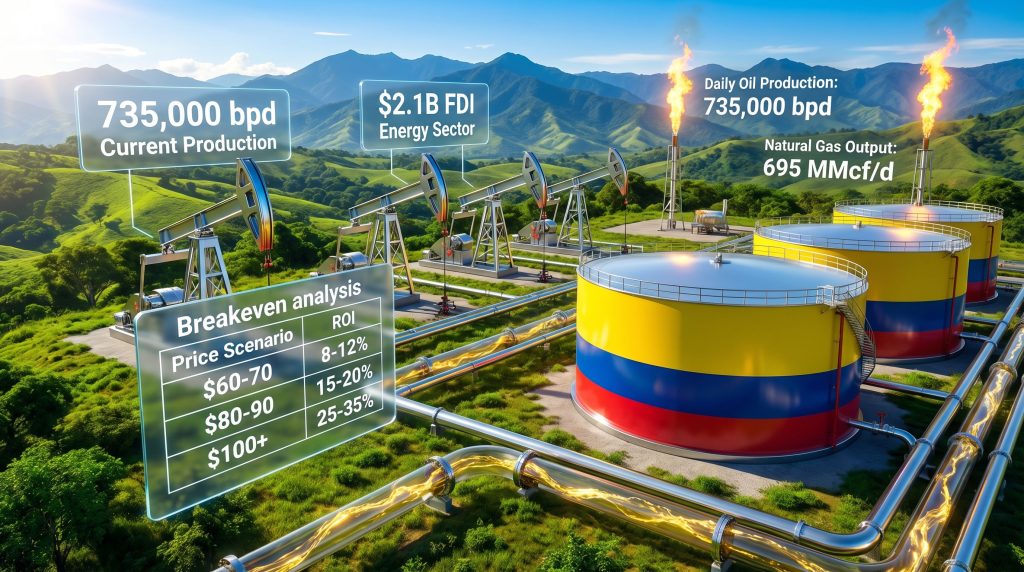
Current Brent pricing around $100 per barrel creates favourable conditions for Colombian operations despite elevated costs and regulatory burdens. Industry analysis suggests breakeven levels between $30-50 per barrel, providing substantial operational margins at current pricing.
| Price Scenario | Operational Margin | Investment Viability | Enhanced Recovery ROI |
|---|---|---|---|
| $60-70/barrel | Limited | Maintenance only | 8-12% |
| $80-90/barrel | Moderate | Selective development | 15-20% |
| $100+/barrel | Strong | Broad-based activity | 25-35% |
Note: Figures represent industry estimates requiring validation against specific operator data
These margins provide sufficient cushion for enhanced recovery deployment whilst supporting continued operations across mature field portfolios. The sustainability of such pricing depends on geopolitical developments and global supply-demand balances.
Strategic Scenarios Reshaping Colombia's Energy Future
Political Transition Impact Modelling
The 2026 presidential election represents a critical inflection point for Colombia's energy sector. Electoral outcomes could significantly alter regulatory frameworks, taxation regimes, and investment climates affecting long-term sector viability.
Policy Continuity Risk Assessment:
- Regulatory Stability: Potential reversal of exploration restrictions and hydraulic fracturing bans
- Fiscal Framework: Possible modification of progressive taxation on extractive industries
- Investment Climate: Restoration of international investor confidence through policy predictability
Political transitions create both opportunities and risks for energy sector recovery. Business-friendly policy shifts could accelerate investment flows whilst policy continuity might perpetuate current production decline trajectories.
Regional Energy Integration Opportunities
Colombia's geographic position provides strategic advantages for regional energy integration despite current production challenges. Natural gas pipeline infrastructure and crude oil export facilities represent valuable assets supporting regional energy security initiatives.
Cross-Border Infrastructure Development:
Enhanced regional cooperation could support Colombian energy sector recovery through infrastructure sharing, joint development projects, and coordinated supply chain optimisation. These initiatives require stable policy frameworks and predictable regulatory environments to attract necessary investment capital.
Investor Evaluation Framework for Colombia's Energy Sector
Comparative Valuation Metrics Across Regional Energy Markets
Investment evaluation in Colombia's energy sector requires sophisticated risk assessment incorporating political, operational, and market factors. Current asset valuations reflect substantial discounts to regional peers due to regulatory uncertainty and production decline trends.
Asset Valuation Considerations:
- Reserve Base Quality: Mature fields with enhanced recovery potential versus greenfield opportunities
- Operational Complexity: Infrastructure requirements for secondary and tertiary recovery deployment
- Regulatory Risk Premium: Policy uncertainty affecting long-term investment returns
- Currency Exposure: Peso volatility impact on USD-denominated project economics
Long-Term Strategic Positioning Assessment
Colombia's energy sector positioning requires balancing current operational challenges against potential policy improvements and commodity price support. The fundamental tension between mature asset management and reserve replacement creates complex investment scenarios.
Strategic Investment Considerations:
- Technology Deployment: Enhanced recovery technique optimisation for mature field portfolios
- Policy Risk Management: Diversification strategies addressing regulatory uncertainty
- Regional Integration: Participation in broader Latin American energy development initiatives
- Transition Hedging: Portfolio positioning for long-term energy transition impacts
The next major ASX story will hit our subscribers first
Key Performance Indicators for Sector Recovery
Production Volume and Investment Activity Metrics
Monitoring Colombia's energy sector recovery requires tracking multiple indicators across production, investment, and policy domains. Current metrics suggest stabilisation at low levels rather than meaningful recovery initiation.
| Metric | Current Level | Recovery Threshold | Strategic Significance |
|---|---|---|---|
| Daily Oil Production | 734,924 bpd | 850,000+ bpd | Reversal of decline trend |
| Natural Gas Output | 695 MMcf/d | 800+ MMcf/d | Domestic supply adequacy |
| Exploration Wells | 15-20 annually | 40+ annually | Reserve replacement capacity |
| Enhanced Recovery Deployment | 80% of production | 90%+ coverage | Mature field optimisation |
Sources: Various including ANH data via Oilprice.com analysis
Market Confidence Indicators and Investment Flows
Foreign direct investment flows represent critical indicators of international confidence in Colombia's energy sector prospects. Recent trends suggest continued capital withdrawal despite favourable commodity pricing, indicating policy and regulatory concerns outweigh price advantages.
Technology Service Sector Activity:
Oilfield services activity provides leading indicators of operational trends and investment confidence. Enhanced recovery service demand reflects continued mature field development whilst exploration service reductions indicate limited new project development.
Strategic Outlook for Colombia's Energy Transformation
Critical Success Factors for Sector Revitalisation
The Colombia oil industry comeback faces fundamental choices regarding long-term sustainability and competitiveness. Current production decline trajectories require immediate intervention through either policy modifications or dramatic technological advancement in enhanced recovery techniques.
Infrastructure Development Priorities:
- Enhanced Recovery Optimisation: Maximising extraction efficiency from existing mature fields
- Natural Gas Infrastructure: Reducing import dependency through improved domestic production
- Export Capacity Maintenance: Preserving regional energy supplier status through production stabilisation
Investment Risk-Return Profile Assessment
Current market conditions create interesting investment opportunities despite structural challenges. High commodity prices provide operational margins sufficient to justify continued investment in existing assets whilst policy uncertainty limits expansion activities.
Risk Mitigation Strategies:
- Portfolio Concentration: Focus on highest-quality, lowest-cost operations
- Technology Deployment: Enhanced recovery technique optimisation
- Policy Hedging: Diversified exposure across regulatory scenarios
- Regional Integration: Participation in broader energy security initiatives
The Colombia oil industry comeback represents a complex investment case combining attractive current economics with significant long-term challenges. The intersection of favourable commodity pricing, regulatory uncertainty, and mature asset management creates unique risk-return dynamics requiring sophisticated analytical approaches for successful navigation. Whilst immediate operational conditions support continued activity, long-term sustainability depends critically on policy evolution and successful reserve replacement through either exploration success or enhanced recovery advancement.
For investors seeking comprehensive market insights, understanding these dynamics alongside broader private investment trends in Colombia provides essential context for strategic decision-making. Furthermore, the Colombia oil industry comeback narrative requires careful evaluation against regional competitors and evolving global energy transition pressures.
Disclaimer: This analysis is based on publicly available information and industry estimates. Specific investment decisions should incorporate comprehensive due diligence and professional financial advice. Commodity price projections and political outcomes involve substantial uncertainty affecting actual results.
What About Mining Investment Opportunities in Colombia?
With Colombia facing production declines in oil whilst still maintaining rich geological diversity, the country's mining sector presents compelling investment alternatives. Discovery Alert's proprietary Discovery IQ model delivers real-time alerts on significant mineral discoveries across global markets, providing subscribers with immediate insights into actionable opportunities that could emerge from Latin American exploration programmes. Begin your 14-day free trial today to position yourself ahead of the market in identifying the next major mineral breakthrough.