May 22, 2026
The Gap Between Mining Innovation and the Pit Floor: Why It Matters Now
The history of industrial technology is littered with breakthroughs that never made it out of the laboratory. In mining, this pattern is particularly pronounced. The physical, financial, and regulatory complexity of operating a mine creates an adoption environment where even genuinely superior commercialisable mining technologies can languish for a decade before seeing meaningful deployment. Understanding why this gap exists, and how it is now being systematically closed, is one of the more consequential developments in the global resources sector.
The challenge is not purely technical. A sensor that accurately maps subsurface geology in controlled conditions must also survive extreme heat, dust, vibration, and moisture underground. A simulation platform that optimises ore blending in a research environment must integrate with legacy SCADA systems, communicate across disparate data architectures, and produce outputs that operational planners can act on within a shift, not a quarter. These are not refinements; they are entire additional layers of engineering that laboratory budgets and timelines rarely accommodate.
This is the structural problem that purpose-built, industry-aligned research programmes are now designed to solve, and the results are beginning to arrive.
When big ASX news breaks, our subscribers know first
Why Most Mining R&D Never Reaches Commercial Scale
The Commercialisation Valley of Death in Resource Extraction
Technology readiness levels, or TRLs, provide a useful lens for understanding where most mining research stalls. The scale runs from TRL 1 (basic research) through TRL 9 (full commercial deployment). In mining, the industry consensus positions commercial viability at TRL 7 or above, where a system has been demonstrated in an operational environment under real-world conditions. Most academic research programmes deliver technologies to TRL 4 or 5 at best, then funding cycles end, researchers move on, and the technology enters a holding pattern that rarely resolves in deployment.
Several compounding forces maintain this gap:
-
Capital approval cycles in large mining organisations typically run 18 to 36 months, meaning technologies that could begin pilot trials immediately face multi-year procurement timelines before a single test can be conducted.
-
Risk aversion at the operational level is structurally embedded. Mine managers are incentivised to maintain throughput targets, not to experiment with unproven systems that could disrupt production.
-
Absence of transition infrastructure means there is rarely a structured mechanism for a research team to hand over a validated technology to an operations team with the context, training, and integration support required to make it work in the field.
-
Cost-per-unit economics are rarely modelled in academic settings. A technology can demonstrate compelling performance while remaining economically unviable when factoring in maintenance, replacement cycles, and failure rates at scale.
The majority of mining R&D investment historically fails to reach commercial deployment, not because the underlying science is flawed, but because the pathway from validation to operational adoption has never been deliberately engineered.
This is where the model pioneered by Australia's ARC Training Centre for Integrated Operations for Complex Resources (IOCR) represents a meaningful departure from conventional research practice.
Four Commercialisable Mining Technologies Ready for Industry Pilots
How the ARC IOCR Programme Compressed the Research-to-Deployment Timeline
Since its commencement in 2021, the ARC Training Centre IOCR has structured its entire research architecture around the operational realities of complex mining environments. Rather than developing technologies in isolation and then seeking industry partners retroactively, the programme embedded operational constraints into PhD and postdoctoral research design from the outset. The result is a portfolio of 16 PhD projects and three postdoctoral research programmes, with four technologies now identified as ready for industry pilot engagement.
Professor Peter Dowd, Director of the Training Centre and Professor of Mining Engineering at Adelaide University, has been direct about the readiness threshold these technologies have crossed. In his assessment, the validation is complete and the capability exists. The next requirement is forward-looking industry partners prepared to trial and deploy these technologies in operational environments. His view is that the companies engaging at this stage will not only strengthen their own operations but will actively shape the competitive future of the broader industry.
Professor Bill Skinner, who leads the mineral processing theme within the Centre, has attributed the programme's accelerated commercialisation pathway to a single structural decision: aligning research directly with operational realities rather than with academic publication targets. The deep connections built between PhD researchers, postdoctoral fellows, and technology innovators throughout the programme created a continuous feedback mechanism that eliminated the typical post-validation rework phase.
The four technologies now seeking industry partners are each solving distinct, well-documented operational pain points across the mining value chain.
Technology 1: Real-Time Orebody Knowledge Updating
Closing the Gap Between Static Block Models and Live Subsurface Intelligence
Resource models are foundational to every operational decision in a mine, from blast design and material routing to processing plant configuration and financial planning. Yet in most active operations, these models are updated infrequently, drawing on periodic drilling campaigns and geological surveys that may be months or years out of date. The result is a persistent mismatch between what the model says and what the ore body actually delivers to the mill.
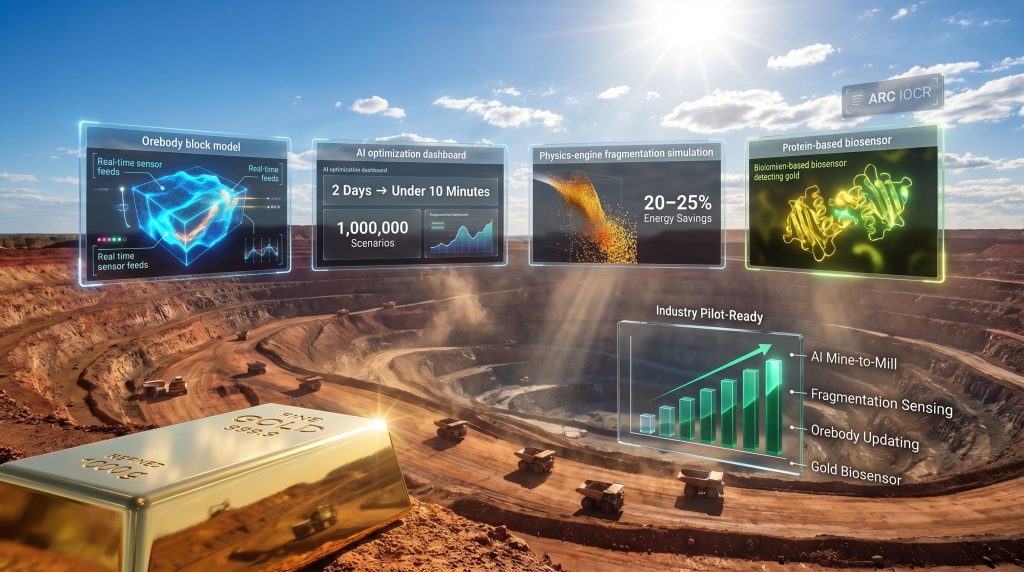
Dr Sultan Abulkhair's research within the IOCR programme addresses this directly. The technology focuses on updating resource knowledge and models dynamically, using integrated sensor data that includes structural geological information. Furthermore, rather than waiting for the next drilling campaign, the system utilises the full value of ore sensing technology to close the knowledge gap in near real-time.
Importantly, Dr Abulkhair has identified a secondary dimension to this work that elevates its strategic significance. Although each of the four IOCR technologies was developed as an independent PhD research project, the research teams are now actively exploring integration pathways between projects with operational crossover. In Dr Abulkhair's framing, combining orebody knowledge updating with AI-driven optimisation, fragmentation sensing, and real-time detection could deliver a unified operational intelligence system with compounding impact exceeding the sum of its individual parts. This convergence possibility represents one of the more underappreciated dimensions of the programme's output.
Technology 2: AI-Driven Mine-to-Mill Optimisation
From Two Days to Ten Minutes: Redefining Operational Planning Cycles
The mine-to-mill value chain has historically suffered from a fundamental data disconnect. Decisions made at the extraction point, including blast pattern design, ore sorting thresholds, and material routing sequences, are rarely informed by real-time knowledge of how those decisions will affect downstream processing performance. The consequence is that processing plants routinely receive ore that is poorly characterised, inconsistently fragmented, or improperly blended for current mill configurations, with compounding losses across throughput, energy consumption, and reagent efficiency.
Pouya Nobahar's AI in mining operations platform addresses this disconnect by directly linking resource characteristics at the point of extraction to predicted mill performance parameters and financial outcomes. The system's performance benchmark is striking in its implications for operational planning: existing platforms require approximately two days to compute one million operational scenarios; the AI-driven system reduces this to under ten minutes.
This is not an incremental improvement. A reduction from 48 hours to 10 minutes represents a 99.7% compression in computation time, effectively shifting mine-to-mill optimisation from a planning-cycle input to a real-time operational tool. Mine planners can evaluate and revise extraction strategies within a single shift rather than waiting for the next weekly planning session.
The step-by-step operational workflow this enables looks substantially different from current practice:
-
Sensor and drill data characterise ore block properties at the point of extraction.
-
The AI engine maps those resource characteristics to predicted mill performance parameters across the full processing circuit.
-
The system generates optimised extraction and processing sequences across more than one million scenario combinations in under ten minutes.
-
Recommendations are delivered to operational planners with projected financial performance outcomes attached to each scenario.
-
As new sensor data is continuously captured, the model updates and generates revised recommendations, creating a closed-loop operational intelligence system.
Nobahar has described the team's readiness to move from research delivery to industry trial as a genuine priority, reflecting the Centre's broader transition posture as its initial programme phase approaches conclusion.
Technology 3: Cave Draw-Point Fragmentation Sensing
Physics Engines Enter the Mine: Simulation Time Cut from Months to Days
Cave mining operations present one of the most complex comminution optimisation challenges in the industry. The fragmentation characteristics of ore as it moves through draw-points determine the particle size distribution entering the crushing circuit, which in turn drives energy consumption, throughput rates, and equipment wear across the entire downstream process. Getting this wrong is expensive; getting it right requires simulation capability that traditional modelling methods have never efficiently delivered.
Ahmadreza Khodayari's work on cave draw-point fragmentation sensing has introduced physics engine-based simulation to this problem. The performance improvement is quantifiable and operationally significant: simulation time for linking particle size to material flow has been reduced from 2.5 months to approximately one week, achieved by pioneering the use of physics engines as a simulation framework for mining fragmentation modelling.
The downstream financial implication of getting fragmentation optimisation right is equally concrete. Optimising particle size distribution entering the crushing circuit is expected to increase energy efficiency in crushing operations by 20 to 25%. At the scale of a large-tonnage cave mining operation, crusher energy costs represent one of the most significant controllable expenditure lines in the processing budget. A 20 to 25% efficiency improvement translates directly to measurable reductions in cost per tonne processed.
The compression of simulation cycles from months to a single week also transforms the planning dynamic around draw-point management. Operations that previously committed to fragmentation strategies for extended periods due to simulation lead times can now model and revise those strategies on a near-continuous basis, with direct integration into production planning. In addition, 3D geological modelling techniques are increasingly being explored alongside these physics engine approaches to further refine subsurface understanding.
The next major ASX story will hit our subscribers first
Technology 4: Protein-Based Gold Biosensor
Eco-Intelligent Detection at the Face of the Mine
Gold detection at the mine face has long relied on a combination of X-ray fluorescence analysis and off-site laboratory processing. Neither method is without significant limitations. XRF requires capital-intensive equipment, delivers moderate accuracy in complex mineral matrices, and introduces delays that affect real-time operational decision-making. Off-site laboratory analysis can take 24 to 72 hours per sample, generates per-sample costs that accumulate rapidly at operational scale, and introduces logistical dependency that is incompatible with fast-cycle extraction environments.
The economic cost of these limitations is direct: when detection is slow or uncertain, mining operations process material that contains little or no gold-bearing ore, consuming energy, reagents, water, and processing capacity on non-productive material.
Dr Akhil Kumar's protein-based biosensor technology addresses each of these limitations simultaneously. The system uses engineered biological molecules that bind selectively to gold ions or particles. When binding occurs, a measurable signal is produced, enabling real-time concentration detection at the face of the mine without the need for chemical reagents, X-ray equipment, or laboratory processing.
| Detection Method | Speed | Environmental Profile | Cost Structure | Location Dependency |
|---|---|---|---|---|
| X-Ray Fluorescence | Moderate | Low to Moderate | High capital cost | On-site equipment required |
| Off-Site Laboratory | 24 to 72 hours | Low | High per-sample cost | Off-site dependency |
| Protein-Based Biosensor | Real-time | Minimal | Low operational cost | Portable, face-of-mine |
The environmental advantage of the biosensor approach extends beyond cost. Eliminating reagent-heavy or energy-intensive detection workflows reduces the environmental footprint of the detection process itself, a consideration of growing importance in a sector under sustained pressure to reduce its environmental impact across all operational phases.
Dr Kumar has articulated the core economic value proposition clearly: the ability to identify and avoid processing non-gold-bearing ore delivers direct cost savings at scale that accumulate continuously across the operational life of a mine. At high-volume operations, even modest improvements in detection accuracy at the extraction point translate to meaningful reductions in processing cost per ounce of recovered gold.
How These Technologies Compare to the Global Commercialisation Landscape
Where Autonomous Systems, Digital Twins, and AI Stand in 2026
These four IOCR technologies do not exist in isolation. The broader commercialisable mining technologies landscape in 2026 spans autonomous haulage, real-time location systems, digital twins, and critical mineral extraction innovations, each at varying stages of deployment readiness.
| Technology Category | Readiness Stage | Primary Operational Benefit | Representative Developers |
|---|---|---|---|
| AI Mine-to-Mill Optimisation | Industry pilot-ready | 99.7% computation time reduction | ARC IOCR, Adelaide University |
| Protein-Based Gold Biosensor | Industry pilot-ready | Real-time eco-friendly detection | ARC IOCR, Adelaide University |
| Cave Fragmentation Sensing | Industry pilot-ready | 20-25% crusher energy savings | ARC IOCR, Adelaide University |
| Orebody Knowledge Updating | Industry pilot-ready | Real-time resource model accuracy | ARC IOCR, Adelaide University |
| Autonomous Haulage Systems | Commercially deployed | Zero-entry hazardous zone operations | Sandvik, Caterpillar, Komatsu |
| RTLS Personnel and Equipment Tracking | Active deployment | Safety, ESG compliance, collision avoidance | Multiple vendors using UWB technology |
| Digital Twin Platforms | Active deployment | Operational simulation and scenario planning | Multiple platforms, major operators |
| Lignite-Based REE Extraction | Pilot-to-FEED stage | Critical mineral supply diversification | University of North Dakota |
Autonomous haulage represents the most mature segment of the commercialisation landscape. Rio Tinto's Mine of the Future programme, which began autonomous truck trials at Marandoo in Western Australia as early as 2008, demonstrated that early adoption of autonomous systems creates compounding productivity advantages that widen over time relative to conventional operations. By the time competitors entered the autonomous haulage market at scale, Rio Tinto had already optimised its systems through years of operational refinement, creating a cost-per-tonne gap that proved structurally difficult to close.
Real-Time Location Systems using ultra-wideband radio technology now enable precise tracking of personnel, vehicles, and equipment across underground and surface mining environments. These systems are deployed across major operations for collision avoidance, emergency response coordination, productivity monitoring, and increasingly for ESG compliance reporting, where demonstrable safety performance is linked to financing costs and regulatory standing.
In the critical minerals space, the University of North Dakota's lignite-based rare earth element extraction programme has advanced from bench-scale testing to a 500 kg per hour continuous pilot operation, with a multi-product revenue model encompassing high-purity REEs, upgraded fuel, and synthetic graphite for battery supply chains. Furthermore, a Front-End Engineering Design study pathway is providing the technical and financial basis for investment-ready commercialisation decisions.
The Strategic Case for Early Industry Engagement
First-Mover Dynamics in Technology Adoption: Evidence from the Field
The competitive logic of early technology adoption in mining is straightforward but consistently underweighted by mid-cycle operators focused on near-term production targets. Technology partnerships entered at the pilot stage deliver two distinct advantages that procurement-stage entry cannot replicate.
The first is operational: pilot partners gain access to validated, deployment-ready technologies without carrying the development risk of early-stage research investment. The technology has already been validated; the partner is entering at the deployment threshold, not the hypothesis stage.
The second advantage is strategic: pilot partners influence the development roadmap. When a processing plant participates in the initial industry trial of an AI mine-to-mill optimisation platform, that operation's specific ore characteristics, mill configurations, and data architecture shape how the system evolves. Late adopters inherit a commercialised product designed around someone else's operation.
Mining companies that establish pilot partnerships with research-stage commercialisable technologies gain not only operational improvements but direct influence over the development roadmap, a structural advantage unavailable to late movers.
This dynamic is already observable in the autonomous systems sector. Operations that partnered with Sandvik and Caterpillar on early autonomous drilling and haulage trials benefited from customised integration support, preferential licensing terms, and system configurations tuned to their specific operational parameters. Operators who entered the market after full commercialisation faced standardised products with limited customisation flexibility and significantly higher upfront costs.
The ARC IOCR programme's August 2026 conclusion creates a defined window within which industry partnership formation carries the highest return on engagement. As the programme transitions from active research delivery to commercial deployment, the four pilot-ready technologies will seek partners who can provide operational environments for initial trials. The terms, integration support, and collaborative development rights available at this stage are unlikely to persist once full commercial licensing structures are established.
Mapping Technologies to Operational Pain Points
What Each Innovation Directly Solves for Mining Operations
The practical value of these four commercialisable mining technologies becomes clearer when mapped against documented operational pain points. Consequently, data-driven mining approaches are proving essential in matching the right solution to each operational challenge:
-
Uncertainty in resource models generating planning decisions based on outdated subsurface information is addressed by real-time orebody knowledge updating through integrated sensor feeds, enabling dynamic model revision throughout the operational cycle rather than between drilling campaigns.
-
Processing inefficiency from poorly characterised ore arriving at the mill with characteristics incompatible with current plant configuration is addressed by the AI mine-to-mill system, which links extraction decisions to downstream performance projections before material is extracted.
-
Energy waste in comminution circuits resulting from suboptimal fragmentation entering the crushing circuit is addressed by physics engine-based simulation that enables continuous draw-point optimisation at a planning cadence previously impossible with conventional methods.
-
Gold detection delays and non-ore processing costs arising from slow or off-site analysis methods are addressed by the protein-based biosensor, which delivers real-time concentration data at the mine face without reagent inputs or laboratory dependency.
The additional dimension identified by Dr Abulkhair, that these independently developed technologies are now being evaluated for cross-project integration, suggests a future trajectory where these four capabilities combine into a unified operational intelligence layer. The implications of this convergence for mine planning, processing efficiency, energy consumption, and environmental impact could substantially exceed the already significant individual contributions of each technology.
Frequently Asked Questions: Commercialisable Mining Technologies
What does commercialisable mean in a mining technology context?
A commercialisable mining technology has progressed beyond proof-of-concept and laboratory validation to a state where it can demonstrably operate under real-world mining conditions at operational scale. This requires proven performance metrics in relevant environments, defined integration requirements compatible with operational systems, and economic viability when total deployment costs are modelled against operational return.
What is mine-to-mill optimisation and why is the AI-driven version significant?
Mine-to-mill optimisation is the process of aligning extraction decisions, including blast design, ore sorting, and material routing, with downstream processing performance. Misalignment between extraction and processing results in throughput losses, excess energy consumption, and reagent waste. AI-driven systems that compute more than one million optimisation scenarios in under ten minutes transform this from a planning-cycle input to a real-time operational tool available within a single shift.
How does a protein-based biosensor detect gold?
Engineered biological molecules within the biosensor bind selectively to gold ions or particles present in ore samples. When this binding occurs, the system produces a measurable signal proportional to gold concentration. This enables real-time, on-site detection without chemical reagents, X-ray equipment, or laboratory processing, and can be deployed directly at the mine face as ore is extracted.
What is RTLS and how is it applied in mining environments?
Real-Time Location Systems use ultra-wideband radio technology to track the precise position of personnel, vehicles, and equipment throughout a mine. Applications in active operations include collision avoidance, emergency response coordination, productivity monitoring, and ESG compliance reporting linked to demonstrable safety outcomes.
Why does the programme conclusion date of August 2026 matter for industry partners?
The transition from active research delivery to commercial deployment changes the terms of engagement available to industry partners. Partnerships formed during the pilot deployment phase carry access to integration support from the research team, influence over how the technology evolves through operational feedback, and commercial structures that reflect early-adopter positioning. These conditions shift once full commercial licensing frameworks are established post-programme.
The Road Ahead: Convergence, Critical Minerals, and the Next Productivity Frontier
From Four Technologies to One Integrated Operational Intelligence Layer
The trajectory of mining technology commercialisation points clearly toward convergence. The four IOCR technologies represent distinct capabilities, but the most significant productivity gains will emerge when they operate as interconnected components of a unified system. Orebody knowledge updating informs AI optimisation inputs; fragmentation modelling feeds into both extraction sequencing and processing plant configuration; real-time gold detection refines ore routing decisions before material enters the circuit.
Digital twin technology provides the architectural bridge for this convergence, enabling a virtual operational model that continuously updates from live sensor feeds and generates scenario projections across the full mine-to-mill value chain. Mining automation trends are accelerating the Industrial Internet of Things infrastructure needed to enable real-time data flows across disparate operational systems, which is the connectivity layer that makes this integration technically feasible at scale.
The critical minerals dimension adds further urgency to the commercialisation timeline. Technologies that improve extraction precision, reduce waste generation, and lower the environmental footprint of detection and processing are increasingly valued not only for their cost reduction profiles but for their strategic positioning within supply chains that face mounting scrutiny from downstream customers, regulators, and financing institutions. In this environment, the ability to demonstrate technological leadership through early adoption of next-generation operational systems carries reputational and commercial value beyond the operational improvements themselves.
The four commercialisable mining technologies emerging from the ARC IOCR programme arrive at a moment when the mining industry's appetite for verifiable, deployment-ready innovation has rarely been higher. The question for operators is not whether these technologies will reshape operational practice, but whether they will be among the companies that shape how that transformation unfolds.
This article is intended for informational purposes only and does not constitute financial or investment advice. Performance projections and efficiency metrics referenced throughout are sourced from researcher statements as reported by Global Mining Review (April 30, 2026) and should be independently verified prior to any commercial decision-making. Readers are encouraged to consult primary sources and conduct their own due diligence before entering into any commercial or pilot partnership arrangements.
Want to Identify the ASX Companies Leading the Next Wave of Mining Innovation?
Discovery Alert's proprietary Discovery IQ model scans ASX announcements in real time, delivering instant alerts when significant mineral discoveries are made — ensuring subscribers can act on major opportunities before the broader market reacts. Explore historic discoveries and their returns to understand the scale of what early positioning can mean, then begin your 14-day free trial at Discovery Alert to secure your market-leading edge.