May 22, 2026
The Infrastructure Gap That's Reshaping Eastern Mediterranean Energy Strategy
Every major offshore gas basin in history has faced the same fundamental tension: resource abundance without export infrastructure is commercially worthless. The Eastern Mediterranean is living through precisely this dilemma in 2026, and the QatarEnergy ExxonMobil Egypt Cyprus gas development deal is emerging as the most credible resolution pathway yet proposed. Cyprus sits atop substantial offshore gas discoveries, yet not a single cubic metre of that gas has reached international export markets at scale. The obstacle is not geological. It is architectural.
Building entirely new offshore-to-market export infrastructure for Cypriot volumes has consistently failed the economics test. The proposed EastMed pipeline, which would have carried gas from Cypriot and Israeli waters through Greece to Italy, carried an estimated price tag exceeding $6 billion and lost critical momentum when the United States withdrew its support in early 2022. Dedicated floating LNG vessels anchored near Cypriot waters face prohibitively high per-unit processing costs when applied to field volumes of the scale currently appraised.
Neither option has attracted the commercial alignment needed to reach a final investment decision. Furthermore, broader energy market volatility across the region has made investors increasingly cautious about committing to large-scale greenfield infrastructure.
This is where infrastructure arbitrage enters the picture. Egypt holds two operational LNG export terminals, at Idku and Damietta, both of which have run well below their nameplate liquefaction capacity for extended periods. Egypt's domestic gas production declined significantly through the 2010s as mature fields depleted, reducing the feedgas available to keep those terminals running at full throughput.
While the giant Zohr field, discovered in 2015 and developed by Eni, partially reversed that production slide, rising domestic energy consumption has competed aggressively with export volumes. This has left periodic spare liquefaction capacity sitting idle — and for a third-party producer with stranded gas and no export route, that idle capacity represents a commercially compelling solution.
When big ASX news breaks, our subscribers know first
What the QatarEnergy ExxonMobil Egypt Cyprus Gas Development Deal Actually Represents
Understanding the MoU: Framework, Not Commitment
The memorandum of understanding signed in May 2026 between QatarEnergy, ExxonMobil, and the Egyptian government establishes a joint study framework for the technical and commercial feasibility of routing Cypriot offshore gas discoveries through Egypt's existing natural gas and LNG export infrastructure. It is important to be precise about what this agreement does and does not represent.
An MoU in upstream gas development is a pre-commercial instrument. It creates the governance structure for a shared feasibility study but carries no binding construction obligation, no confirmed capital commitment, and no final investment decision. The parties are formally agreeing to investigate whether a commercially viable architecture exists, not agreeing to build one.
The three-party structure is itself instructive. QatarEnergy and ExxonMobil hold upstream concession interests in Cypriot offshore blocks and bring the resource-side of the equation. Egypt contributes the processing and export gateway. The study phase will likely examine:
- Subsea pipeline routing options from Cypriot waters to Egyptian onshore receiving facilities
- Liquefaction tolling fee structures at Idku or Damietta terminals
- LNG cargo offtake arrangements and marketing channels into European spot markets
- Revenue-sharing and cost-allocation frameworks between sovereign and private parties
- Regulatory approval sequencing across Cypriot, Egyptian, and potentially Greek maritime jurisdictions
Based on comparable Eastern Mediterranean project timelines, the pathway from a signed MoU to a final investment decision typically spans three to seven years, subject to commercial alignment between parties, feedgas pricing mechanisms, and infrastructure cost estimates.
QatarEnergy's Strategic Calculus: Why Cyprus Matters Now
QatarEnergy's interest in this agreement cannot be understood without reference to the severe disruption its domestic LNG operations have experienced. The company operates 14 LNG trains in Qatar, making it the world's single largest LNG producer prior to the conflict with Iran. Iranian attacks in March 2026 damaged two of those trains, removing approximately 12.8 million tonnes per year of liquefaction capacity from global markets for an estimated three to five years.
Compounding this, the effective closure of the Strait of Hormuz, through which roughly one-fifth of global oil and gas supply previously flowed, has severely constrained QatarEnergy's ability to physically export LNG from its Qatari terminals regardless of production status. The combined effect — domestic infrastructure damage and blocked export routes — has created an acute imperative to develop alternative commercialisation pathways for gas assets located outside the Persian Gulf. Consequently, this situation also intersects with the global LNG supply outlook, as the loss of Qatari volumes has rippled across international energy markets.
QatarEnergy's international upstream acquisition strategy has accelerated meaningfully in this context, with recent stake purchases across offshore basins in Uruguay, Namibia, and multiple other jurisdictions reflecting a deliberate effort to build a geographically diversified production base that is not constrained by Persian Gulf export routes.
The Cyprus MoU fits neatly within this portfolio diversification logic. Gas produced from Cypriot blocks and liquefied through Egyptian terminals would be entirely outside the Hormuz chokepoint, exportable directly into Mediterranean and Atlantic Basin LNG markets.
Scenario Analysis: How Cypriot Gas Could Flow Through Egypt
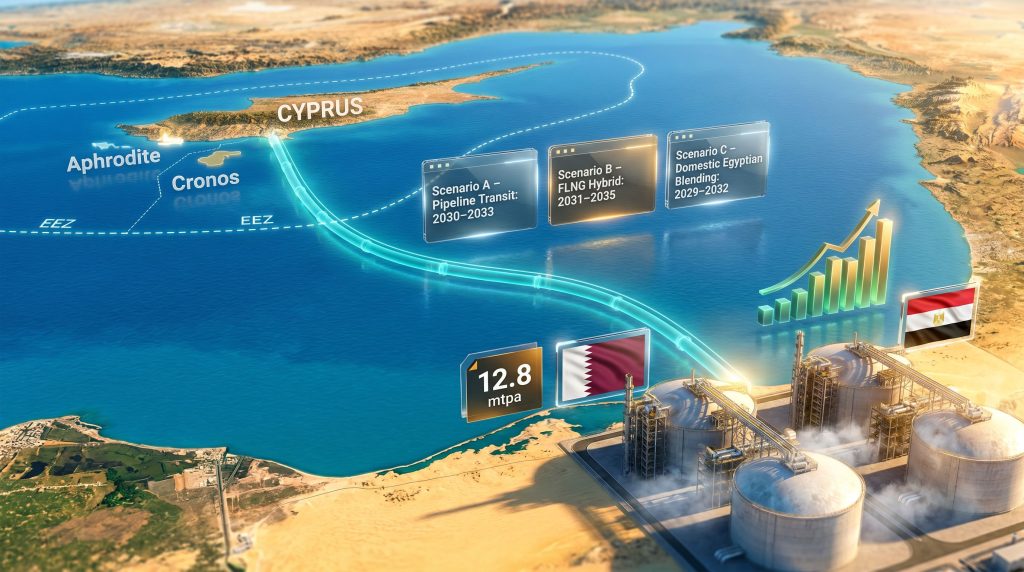
Three principal commercialisation pathways are under consideration for routing Cypriot gas through Egyptian infrastructure, each with distinct cost profiles, timelines, and risk characteristics.
| Scenario | Description | Key Advantage | Timeline Estimate |
|---|---|---|---|
| Scenario A: Pipeline Transit | Subsea pipeline from Cypriot blocks to Egyptian onshore grid, then liquefaction at Idku or Damietta | Lowest per-unit processing cost at scale | 2030 to 2033 |
| Scenario B: FLNG Hybrid | Floating LNG vessel near Cypriot waters with partial processing or blending in Egypt | Avoids full pipeline CAPEX | 2031 to 2035 |
| Scenario C: Domestic Blending | Cypriot gas displaces Egyptian domestic supply, freeing Egyptian gas for LNG export | Structurally simplest; lowest infrastructure cost | 2029 to 2032 |
Scenario C is particularly underappreciated in mainstream analysis. Rather than physically moving Cypriot gas to Egyptian LNG terminals, a blending or displacement model would inject Cypriot gas into the Egyptian domestic grid, offsetting volumes that Egypt would otherwise consume internally. The freed-up Egyptian domestic gas would then be routed to Idku or Damietta for liquefaction.
This approach requires significantly less new infrastructure and could reach commercial operation earlier than a dedicated subsea pipeline. The Eni-operated Zohr field established precedent for large-scale Mediterranean-to-Egyptian grid integration, while the long-running commercial negotiations around the Shell-operated Aphrodite field in Block 12 of Cyprus's EEZ have provided the industry with detailed knowledge of the regulatory and commercial complexities involved in cross-border routing.
Egypt's Hub Architecture: The Commercial Logic Behind the Strategy
Why Egypt Is the Region's Most Credible Gas Processing Gateway
Egypt's ambition to serve as the Eastern Mediterranean's primary gas processing and re-export hub predates this MoU by several years. The country is a founding member of the East Mediterranean Gas Forum — a multilateral body including Cyprus, Greece, Israel, Italy, Jordan, and the Palestinian Authority — established in 2019 specifically to coordinate regional gas commercialisation frameworks.
The commercial logic for Egypt operating as a regional hub involves three distinct revenue streams:
- Tolling revenue: Fees charged per unit of third-party gas processed through Idku or Damietta's liquefaction trains
- Pipeline transit charges: Access fees for cross-border gas flows through Egyptian onshore infrastructure
- Re-export premiums: LNG cargoes sold into European spot markets, where prices have consistently exceeded Egyptian domestic gas valuations since 2022
The international energy major landscape already engaged in Egypt-Cyprus gas frameworks includes Eni, TotalEnergies, Chevron, and Shell, operating across fields including Cronos and Aphrodite in Cypriot waters. The addition of QatarEnergy and ExxonMobil deepens the financial and commercial weight behind the hub concept considerably.
Egypt's hub strategy also functions as a foreign policy instrument, simultaneously deepening bilateral energy ties with Cyprus and Greece, reinforcing Egypt's role as an indispensable partner for European LNG buyers seeking to reduce dependence on Russian pipeline gas, and strengthening the country's position within regional multilateral energy governance frameworks.
Competing Export Routes: Why Egypt Wins the Comparison
Understanding the commercial logic of the QatarEnergy ExxonMobil Egypt Cyprus gas development deal requires situating it against the alternatives that have been considered and largely abandoned over the past decade.
| Export Route | Key Challenge | Current Status | Egypt Routing Advantage |
|---|---|---|---|
| EastMed Pipeline (Cyprus to Greece to Italy) | Estimated cost above $6 billion; US withdrew support in 2022 | Effectively shelved | Avoids greenfield infrastructure spend entirely |
| Israel-Cyprus-Greece Interconnector | Complex bilateral negotiations; seismic routing challenges | Feasibility stage only | Egypt bypasses political complexity |
| Dedicated Cyprus FLNG | High per-unit cost for smaller appraised field volumes | Conceptual only | Egypt's terminals offer proven, lower unit costs |
| Egypt LNG Routing (current MoU) | Requires subsea pipeline to Egypt; tolling agreement needed | Active joint study phase | Proven infrastructure; established European buyer network |
The EastMed pipeline's failure to reach commercial viability is particularly instructive. Despite years of diplomatic advocacy from Cyprus, Greece, and Israel, the project could never bridge the gap between its estimated construction cost and the volumes available to justify it. The Egypt routing model effectively solves this problem by leveraging sunk-cost infrastructure that Egypt built during its earlier period of gas export ambition, before domestic production declined.
Risks That Could Delay or Derail the Development
No analytical assessment of this MoU is complete without a clear-eyed examination of the risks that could push timelines beyond current projections or prevent the deal from reaching a final investment decision entirely.
- Geopolitical risk: The Strait of Hormuz closure and ongoing regional conflict create an environment of elevated uncertainty for long-dated capital commitments. The broader geopolitical risk landscape affecting commodities globally compounds this challenge for investors evaluating Eastern Mediterranean projects.
- Commercial alignment risk: Multi-party tolling and revenue-sharing negotiations between sovereign governments and private energy operators are historically protracted. Precedent from other Eastern Mediterranean projects suggests that reaching commercial heads of agreement alone can take two to three years after an MoU is signed.
- Regulatory and permitting risk: A cross-border subsea pipeline from Cypriot waters to Egypt requires coordinated approvals across multiple maritime jurisdictions. Delays in any single regulatory process can cascade across the entire project schedule.
- LNG price risk: The commercial viability of upstream development decisions is sensitive to long-term LNG price assumptions. A sustained period of depressed LNG prices could push the economics of Cypriot gas development below the return thresholds required by ExxonMobil and QatarEnergy.
- Infrastructure capacity competition risk: If multiple Cypriot field operators simultaneously seek Egyptian LNG processing capacity, tolling fee competition could emerge, potentially disadvantaging smaller concession holders.
- Trade and sanctions risk: Escalating global trade disruption risks could affect LNG buyer appetite, financing conditions, and equipment supply chains critical to project execution.
Disclaimer: This article contains forward-looking analysis and scenario projections based on publicly available information. Nothing in this article constitutes investment advice. Readers should conduct their own research and consult qualified financial advisers before making investment decisions.
The next major ASX story will hit our subscribers first
Frequently Asked Questions: QatarEnergy ExxonMobil Egypt Cyprus Gas Deal
What is the QatarEnergy ExxonMobil Egypt Cyprus gas MoU?
A memorandum of understanding announced in May 2026 between QatarEnergy, ExxonMobil, and the Egyptian government to jointly study the technical and commercial feasibility of routing Cypriot offshore gas discoveries through Egypt's existing natural gas and LNG export infrastructure for commercialisation in global markets.
Does this MoU commit the parties to building infrastructure?
No. An MoU is a pre-commercial study agreement establishing a framework for joint technical and commercial analysis. It does not constitute a final investment decision, a construction commitment, or a binding commercial contract.
Why has Cypriot gas remained stranded for so long?
Cyprus lacks domestic liquefaction infrastructure, and the economics of a dedicated pipeline to Europe have consistently failed to achieve commercial viability. The Egypt routing model is the first commercially credible solution to gain multi-party major energy company support, as reflected in the current crude oil market overview and broader Eastern Mediterranean energy dynamics.
How does the Strait of Hormuz situation affect QatarEnergy's motivations?
The effective Hormuz closure has blocked QatarEnergy's ability to ship LNG from its Qatari terminals regardless of production volumes. Combined with the loss of approximately 12.8 million tonnes per year of domestic liquefaction capacity from the March 2026 infrastructure damage, QatarEnergy faces a strategic imperative to commercialise gas assets located entirely outside the Persian Gulf export corridor.
When could commercial gas flows realistically begin?
Based on Eastern Mediterranean development precedents and the current MoU stage, commercial gas flows through Egyptian infrastructure are unlikely before the early-to-mid 2030s, contingent on a positive final investment decision, regulatory approvals, and infrastructure construction timelines.
Want to Stay Ahead of the Next Major Energy and Resources Discovery?
Discovery Alert's proprietary Discovery IQ model scans ASX announcements in real time, instantly identifying significant mineral discoveries and translating complex data into actionable investment insights — the same kind of market-moving developments reshaping global energy strategy today. Explore historic discoveries and their returns to understand the opportunity, then begin your 14-day free trial at Discovery Alert to position yourself ahead of the broader market.