May 21, 2026
The Strategic Logic Reshaping Norwegian Continental Shelf Ownership
Offshore petroleum development has always been as much about ownership architecture as it is about geology. On the Norwegian Continental Shelf, where the resource base is mature but far from exhausted, the real barriers to production growth are increasingly structural rather than technical. Fragmented equity positions across multi-party discoveries slow decision-making, dilute operator accountability, and extend the gap between a commercially viable resource and a sanctioned development project. Understanding why the Equinor and Aker BP NCS asset deal matters requires looking at this structural problem first, before examining the transaction itself.
The Norwegian Continental Shelf holds one of the most significant inventories of technically discovered but commercially undeveloped petroleum resources among any mature basin in the world. The challenge is not finding hydrocarbons; it is converting known discoveries into producing assets efficiently. That challenge is increasingly being addressed not through exploration campaigns, but through ownership realignment between established operators. For broader context on industry consolidation trends, this kind of strategic repositioning reflects a wider pattern emerging across resource-intensive sectors globally.
When big ASX news breaks, our subscribers know first
What the Equinor and Aker BP NCS Asset Deal Actually Involves
This is not a straightforward divestment where one party exits and another enters. The transaction announced in May 2026 is a multi-directional equity exchange across three geographically and strategically distinct offshore areas, with each movement serving a specific development-acceleration objective.
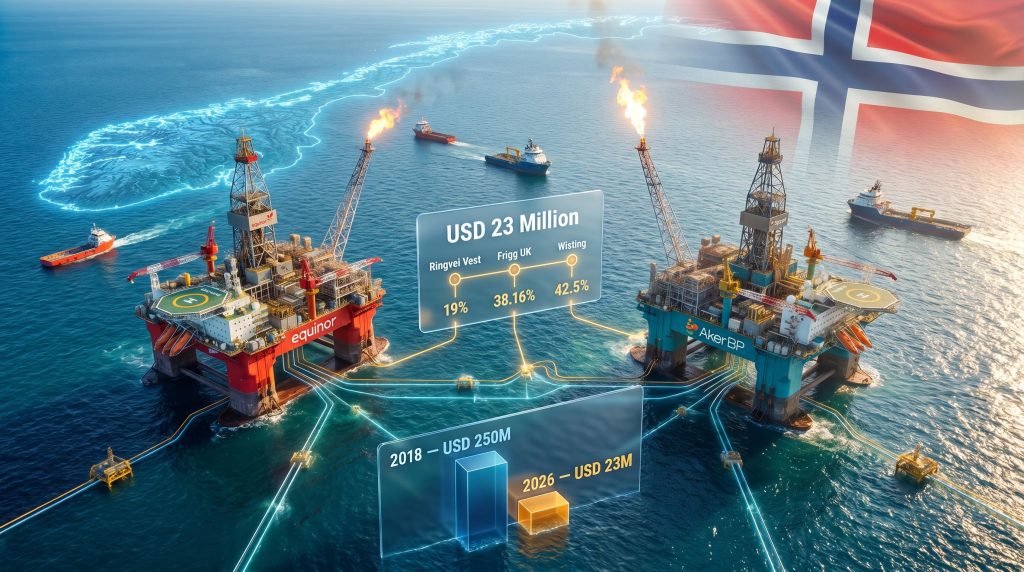
Transaction Structure at a Glance
| Asset / Area | Transaction Type | Stake Transferred | Acquiring Party | Financial Consideration |
|---|---|---|---|---|
| Ringvei Vest Cluster (Grosbeak, Røver Nord, Røver Sør, Toppand, Swisher) | Equity acquisition | 19% interest | Aker BP | Part of USD 23M net total |
| Frigg UK Licence (P2343 / Omega Alfa) | Equity acquisition | 38.16% interest | Aker BP | Part of USD 23M net total |
| Wisting Discovery | Equity increase | 35% to 42.5% | Equinor | Offset within deal structure |
| Net Cash Settlement | Cash consideration | Bilateral offset | Aker BP to Equinor | USD 23 million |
The USD 23 million net cash consideration flowing from Aker BP to Equinor is modest relative to the strategic weight of the transaction. This figure reflects the offsetting nature of the asset movements rather than any single acquisition price. Stakes are moving in multiple directions simultaneously, with the cash settlement representing the residual imbalance after the equity values are netted against each other.
The Ringvei Vest Cluster: Infrastructure-Rich Development in the Troll-Fram Corridor
The Ringvei Vest cluster sits within the Troll-Fram area of the North Sea, one of the most densely infrastructure-equipped offshore regions in Norway. This matters enormously for development economics. Tieback solutions to existing infrastructure can compress development capital requirements significantly compared to standalone field developments requiring new platforms or floating production systems.
The cluster encompasses five named discoveries:
- Grosbeak — the anchor discovery within the cluster
- Røver Nord and Røver Sør — paired northern and southern structures
- Toppand — an additional resource within the broader cluster
- Swisher — extending the cluster's resource footprint
The Kveikje discovery is also under evaluation for potential inclusion within the Ringvei Vest development framework, which could further improve the economics of a coordinated tieback development campaign. Equinor retains operatorship, while Aker BP's new 19% equity position creates aligned financial incentives to advance the cluster toward development sanction.
Frigg UK Licence: Cross-Border Complexity and the Omega Alfa Discovery
The Frigg UK licence, designated P2343, introduces a cross-jurisdictional dimension to this transaction that adds regulatory complexity but also development optionality. The licence straddles the UK-Norway maritime boundary, meaning that development of the Omega Alfa discovery will require coordination across two regulatory regimes: the Norwegian Offshore Directorate and the UK's North Sea Transition Authority.
Aker BP acquires 38.16% of this licence, with Equinor retaining a majority 61.84% interest and maintaining operatorship. The Omega Alfa discovery anchors the near-term development case, though the licence area carries additional upside resource potential that could be delineated through further appraisal work.
Wisting: The NCS's Most Consequential Undeveloped Discovery
The most strategically significant component of the entire transaction may be the least immediately obvious: Equinor's decision to increase its Wisting stake from 35% to 42.5%. This is not a passive repositioning. Wisting has been described as the largest undeveloped discovery remaining on the Norwegian Continental Shelf, a characterisation that carries substantial implications for Equinor's long-term production strategy.
Furthermore, a Reuters report confirms that TotalEnergies and Aker BP had separately been seeking larger stakes in the Wisting field, underscoring just how strategically prized this asset has become among NCS operators.
By concentrating its ownership position in Wisting, Equinor gains greater authority over development planning timelines, infrastructure selection decisions, and ultimately the timing of any final investment decision. In a project of this scale and complexity, ownership concentration at the operator level is a direct instrument of development control.
How Ownership Concentration Accelerates Offshore Development
The relationship between equity structure and development velocity is well-established in offshore petroleum economics, though it remains underappreciated outside specialist circles. When a discovery has numerous non-operating equity partners, each with different cost-of-capital thresholds, different portfolio priorities, and different risk appetites, achieving unanimous or majority consent for major development decisions can take years longer than when ownership is concentrated around a capable, committed operator.
Three mechanisms explain how this deal creates long-term development value:
- Compressed decision timelines — Fewer parties required to reach investment decisions means shorter periods between development concept selection and project sanction approval
- Shared infrastructure utilisation — Unified or closely aligned ownership across co-located cluster assets enables coordinated drilling campaigns and shared subsea tieback infrastructure, reducing per-barrel development costs
- Reduced joint venture governance friction — Fewer equity partners per licence reduces the contractual coordination burden, the number of technical committee approvals required, and the overall administrative overhead of multi-party development projects
What USD 23 Million Reveals About NCS Asset Pricing
The relatively small net cash figure in this transaction tells an important story about how mature basin operators value strategic positioning versus immediate financial returns. At USD 23 million net, the stakes being exchanged across three distinct offshore areas would individually command far higher prices in open-market transactions.
The bilateral structure essentially functions as a barter mechanism where the primary currency is strategic alignment rather than cash. Both companies are implicitly signalling that the value of concentrated ownership, cleaner governance structures, and faster development pathways exceeds what either party could realise by selling these interests on the open market and redeploying the cash elsewhere.
This pricing dynamic is characteristic of what NCS practitioners sometimes call portfolio-optimisation trades, where incumbent operators who already understand the assets, the geology, and the regulatory environment exchange interests to improve their respective development positions without triggering the friction of open-market deal processes. The geopolitical mining landscape provides useful parallel context for how resource-rich jurisdictions globally are seeing similar consolidation dynamics play out.
How This Compares to Earlier Equinor-Aker BP Transactions
The evolution of the relationship between these two companies over recent years illustrates the broader shift in NCS deal strategy.
| Year | Transaction | Value | Strategic Purpose |
|---|---|---|---|
| 2018 | Equinor divests 77.8% operated interest in King Lear to Aker BP | USD 250 million | Capital reallocation, asset rationalisation |
| 2026 | Multi-asset equity realignment across Ringvei Vest, Frigg UK, Wisting | USD 23 million (net) | Development acceleration, ownership concentration |
The 2018 King Lear transaction was a conventional divestment: Equinor exiting an operated position at a substantial price to redeploy capital. The 2026 transaction is structurally different in almost every respect. It is bilateral, multi-directional, modest in net cash terms, and explicitly framed around development acceleration rather than asset monetisation. This contrast reflects how NCS deal strategy has evolved as the shelf has matured and the remaining undeveloped resource base has become increasingly concentrated in complex, multi-party assets.
Regulatory Conditions and the Approval Timeline
The agreements carry an economic effective date of 1 January 2026, meaning that financial interests in the relevant assets transfer from that date for accounting purposes. However, formal legal completion remains conditional on regulatory approvals from both Norwegian and UK authorities.
For the Norwegian components, review processes involve the Ministry of Energy and the Norwegian Offshore Directorate, which assess whether equity transfers comply with licence obligations and whether the acquiring party demonstrates adequate technical and financial capability. For the Frigg UK licence, the UK's North Sea Transition Authority conducts a parallel review process.
Multi-asset packages involving cross-border elements typically require several months to over a year to complete regulatory review, depending on the complexity of the transaction and the current workload of the relevant authorities. Investors and analysts tracking this transaction should note that the effective date and the completion date are likely to diverge meaningfully.
What This Deal Signals for NCS Production Through 2035
Equinor has articulated a clear strategic objective of sustaining and growing Norwegian Continental Shelf production by advancing the development of known discovered resources. The Ringvei Vest cluster, the Omega Alfa discovery, and above all the Wisting field represent material contributions to that production growth ambition if they can be moved through development sanction efficiently. A nordic mining overview of the region further illustrates how Norway's broader resource sector is repositioning itself for long-term output sustainability.
For Aker BP, the rationale is complementary but distinct. The company has consistently prioritised adding exposure to high-quality, long-life assets with credible infrastructure-led development pathways. The Ringvei Vest cluster's location within the Troll-Fram infrastructure corridor and the Omega Alfa discovery's cross-border resource potential both fit that investment thesis at a relatively low entry cost.
As the Norwegian Continental Shelf continues to mature, bilateral portfolio realignment transactions of this type may increasingly become the dominant mechanism for unlocking development on complex multi-party discoveries, gradually displacing traditional farm-in structures and open-market divestments as the preferred deal format between established NCS operators.
This article is intended for informational purposes only and does not constitute financial or investment advice. Forward-looking statements regarding development timelines, regulatory outcomes, and production forecasts are subject to material uncertainty and should not be relied upon as predictions of actual results.
The next major ASX story will hit our subscribers first
Frequently Asked Questions: Equinor and Aker BP NCS Asset Deal
What is the total financial consideration in this deal?
Aker BP will pay Equinor a net cash amount of approximately USD 23 million. This figure represents the residual cash balance after the bilateral equity values across all three asset areas are offset against each other. The strategic value of the transaction considerably exceeds this cash figure.
Which assets are covered by the transaction?
The deal spans three distinct offshore areas: the Ringvei Vest cluster (Grosbeak, Røver Nord, Røver Sør, Toppand, Swisher), the Frigg UK licence P2343 anchored by the Omega Alfa discovery, and the Wisting discovery where Equinor increases its stake from 35% to 42.5%.
Why is Equinor buying more of Wisting rather than selling down?
Wisting is considered the largest undeveloped discovery on the Norwegian Continental Shelf. Increasing its ownership from 35% to 42.5% gives Equinor greater influence over the development concept, infrastructure choices, and the timing of a final investment decision on what could become one of the NCS's most significant upstream projects of the next decade. The commodity price impacts on large undeveloped fields like Wisting also make ownership concentration a prudent hedge against prolonged price volatility.
When will the transaction formally complete?
The agreements are economically effective from 1 January 2026, but formal legal completion requires regulatory clearance from Norwegian authorities and, for the Frigg UK licence, from UK regulators as well. Completion timelines for multi-asset cross-border transactions of this nature typically extend from several months to beyond one year.
How does this deal differ from traditional NCS farm-in transactions?
Traditional farm-in structures involve a single asset, a single equity movement, and typically a straightforward cash or carry payment. The Equinor and Aker BP NCS asset deal involves simultaneous, multi-directional equity movements across three separate offshore areas, with a modest net cash settlement. The primary objective is ownership alignment for development acceleration, not asset monetisation, which is structurally distinct from conventional farm-in mechanics. In addition, mining finance trends in comparable resource jurisdictions suggest that deal structures of this bilateral, non-cash-dominant type are becoming more prevalent as operators seek efficiency over immediate capital returns.
Want to Stay Ahead of the Next Major Resource Discovery?
Discovery Alert's proprietary Discovery IQ model delivers real-time alerts on significant ASX mineral discoveries, transforming complex resource data into actionable investment insights for traders and long-term investors alike — explore historic examples of exceptional discovery returns to understand the opportunity, then begin your 14-day free trial at Discovery Alert to position yourself ahead of the broader market.